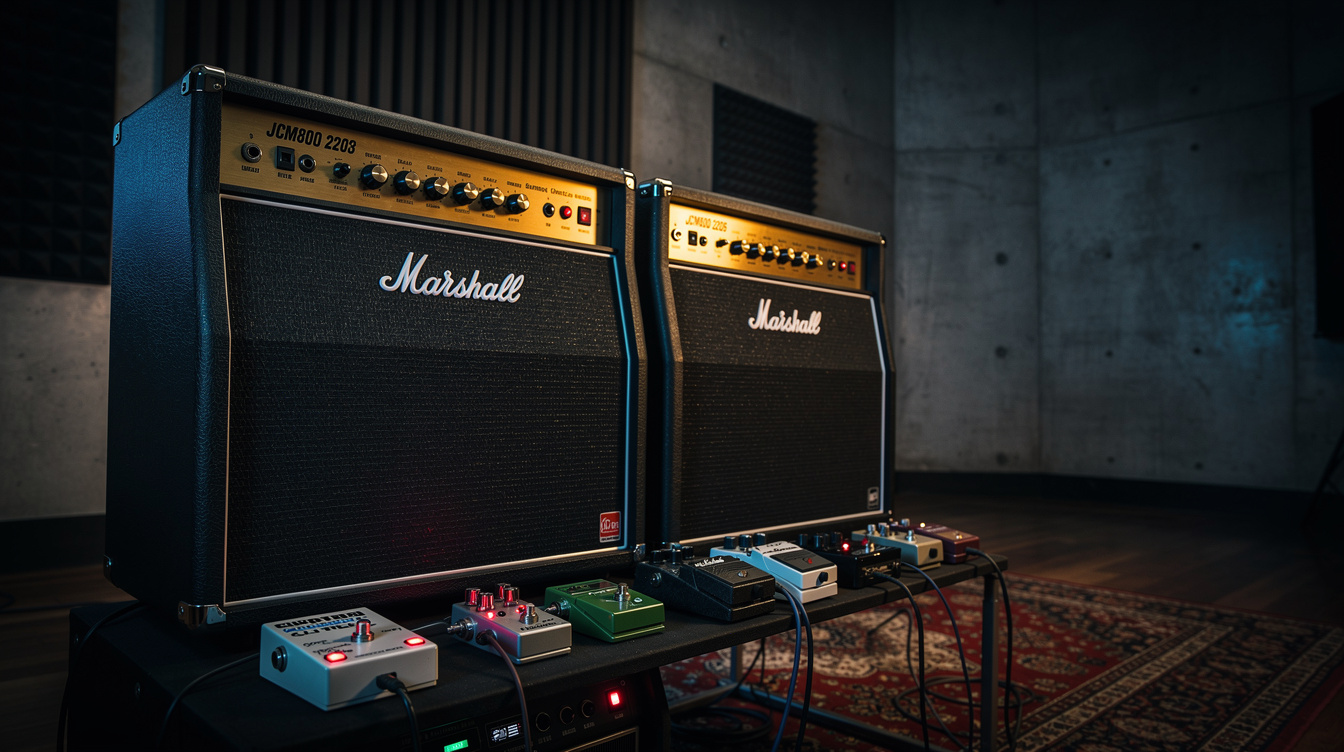
Start Here: The JCM800 2203 is a single-channel, master volume amp. One input, one gain stage, one channel. All the tone shaping happens at the amp's front end and with whatever you put in front of it. The JCM800 2205 is a two-channel amp with a switchable lead channel that has its own dedicated gain control and volume. They look similar on the front panel. They don't sound the same and they don't serve the same purpose. The quick identification guide is in How to Tell Which One You Have. Settings for both are below that.
Why This Matters and Why Nobody Explains It
Every JCM800 settings guide on the internet treats the JCM800 as one amp. It isn't.
Marshall produced the JCM800 series from 1981 to 1991 and sold versions with completely different internal architectures under essentially the same name. The 2203 (100-watt single channel) and 2204 (50-watt single channel) are one family. The 2205 (50-watt two-channel) and 2210 (100-watt two-channel) are another. Guides that don't tell you which version they're discussing are giving you information that may or may not apply to the amp in your possession.
The 2203 is the JCM800 that became the backbone of 80s heavy rock. Angus Young used a modded version. Slash used one. The tone you hear on Back in Black and Appetite for Destruction came from these amps or their close cousins. When someone says "the JCM800 sound," they usually mean the 2203.
The 2205 is a different animal. It added a switchable channel for versatility: a clean/rhythm channel and a lead channel with its own independent gain control. More flexibility. Different circuit topology. A different sound.
The 2203: Circuit and Character
The JCM800 2203 uses a cascading gain stage preamp: two 12AX7 preamp tubes in a configuration that amplifies the guitar signal in stages before it hits the tone stack. There's no channel switching. No separate gain path. One way in, one way out.
What this gives you is a direct, responsive connection between the guitar, the player's touch, and the output. The 2203 is not a high-gain amp by modern standards. At moderate volume, it's a loud, slightly overdriving amp. At high volume, the power section compresses and the output transformer starts doing work. That's where the 2203 starts to sound like a 2203. The amp wants to be loud.
The front panel on a 2203:
| Control | Range | Notes |
|---|---|---|
| Preamp Volume | 0–10 | Gain/preamp drive. This controls how hard the preamp stages run. |
| Bass | 0–10 | Low-frequency content |
| Middle | 0–10 | Mid-frequency content |
| Treble | 0–10 | High-frequency content |
| Presence | 0–10 | Upper harmonics and bite |
| Master Volume | 0–10 | Output level to power section |
The relationship between Preamp Volume and Master Volume is the whole ballgame. High Preamp Volume with low Master Volume gives you preamp distortion at manageable volumes (the sound that most people associate with JCM800 recordings). High Master Volume with lower Preamp Volume gives you power amp saturation, which is a different, looser, more organic distortion character. A lot of recordings split the difference.
The 2205: Circuit and Character
The JCM800 2205 is a two-channel amp. The first channel (Normal or Rhythm, depending on the iteration) is voiced clean. The second channel (Lead) has its own dedicated gain stage and a Gain control that lets you dial in lead distortion independently.
The preamp circuit topology in the 2205 is meaningfully different from the 2203. The 2205 uses a different gain structure to produce its lead channel's distortion. The result is a slightly different character that's more compressed, more saturated at lower volumes, and doesn't depend as heavily on the power section doing work.
Front panel differences on a 2205:
| Control | Channel | Notes |
|---|---|---|
| Input Sensitivity | Both | Selects high or low sensitivity input |
| Normal Volume | Normal channel | Controls the clean/rhythm channel level |
| Lead Gain | Lead channel | Dedicated gain for the lead channel (this doesn't exist on a 2203) |
| Lead Volume | Lead channel | Independent volume for the lead channel |
| Bass, Middle, Treble, Presence | Shared | Tone controls affect both channels |
The shared tone stack is a limitation. Setting the EQ for your clean channel affects your lead channel too. This forces a compromise. The amp can't be optimized for clean and high-gain simultaneously. Players who notice this either accept it, compensate with an EQ pedal on the lead channel, or use an external overdrive to get lead sounds on the Normal channel without touching the Lead channel at all.
How to Tell Which One You Have
The front panel labels will tell you:
It's a 2203 (or 2204) if:
- There is only one Volume control labeled "Preamp Volume" (or just "Volume")
- There is no channel switching button on the front panel
- There is no separate "Lead" section with its own controls
It's a 2205 (or 2210) if:
- There are separate Volume controls for "Normal" and "Lead" channels
- There is a "Gain" control specifically for the lead channel
- There is a channel switching footswitch jack on the back panel
If you're looking at the back panel: the 2205 has a footswitch input for channel switching. The 2203 does not.
The wattage: both 100-watt (2203, 2210) and 50-watt (2204, 2205) versions exist. The 50-watt version breaks up at lower volumes and has a slightly different power tube compression character. For most uses (rehearsals, recording, smaller venues), the 50-watt versions are more practical.
Settings for the 2203
The classic rock foundation (think Back in Black or Pyromania-era):
| Control | Setting | Notes |
|---|---|---|
| Preamp Volume | 7 | This is running the preamp hard. At stage volume, this is where the amp starts to sing. |
| Bass | 6 | Slightly above noon |
| Middle | 6–7 | Not scooped. A scooped 2203 sounds hollow in a mix. |
| Treble | 6 | Present but not harsh |
| Presence | 6 | Adds bite. Dial to taste for your cabinet and room. |
| Master Volume | 4–5 | Moderate output. Higher for more power amp compression. |
If you're using a Tube Screamer or similar overdrive in front:
The TS-into-Marshall approach gives you a tighter, more articulate version of the 2203 sound. The TS rolls off lows, boosts mids, and pushes the preamp harder.
| Setting | Position | Notes |
|---|---|---|
| Preamp Volume | 5–6 | Back it off slightly because the TS is adding drive |
| Drive (on TS) | 9–10 o'clock | Just enough to push. Not much. |
| Tone (on TS) | 12 o'clock | Flat |
| Level (on TS) | 2–3 o'clock | Higher than unity; you're boosting the signal |
Drop the Middle control on the amp by 1–2 notches when using a mid-hump overdrive. The TS adds mids and you don't want it stacking on amp mids to the point of mud.
Settings for the 2205
The 2205 settings split by channel. The shared tone stack means you'll dial in a compromise.
Normal channel (clean/rhythm):
| Control | Setting | Notes |
|---|---|---|
| Normal Volume | 5–6 | Moderate level, clean headroom |
| Bass | 6 | |
| Middle | 6 | Shared EQ; set for the middle ground |
| Treble | 5 | |
| Presence | 5 |
Lead channel (distortion):
| Control | Setting | Notes |
|---|---|---|
| Lead Gain | 6–7 | The sweet spot for classic rock leads without getting too compressed |
| Lead Volume | 5 | Match to Normal channel volume |
| Bass, Middle, Treble | Inherited from above | You're stuck with the shared EQ. Adjust from Normal baseline. |
The compromise: Setting the tone controls for the Normal channel to work on the Lead channel too means your clean tone will be slightly brighter than ideal (to give the compressed lead channel some definition) or your lead tone will be slightly dark (to protect the clean channel from harshness). Most players settle slightly warm on the shared EQ and compensate for lead definition with the Lead Gain and Presence controls.
Modeler Versions
For modeler players, both amp architectures appear in Helix and Quad Cortex libraries under various names.
In Helix:
- "Brit 2204": based on the JCM800 2204 (50-watt single-channel). This is the 2203/2204 family.
- "Brit J45 Nrm" and "Brit J45 Brt": based on different input sensitivities of the same amp
The two-channel versions (2205/2210) are not directly modeled in Helix's stock library as of the current firmware. Players approximating the 2205 on a modeler typically use the 2203 model with a separate gain block to simulate the lead channel's additional gain stage.
On Quad Cortex: Community captures of both the 2203 and 2205 exist in the Cortex Cloud library. Search "JCM800 2203" or "JCM800 2205" specifically. The naming in community captures tends to be accurate.
FAQ
Which sounds better: the 2203 or the 2205? They serve different purposes. The 2203 is the better single-channel amp for players who build their tonal range with pedals and technique. The 2205 is more practical for players who want a clean/lead switch without relying on pedals. "Better" depends on how you play.
Why do so many JCM800 guides not specify the model? Because the writers usually mean the 2203 and assume that's what everyone owns. The 2203 is more commonly discussed and more commonly found in studios and live rigs. This leaves 2205 owners applying incorrect settings and wondering why the results don't match.
Can I get similar sounds from both with pedals? Yes. A 2203 with an overdrive pedal on the clean input approximates a dirty channel, which covers some of the 2205's lead channel territory. A 2205 with the Lead Gain backed off and an OD in front of the Normal channel approximates the 2203 approach. The results aren't identical but they're closer than you'd expect.
Is the 50-watt (2204/2205) noticeably different from the 100-watt (2203/2210)? Yes. The 50-watt versions break up earlier in the Master Volume range and have a slightly rounder, more compressed power section response. For recording and moderately loud rehearsal, the 50-watt versions are often preferred. For very loud stage use, the 100-watt versions cut harder.
What cabinet pairing is right for a JCM800? The traditional pairing is a Marshall 1960A or 1960B 4x12 loaded with Celestion G12T-75 or Vintage 30 speakers. The Vintage 30 sounds brighter and more aggressive. The G12T-75 is slightly warmer and more compressed. Both are historically appropriate. The Vintage 30 is the more commonly referenced cabinet for classic JCM800 tones.