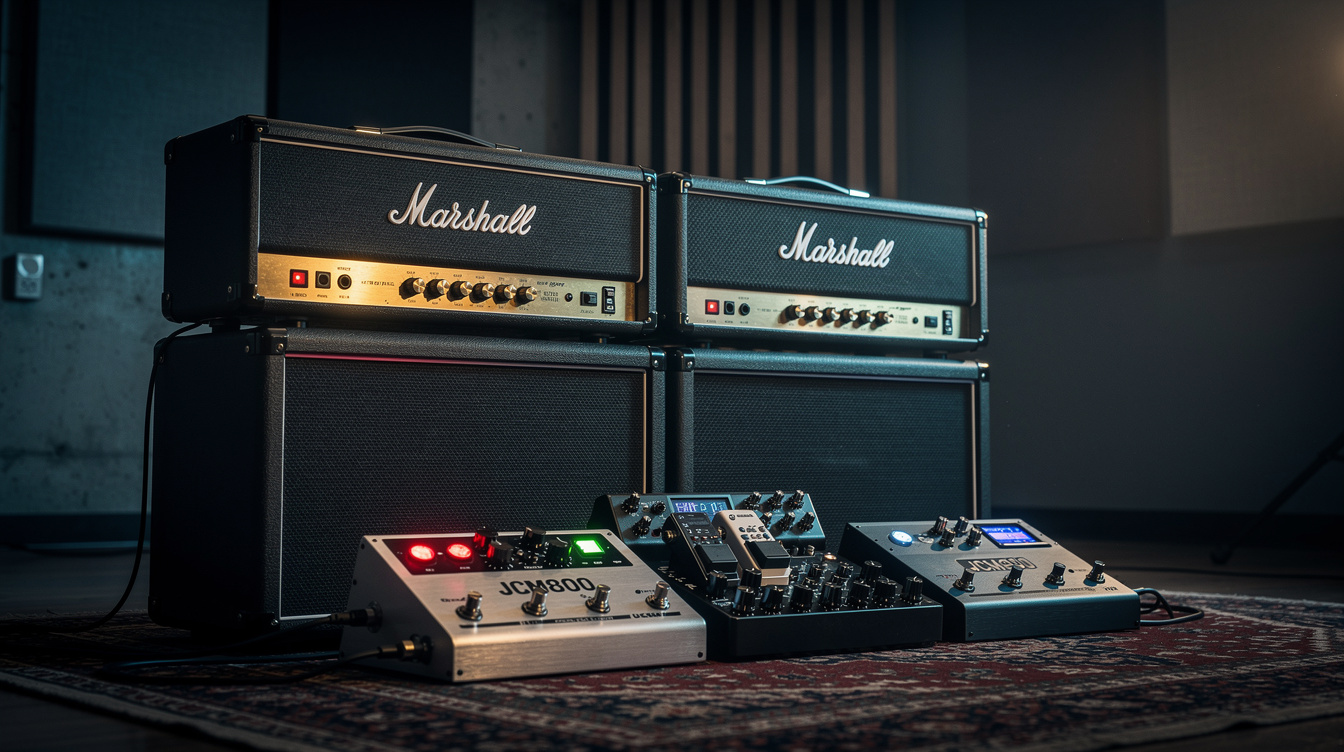
Start Here: The JCM800 (1981–1990) and JCM900 (1990–1999) are both Marshall master-volume designs, but they're different animals. The JCM800 is a single-channel, high-headroom amp that breaks up musically and stacks beautifully with pedals. The JCM900 SL-X added channel switching, more preamp gain on tap, and (in the eyes of a lot of players) something smoother and less combative in the best way or less alive in the worst. The right choice depends on what you're actually trying to do.
Why Does This Question Keep Coming Up?
The JCM900 replaced the JCM800 in Marshall's lineup in 1990. It sold well. It appeared on stages throughout the 1990s. It's a genuinely capable amp.
And yet, 35 years later, used JCM800s sell for twice what comparable JCM900s sell for. The JCM800 2203 is the amp young players save up for. The JCM900 is the one they already own, trying to figure out if they should swap it.
That gap in reputation is real. It's also somewhat earned and somewhat oversimplified. Here's what's actually happening.
The Key Differences: Circuit to Circuit
Gain Structure
The JCM800 2203 and 2204 are single-channel amps. One channel. One gain control. One master volume. The circuit is based on a modified Plexi design with a solid-state diode rectifier, cascaded preamp gain stages, and that master volume control that let Marshall build a high-gain amp that could be played at rehearsal volume without deafening everyone.
The preamp in the JCM800 uses two cascaded gain stages. Push the Preamp Volume control and you push those stages into saturation. The characteristic JCM800 tone (aggressive midrange, tight low end, that slightly compressed and punchy quality) comes from this preamp structure interacting with the amp's EQ section and power section.
The JCM900 SL-X (the channel-switching model, 2100 and 2101) added a third preamp gain stage. More stages means more gain available before the signal reaches the master volume. It also changes the character: more gain at moderate control settings, a different compression texture, and a slightly different frequency response at the same dial positions.
| Feature | JCM800 2203/2204 | JCM900 SL-X |
|---|---|---|
| Channels | 1 | 2 (clean + lead) |
| Preamp gain stages | 2 (cascaded) | 3 (lead channel) |
| Effects loop | No (early versions) | Yes (series) |
| Gain range | Medium-high crunch | High gain |
| Master volume | Yes | Yes |
| Clean channel | No | Yes (rhythm channel) |
The Diode Clipping Controversy
Here's where opinions get heated. The JCM900 SL-X added diode clipping to the lead channel's gain circuit: a pair of diodes in the feedback loop that hard-clips the signal before it reaches the output section. This is the same fundamental trick used in overdrive pedals (including the Tube Screamer) to push the signal into clipping without relying solely on tube saturation.
The result is more gain available at lower volume settings. The diodes do some of the clipping work that tubes would otherwise do.
Players who dislike the JCM900 tend to pinpoint this. The clipping character from diodes is different from tube saturation: harder, with a slightly different harmonic content. At high gain settings in particular, some players find the JCM900 lead channel's distortion less complex than the JCM800 pushed hard.
Players who like the JCM900 point out that it delivers usable high-gain tones at volumes where a JCM800 is still relatively clean. That's not nothing.
The Effects Loop
Early JCM800 2203s didn't have an effects loop. A lot of classic-rock players see this as a feature: you're running everything through the preamp, nothing between preamp and power amp, simpler signal path.
The JCM900 SL-X has a series effects loop. If you're running time-based effects (delay, reverb), this matters. Running delay and reverb in the effects loop keeps them after the distortion stage, so your modulation effects don't get smeared by the gain circuit. For players using effects, the JCM900's loop is genuinely useful.
Quick Reference: Settings Comparison
These starting-point settings produce roughly equivalent tonal territory on each amp. Note that the same dial positions won't produce the same sound. The JCM900 will be fuller at moderate gain settings; the JCM800 dirtier.
Classic Rock Crunch
| Control | JCM800 2203 | JCM900 SL-X (Lead Ch.) |
|---|---|---|
| Preamp / Gain | 5-6 | 4-5 |
| Bass | 5 | 4 |
| Mid | 6-7 | 6 |
| Treble | 6 | 5.5 |
| Presence | 5 | 4-5 |
| Master | 6-7 | 5-6 |
On the JCM800, that Preamp at 5-6 puts you at the edge of saturation; notes bloom, single-coil pickups sound full. On the JCM900, Gain at 4-5 is already past that point into medium-high gain territory. The JCM900's rhythm channel (set clean) is more useful for true clean tones.
Hard Rock / Heavy
| Control | JCM800 2203 (+ OD pedal) | JCM900 SL-X (Lead Ch.) |
|---|---|---|
| Preamp / Gain | 6 (amp), TS in front | 6-7 |
| Bass | 4 | 4 |
| Mid | 7 | 6 |
| Treble | 6 | 5 |
| Presence | 5-6 | 5 |
| Master | 5-6 | 5 |
The standard JCM800 recipe for heavy tones involves putting a Tube Screamer (or similar) in front with the Drive low and Level high. The OD pedal tightens the low end, pushes the front end, and adds sustain without muddying the harmonic content. On the JCM900 lead channel, that OD-in-front trick still works (it tightens the sound), but you have more gain available without it.
Who Played What?
JCM800 users (notable): Slash, Zakk Wylde (early), Dave Murray and Adrian Smith of Iron Maiden, The Edge (original The Joshua Tree sessions), Tom Morello, Gary Moore
JCM900 users (notable): Kurt Cobain used a JCM900 live on the In Utero tour, Vernon Reid, some of Soundgarden's touring setup, various 1990s hard rock acts
The pattern you see here: the JCM800's heaviest users tend to be players who specifically sought out that single-channel clarity and pedal-stacking character. The JCM900 appeared more in contexts where players wanted more built-in gain or appreciated the clean channel.
What Does the JCM900 Get Right?
It's easy to write the JCM900 off as the compromised successor. That's not fair.
The clean channel is genuinely good. The JCM800 has no clean channel; you get clean by running the gain low and the master lower. The JCM900's rhythm channel delivers a real clean tone with more headroom than the 800's modified-Plexi-on-minimum approach.
The gain range is more practical for modern music. If you're playing in a band that needs heavy rhythm tones, the JCM900's lead channel gets you there without pedals. That's a real-world advantage in a rehearsal setting.
The effects loop. I said it before. If you're running delays and reverbs, the loop is useful. Period.
The price. A clean-condition JCM900 SL-X costs considerably less than a comparable JCM800. If you're building a working rig and the price difference is the difference between buying it or not, the JCM900 is a genuinely capable amp that sounds like Marshall.
What Does the JCM800 Get Right?
The preamp-only gain structure. Two cascaded tube stages with no diode clipping means the saturation character changes dynamically with pick attack, guitar volume position, and how hard you're playing. The amp responds. That's the thing the JCM900's diode clipping alters, and it's the thing players who care about it really care about.
Pedal response. The JCM800's front end responds beautifully to pedals: Tube Screamer, Klon, Blues Driver, all of it. The JCM900 also responds, but the 800's relatively clean front end (at lower gain settings) gives pedals more room to define the tone.
Single-channel simplicity. No switching, no modes, no decisions mid-set. Plug in, set it, play.
It's a specific sound. The JCM800 has a defined character that you either hear or you don't. It sounds like a JCM800. The JCM900 sounds like a modern high-gain British amplifier, which is also useful but less distinctive.
On Modeler Versions
If you're playing through a Line 6 Helix, Quad Cortex, or Fractal Axe-Fx, you likely have access to models of both:
- Helix: The "Brit 2204" is based on the JCM800 2204 50W. The "Brit J-45" models a JCM900. The settings differences between them apply. The Brit 2204 wants a boost pedal in front for heavy gain; the Brit J-45 has more onboard.
- Quad Cortex: The "JCM800 Lead" capture is the dominant community preset target. Third-party captures of both amps are available from the Cortex Cloud.
- Fractal Axe-Fx: Both are represented in the amp library with manufacturer documentation on which model was the source.
On modelers, the diode clipping difference is captured in the amp model character rather than circuit behavior. The Brit 2204 will still feel like it wants pedals; the J-45 will deliver more gain on its own.
So Which Do You Buy?
Here's the straight answer:
Buy the JCM800 if:
- You're building a single-channel, pedal-forward rig
- You care about touch responsiveness above all else
- You play classic rock, blues-rock, or hard rock that doesn't need sustained high gain
- You have the budget (they're not cheap for good reason)
Buy the JCM900 if:
- You need a clean channel plus high gain in one amp
- You're using an effects loop with delays and reverbs
- You're on a tighter budget
- You need more gain available without pedals
- You play heavy music that benefits from the extra preamp gain
Use a modeler if:
- You need both in the same gig, at home volume, without a $3,000 amp investment
The JCM900's reputation problem isn't that it's a bad amp. It's that it's not the amp the JCM800 is. Different tool for a different job. Know which job you're hiring for.
Frequently Asked Questions
Does the JCM900 have diode clipping? The JCM900 SL-X lead channel uses diode clipping in the gain circuit. This provides more gain at lower settings compared to the all-tube JCM800 preamp, but changes the compression character of the saturation.
Can you upgrade a JCM900 to sound more like a JCM800? Partially. Some techs remove or modify the diode clipping circuit to bring the JCM900 closer to an all-tube gain structure. The results vary, and a proper mod requires a qualified tech. It's generally easier to buy the JCM800 if that's what you want.
What's the difference between JCM900 models? The JCM900 came in several variants: the SL-X (channel switching with diode gain), the Dual Reverb (2x100W stereo), and the Hi-Gain Dual Reverb. The SL-X is the most common reference point in the JCM800 vs. JCM900 debate.
Do the same settings work on both amps? Not directly. The same knob positions produce different amounts of gain and different frequency content. See the tables above for approximate equivalents.
What amp does the Helix "Brit 2204" model? The Marshall JCM800 2204 (50W). The controls work similarly to the real amp, but the Helix adds some control over input impedance and sag that the real 2204 doesn't have.