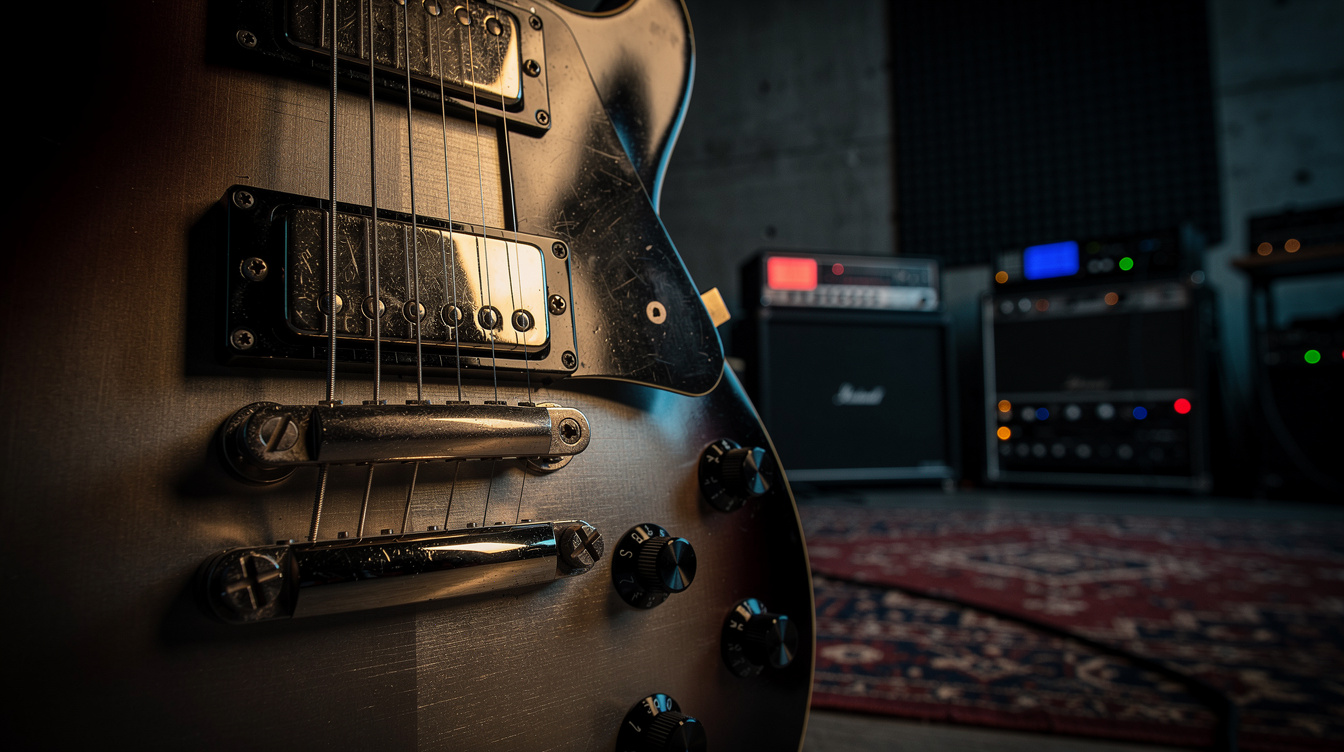
Quick read: The Marshall Studio Classic SC20C ($1,799 street) is a 20-watt 1×10 combo with the 1959 Super Lead Plexi circuit inside: the four-input, no-master-volume, push-the-front-end-with-a-pedal amp. The Studio Vintage SV20H ($1,599 street head) is the same wattage with the JCM800 2203 circuit: single channel, master volume, more gain on tap and a tighter low end before you ever plug in a pedal. Same Studio platform, same low-power switch (20 W / 5 W), totally different amps in tone, gain structure, and the way they take pedals. Buy the SC20C if your sound is "clean amp shoved into breakup with a Tube Screamer" (Plexi voicing, blooming top end, dirt that lives in the right hand). Buy the SV20H if your sound is "amp does the gain, pedals do the color" (tighter mids, more saturation, a master volume that lets you crank the preamp without taking the roof off).
The Marshall Studio line confuses people, and the marketing doesn't help. Marshall sells four amps in this family: the SV20H/SV20C (Studio Vintage, JCM800 circuit), the SC20H/SC20C (Studio Classic, 1959 Plexi circuit), the ST20H/ST20C (Studio JTM, JTM45 circuit), and the SJ20H/SJ20C (Studio Jubilee, Silver Jubilee 2555 circuit). All 20 watts. All with a low-power switch. All in heads and 1×10 combos. The product pages tell you the wattage and the speaker but not the circuit difference, and most demo videos compare two amps from the same circuit family rather than across families.
That's the comparison most buyers actually need. Studio Classic vs. Studio Vintage; Plexi vs. JCM800, the two iconic Marshall voices in the same chassis platform. I've spent enough time with both to tell you what's the same, what's different, and which one you actually want.
| Spec | SC20C (Studio Classic) | SV20H (Studio Vintage) |
|---|---|---|
| Circuit | 1959 Super Lead (Plexi) | JCM800 2203 |
| Format | 1×10 combo | Head only (1×12 cab sold separately) |
| Power | 20 W / 5 W switchable | 20 W / 5 W switchable |
| Output tubes | 2× EL34 | 2× EL34 |
| Preamp tubes | 3× ECC83 | 3× ECC83 |
| Channels | 1 (high & low input pairs, jumpered) | 1 (single input) |
| Master volume | None (preamp volume only) | Yes |
| Speaker | 10″ Celestion V-Type | None (head only) |
| Effects loop | No | Yes (series) |
| Street price (May 2026) | ~$1,799 | ~$1,599 |
| Weight | 35 lbs | 22 lbs (head only) |
What Each Circuit Actually Sounds Like
The Plexi and the JCM800 are both Marshalls, but they're built around different ideas about how a guitar amp should make dirt.
The 1959 Super Lead Plexi was designed in 1965 as a clean amp with enough headroom to keep up with a louder band. The dirt came when you pushed the volume past about 6. The preamp ran out of clean headroom, the power section started to clip, and the whole amp went into that bloomy, midrange-forward breakup that defined British rock for the next 30 years. The Plexi has no master volume because in 1965 nobody had invented one yet, and Jim Marshall wasn't trying to solve the problem of getting that sound at apartment volume. You turned the amp up to make it sound right.
The JCM800 2203 was designed in 1981 to fix exactly that problem. Marshall added a master volume (actually two gain stages where the Plexi had one) so you could push the preamp into saturation while keeping the power section at a reasonable volume. The result is a tighter, more aggressive amp with more gain on tap and a midrange that sits a little higher in the mix. It's the amp Slash used. It's the amp every metal player from 1982 to about 1992 used. The JCM800 is what Plexi-meets-modernity sounds like.
In the Studio platform, both circuits are reproduced faithfully. The SC20C sounds like a small Plexi: bloomy breakup, four inputs (two high-sensitivity, two low-sensitivity, jumpered with a short cable in the classic configuration), no master volume. The SV20H sounds like a small JCM800: tighter, more gain, master volume, single input. Same chassis platform, same low-power switch, same EL34s. Different amps.
The 20 W / 5 W Switch Is the Same on Both
This is what makes the Studio platform worth buying in the first place. Both amps have a switch on the back that drops the output from 20 watts to 5 watts. At 5 watts, you can crank either amp into full power-section saturation in a small room without making your neighbors call the police. At 20 watts, you have enough power to play a club gig without micing. These aren't bedroom-only amps, they're real working amps that can also work at home.
The 5-watt mode is honest. It's not a gimmick; it's a genuine pentode-to-triode mode change that drops the wattage and lets you push the amp into the same kind of saturation you'd get at gig volume. If you're buying a Studio amp specifically because you want that saturated tone at home, both amps deliver it equally well in 5-watt mode. The difference is what the saturation sounds like (Plexi-bloom vs. JCM800-tightness), and that's the circuit difference, not the wattage.
I'll tell you something I didn't expect: I thought the 5-watt mode on the Plexi-circuit SC20C would be the better small-room amp, because Plexi breakup feels right at lower volumes and JCM800 saturation usually wants more air. I was wrong. The SV20H at 5 watts with the master at 4 and the preamp at 7 sounds more like a real cranked JCM800 than I had any right to expect. The master volume actually does its job: you get the preamp saturation without the power amp wattage, and it sounds like a JCM800 should sound, just smaller. The SC20C at 5 watts is also great, but it sounds like a Plexi at low volume, which is a different thing than a Plexi at high volume. The SV20H translates better to bedroom use than the SC20C does, and that surprised me.
How Each Amp Takes Pedals
The Plexi circuit is famously pedal-friendly. Push it with an overdrive (Tube Screamer, Klon, anything that adds a little gain and bumps the mids) and you get the classic British-rock sound that's lived on a thousand records. The SC20C is no different. Plug a TS808 in front, set the drive at about 9 o'clock, the level at 2 o'clock, the amp's volume at 6, and you've got the sound that Angus Young and Billy Gibbons and a hundred other players have built careers on. The Plexi takes pedals because it doesn't have its own gain to fight with. The pedal supplies the dirt, the amp supplies the breakup character.
The JCM800 takes pedals differently. The 2203 circuit already has plenty of gain, so an overdrive in front isn't there to add dirt; it's there to tighten the low end and push the front end harder for a more saturated, focused tone. Run a TS808 into the SV20H with the drive at about 8 o'clock (almost off), the level at 2 o'clock, and the amp's preamp at 7. The pedal acts as a clean boost and tightener, not as a dirt source. The amp is doing the gain. The pedal is shaping the way the amp sees the signal.
If your signal chain is "clean amp + dirt pedal," buy the SC20C. The Plexi is built for that workflow. If your signal chain is "high-gain amp + clean boost in front," buy the SV20H. The JCM800 is built for that workflow. Both signal chains can work on either amp, but each amp is voiced for one of them.
The Format Difference Matters
The SC20C is a combo: a 1×10 with a Celestion V-Type. The SV20H is a head, and you need to add a cab. That's a real cost and weight difference.
The SC20C combo is a complete amp. You buy it, you bring it to a gig, you plug in. The 10″ V-Type is a smaller-than-standard speaker for a Marshall (most classic Plexi tones come from 12″ Celestions in 4×12 cabs), but the V-Type does a competent job and the small format is honestly part of the appeal. A 35-lb combo that sounds like a Plexi is something the world didn't have before this amp existed.
The SV20H requires a cab decision. A 1×12 with a Celestion G12M Greenback is the closest small-format approximation of the classic JCM800-into-4×12 sound. Marshall sells the SV112 1×12 cab specifically for this, and that combination runs about $2,099 total ($1,599 head + $500 cab). A 2×12 with two Greenbacks gets you closer to the cab coupling of a real 4×12 stack and runs about $2,299 total. Or you can run the SV20H into any cab you already own.
If you want a one-box solution and the Plexi voicing fits your sound, the SC20C is genuinely the easier amp to live with. If you want the JCM800 voicing and you're willing to commit to a cab choice, the SV20H gives you more flexibility: you can swap cabs to change the character, run different speakers for different gigs, or go through an attenuator into a load box for direct recording. The combo is simpler. The head is more flexible.
What About the Speaker in the SC20C
The 10″ Celestion V-Type in the SC20C is the most polarizing thing about the amp. A 10-inch speaker doesn't move the same air a 12-inch does. The low end rolls off earlier, the cab coupling is different (the SC20C is open-back like an old Plexi combo, but the smaller cabinet volume affects the low-end resonance), and you don't get the same chest-thump you'd get from a 4×12.
For most players in most rooms, the V-Type is fine. For some players, it's the wrong speaker. They want a 12-inch and the SC20C doesn't give them one without modifying the cabinet. The SC20H head version exists for exactly this reason: same SC20 circuit, no built-in speaker, you pick your own cab. If you know you want the Plexi circuit but you don't want the 10-inch speaker, buy the SC20H head and a 1×12 cab. That gets you to about $2,099 total, the same money as the SV20H + 1×12 cab.
Cross-Platform Notes for Modeler Players
If you're not buying either amp and you just want this voicing in your modeler, both circuits are well-modeled in Helix, Quad Cortex, and TONEX. On a Helix, the "Brit Plexi Brt" model captures the SC20C's voicing reasonably well; the "Brit 2204" model is the JCM800 (the SV20H is based on the 2203, which is the 100-watt version of the same circuit, but the 2204's 50-watt preamp voicing is closer to the SV20H's 20-watt low-power feel). On a Quad Cortex, the "Plexi 1959 Tweed" capture and the "Brit JCM 800" capture cover the same territory.
The pedal advice translates: a Tube Screamer in front of the Plexi model adds dirt; a Tube Screamer in front of the JCM800 model tightens the low end. Same workflow on the modeler as on the real amps.
So Which One Should You Buy
Buy the SC20C if:
- Your sound is built around a clean-to-edge-of-breakup amp pushed by an overdrive pedal
- You want a combo, not a head plus cab
- You play classic rock, blues, AC/DC, ZZ Top, early Van Halen; anything pre-1980 in the British-amp tradition
- You're fine with a 10-inch speaker
Buy the SV20H if:
- Your sound is built around an amp that already has gain, with pedals shaping how it responds
- You're willing to add a cab (and have an opinion about which one)
- You play hard rock, '80s metal, Slash-style, Zakk Wylde-style, early Metallica
- You want a master volume so you can dial in saturation independently of output level
If you can't decide: get the SV20H. The master volume makes it a more useful amp at home, the JCM800 voicing covers more ground than the Plexi (you can do clean-to-classic-rock by backing off the preamp; you can't do high-gain-Slash on a Plexi without three pedals stacked), and the head format is more flexible for upgrades. The SC20C is the right amp if you specifically want the Plexi sound. The SV20H is the right amp if you're not sure which Marshall sound you want; it'll cover more of them.
For more on the Studio Vintage line specifically, our SC20H combo vs. SV20H head + 1×12 cab comparison covers the head-vs-combo question within the JCM800-circuit Studio line, and our SV212 vs. SV112 cab comparison covers which cab to put under the SV20H once you've made the head choice. For the broader question of which small-format Marshall fits which player, our DSL20HR vs. Origin 20 piece covers the cheaper end of the lineup.