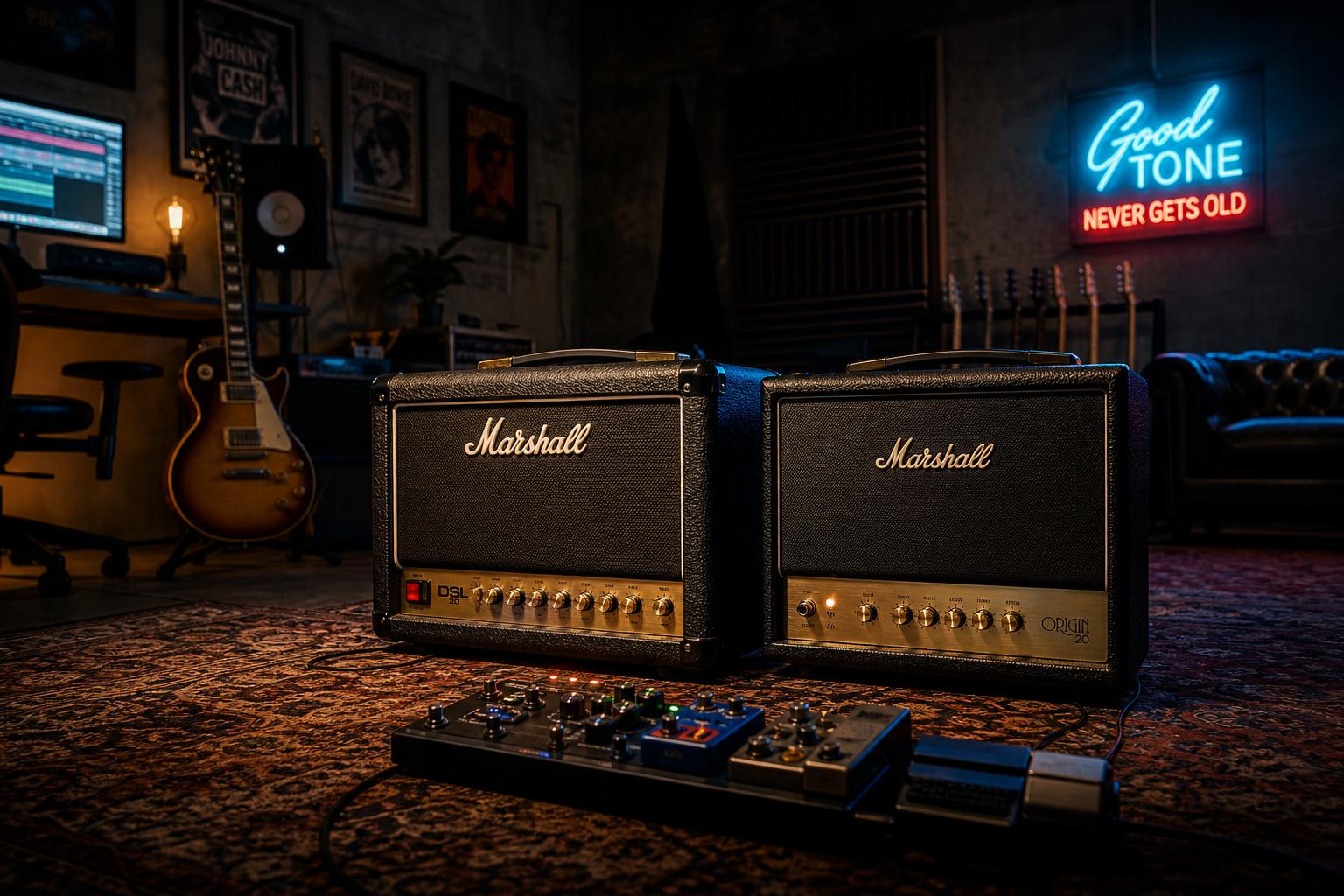
Quick read: The Marshall DSL20HR ($600 street) and the Origin 20H ($700 street) are the two cheapest tube-Marshall heads you can buy new in 2026, and they are not the same kind of amp. The DSL is a two-channel hybrid with a solid-state rectifier and a JCM2000-lineage Ultra Gain channel. Buy it if you want two voices on one footswitch and a high-gain channel that can do '90s rock without a pedal. The Origin is a single-channel tube-rectified pedal platform with a Boost circuit and a Tilt EQ. Buy it if your tone lives in your pedalboard and you want a clean Marshall canvas to paint on. Players who lump them together as "the cheap Marshalls" buy the wrong one about half the time. They are different design philosophies at the same price tier, and the right pick depends entirely on whether your gain comes from the amp or from the floor.
| Spec | DSL20HR | Origin 20H |
|---|---|---|
| Street price (May 2026) | $600 | $700 |
| Channels | 2 (Classic Gain / Ultra Gain) | 1 (Boost switch on front panel) |
| Power section | 2 × EL34, 20 W / 10 W | 2 × EL34, 20 W / 5 W / 0.5 W |
| Rectifier | Solid-state | Tube (GZ34/5AR4) |
| Preamp tubes | 4 × ECC83 | 2 × ECC83 |
| Tone stack | Bass / Middle / Treble per channel + Resonance + Presence | Bass / Middle / Treble + Tilt + Presence |
| FX loop | Yes, series | Yes, series |
| Reverb | Yes, digital | No |
| Voicing | JCM2000 lineage | Plexi-leaning, broader sweep |
I sold a lot of both of these out of Presswood Guitars in the last five years before I retired, and the question that came across the counter most often was "which one is the cheap Marshall?" The honest answer is that they are both the cheap Marshall, and the player who asks the question that way is going to buy the wrong one. The right question is "what does my pedalboard look like, and what gain do I need from the amp itself?" Once you know that, the choice becomes obvious.
What the DSL20HR Actually Is
The DSL line goes back to 1997, and the original DSL was built to give players a JCM2000-style two-channel rig in a head you could afford. The DSL20HR is the 2018 redesign: same two-channel layout, but with a more refined high-gain channel, a solid-state rectifier, and a 10-watt power-section pentode-to-triode switch. There are 4 ECC83s in the preamp and a long-tail phase inverter going into the EL34 pair.
The Classic Gain channel is voiced like a JCM800 with the gain pulled back. With the gain at 9 o'clock and the master pushed, you get a Marshall-flavored clean with edge-of-breakup. With the gain past noon, you get a JCM800-ish crunch (not the actual 2203 circuit, but a believable cousin of it). The Ultra Gain channel is the JCM2000 channel: more gain stages, more compression, and a tighter low end. Past 1 o'clock on Ultra Gain you're in '90s alternative-rock territory, and at 3 o'clock you're at the gain ceiling most modern rock players ever need.
The reverb is digital and surprisingly competent. It's a single knob with a hall-leaning algorithm. It's not a Strymon, but it's there when you need a touch of room and don't want to set up a pedal. The presence and resonance work the way you'd expect on a JCM2000: presence above 4 kHz, resonance at the cab thump frequency around 80 Hz.
The solid-state rectifier matters more than people give it credit for. It tightens the low end at high gain in a way the tube-rectified Origin doesn't, which is part of why the Ultra Gain channel can deliver tight modern-rock palm mutes. If you want the slightly compressed, sagging response of a tube rectifier, this is not your amp.
What the Origin 20H Actually Is
I covered this in detail in our Origin 20 vs. SV20H breakdown, but the short version: the Origin is a single-channel Marshall voiced cleaner than either the JCM800 or the Plexi, with two ECC83s in the preamp and a tube rectifier. With the Gain at noon and the Boost off, the Origin is a clean platform with a slight midrange push. With the Boost engaged, you get a Tube Screamer-flavored front-end push that adds about 6 dB of gain and a midrange bump.
The Tilt knob is the part most reviewers miss. It's a single tone-shaping control that moves the EQ curve from Plexi-bright (counterclockwise) to JTM45-dark (clockwise), and it gives you more useful range than the three-band stack alone. Used with the standard Bass / Middle / Treble, it's how you get the Origin to sound like more than one Marshall.
The Powerstem on the back is 20W / 5W / 0.5W. The half-watt setting is genuinely usable at apartment volume, and that matters for a player whose practice room is a spare bedroom.
There is no second channel. There is no built-in reverb. There is one signal path, and your pedalboard is what shapes it.
The Design Philosophy Difference
Here is the thing that gets missed when these two are cross-shopped on price alone. The DSL20HR is a self-contained amp. You can plug a guitar into it with no pedalboard at all and get two distinct voices on a footswitch: clean to crunch on the Classic Gain channel, mid-gain to high-gain on the Ultra Gain channel. The amp does the work.
The Origin 20H is a platform. The amp gives you one voice, and the assumption baked into the design is that you have a pedalboard doing the rest. The Boost circuit is the only piece of the Origin that adds gain beyond what the single channel offers. Everything else lives on the floor.
Neither philosophy is right or wrong. They are the same dollars buying different problems.
When the DSL20HR Is the Right Amp
You should buy the DSL20HR if any of these are true:
- You don't have a high-gain pedal you love. If you've never found an overdrive or distortion that gets you to '90s rock or modern hard rock without sounding fizzy, the DSL's Ultra Gain channel solves that problem at the amp level. The Ultra Gain at 1 o'clock with a humbucker guitar is the Black Album zone, and you don't need a pedal to get there.
- You want a footswitchable two-channel rig. A two-button footswitch (channel + reverb) is included. If your set list moves between clean verses and dirty choruses and you don't want to manage that on a pedalboard, the DSL gives it to you on the amp.
- You play a lot of '90s rock or modern alternative rock. The DSL's Ultra Gain voicing is descended from the JCM2000 DSL100, which is the amp on dozens of records from that era. You can hear it on early Foo Fighters, Audioslave-era Tom Morello rhythm tones, and a lot of post-grunge radio rock. The Ultra Gain channel knows how to do that.
- You want built-in reverb and don't want to add a pedal. The DSL's reverb isn't going to replace a Big Sky, but it's good enough that you can leave it engaged at maybe 9 o'clock and skip the reverb pedal entirely for rehearsal volume.
When the Origin 20H Is the Right Amp
You should buy the Origin 20H if any of these are true:
- Your tone is on the floor. If you have a Tube Screamer, a Klon-style mid-hump pedal, a fuzz, or any combination of those that you've spent years dialing in, the Origin's clean platform is what you want under them. The DSL's Classic Gain channel is also a decent pedal platform, but you're paying for two channels of which you'll only use one.
- You want true bedroom volume. The Origin's 0.5-watt setting is meaningfully usable at apartment volume. The DSL's 10-watt low setting is still louder than most shared living situations tolerate after 9 PM. If your practice happens at night and your walls are thin, the Origin is the answer.
- You're chasing a Plexi or JTM-flavored sound. The Origin's Tilt-counterclockwise voicing has a brighter, more chime-forward character that's closer to the Plexi family than the DSL's JCM2000 lineage. It's not a Plexi reissue, but it leans that way more than the DSL does.
- You like the feel of a tube rectifier. The Origin's GZ34 rectifier gives you the slight sag and bloom on note attack that solid-state rectifiers don't. If you've A/B'd a tube-rectified amp against a solid-state-rectified amp at the same volume and felt the difference under your hands, you'll feel it here too.
The Settings That Show the Difference
Here are the settings I use on each amp at the same target tone (a classic-rock rhythm voice with a humbucker guitar, no overdrive pedal in front). These are the settings that demonstrate what each amp does on its own.
The DSL gets to a usable rhythm voice with the Ultra Gain channel at 5 and no help; the channel is doing the work. The Origin needs the Boost engaged to get there, because the single channel runs cleaner. The Bass settings are similar but the Origin's tone stack is voiced slightly differently. At the same Bass setting, the Origin's low end is a touch looser because the tube rectifier softens the response. Drop the Bass to 4 on the Origin and the bottom tightens up to match.
I expected the DSL's Ultra Gain channel to feel like a budget compromise the first time I heard one. What I found, after enough hours behind the counter, was that the Ultra Gain channel does '90s rock genuinely well. It's not a JCM800 and it's not a Mesa Rectifier, but it's not trying to be either. It is a JCM2000 in a smaller package, and judged on those terms it earns its keep.
What About the Reverb and Effects Loop
The DSL's digital reverb is fine. The effects loop is series and works well with time-based effects in the loop, the way most players run their delay and reverb pedals on a JCM-style amp. The Origin's effects loop is also series and works the same way, but you have no built-in reverb to fall back on if your reverb pedal dies.
If you run a stereo wet/dry rig, neither of these amps is the right choice. Both are mono with a single FX loop. For that conversation, our stereo signal chain architecture guide covers what changes when you go stereo and what amps make sense for the wet side.
A Word About the Cabinet
Both heads pair naturally with a Marshall 1×12 or 2×12 cabinet (the MX212R and MX212A are the obvious choices at the price tier). But the speaker swap matters. The stock Celestion Seventy 80 in those cabs is voiced bright and a little aggressive in the upper-mids. If you want a more vintage character with either head, the Celestion G12M Greenback or G12H Anniversary loads change the amp's voicing more than any tone-stack adjustment will. Our Celestion speaker showdown breaks down what each loading actually does to the high end and the cab thump.
So Which One Should You Buy
If you don't have a pedalboard and you don't want to build one, buy the DSL20HR. The Ultra Gain channel will give you the rock voice you want without any pedals on the floor, and the built-in reverb fills the only other obvious hole.
If you have a pedalboard you love and you've been running it through a clean amp that doesn't have any Marshall character, buy the Origin 20H. The single channel with the Boost is a more flexible pedal platform than the DSL's Classic Gain, and the Tilt control gives you tonal range the DSL doesn't have.
The mistake players make is comparing them on dirt, head-to-head, at high gain. The DSL wins that comparison every time, because the Ultra Gain channel is built for it. But "the amp with more gain on tap" is the wrong frame. The Origin doesn't have a second channel because it doesn't need one; it expects your pedalboard to be the second channel. If your pedalboard already is, the Origin is the better buy. If it isn't, the DSL is.
Twenty-five years behind a counter taught me that the answer to "which Marshall should I buy?" is almost always "show me your pedalboard first." That answer hasn't changed.