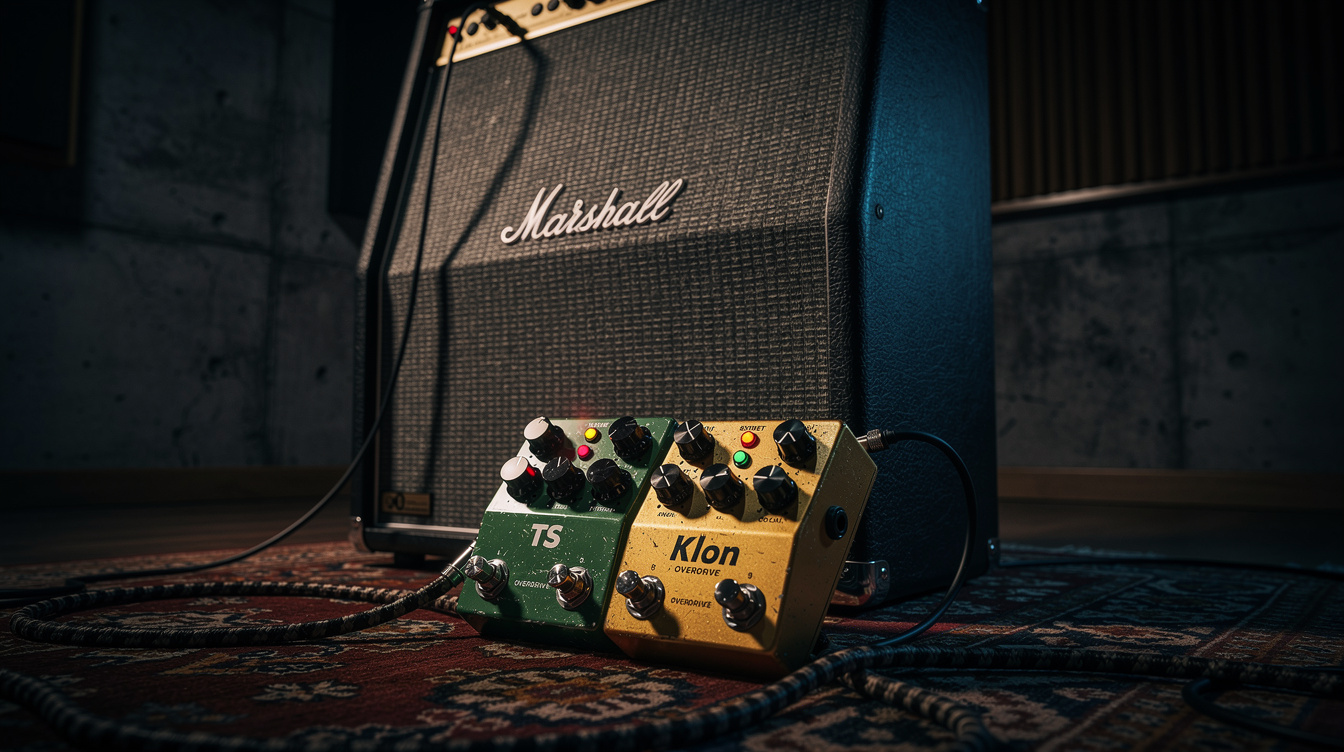
The short version: Running a TS808 and a Klon stacked into a Marshall works because each pedal does a different job. The Klon opens up the signal and adds upper-harmonic detail at the front end. The TS tightens the low-mids and pushes the amp harder. Together they add up to more than either one does solo, but only if you understand how to set both of them.
| Pedal | Gain setting | Level setting | Tone/Treble | Function |
|---|---|---|---|---|
| Klon (first in chain) | 9–10 o'clock | Unity or slightly above | Noon | Upper harmonic clarity, signal lift |
| TS808 (second in chain) | 8–9 o'clock (barely open) | 2–3 o'clock | Noon | Low-mid tightness, amp push |
| Marshall (back end) | Volume 5–7, Preamp as needed | (n/a) | Treble 6, Mid 6, Bass 5 | Final gain stage, speaker response |
Why This Combination Exists
The "People Also Ask" question in every Klon discussion is some version of: can you run a Klon and a Tube Screamer at the same time? The assumption in the question is that you'd be doubling up on the same thing. You're not.
The Klon and the TS808 clip differently, boost different frequency ranges, and interact with an amp's input stage differently. Run them together correctly and the result is a tone that neither can produce alone: tight in the low-mids, open in the upper harmonics, with the push and sag of a Marshall that's being driven hard.
This isn't something I cooked up in a gear forum. I've been running some version of a TS and a boost into a Marshall since before the Klon existed (a TS808 and a Dallas Rangemaster copy, if you want the period-correct version). The principle is the same. The Klon is just the current best implementation of the boost function.
What Each Pedal Is Actually Doing
The Klon: Upper Harmonics and Signal Integrity
The Klon's circuit is built around an 18-volt charge pump that operates the gain stage at higher than standard 9-volt headroom. This headroom (the extra space before the signal clips) means the Klon can amplify the signal while preserving the dynamic range that gets compressed away by lower-headroom circuits.
Set with the gain low (9 o'clock or below), the Klon acts primarily as a clean boost with a specific character: it lifts the upper harmonics of the signal without thickening the low-mids. The result on a Les Paul or an SG is an opening up of the note: more air, more presence, more of the guitar's natural character. The note sounds more like itself, just louder.
This is why the Klon stacks so well. It's not fighting the TS for the same frequency territory. It's working in the frequency range where the TS has the least effect.
The TS808: Low-Mids and Amp Drive
The TS808's clipping circuit has a well-documented frequency response: it boosts the midrange centered around 720Hz and gently rolls off the high and low extremes. Set with the gain low and the level high, the TS sends a mid-boosted, slightly compressed signal into the amp's input stage. The amp sees more signal in the frequency range it's most responsive to and begins to saturate earlier and more evenly.
On a Marshall, which already has a mid-forward character, the TS's mid boost reinforces the amp's natural voicing rather than fighting it. The combination produces a tighter, more focused breakup, especially on the low strings, where the TS's low-end rolloff prevents the bass frequencies from overwhelming the gain stage.
The Marshall: Where It All Resolves
Neither pedal is trying to be the entire distortion circuit. Both are managing the signal before it hits the amp so that the amp's preamp and output stages do the final work. A Marshall (specifically a Plexi or JCM800 circuit) produces a particular harmonic character when it breaks up that sounds different from pedal distortion: more even-order harmonics, a natural compression from the power tubes, and a sag in the response that makes the playing feel connected to the sound.
Running the pedals into the amp at the settings in the table above, the amp still breaks up naturally. You're not using the pedals to replace the amp's overdrive. You're using them to make the amp break up more consistently, at a lower volume setting, with better note separation.
The Order Matters
Klon first, TS second. Not the other way around.
Here's why: the Klon boosts the signal and opens the harmonics. The TS then shapes that opened signal, tightening the low-mids and adding its own gentle compression and midrange push, before sending it to the amp.
Run the TS first and the Klon second: the Klon boosts the already-mid-compressed TS output, which makes the combined signal thicker and less defined. You lose the clarity that makes this combination work.
This is the same principle as ordering most other boosts and drives: the pedal doing the frequency shaping goes before the pedal doing the final push.
Specific Settings for a Few Common Scenarios
Clean-ish Crunch (Volume at 5)
The amp is clean or barely breaking up. The pedals add all the crunch.
- Klon: Gain at 10 o'clock, Level at unity, Treble at noon
- TS808: Gain at 9 o'clock, Level at 2 o'clock, Tone at noon
- Marshall: Volume 5, Treble 6, Mid 6, Bass 5, Presence 5
What you get: a touch-sensitive crunch where picking lightly stays clean and digging in pushes into breakup. The note separation is better than either pedal alone because the Klon preserves the harmonic detail and the TS organizes the low-mids.
Classic Rock Lead (Volume at 6–7)
The amp is beginning to saturate. The pedals push it further and shape the character.
- Klon: Gain at 9 o'clock (barely open), Level at 2 o'clock, Treble at noon
- TS808: Gain at 8 o'clock (just cracked), Level at 3 o'clock, Tone at noon–1 o'clock
- Marshall: Volume 6–7, Treble 7, Mid 5, Bass 4, Presence 6
What you get: a sustained, singing lead tone with good string-to-string separation and the kind of note bloom you get when tubes are actually working. This is the setting range where the stacking technique produces results that neither pedal can get independently.
High-Energy Rhythm (Volume at 6, Bridge Pickup)
- Klon: Off or at unity/clean boost only
- TS808: Gain at 10 o'clock, Level at 2 o'clock, Tone at 11 o'clock (slightly dark)
- Marshall: Volume 6, Treble 6, Mid 7, Bass 4, Presence 5
Sometimes the right answer is one pedal, not two. For rhythm work where you want consistent, defined chords, the TS into the Marshall without the Klon is often cleaner and more punchy. Save the stacked setting for leads where the extra harmonic complexity helps.
The Modeler Version
This stacking technique translates directly to the Helix and Quad Cortex. Use the Brit Plexi Nrm or Brit 2204 amp model. Put a Klon-type drive block (the Minotaur in Helix) first, then a TS808 block second, then the amp.
The same settings logic applies: Minotaur gain low, level moderate; TS gain very low, level high. The amp model at 5–6 on the gain control. The main adjustment is that modeler amp models may need the sag parameter raised slightly (to around 4–5 on a 0–10 scale) to replicate the power-stage responsiveness of a real Plexi under load. Without that, the stacked pedal combination into a modeler amp can feel slightly stiff compared to the real thing.
FAQ
Can I use a Klon clone instead of an original? Yes. The functional differences between a KTR, an Archer, a Tumnus, and an original Klon are smaller than the price differences suggest. Any Klon-circuit clone set to the same knob positions will produce the same stacking behavior. The Klon settings guide covers the clone landscape in detail.
Does this work with a master-volume Marshall (JCM800, JVM)? Yes, with an adjustment: master-volume Marshalls let you push the preamp stage independently of the power stage. The stacking technique works primarily on the preamp input here, so the interaction with the power tubes is less pronounced unless the master volume is also up. Set the preamp gain lower than you think (let the pedals do the pushing) and raise the master volume to get power-stage response.
What if I don't have a Klon? Can I substitute something else? Any transparent or low-gain overdrive with good high-frequency response works in the Klon position: a JHS Morning Glory, a Wampler Tumnus Deluxe, or even an EP Booster. The key is that it lifts the signal without significantly reshaping the low-mids. The tube screamer vs. klon vs. blues driver comparison covers the functional differences.
Should the Klon be on at all times or switched in for solos? Both approaches work. Leaving both on creates a consistent crunch-to-lead character. Switching the Klon in for solos adds a volume boost and harmonic lift without changing the TS's low-mid character. I leave the TS on constantly at low settings and kick the Klon in for leads.