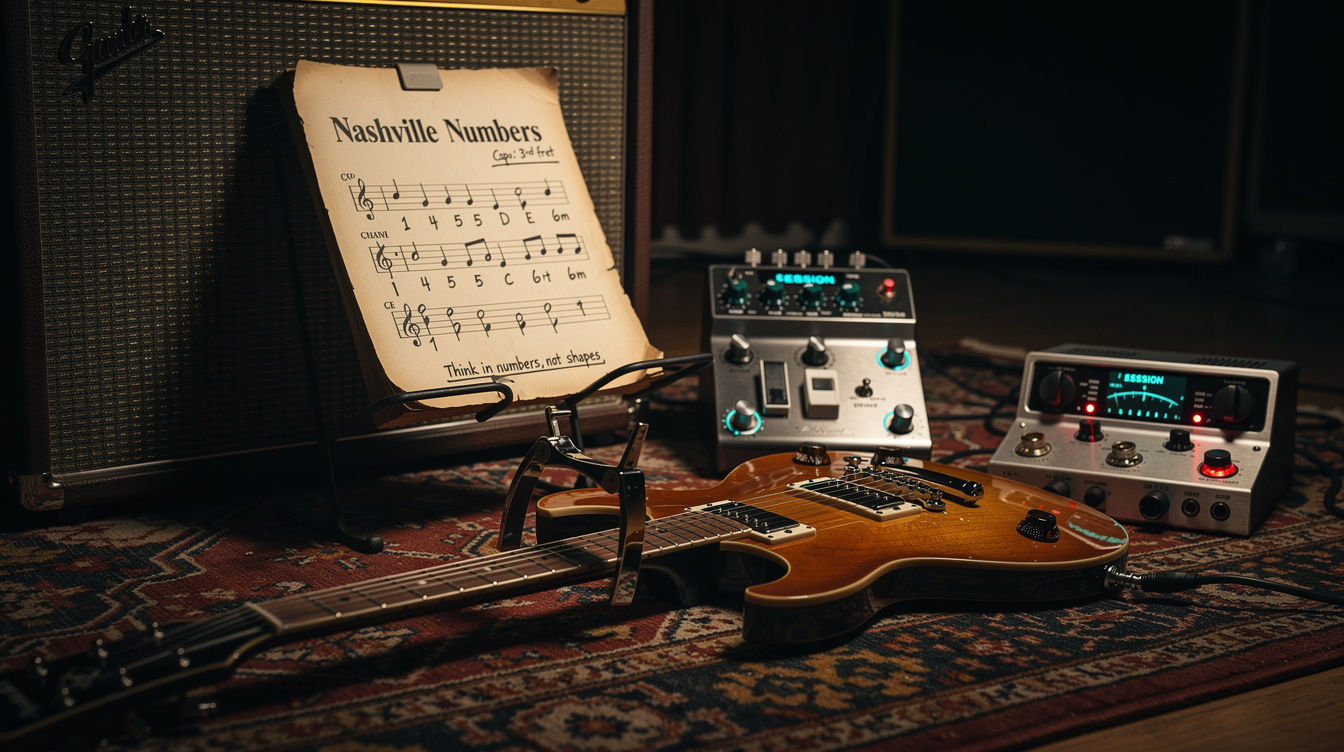
The Short Version Numbers are scale degrees in the band's concert key: 1, 4, and 5 major, 2, 3, and 6 minor. They never change when the key changes, which is the entire point. The capo is where guitarists come unstuck, because a capo changes your shapes and not the numbers — so if the song is in B and you are capo 4 playing G shapes, the 4 is still concert E and you play it as a C shape. Memorize the six numbers in the five open keys (E, A, D, G, C) once, decide your capo position, and read. Twenty minutes of work buys you every key there is.
Neal Matthews Jr. sang in the Jordanaires, which meant he spent the late 1950s standing behind Elvis Presley in rooms where a song might get cut in three takes and the key might get decided somewhere in the middle of the second one. He needed a way to write down a vocal arrangement that would still be right after the producer moved the whole thing up a step, and what he came up with was to stop writing chord names and start writing numbers.
The Nashville players took it, extended it to instruments, and it became the shorthand of an entire recording industry — a system where a session guitarist could walk into a room, be handed a napkin with fourteen numbers on it, and cut the record.
It is still the most useful hour of study available to a rhythm guitarist, and it is still the thing guitarists get wrong more often than any other instrument in the band. Not because it is difficult. Because of the capo.
The System, in One Table
Numbers are scale degrees of whatever key the band is in. The qualities are fixed by the major scale itself, so a bare number carries an assumed quality and charts only mark the exceptions.
| Number | Quality | In the key of G | In the key of D |
|---|---|---|---|
| 1 | Major | G | D |
| 2 | Minor | Am | Em |
| 3 | Minor | Bm | F#m |
| 4 | Major | C | G |
| 5 | Major | D | A |
| 6 | Minor | Em | Bm |
| 7 | Diminished | F#dim | C#dim |
You will use 1, 4, 5, and 6 for most of what you play. The 2 shows up as a substitute for the 4, the 3 shows up as a passing chord toward the 4, and the 7 shows up so rarely in a pop or country chart that when you see one it is usually a mistake or a jazz tune wearing a disguise.
The notation on top of the numbers is not much, and it is worth learning all of it in one sitting:
| Mark | Means |
|---|---|
| Diamond around the number | Hit it once and let it ring |
| Caret or upward mark before the number | Push it — arrive an eighth ahead of the downbeat |
| Two numbers sharing one bar | Split the bar evenly between them |
| A number with a second number under a slash | Inversion; the lower number is the bass note |
| A dash or minus after a number | Minor, when the chart wants to be explicit |
| A small triangle or "maj" | Major seventh |
Bars are usually grouped four to a line, so the shape of the page tells you the form before you have read a single number. That is not incidental. A number chart is meant to be legible from a music stand at the far end of a stage, by someone who is also trying to remember the arrangement.
Where Guitarists Go Wrong
Everything above is true for every instrument in the band. Here is the part that is only true for you.
The numbers are in concert key — the actual key the band is playing in, the one the singer picked. They are not in the key of your shapes.
A capo does not change the key. It changes which shapes produce that key. If the band is in B and you put a capo at the fourth fret, you are playing G shapes and the band is still in B. The 1 chord is concert B, which you play with a G shape. The 4 chord is concert E, which you play with a C shape. The 6 minor is concert G sharp minor, which you play with an E minor shape.
The failure mode is a guitarist who capos up, thinks in shapes, and writes "G C D Em" in the margin of the chart. It works fine until the leader stops the rehearsal and says take it from the 4, at which point that guitarist is doing arithmetic while everyone else is playing.
The fix is not to think harder in concert key. The fix is to notice that the numbers already solved the problem, and to read them directly as shapes.
Read Numbers as Shapes
Here is the thing that makes this easy, and it is the reason the system is better for guitar than for almost any other instrument.
The numbers map onto your shapes identically in every key. If you know that in G shapes the 4 is a C shape and the 6 is an E minor shape, that is true whether the capo is at zero, at four, or at seven. The capo moves the sound. It does not move the relationship.
So you learn this once, for the five open keys guitarists actually use:
| Shape key | 1 | 2 | 3 | 4 | 5 | 6 |
|---|---|---|---|---|---|---|
| E | E | F#m | G#m | A | B | C#m |
| A | A | Bm | C#m | D | E | F#m |
| D | D | Em | F#m | G | A | Bm |
| G | G | Am | Bm | C | D | Em |
| C | C | Dm | Em | F | G | Am |
Five rows. Thirty chords, most of which you already play. That is the whole memorization job, and once it is done you never transpose anything again — you pick a capo position and read the numbers as shapes in that row.
The Capo Chart
Which brings up the only remaining question: given the band's key, where does the capo go?
| Band's key | Capo 0 | Capo 1 | Capo 2 | Capo 3 | Capo 4 | Capo 5 | Capo 7 |
|---|---|---|---|---|---|---|---|
| C | C shapes | — | — | A shapes | — | G shapes | — |
| D | D shapes | — | C shapes | — | — | A shapes | G shapes |
| E | E shapes | — | D shapes | — | C shapes | — | A shapes |
| F | — | E shapes | — | D shapes | — | C shapes | — |
| G | G shapes | — | — | E shapes | — | D shapes | C shapes |
| A | A shapes | — | G shapes | — | — | E shapes | D shapes |
| B | — | — | A shapes | — | G shapes | — | E shapes |
| Bb | — | A shapes | — | G shapes | — | — | — |
Bb is the awkward one: its E-shape position is capo 6, which is off the right edge of that table and high enough that the chords start to sound like a mandolin. Most players stay at capo 1 or 3 for a flat key and accept it.
Read across your key's row and pick a shape family. They all produce the correct chords. What they do not produce is the same sound, and that difference is worth more than most guitarists give it credit for.
The Part Nobody Writes Down
Here is what surprised me about the system after years of assuming its value was transposition speed.
Transposition speed is real but it is not the payoff. The payoff is that once the chords are numbers, the capo position stops being part of the song, and it becomes an arrangement decision you get to make separately.
Consider a song in concert E with two guitars. Both play the correct chords. If both play open E shapes, they are playing the same voicings in the same register, and the result is not two guitars — it is one louder guitar with slightly worse timing. Every note either of them plays is doubled by the other.
Now put one at capo 0 in E shapes and the other at capo 4 in C shapes. Same chords, same numbers on the same page — but the C-shape player's root now sits on the A string at the seventh fret, a full octave above the first guitarist's open low E, with the upper voices raised to match. A completely different set of open strings rings underneath, too: the G and B strings that drone through a C-shape progression land in a different place than the B and E strings of the open E shapes. The two parts occupy separate registers and the arrangement suddenly has depth in it that nobody had to write.
That is not a theory observation. It is why the Nashville sessions had multiple acoustic guitars on nearly every track and why they never sounded like a crowd — those players were choosing capo positions to stay out of each other's way, and the number chart is what made that a two-second conversation instead of a rewrite.
So the choice of row in the capo table is really a choice about which open strings drone under your part, and where in the register your chords sit. That is the arrangement. The numbers just made it separable from the chords.
A Twenty-Minute Drill
Take a song you already know cold. Write it out as numbers, in concert key, on one page, four bars to a line, and add the diamonds and pushes where the arrangement has them.
Then play it three times: at capo 0, then from a different row of the capo table, then from a third. Read the numbers each time. Do not translate to chord names in your head — read the number and play the shape from that row.
If you play in a band that runs in-ear mixes and modeled rigs, do the drill against your actual Sunday morning patch rather than an unplugged guitar — the capo position changes which strings ring open, and a compressed clean tone will make that difference far more obvious than an acoustic will.
The first pass is slow. The second is less slow. By the third, something has come loose, and the chart stops looking like a puzzle and starts looking like the song. That is the whole learning curve. It is shorter than it has any right to be, which is exactly what Matthews was after in a room where the key might change before the tape ran out.
Once it is fluent, it changes what you can do on short notice — a leader who wants a song a whole step down gets it immediately, and a volunteer guitarist walking into a Sunday morning with fourteen numbers on a page is no worse off than the person who has played the song for a year. And when you land on the sound the Nashville session players built out of a Telecaster and a compressor, you will find the chart in front of them was almost always numbers too.