Your first month on a worship team will tempt you to fix the wrong thing. You will hear a great tone on the recording, look at your rig, and assume the gap is gear. It usually is not. The gap is almost always volume, note choice, or not knowing the song well enough. None of those cost money.
This is a guide for that first month. Not a gear list. The gear you already own is fine.
Turn Down
This is the first thing to get right and the easiest to ignore.
New volunteers play too loud. Every one I have stood next to did it, myself included, years ago. You cannot hear yourself, so you turn up. Then you cannot hear the singer, and neither can anyone else.
Set your volume so you can clearly hear the vocal over your own guitar. Then leave it. If the sound person keeps pulling you down, turn the amp down at the source. Do not make them fight you every week.
The band that sounds "tight" usually just has everyone playing at the right volume. That is most of it.
Play Less
The second mistake is playing too much.
In most worship songs the electric guitar is not the lead instrument. It is texture. A pad. A swell. A single line that answers the vocal. Sustained chords that sit under everything.
Listen to the recording before you decide what to play. Notice where the guitar drops out. Copy that restraint first, the notes second. A whole verse of one held chord is a real part. The space you leave is part of the song.
The song doesn't need that busy strumming pattern you are proud of. It needs you to hold back.
Learn Two Sounds
You need two guitar tones for your first month. That is it.
| Sound | When | How to set it |
|---|---|---|
| Clean | Verses, pads, swells | Amp clean, a little reverb, tone rolled back if it is harsh |
| Light overdrive | Choruses, fuller sections | Just enough grit to thicken, not a solo tone |
That covers almost every song you will play. A clean tone with reverb for the quiet parts. A light overdrive for the big parts. Once those feel natural, add a delay set to a quarter note or a dotted eighth for movement. The mechanics of a fade-in pad are in our volume swell guide, and that one technique will make your clean tone sound twice as expensive.
Notice what is not on that list. No fuzz. No shimmer. No second overdrive stacked on the first. You will want those someday. Not this month.
Know the Songs Before You Walk In
Rehearsal is not the time to learn the songs. It is the time to lock in with the band.
Get the setlist early. Learn the arrangements at home. Know the key, the tempo, and where the dynamics rise and fall. Know which sections you sit out. A guitarist who knows the song cold and owns a cheap guitar is worth more to a team than one with a boutique rig who is reading the chart for the first time.
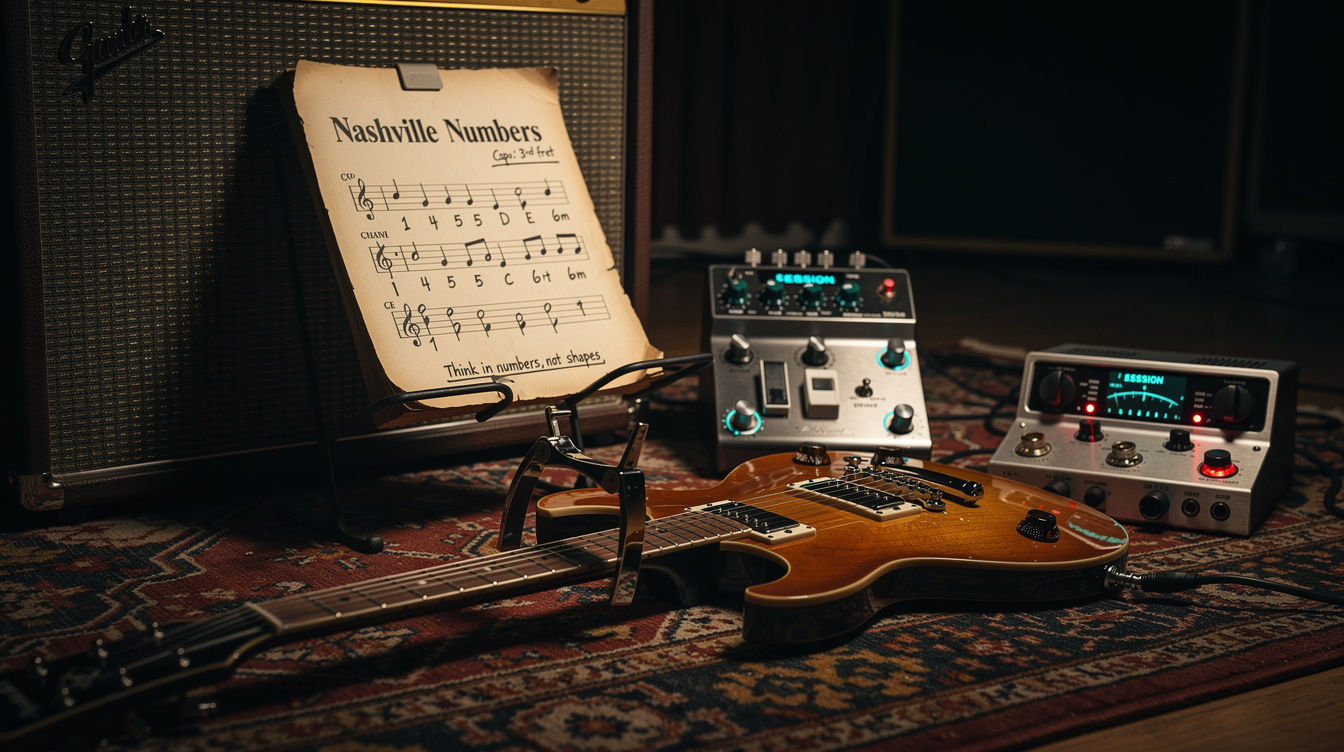
Charts help. Most worship teams use the Nashville number system so a song can move to any key. Learn to read numbers. It is an afternoon of effort and it makes you portable.
What You Have Is Enough
You do not need a pedalboard yet.
A guitar, a tuner, one cable, and any amp or modeler you already own will get you through your first month and probably your first year. A Telecaster into a small combo. A modeler into the board through headphones at home to practice. A solid-state amp you have had since high school. All of it works.
Keep the tuner on, or mute between songs and check your tuning. Silence between songs is your job too. A stray chord or a burst of hum while the leader is praying is the kind of thing people remember.
If you want to see what a full worship board looks like once you are ready to grow, the worship pedalboard guide lays it out, and a first real tone to learn is the clean-to-lead build in Way Maker. But grow into that. Do not start there.
The First Month
Here is the honest surprise from watching new players come onto teams. I expected the hard part to be the gear and the tones. It is not. Every new volunteer I have played next to got hung up on volume and on playing too many notes, and every one of them sounded better the week they turned down and played half as much. The gear was never the problem.
So for your first month, aim small. Turn down. Play less. Learn the songs. Stay in tune. Do those four things with the guitar you already have, and you will be a guitarist your team is glad they added.