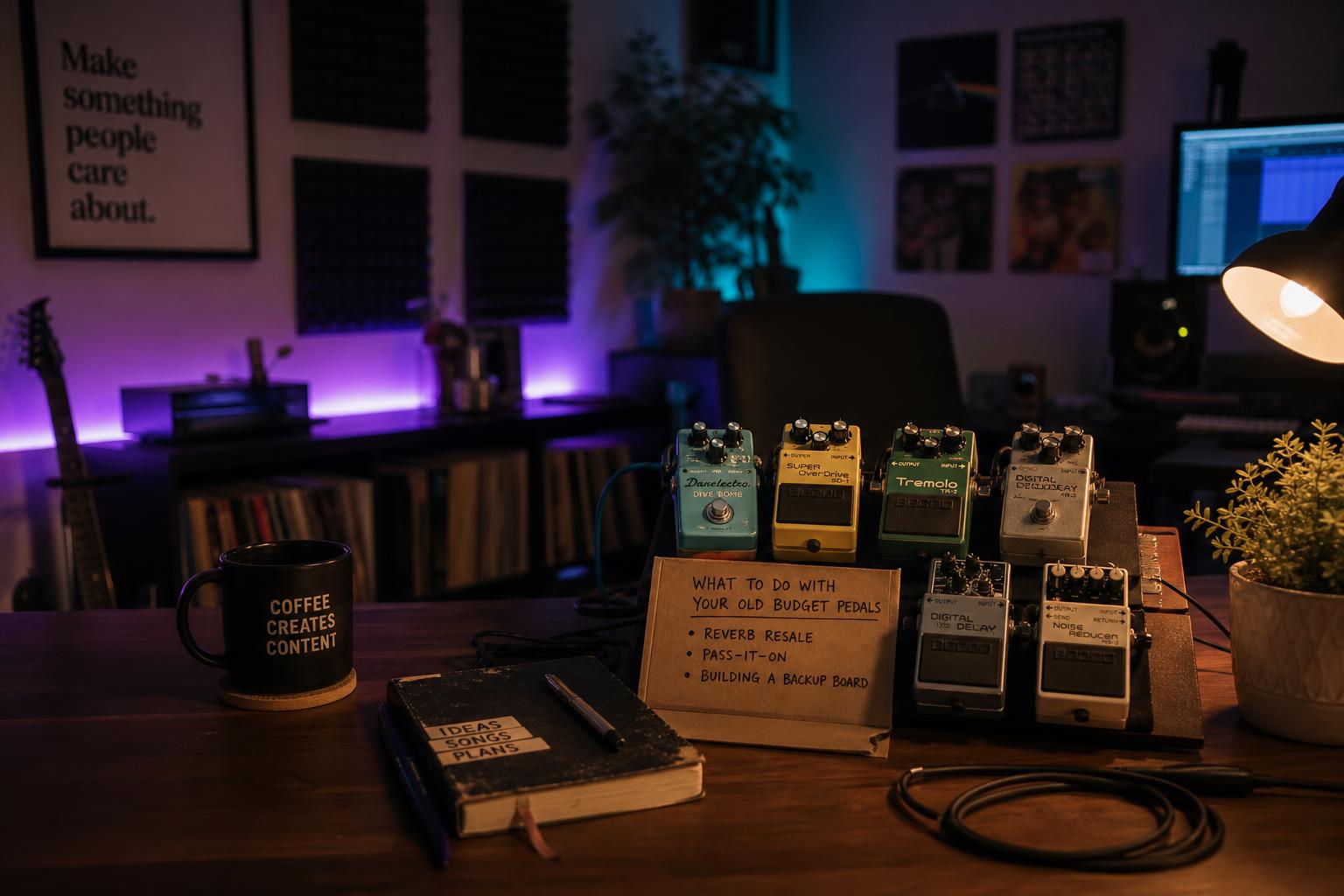
Quick read: After a pedalboard upgrade, the old pedals fall into three categories. Sell on Reverb if it's a Mooer or above (most clear in 1-2 weeks at 50-60% of new price), pass it on directly if it's a Behringer or a no-name (Reverb fees and shipping eat most of the proceeds), and keep one as a backup if it's the kind of pedal that fails in ways you can predict (digital delays, tuners, anything with a screen). The numbers most upgrade guides skip: Reverb takes about 8% in fees plus shipping, which means a $40 pedal sale nets you about $25 after fees. For Behringer-tier pedals that retail at $30-40, the math doesn't work — selling costs more time than the cash is worth. Pass those to a teenager learning, the youth band at church, the friend whose first board is still a tape deck and a velcro strip. The pedals don't lose value when they leave your house; they gain a new use. The backup-board idea sounds obsessive but it's the most useful thing you can do with old gear if you ever gig: a duplicate compressor, tuner, and overdrive in the gig bag has saved more shows than any pedal upgrade ever has.
The $300 starter pedalboard post and the $500 upgrade path post mapped what to buy first. This is the question those posts left open: what happens to the pedals you're replacing. Most upgrade content stops at "sell the old one to fund the new one" without doing the actual math, and the actual math is what makes the difference between cash in hand and a closet full of pedals you'll never use again.
Here's the short version. Some pedals are worth selling. Some are worth passing on. Some are worth keeping. The decision depends on the original price, the resale market for the specific pedal, and whether you'd actually use the pedal again if your current one died at a bad time.
The Three-Tier Decision
| Original price | Resale path | Why |
|---|---|---|
| Behringer ($25-40) | Pass to a beginner | Reverb fees + shipping leave $5-10 net; the pedal's value as a starter tool is worth more than the cash |
| Mooer / TC Tonepedal ($50-100) | Reverb sale | Clears in 1-2 weeks at 50-60% of new; net after fees is real money |
| Boss / mid-tier ($100-200) | Reverb sale | Holds value well, clears fast, fees are a small percentage of the sale price |
| Strymon / boutique ($300+) | Reverb sale or trade | Holds value best, trade-in credit at most music stores is competitive |
| Anything broken | Parts on eBay or recycle | Fixed-cost shipping makes "for parts" listings only worth it for $50+ pedals |
The Reverb fee structure as of May 2026 is 4.99% selling fee plus a 2.7% + $0.25 payment processing fee, totaling about 7.7% of the sale price plus the flat 25 cents. Shipping in the US is $8-12 for a small pedal in a padded envelope, which the buyer typically pays but you have to package and drop off. Time-wise, listing takes 10-15 minutes per pedal, and dropping off at the post office is another 20 minutes.
So a $40 Behringer pedal listed at $25 (typical resale price) clears with $23.07 to you after fees, then minus your time and the inconvenience of shipping. A $80 Mooer pedal listed at $50 clears with $46.13 after fees. A $150 Boss pedal listed at $90 clears with $83.05. The percentages are the same; the absolute dollars are what determine whether the effort is worth it.
When to Sell on Reverb
If the pedal is priced over $40 used and is from a brand with active resale demand, sell on Reverb. The brands that move fast:
- Boss — every Boss compact pedal clears in under a week at fair market value
- Mooer — clears in 1-2 weeks; some specific models (Black Secret, Ana Echo) move faster than others
- TC Electronic — clears in 1-2 weeks; Polytune tuners move fastest
- MXR / Dunlop — clears fast, especially mini-format pedals
- EHX — Big Muff variants clear fast; some niche models sit longer
- Strymon / Eventide / Empress — clears fast at the high end; buyers know what they want
Pedals that sit longer:
- Off-brand or no-name pedals (Stage Right, Fame, Harley Benton in the US market)
- Discontinued models that nobody remembers (the original Behringer V-Tone effects from 2003)
- Anything cosmetically rough — chipped paint, missing knobs, missing backplate screws
The pricing rule of thumb: list at 60% of the current new price, accept offers down to 50%. If the pedal hasn't sold in a month, drop the price 10% and re-list. Use the Reverb price guide for the specific model rather than guessing — the price guide shows what units have actually sold for in the last 90 days, which is the only number that matters.
The packaging matters more than people think. A pedal that arrives with no scratches, in clean packaging, with the original box if you still have it, gets repeat buyers and good feedback. A pedal that arrives wrapped in a grocery bag inside a flat envelope generates complaints and refund requests. Spend the $2 on a bubble mailer.
When to Pass It On
If the math says you'd net under $25 from a Reverb sale, the pedal is worth more as a hand-me-down than as cash. The candidates for hand-me-down are easier to find than you'd think:
- A teenager learning guitar. The kid in your neighborhood, your friend's kid, the church youth group. Their first pedal is the one that makes the practice fun. A Behringer Tube Monster is a real overdrive at a price that lets a 14-year-old experiment without breaking anything irreplaceable. Pass it on.
- The youth band at your church. Worship teams build communal pedal boards out of whatever gets donated. A spare Boss DD-3 or a Mooer Ana Echo on the church board solves a real problem for free.
- A music teacher. Public school music programs have zero budget. A box of working pedals donated to the local middle school's guitar program is a real gift.
- The friend whose "pedalboard" is a tape deck and a velcro strip. They're saving up for the upgrade you just did. Give them a head start.
The pedal doesn't lose value when it leaves your house. It just gains a different kind of value — one that doesn't show up in Reverb's price guide. I gave my first Behringer compressor to a 13-year-old who lives down the street last year, and she texted me a video of her band's first basement gig three months later. The compressor was on the board. That's better than the $18 net I'd have gotten on Reverb.
When to Keep It as a Backup
This is the option most upgrade guides skip and it's the most useful one if you ever play out.
A backup board is a duplicate of the most failure-prone pieces of your main board, stored in the gig bag and ready to swap in mid-show. The pedals that fail most often are the digital pedals (delays, reverbs, tuners with screens), the pedals with moving parts (volume pedals, wah pedals, expression pedals), and the pedals with active switching electronics (footswitches with relay-based circuits).
The backup-board candidates from your old pedal pile:
- The old tuner. Tuners die at the worst possible time. A backup Boss TU-3 in the gig bag has saved me twice in the last three years. The screen is the failure point — backlight burns out, segments stop showing, the whole display goes dim. A spare tuner is worth more than the $25 Reverb sale.
- The old digital delay. If your main delay is now a Timeline or a Nemesis, your old DD-3 or Ana Echo is the backup. Digital pedals can fail unpredictably — a bad solder joint inside, a popped capacitor, a stuck footswitch. The backup runs at 70% of the main pedal's capability and gets you through the show.
- The old overdrive. Less prone to failure (no digital electronics, no moving parts) but the easiest pedal to lose. The amount of times someone has lifted a Tube Screamer off a backstage pedalboard at a multi-band show is non-trivial.
- The old compressor. Compressors are reliable but if you're a chicken-pickin' or worship player who relies on always-on compression, having a backup that you can wire in fast matters.
The backup board doesn't need to be a real board. It can be a small Tupperware box of pedals, patch cables, a power supply brick, and a few hex keys. Keep it in the same bag as the main board. The backup doesn't need to be set up the same way as the main board — it just needs to be functional in five minutes if something on the main board dies before showtime.
I never thought I'd be the person who keeps a backup pedalboard. But I gigged for ten years with Static Ceremony and I lost more time to broken pedals at sound check than to almost any other equipment problem. The backup is cheap insurance.
What Not to Do
Some old pedals deserve a quiet retirement rather than a second life. Don't list these on Reverb:
- Pedals with broken jacks or stripped pots. They'll generate refund requests and damage your seller rating. Either repair them first or scrap them for parts.
- Pedals where the original power supply jack has been jury-rigged with electrical tape. Same problem.
- Pedals that work intermittently — sometimes they pass signal, sometimes they don't. This is almost always a cold solder joint or a failing footswitch. List as "for parts/repair" or recycle.
- Pedals where the LED has been replaced with a different color than original. The Reverb buyer pool for "modded" budget pedals is small, and the mod usually subtracts value rather than adds it.
- Pedals with batteries left inside that have leaked. The corrosion will spread to the PCB and the pedal is effectively scrap. Recycle the chassis and pull the knobs for spares.
The "parts/repair" listings on Reverb are tempting because they let you offload a broken pedal for $5-10. The flat shipping cost makes this not worth it for anything below $50 new — you're paying $8 to ship a $5 sale. Recycle instead. Most cities have electronics recycling at the public library or the city hall on certain Saturdays.
A Practical Workflow
Here's the order I'd recommend for working through a pile of replaced pedals after an upgrade:
-
Sort into three piles. Worth-selling, worth-passing-on, broken. Use the price/brand table above. If you're not sure, look up the specific model on Reverb's price guide — if completed sales are above $40 in the last 90 days, it goes in the sell pile.
-
Decide on backups. From the sell pile, pull any pedal that duplicates your main board's most failure-prone pieces. Tuner, digital delay, anything with a screen. Those become backup-board candidates, not sale items.
-
List the sell pile in one batch. Reverb's listing flow is faster if you do five pedals at once. Take the photos in one session, write the descriptions in one session, set the prices in one session. The 15-minute-per-pedal estimate drops to 5-7 minutes per pedal when you batch the work.
-
Identify recipients for the pass-on pile. Text the friends with kids learning. Email your church's worship leader. Drop a note in your neighborhood's group chat asking if any kid is starting on guitar. The pedals find homes faster than you'd think.
-
Recycle the broken pile. Electronics recycling, not the trash. Most cities have free drop-off; the alternative is the landfill, and the pedal's brass and steel components are worth recycling.
The whole process for a 5-pedal upgrade takes about 90 minutes spread over two evenings. The cash that comes back is real and helps fund the next upgrade. The hand-me-downs put real instruments in real hands. The backup board pays for itself the first time something breaks at a soundcheck. All three are better outcomes than a box of pedals in the closet, which is what most upgrade paths end at.
The upgrade isn't done when the new pedal is on the board. It's done when the old pedal has a new home, whether that's a new owner who paid for it, a new player who got it for free, or a backup spot in the gig bag for the night something breaks. The pile of replaced pedals isn't dead weight; it's the second use case for gear that did its first job. Take the 90 minutes to sort the pile and the gear keeps doing work. Good enough is great — but only when the gear keeps moving.