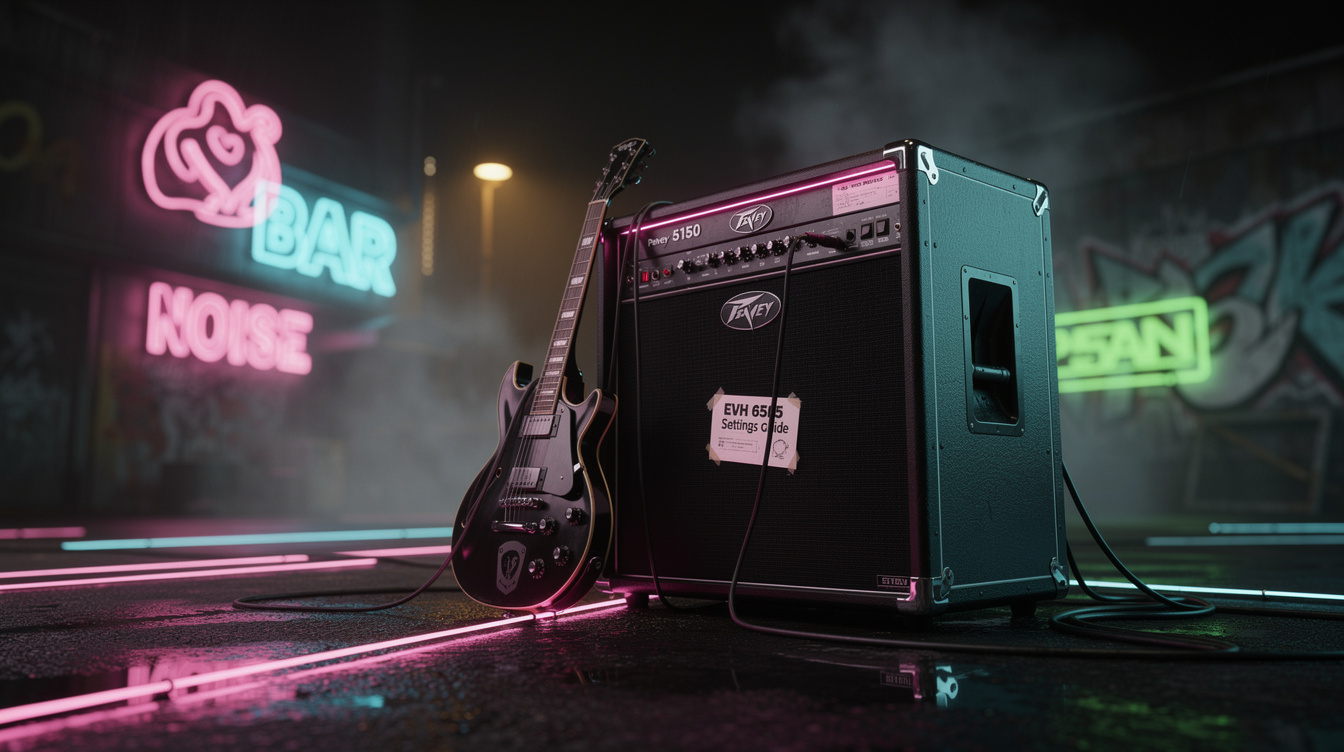
Start Here: 5150/6505 settings reference: five starting points that cover most use cases:
Style Pre Post Bass Mid Treble Res Pre Modern metal (rhythm) 6 5 5 4 6 5 7 Classic metal (Pantera-adjacent) 7 5 6 3 7 4 8 High-gain lead 6.5 5.5 4.5 5.5 6.5 5 7.5 Clean/edge-of-breakup (Ch. 1) 3 5 5 6 5 5 6 Tightest palm mutes 5.5 5 4.5 5 7 3 8 All values on a 0–10 scale. Pre = Preamp gain. Post = Post gain. Res = Resonance. Pre (last) = Presence.
The 5150 Family: Which One Do You Have?
Before settings, you need to know which amplifier you're actually working with. The Peavey 5150 and its variants have meaningfully different voicings despite sharing a lineage.
| Amp | Year | Key Characteristic |
|---|---|---|
| Peavey 5150 (original) | 1992–2004 | Raw, aggressive, slightly looser low end; the Dimebag/EVH classic |
| Peavey 5150 II | 1995–2004 | Added a clean channel with more headroom; same voicing on Lead ch. |
| Peavey 6505 | 2004–present | Rebranded 5150 after EVH and Peavey parted ways; same circuit |
| Peavey 6505+ | 2004–present | Added independent EQ for each channel; more flexible |
| Peavey 6505 MH (Mini) | 2016–present | 20/5/1-watt versions; same preamp voicing, different power section behavior |
| EVH 5150 III (Fender/EVH) | 2007–present | Three channels (clean, crunch, lead); different voicing (smoother, more refined than original) |
| EVH 5150 III 50W | 2014–present | 50-watt version; slightly different power tube behavior than 100W |
Critical distinction: The EVH 5150 III and the Peavey 6505 are not the same amplifier. After Eddie Van Halen ended his relationship with Peavey in 2004, he partnered with Fender to produce the EVH 5150 III, which uses a different circuit topology with three channels and a more refined high-gain character. The Peavey continued as the 6505. They both have "5150" in their name in common usage, but the settings in this guide apply primarily to the Peavey 5150 / 6505 family, with EVH III notes where the behavior diverges.
Channel Structure
Peavey 5150 / 6505 (Two-Channel Models)
| Channel | Name | Character |
|---|---|---|
| Ch. 1 | Rhythm | Can be set clean or slightly driven; less gain on tap than Ch. 2 |
| Ch. 2 | Lead | The primary high-gain channel; where the amp's reputation lives |
The Rhythm channel is useful but not the main event. Most players use Ch. 1 for clean or edge-of-breakup tones and Ch. 2 for everything that requires significant gain.
EVH 5150 III (Three-Channel Model)
| Channel | Character |
|---|---|
| Ch. 1 (Clean) | Clean headroom; more refined than Peavey 5150 Ch. 1 |
| Ch. 2 (Blue/Crunch) | Pushed overdrive; vintage crunch through hot blues/classic rock |
| Ch. 3 (Red/Lead) | Full high-gain; smoother than Peavey 5150 Ch. 2 |
Understanding Resonance and Presence
These two controls are the most misunderstood on the 5150/6505 and the ones that matter most for achieving tight, defined high-gain tone.
Resonance
The Resonance control is a low-frequency feedback filter in the power amplifier section. It shapes how the power amp responds to the low-frequency content of the signal before it reaches the output transformer.
| Resonance Position | Effect |
|---|---|
| Low (0–3) | Tighter, more focused low end; reduces the "flub" on palm mutes; modern metal starting point |
| Mid (4–6) | Balanced low-end response; general-purpose starting point |
| High (7–10) | More low-end fullness and "air" in the bass; can produce flabby palm mutes on high-tuning or heavy-gauge setups |
This is not a bass-frequency EQ boost. The Resonance control changes the power amplifier's behavior: how the output stage interacts with the speaker load. Running Resonance too high on a down-tuned rig with heavy strings and maximum preamp gain is the most common reason 5150/6505 palm mutes lose definition.
For 7-string or 8-string players in drop tunings: start Resonance at 3 or lower. For standard tuning with lighter strings, Resonance at 4–6 is appropriate. Measure the effect by picking a single low open string palm mute. If it feels "spongy" rather than "percussive," reduce Resonance by 2 points.
Presence
The Presence control is a high-frequency feedback filter that affects the amplifier's upper-midrange and treble response. More Presence = more upper-midrange and high-frequency emphasis in the output.
| Presence Position | Effect |
|---|---|
| Low (0–3) | Darker, softer top end; leads feel "woolly"; not ideal for most high-gain applications |
| Mid (5–7) | Balanced; the reference point for most classic 5150 tones |
| High (8–10) | Bright, aggressive, forward upper mids; can produce digital-sounding fizz if combined with high preamp gain and poor IR choice |
High Presence at high preamp gain is a common source of the "fizzy digital sound" associated with amp modeling and poorly dialed-in real amps. The 5150 is more prone to this than most amplifiers because of its high preamp gain range. If your tone fizzes above 4 kHz, reduce Presence before you change anything else.
Preamp Gain: More Is Not More
The 5150's Lead channel has significant preamp gain available (more than most players need). The relationship between preamp gain and tonal quality is not linear:
| Pre-gain Range | Character | Use |
|---|---|---|
| 0–4 | Clean to light drive; the amp's character is in the EQ, not the saturation | Rhythm clean, edge-of-breakup |
| 5–6 | Classic high-gain territory: tight, defined, enough saturation for full chords | Modern metal rhythm, 80s/90s metal rhythm |
| 6.5–7.5 | Full high-gain: thick, compressed, saturated; leads sustain without effort | Lead tones, solo sections |
| 8–10 | Excessive for most purposes. Note definition degrades, palm mutes lose articulation, mid-frequency content collapses | Occasionally useful for a specific compressed lead effect; rarely useful for rhythm |
The Pantera "Vulgar Display" and "Far Beyond Driven" rhythm tones (Dimebag's defining work on this amplifier) sit at approximately 6.5 to 7 on preamp gain, not at maximum. The definition in those palm mutes comes partly from the preamp gain being under control, the OD-808 always-on boost in front, and the Resonance being tighter than the front-of-the-knob position would imply.
Style-Specific Settings
Classic Metal (Dimebag / Pantera Reference)
| Control | Setting | Notes |
|---|---|---|
| Preamp gain | 7 | Higher than modern metal; the raw, aggressive character is intentional |
| Post gain | 5 | Output stage not pushed hard; the preamp does the work |
| Bass | 6 | Fuller low end than modern metal; Dimebag's tone has body |
| Mid | 3 | Scooped (this is a stylistic choice specific to the era; not universally correct) |
| Treble | 7 | Bright, aggressive; the "chainsaw" top end characteristic of Vulgar Display |
| Resonance | 4 | Moderate; allows some low-end air. Dimebag's tuning (Db standard) benefits from some warmth |
| Presence | 7 | High; forward upper mids. This is the "cut" in a loud live mix |
Front-end boost note: Dimebag ran an MXR 6-band EQ in the effects loop, scooped at 800 Hz, boosted at 3.2 kHz. This is the other half of the tone signature. The amp settings above without the loop EQ produce a rawer, less sculpted version of the sound.
Modern Metal (Post-2000 High-Gain)
| Control | Setting | Notes |
|---|---|---|
| Preamp gain | 6 | Less than classic metal; allows better palm mute articulation |
| Post gain | 5 | Matched to a tight, controlled output level |
| Bass | 5 | Neutral; let the Resonance control manage the low-end character |
| Mid | 4–5 | Less scooped than 90s reference; modern metal sits more mid-present |
| Treble | 6 | Moderate brightness; avoids the harsh upper-mid spike of high Treble + high Presence |
| Resonance | 3–4 | Tight; critical for 7/8-string or drop-tuned applications |
| Presence | 6–7 | Moderate-high; keeps the top end defined without fizz |
Lead Tone
| Control | Setting | Notes |
|---|---|---|
| Preamp gain | 6.5 | Enough saturation for full sustain without note definition collapsing |
| Post gain | 5.5 | Slightly higher output for lead level boost; or use a volume block in your loop |
| Bass | 4.5 | Pull back slightly from rhythm setting; leads get muddy when the bass is high |
| Mid | 5.5 | Boost from rhythm setting; the mid frequency is where lead clarity lives |
| Treble | 6.5 | Consistent with rhythm; don't change treble between rhythm and lead patches |
| Resonance | 5 | Neutral for single-note lines |
| Presence | 7 | Higher than rhythm; forward upper mids cut through cymbals and keys |
Clean / Edge of Breakup (Channel 1)
| Control | Setting | Notes |
|---|---|---|
| Preamp gain | 3 | Clean headroom; bring up for edge-of-breakup character |
| Post gain | 5–6 | Match to stage volume |
| Bass | 5 | Neutral |
| Mid | 6 | More mid presence than the high-gain channels; clean tones need this |
| Treble | 5 | Neutral |
| Resonance | 5 | Neutral |
| Presence | 5 | Neutral; the clean channel doesn't benefit from high Presence the way the Lead channel does |
The OD808 Trick
Every 5150/6505 discussion eventually arrives here: the Tube Screamer or OD808 in front, gain at zero, level high.
This is not a myth or a forum superstition. It has a measurable circuit explanation: an overdrive pedal with the gain at minimum still has a clipping circuit that shapes the frequency content and impedance of the signal. Setting the level high increases the signal's amplitude entering the amp's input, which pushes the preamp into its compression/saturation behavior earlier. The result is not more gain; it's a tighter, more defined compression character from the preamp's first stage.
For the 5150/6505 specifically:
| OD Pedal | Gain Setting | Level Setting | Effect |
|---|---|---|---|
| Maxon OD808 (always on) | 0 | Max or near-max | Tightens low end, adds slight midrange emphasis, compression from preamp saturation |
| Ibanez TS808/TS9 | 0–1 | 3/4 to max | Similar; slightly more pronounced midrange boost from the TS's characteristic hump |
| Boss SD-1 | 0 | Max | Less precise than OD808 for this application; works but noisier |
| Klon-style (Morning Glory, Tumnus) | 0 | 3/4 | Less emphasis on the 720 Hz midrange hump; cleaner tightening without the TS color |
Whether you prefer this or not is a question of taste. The OD808 tightening is distinctly colored: it pushes the 720 Hz region and gives the palm mutes a specific "bump" that some players love and others find intrusive. If you want the tight input-stage behavior without the TS midrange character, try a clean boost pedal (Xotic EP Booster, TC Electronic Spark Mini) instead.
EVH 5150 III Settings: Where It Diverges
The EVH 5150 III has a different circuit topology. Key differences in settings behavior:
| Parameter | Peavey 5150 / 6505 | EVH 5150 III |
|---|---|---|
| Channel 3 gain ceiling | Very high, can become loose | High, but more compressed and refined at the top |
| Resonance range | Wide-range effect; very noticeable | Narrower range; more subtle |
| Presence range | Wide-range; fizz risk at high settings | Narrower; more consistent high-frequency behavior |
| Clean channel | Limited headroom on Ch. 1 | Genuinely useful clean channel with more headroom |
| Default starting point | Lower gain than you think | Gain 6–7 on Ch. 3 for full high-gain; less than Peavey equivalent |
On the EVH III, I start Lead channel settings at: Gain 6.5, Volume 5, Bass 5, Mid 4.5, Treble 6, Resonance 5, Presence 6. The amp's more refined gain structure means maxing gain produces workable tone, unlike the original 5150 where maximum gain starts to sound unfocused.
Modeler Settings (Helix, Quad Cortex)
For players running the 5150/6505 through a modeler:
| Modeler | Model Name | Notes |
|---|---|---|
| Line 6 Helix | "PV Panama" (original 5150) | Accurate preamp character; adjust Resonance and Presence as described above |
| Neural DSP Quad Cortex | "Peavey 5153" (6-channel EVH III version) | EVH III voicing, not original 5150; the "Red channel" is closest to the classic sound |
| Neural DSP Archetype: Abasi | PV-based high-gain model | Optimized for extended range; tight and modern |
| Fortin NTS plugin | Independent design, NTS circuit | Not a 5150 model but competes in the same sonic territory |
IR selection matters significantly with the 5150 voicing. The amp's preamp gain character is forward in the upper mids; an IR from a Mesa Rectifier 4x12 or a Greenback-loaded 4x12 provides a more balanced result than Celestion V30-heavy IRs, which can push the upper-midrange further into fizz territory.
FAQ
What's the difference between the Peavey 6505 and the original 5150? The 6505 is the same amplifier as the original Peavey 5150, renamed when Eddie Van Halen and Peavey ended their endorsement relationship in 2004. The circuit is functionally identical; the cosmetic differences (different grille logo, different color options) are the main distinguishing features. A 6505 and an original 5150 with the same tube complement will sound essentially identical at the same settings.
Why do my palm mutes sound flabby through the 5150? Almost always the Resonance control. The 5150/6505's Resonance at high settings allows the low-end feedback path through the output stage to build up, creating a looser, more "spongy" low end that hurts palm mute articulation. Reduce Resonance to 3–4 and test. If still flabby, also reduce preamp gain. High gain levels compress the attack transient and make palm mutes feel sloppy. The OD808 trick can help recover articulation while maintaining gain.
Should I use both channels or just the Lead channel? Most metal players use only the Lead channel, sometimes with the Rhythm channel for a clean tone. The Rhythm channel has less preamp gain range and a slightly different tonal character; it's useful for clean and light drive tones, but switching between channels mid-set introduces EQ and level inconsistency because the channels have separate EQ controls. A simpler approach: use the Lead channel for everything and rely on your guitar's volume knob or a boost/cut pedal for the gain range you need.
Is there a meaningful difference between 50W and 100W versions? Yes, but it's primarily about output stage behavior at performance volume. The 100W version has more output power and a slightly more headroom-forward power amp section. The 50W version compresses and saturates the output stage earlier at lower volumes, which some players prefer for the additional "sag" character. For direct recording or studio work, the wattage difference is irrelevant; it's only meaningful at the volume levels where the power amp section is working hard.
What speakers work best with the 5150/6505? The 5150's forward upper-midrange preamp character benefits from speakers that don't exaggerate that region. Mesa Rectifier 4x12 with V30/C90 mix is the classic pairing; it's what the amp was developed alongside. Greenback-loaded 4x12s (Celestion G12M) work well for classic metal with less aggressive top end. Vintage 30-only cabs can be bright and forward (workable, but requires pulling the Presence control back). For modelers using IRs, start with a Mesa 4x12 IR before experimenting.