Quick Answer: Pick thickness changes three things you can actually hear: the amount of pick attack in the transient, the brightness of the tone, and how the string responds when you dig in. A thin pick gives you more flex and a brighter, clickier sound. A heavy pick gives you more control, a warmer transient, and more consistent dynamics. The difference is real, and it costs nothing to test.
A pick is the cheapest tone variable there is. A pack of Dunlop nylons runs two dollars. If you've never deliberately tested different gauges back-to-back on the same guitar and amp, you're missing something.
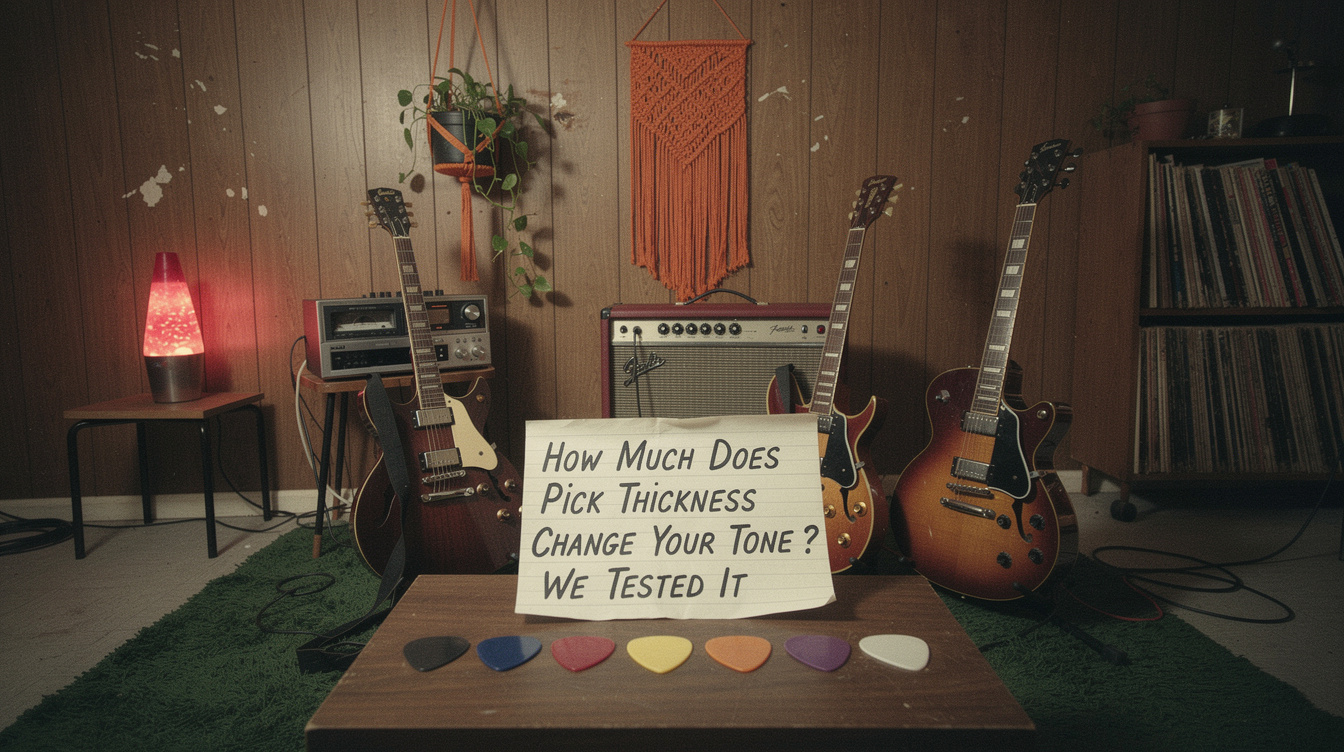
I ran five picks (the same brand, the same shape, different thicknesses) through a 1997 Telecaster into a Blues Junior, clean channel, volume at about 6, tone flat. Same strings, same guitar, same amp, same room. Here's what I heard.
The Test Picks
| Thickness | Category | Pick Used |
|---|---|---|
| 0.46mm | Extra Thin | Dunlop Nylon Standard .46 |
| 0.60mm | Thin | Dunlop Nylon Standard .60 |
| 0.73mm | Medium | Dunlop Nylon Standard .73 |
| 1.00mm | Heavy | Dunlop Nylon Standard 1.0 |
| 1.50mm | Extra Heavy | Dunlop Nylon Standard 1.5 |
Same shape. Same material. Same hand.
What Pick Thickness Actually Controls
Before the results: here's the physics.
A thinner pick flexes before the string does. When you strum or pick, the pick bends out of the way and releases the string with a quick, snappy motion. That snap creates a bright, percussive transient: the "click" in the attack.
A thicker pick doesn't flex. It transfers energy directly from your hand to the string. Less pick snap, more string movement. The transient is rounder, the note blooms more, and your dynamics are more directly tied to how hard you play.
Neither is better. They're different tools for different sounds.
Results by Gauge
Extra Thin (0.46mm)
The pick does most of the work here. The flex is extreme. Strum a chord aggressively and you can hear the pick itself as a percussive element. On single notes, the attack is bright and thin. On chords, you get a full strum easily because the pick follows the strings.
I expected it to feel sloppy on single notes. What I found: the extra thin was harder to control for precision playing than I anticipated. The flex makes the pick feel like it's fighting you on fast passages, but for open chord strumming it was genuinely musical.
Best for: Open chord folk/country strumming, acoustic-adjacent sounds, gentle R&B comping.
Tone character: Bright attack with a percussive click. Less sustain. Very responsive to light touch.
Thin (0.60mm)
More control than the extra thin, still flexible. This is the most forgiving gauge for beginner technique because the flex smooths out inconsistencies in your picking angle and pressure.
The tone is still bright, but the transient is cleaner: less "click," more actual note. Works well for lead playing in styles where a bright, singing sound is the goal.
Best for: Blues leads, single-note country work, beginner players learning pick control.
Tone character: Bright, articulate, with a distinct transient. The string ring is clear.
Medium (0.73mm)
This is where I spend most of my time. The flex is minimal, the response is direct, and the pick doesn't get in the way. On a Telecaster into a clean amp, this gauge sits in the middle of the tonal spectrum: not the snappy brightness of the thin picks, not the roundness of the heavies.
The medium was the most "transparent" in the sense that it didn't impose a strong tonal character. What you hear is mostly the guitar and amp, with the pick staying out of the way.
Best for: All-around playing. If you don't know where to start, start here.
Tone character: Balanced. Neither bright nor warm by extreme. The pick itself doesn't dominate.
Heavy (1.00mm)
The difference from medium to heavy was more significant than I expected. The attack is noticeably rounder. The click is almost gone, replaced by a more immediate string response. Notes feel fatter, especially in the low register.
Palm muting on the bridge pickup changed character completely. With the thin picks, palm mutes had a snappy, clicky quality. With the heavy, they were tighter and more defined. The pick transferred more energy to the string, so the mute reacted more directly to pressure.
For fingerstyle-adjacent lead work (where you want notes to sing rather than attack), the 1.0mm was the better pick.
Best for: Lead playing, palm muting, anything where you want less pick snap and more string body.
Tone character: Warmer attack, fuller low-end, more sustain. Feels like the amp is working with you instead of against you.
Extra Heavy (1.50mm)
Rigid. There's no flex at all. What your hand does, the string does. This is either exactly right or completely wrong depending on how you play.
For the Telecaster clean test, the extra heavy made the guitar sound bigger on single notes. The low strings had a pronounced thickness that the thinner picks didn't produce. On chords, it felt mechanical. If your strumming technique isn't precise, a rigid pick will expose every imperfection.
The surprise: chicken pickin' patterns sounded more defined on the 1.5mm. The snap-and-release of the hybrid picking technique was cleaner because the pick didn't add its own flex to the motion.
Best for: Experienced players who want maximum control. Jazz chord comping. Hybrid picking.
Tone character: Most direct response. Warmest attack. Feels like fewer variables between your hand and the sound.
Side-by-Side Summary
| Thickness | Attack | Brightness | Chord Strum | Single Notes | Palm Mutes |
|---|---|---|---|---|---|
| Extra Thin (0.46mm) | Snappy, clicky | Very bright | Easiest, most forgiving | Harder to control | Springy |
| Thin (0.60mm) | Bright, articulate | Bright | Forgiving | Good for leads | Light strum quality |
| Medium (0.73mm) | Balanced | Neutral | Reliable | All-purpose | Workable |
| Heavy (1.00mm) | Round, fuller | Warmer | Requires precision | Best for singing lead | Tight, defined |
| Extra Heavy (1.50mm) | Direct, immediate | Warmest | Most demanding | Maximum control | Snappiest |
What Didn't Change
The frequency content of the guitar itself (the fundamental note, the resonance of the body) doesn't change with pick thickness. The amp response doesn't change. The pickups don't care which pick you're using.
What changes is how the string starts vibrating. Pick thickness is a variable in the transient: the first 10-50 milliseconds of a note. After that, the string is doing its thing regardless.
For recordings that sit in a dense mix, pick thickness may be inaudible once the track is full. For recordings with space (solo acoustic, clean guitar in a spare arrangement), it's clearly there.
For live playing, the biggest variable is feel, not tone. The pick you're most comfortable with will produce better playing than the pick with the theoretically optimal tone character.
My Recommendation
If you've been playing the same pick for years without thinking about it: buy a sampler pack. Dunlop makes them. Spend twenty minutes on a clean amp, one gauge at a time. You'll hear the difference. You'll probably find a gauge you didn't expect to prefer.
The best pick is the one that feels right in your hand. The tone follows from that.
FAQ
Q: Does pick material matter more than thickness? A: They're different variables. Thickness controls the flex and the transient snap. Material affects the surface interaction: how the pick releases the string, grip texture, and some tonal brightness. A nylon pick and a Tortex pick of the same thickness will still sound different, but thickness is the bigger variable for most players.
Q: Do professional guitarists actually think about pick thickness? A: Yes. Brad Paisley uses Dunlop .46mm extra thins; the pick flex is part of his strumming character. Jimmy Page used Herco .75mm. Angus Young uses heavy Dunlops because he needs the control for his playing style. It's not an accident.
Q: I use a thin pick and it keeps breaking. Should I go thicker? A: Probably, yes. A breaking pick is either too thin for the amount of force you're applying or a quality issue. Moving to a medium or heavy won't hurt your tone, and it'll stop costing you picks every gig.
Q: Can pick thickness affect tuning stability? A: Only indirectly. A rigid heavy pick transfers more energy to the string, which can increase pitch wobble on vibrato if your technique is aggressive. This isn't a significant issue for most players but it's a real variable on floating tremolo bridges.
Q: What pick should a beginner start with? A: Medium (0.73mm). Enough flex to forgive inconsistent technique, enough stiffness to feel the note. Try the thins after six months when you have some control. You'll know if you want to go lighter or heavier from there.