The short version: Where you pick determines which harmonics are present in the note. Near the bridge produces a spectrum dominated by upper partials — bright, thin, and full of attack. At the midpoint of the vibrating string, the even harmonics cancel entirely and you get a hollow, woody sound built on the fundamental. The tone knob can only subtract from what your hand created. That is why the hand has the wider range.
There is a moment that happens to most players eventually. You are working out a part, it sounds right, and then somewhere in the second pass it stops sounding right — nothing has changed, no knob has moved, and the note has gone thin and glassy on you. What actually happened is that your hand drifted an inch toward the bridge while you were thinking about the fretting.
That drift is worth more tonal range than most of the pedals on the board, and almost nobody treats it as a control.
The Position Map
| Where the pick strikes | Harmonic character | What it is good for | What it costs |
|---|---|---|---|
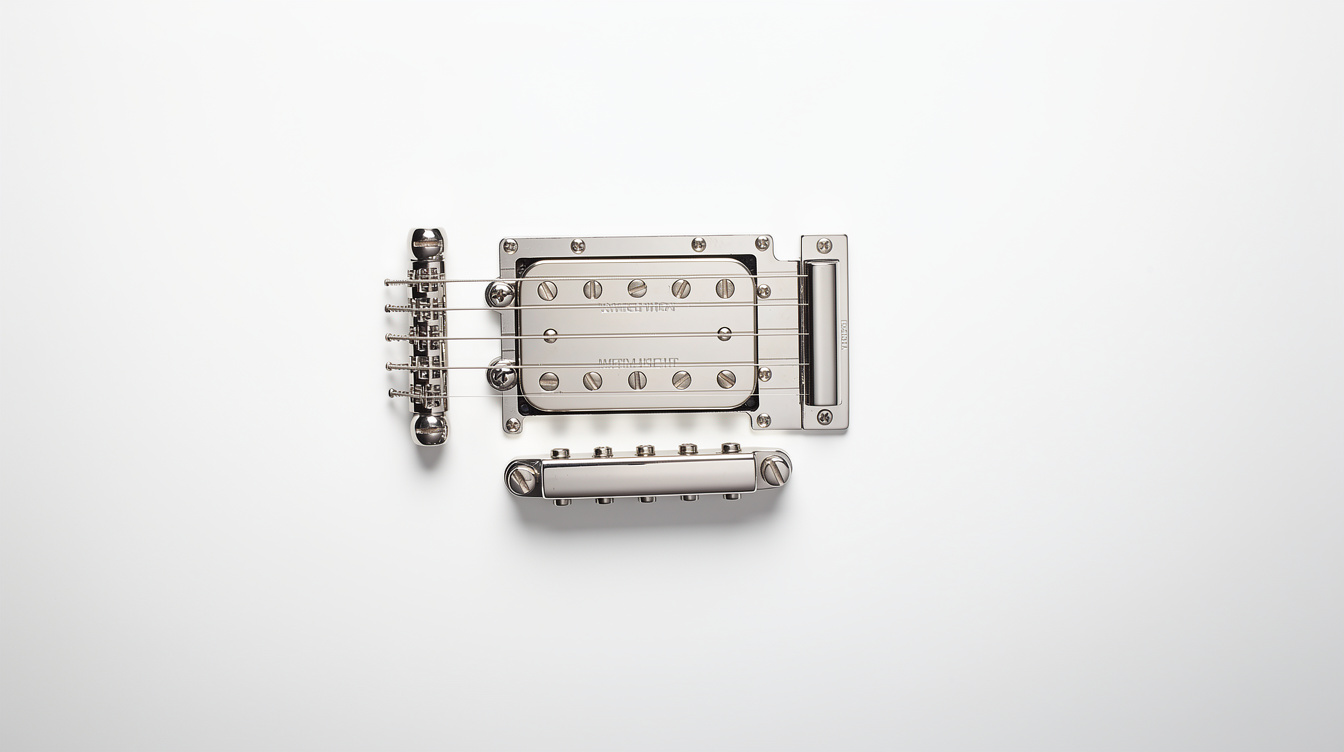
| On top of the bridge saddles | Almost pure upper partials, no body | Percussive stabs, muted funk, harmonics-forward textures | Every trace of body, and most of the sustain |
| Just behind the bridge pickup | Strong highs, tight lows, hard attack | Palm-muted riffs, country snap, anything that must cut | Bloom; single notes read as clicks under gain |
| Between the pickups | Balanced, slight upper-mid emphasis | Default rhythm position, most rock playing | Nothing much — it is the neutral setting |
| Over the neck pickup | Fundamental-forward, softened attack | Blues leads, jazz comping, singing sustained notes | Definition in a dense mix |
| Over the end of the fretboard | Very strong fundamental, gentle onset | Ballad cleans, fingerstyle, anything that needs to feel spoken rather than struck | Cut, articulation, pick definition |
| The exact midpoint of the vibrating length | Odd harmonics only; even harmonics cancel | A specific hollow, woody colour | Sounds artificial if held for long |
Six positions across maybe eight inches of string. That is a wider palette than most players get out of an entire pedalboard, and the transitions between them are continuous rather than switched.
Why It Works: The Node Rule
The mechanism is simple enough to be worth understanding, because understanding it turns a vague suggestion into a predictable tool.
When you pull a string aside and release it, you are not choosing a pitch — the string's length and tension already decided that. You are choosing a shape. That initial shape determines how much energy goes into each harmonic, and the rule governing it is short: a harmonic is suppressed when you pluck at one of its nodes.
Every harmonic has nodes, the still points along the string where it does not move. The second harmonic has one at the middle. The third has two, at the one-third points. Pluck exactly where a harmonic wants to stand still, and you cannot put energy into it.
The most dramatic case is the midpoint. Pluck a string dead centre and you have landed on the node of the second harmonic, the fourth, the sixth, and every other even harmonic in the series. All of them, cancelled at once. What survives is the fundamental and the odd harmonics, which is the same spectrum a clarinet produces, and it sounds like it — hollow in a specific way, with a woody, slightly boxy centre and no shimmer on top at all.
Pull the pick toward the bridge and the opposite happens. You are now far from most of the low-order nodes, and the initial shape you have put in the string is a sharp corner rather than a broad curve. Sharp corners are made of high harmonics, mathematically and audibly. The note gets its bite, its glassiness, and its slight nasal quality all from the same source.
Bowed-string players have had names for the two ends of this for centuries — sul ponticello at the bridge, sul tasto over the fingerboard — which tells you how long it has been obvious to everyone except guitarists.
The Part That Surprised Me
I went into this assuming that picking toward the neck would be the thing that made a high-gain tone muddy. It reads as the intuitive direction: more fundamental, less top end, less definition, mud.
It is backwards.
Picking closer to the neck under high gain produces a cleaner result, not a muddier one, and the reason is what distortion does to the material it is given. Clipping does not just add harmonics; it generates intermodulation products between every pair of frequencies present at the input. Two frequencies going in produce sum and difference tones coming out, and those products are not harmonically related to anything you played. Feed a distortion stage a spectrum crowded with high partials and it manufactures a dense haze of non-harmonic content in the top octaves.
That haze is fizz. It is what people are hearing when they say a high-gain tone sounds like frying bacon, and it is why the standard fixes — high-cut, a different cab, less presence — work by removing it after the fact rather than not creating it.
Move the picking hand an inch and a half toward the neck and you have reduced the amount of high-harmonic content entering the clipping stage in the first place. Less material to intermodulate, less fizz manufactured, and the note keeps its low-order structure because that content was never the problem. The tone sounds more defined, which is precisely the opposite of what a spectral description would predict.
I have since found this to be the single fastest diagnostic for a lead tone that will not stop sounding brittle. Before the amp, before the pedal, before the impulse response: play the phrase again with your hand over the neck pickup. It is free and it takes four seconds.
The Midpoint Moves, and That Is the Useful Part
Here is the detail that reframes the whole thing, and it is the reason "pick over the twelfth fret for a full sound" is advice that stops working the moment you use it.
The midpoint is the midpoint of the vibrating length, not of the guitar. For an open string, the vibrating length runs from nut to bridge, so the centre sits over the twelfth fret — about 12.75 inches from the bridge on a 25.5-inch scale. Fine.
But the instant you fret a note, the vibrating length shortens, and it shortens from the nut end. Fret at the twelfth and the speaking length is halved; its midpoint is now only a quarter of the scale from the bridge, which on a Strat-scale instrument lands remarkably close to where the neck pickup sits. Fret at the seventeenth and the midpoint has moved closer still, into the territory between the pickups.
Which means the hollow, fundamental-heavy colour you get from centre-picking an open chord requires a completely different hand position when you are playing a melody up the neck. The sweet spot travels toward the bridge as your fretting hand climbs, and a hand that stays parked over the same spot on the body is sliding through the harmonic map without meaning to.
It also explains a frustration a lot of players have without diagnosing it: leads above the twelfth fret sound thinner than the same phrases lower down, even at the same volume and on the same pickup. Part of that is the shorter string producing less energy overall. But part of it is that your hand, which was near the midpoint at the fifth fret, is now well on the bridge side of the midpoint at the fifteenth, and you have unintentionally moved to a brighter picking position at exactly the moment the note needed more body.
The correction is to drift the picking hand toward the neck as you go up. Many players who sound good high on the neck already do this and have never articulated it.
Picking Position Times Pickup Position
The two effects are separate, they are both spatial, and they multiply.
A pickup is a sampler. It senses string motion at one point along the length, and it can only report what is moving there. If a harmonic has a node sitting directly over the coil, that harmonic is essentially invisible to the pickup no matter how strongly your hand excited it.
So there are two independent filters between the string and the amp. Your hand decides which harmonics get created. The pickup decides which of the survivors get transmitted. Line them up badly and you can cancel the same partial twice; line them up well and you get colours that neither position produces alone.
The practical version:
- Bridge pickup, bridge picking — maximum brightness and maximum thinness, both amplified. Useful for cutting through, punishing on its own.
- Bridge pickup, neck picking — my favourite combination on a Telecaster, and the one people underestimate. The pickup keeps the attack and the definition; the hand puts the body back. It sounds like a bridge pickup that has been talked down from something.
- Neck pickup, neck picking — the classic thick jazz voice. Beautiful and very easy to lose in a band.
- Neck pickup, bridge picking — the sneaky one. Enough top-end attack to be heard, enough low-order weight to sound substantial. Worth trying on any part that keeps disappearing in a mix.
If the pickup half of that interests you, our pickup position guide covers the switch side in more detail. This article is the other half of the same mechanism.
What It Does to Compression and Gain
Compression flattens the level difference between picking positions almost completely, and it does nothing at all to the timbral difference. This is worth knowing because it makes compressed clean tones a better place to use the technique rather than a worse one — you can move from the neck to the bridge and get the full colour change without the part jumping forward in the mix.
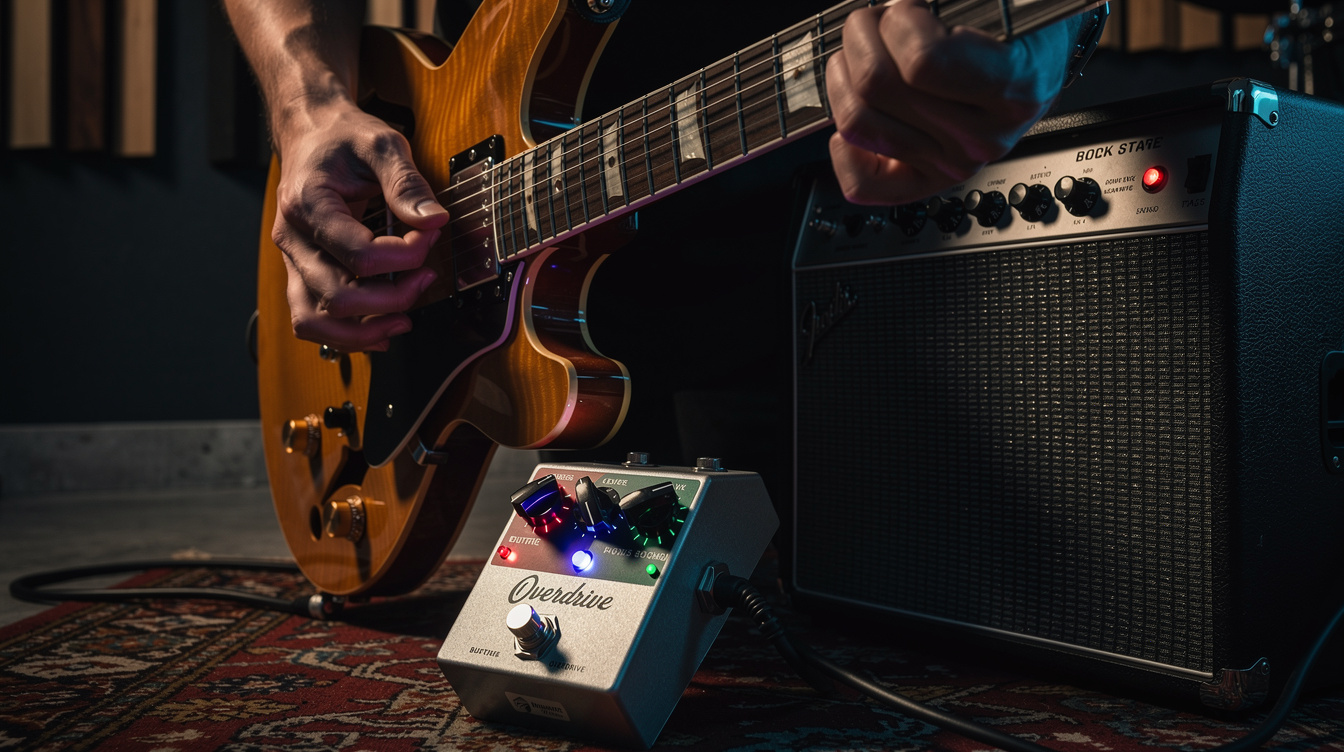
Gain behaves differently, as described above, but there is a second effect worth naming: the further you pick from the bridge, the more compliant the string is, so the same physical effort produces a larger displacement and a hotter signal into the front end. Picking near the neck therefore pushes a drive pedal harder even when it feels gentler under the hand. That interaction is why some players find their overdrive "inconsistent" — it is tracking a variable they are not aware they are changing.
A Drill Worth Fifteen Minutes
Not a warm-up. A calibration.
- Pick one note. Fifth fret, D string. Neck pickup, clean, no effects.
- Play it eight times, moving a half inch toward the neck each time, starting at the bridge saddles and finishing past the end of the fretboard. Same attack strength every time. Listen to the whole decay, not the attack.
- Find the midpoint by ear. Somewhere in there is a position where the note goes hollow and slightly artificial. That is the even-harmonic cancellation. Mark where your hand is.
- Repeat at the twelfth fret. The hollow spot will be noticeably closer to the bridge. Feel how far it moved.
- Now play a phrase you know well and deliberately use two positions in it — the sustained notes near the neck, the articulated ones near the bridge.
Step 5 is where it stops being physics and becomes playing. The reason players with distinctive touch sound distinctive is rarely one signature position; it is that they are moving between positions in a way that matches the phrase, and they have usually stopped noticing that they do it.
Two Places This Actively Matters
Double-tracking. If you move your hand between takes, the two takes will not fuse — the timbral difference is large enough that the ear reads two guitars instead of one wide one. Keeping the picking position consistent is as important as keeping the tone consistent, and it is the variable that gets forgotten. Double-tracking on a time budget covers the rest of what makes takes fuse or fail.
Anything with a pick you have changed recently. A thicker pick at the bridge and a thinner pick at the neck can land in a similar place, which means changing picks quietly changes the position that sounds right to you. If a new pick feels wrong, try moving your hand before you conclude the pick is the problem — pick thickness and hand position are entangled in ways that make each one hard to evaluate alone.
The Argument
The claim in the title is not rhetorical. An overdrive pedal has a fixed voicing; it applies the same curve and the same clipping character to whatever arrives. Your hand changes the source material before any of that happens, continuously, across a range wide enough to cover a clarinet at one end and a harpsichord at the other, with a response time of zero and a price of nothing.
It is also the only tone control that gets better as you get better at using it. That is not true of anything you can buy.