Why Position Matters
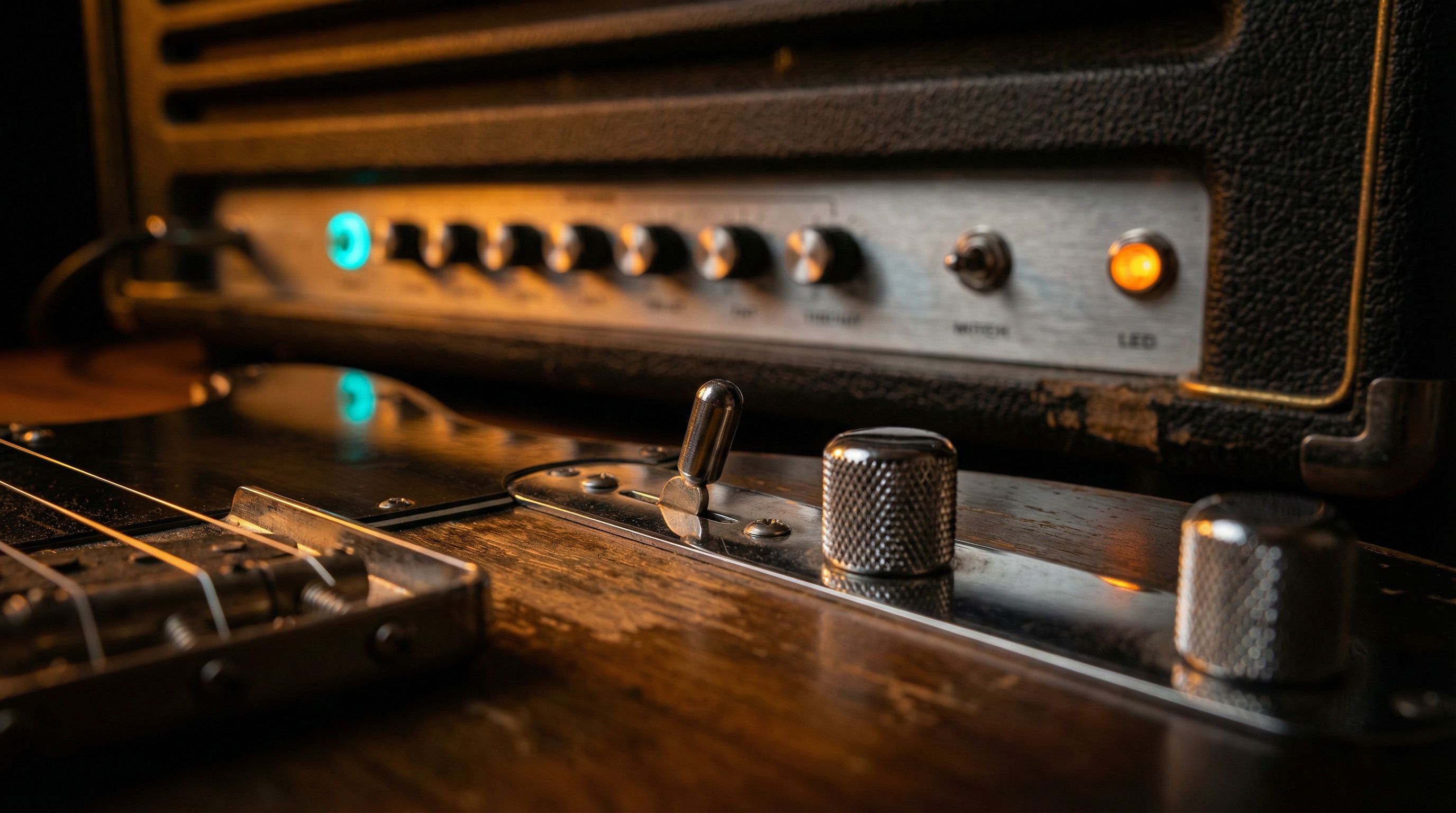
Pickup position shapes your tone more than any pedal. A pickup reads the string vibration at its location. Near the bridge, the string moves tight and fast. Strong upper harmonics. Near the neck, the string swings wide. Strong fundamental, fewer overtones.
Same guitar. Different switch position. Different sound entirely.
Bridge Pickup: Bright, Cutting, Aggressive
The bridge sits where string tension is highest. Tight, articulate, strong upper harmonics.
Best for:
- Lead guitar. Cuts through a full band mix.
- Metal and hard rock. Tight palm mutes. Defined riffs.
- Country chicken pickin'. The snap of a Tele bridge into a clean amp, the sound of the pick hitting the string as much as the note itself.
- Punk and aggressive rhythm. All bite.
The tradeoff: Can sound thin or harsh solo. Roll the tone knob back. Use a darker amp setting. Pairing the bridge pickup with an overdrive rather than a distortion pedal can also tame the harshness while keeping the cut.
Neck Pickup: Round, Full, Vocal
The neck sits where the string moves the most. Strong fundamental. Rolled off highs. The sound of a note that blooms instead of attacks.
Best for:
- Blues leads. B.B. King, Clapton, SRV. That thick, singing sustain.
- Jazz. Neck humbucker, tone rolled back. The standard voice.
- Smooth solos. Sustain without the top end fighting you.
- R&B and soul rhythm. Full chords that sit behind the vocal.
The tradeoff: Gets muddy fast with too much gain. Keep the amp's presence up.
Middle Pickup: Neutral, Honest
On a three pickup guitar, the middle sits between the extremes. Balanced. Not much character on its own.
It shines in combination.
Positions 2 and 4: The Secret Weapons
On a five-way Strat switch, positions 2 and 4 combine two pickups slightly out of phase. The result is a hollow, bell-like tone you cannot get any other way.
- Position 4 (neck + middle). Glassy with a slight scoop in the mids. Knopfler's position. Mayer's clean tone. The sound of a single coil into a small amp where the speaker is just starting to push.
- Position 2 (bridge + middle). Snappier. Percussive. Hendrix lived here. Common in funk and R&B.
These tones come from single coils in a Strat configuration. Humbuckers do not produce the same phase interaction.
Quick Reference: Genre to Pickup Position
| Genre/Style | Typical Position | Why |
|---|---|---|
| Metal rhythm | Bridge | Tight, defined, aggressive |
| Metal lead | Bridge or neck | Bridge for shred, neck for melodic leads |
| Blues lead | Neck | Singing sustain |
| Blues rhythm | Neck or position 4 | Full chords |
| Jazz | Neck (tone rolled back) | Round, no harshness |
| Country | Bridge | Twang, snap, clarity |
| Funk | Position 2 or 4 | Percussive, hollow |
| Classic rock | Bridge or neck | Bridge for riffs, neck for solos |
| Indie/jangle | Position 2 or 4 | Bell-like, chimey |
| Worship/ambient | Neck or position 4 | Smooth, no harsh edges |
Where You Pick Changes What the Pickup Hears
The switch is only half of it. The other half is your right hand, and most players never think about it.
A pickup reads the string at one spot. It can only report motion that is happening over the coil. But your picking hand decides what kind of motion is there in the first place. Pick near the bridge and you put a lot of high harmonic content into the string. Pick over the end of the fretboard and you mostly put in the fundamental.
So there are two filters, not one. The hand decides what exists. The pickup decides what gets heard.
This is why the same pickup can sound like two different pickups.
Try it. Bridge pickup, clean amp. Play a phrase with your hand back by the saddles. Then play the same phrase with your hand over the neck pickup. Same switch position. Same settings. The second one has body the first one does not.
That combination is worth knowing about. A bridge pickup picked near the neck keeps the attack and loses the ice pick. It is the best sound on a Telecaster and hardly anybody uses it.
The full mechanism is in where your picking hand sits. The short version is that you have a tone control on your right hand and it does not cost anything.
Pickup Height Is the Adjustment Nobody Makes
Two screws. A screwdriver. Ten minutes. Most guitars have never had it done.
Pickup height sets how much of the string's magnetic field the coil sees. Closer means louder and more aggressive. Further means quieter and cleaner. That part is obvious.
Here is the part that is not. Too close and the magnet pulls on the string hard enough to interfere with it. The note starts to warble. You hear it worst on the low E and A strings, and worst on the neck pickup, because the string swings widest there. Players hear that wobble and blame the guitar. It is a screwdriver problem.
Start with whatever your pickup maker publishes for that specific model, measured with the string held down at the highest fret. Then do this:
- Play the bridge pickup. Play the neck pickup. Whichever one is louder, that is the one to lower.
- Get them close in volume. Not identical. Close enough that switching mid-song does not jump.
- Play the low E on the neck pickup and let it ring. If the note warbles or sounds like it is beating against itself, lower that pickup until it stops.
- Check the treble side separately. The high strings usually want the pickup a little closer than the bass side.
Humbuckers sit closer than single coils. The neck pickup always sits lower than the bridge. Those two rules cover most of it.
I did not expect this to matter much. I set the neck pickup on a Tele down about a turn and a half because the low string was wobbling. The wobble stopped, which I expected. What I did not expect was that the pickup got clearer. Lower output, better note. The magnet had been fighting the string the whole time and I had been calling it a dark pickup.
Humbuckers vs Single Coils
Single coils produce a wider gap between bridge and neck voicings. Big contrast. Humbuckers narrow that gap. A bridge humbucker still bites, but it will not sound thin. A neck humbucker can get muddy with gain.
Coil splitting gets you closer to a single coil voice. Not identical. But I was surprised how much it opened up a neck humbucker that had been sitting in the mud for months. One switch and the note had air again.
The One-Minute Rule
Neck for anything smooth or melodic. Bridge for anything aggressive or cutting. Neither feels right, try position 4.
Then let your ears decide. For more on how your gear shapes tone, browse our tone recipes to see how pickup position fits into complete signal chains.