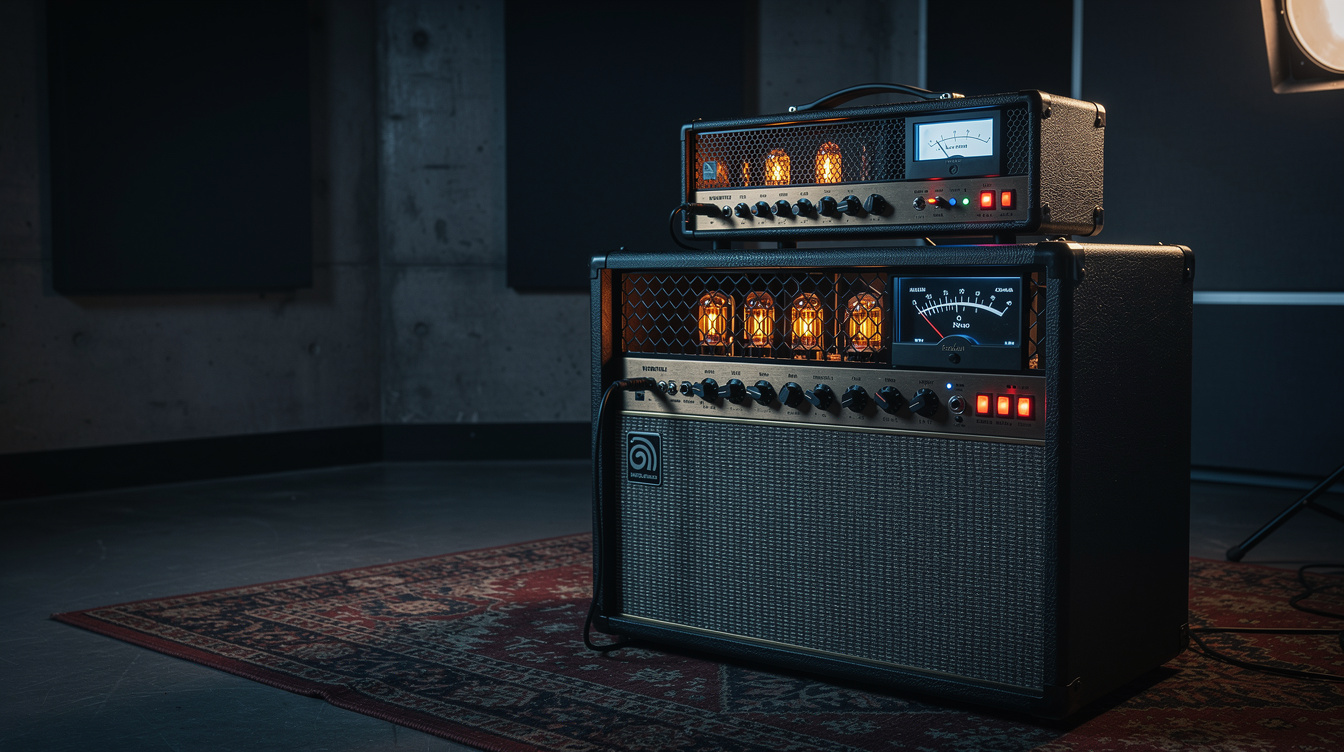
The essential distinction: Preamp distortion comes from the amp's gain stages before the output transformer. Power tube saturation comes from the output tubes themselves (6L6s, EL34s, 6V6s) running at the limits of their design. Each stage produces a different harmonic character, a different dynamic response, and a different feel under your fingers.
| Preamp distortion | Power tube saturation | |
|---|---|---|
| Where it happens | Gain stages before the output transformer | Output tubes and output transformer under high load |
| How to get it | Turn up the gain or preamp volume control | Turn up the master volume (or use a single-volume amp at high setting) |
| Harmonic character | More odd-order harmonics (harsh, aggressive) | More even-order harmonics (warm, musical, full) |
| Dynamic response | Compresses earlier, less dynamic range | More dynamic; responds more to pick attack |
| Sag | Absent or minimal | Present (power supply briefly sags on loud attacks) |
| Classic example | JCM800 preamp cranked, master at 3 | Plexi at volume 7–8, no master volume |
The Amp as Two Separate Distortion Machines
A tube amp is not a single gain stage. It's a series of amplification stages: the preamp section (where gain controls and tone shaping happen) feeds a power section (where output tubes amplify the signal to speaker-driving power levels). Both sections can distort. They distort differently.
Most players understand preamp distortion intuitively because preamp-stage distortion is what happens when you turn the gain knob up. It's fast, it's responsive to gain control, and it's the dominant distortion character in most modern amp designs. In a JCM800, the Marshall JVM, the Peavey 5150, the Mesa Boogie Dual Rectifier. These amps have substantial preamp gain. The gain control is doing most of the work.
Power tube saturation is what happens when the output tubes themselves are pushed past their comfortable operating range. This requires volume (actual volume, speaker-moving volume) because the output tubes are driving the output transformer and speakers, and they only saturate when they're being asked to produce more current than they comfortably can.
The two things most players know about this but rarely see explained clearly:
-
Master volume controls on modern amps can separate the two. A high-gain preamp with a master volume at 2 gives you preamp distortion without power tube saturation. The same preamp at a moderate gain setting with master volume at 8 gives you some power tube saturation without maximum preamp distortion.
-
Old Plexis and other single-volume amps have no way to separate the two. There's one volume control. It raises both the preamp signal level and the output power level simultaneously. Getting the power tubes to saturate means making the amp loud. This is the defining constraint of the pre-master-volume era of amplifier design, and also why those amps sound the way they sound.
The Harmonic Story: Why They Sound Different
Here's the part that explains the perceptual difference.
Vacuum tubes produce distortion through a specific mechanism: when the signal exceeds the tube's linear operating region, the tube clips. It can't amplify any higher, so the peaks of the sine wave get flattened. The shape of that clipping determines the harmonic content of the distortion.
The most common shorthand you'll read online is "preamp distortion is odd-order, power tube distortion is even-order." That's a useful starting point, but the reality is circuit-topology dependent, and the topology differs between preamp and power sections in ways that matter.
Preamp stages in guitar amps are almost always single-ended triode gain stages (one 12AX7 half-tube handling the signal without a mirror-image partner). When a single-ended stage is pushed into clipping, the waveform clips asymmetrically (the positive and negative half-cycles don't hit the rails the same way), which produces a broadband spectrum with significant odd-order content (3rd, 5th, 7th) and a harsher, more aggressive tonal signature. That's why high-gain preamp distortion sounds fuzzy, edgy, or clinical as it's pushed further.
Power stages in most guitar amps (Marshall Plexi, JCM800, Bassman, Twin Reverb, Mesa, AC30) are class AB push-pull. Two output tubes (or two pairs) work in opposition: one amplifies the positive half-cycle, the other the negative. A perfectly balanced push-pull stage cancels even-order harmonics by topology, leaving odd-order products behind. So "power tubes = even-order" is only accurate for single-ended class A amps (Fender Tweed Champ, Vox AC4, some old Princeton circuits). On a Plexi or a Bassman, the output stage is still dominantly odd-order when it saturates.
So where does the famous "warm, musical, honey" character of a cranked Plexi actually come from? Not from tube harmonic even-order. It comes from a stack of effects the push-pull math doesn't cancel:
- Output-transformer saturation. The transformer's magnetic core has its own clipping behavior, and transformer saturation does produce rich even-order content, especially at low frequencies.
- Sag and power-supply compression (see next section). The tubes run on a moving voltage rail, which softens peaks and bloom-compresses notes in a way no pedal replicates.
- Crossover distortion at the zero-crossing in class AB operation, which adds its own spectral signature.
- Speaker + cab interaction. A guitar speaker's impedance curve fights back against the amp's output impedance, and that interaction shapes transient response and harmonic content in ways the amp alone can't.
The practical implication: if you want that warm, fat breakup that sounds like it's coming from inside the amp (not like a pedal, not like processed gain, but like the whole amplifier is singing), you're hearing the combined effect of transformer saturation, sag, speaker interaction, and yes, some tube nonlinearity. Getting that through a small bedroom amp or through a modeler at low volume requires either a power attenuator (preserves most of it), a lower-wattage amp (same effects at more manageable volumes), or a very good power-stage model (approximates sag and transformer behavior specifically).
The Sag Factor
Power tube saturation comes with a companion effect: sag. When the output tubes draw more current from the power supply than usual (which happens on loud, sustained notes or hard attack peaks), the power supply voltage briefly drops. The tubes are running at lower voltage for a moment, then voltage recovers.
This produces a specific dynamic characteristic: loud attacks bloom and soften slightly as the power supply sags, then recover as voltage comes back. It's a natural compression that the player feels more than consciously hears. The guitar's attack feels connected to something physical. Notes sustain in a particular way. The whole playing experience is slightly different.
No preamp distortion circuit produces sag. Some attenuators reduce it. Some amp designs (particularly cathode-biased designs like tweed Fenders and the Vox AC30) have more sag than fixed-bias designs (like the Plexi Marshall). Sag is one of the characteristics that modeler designers focus significant engineering on replicating, with varying success.
When players say a modeler "feels stiff," sag behavior is often what they're actually describing. The notes don't have that subtle give.
How to Get Power Tube Saturation in Practice
Real Tube Amps
For a single-volume amp (Plexi, tweed Deluxe, AC30): the only way is volume. These amps are the gold standard for power tube saturation, and the trade-off is that getting the saturation means making the amp loud. At 100 watts, a Plexi pushing the output tubes means stage volume that clears a 2,000-seat venue. A 15-watt tweed Deluxe can be pushed into power tube saturation at more manageable volumes.
For a master-volume amp: leave the preamp gain at a lower setting than usual (so you're not front-loading the system with preamp distortion) and raise the master volume until the amp starts to breathe. On a JCM800 2203 or 2204 with a single channel, this means backing off the preamp volume and letting the master carry more of the load.
A power attenuator (the Two-Notes Torpedo Reload, the Weber Mass, or the Fryette Power Station) lets you push a large-wattage amp's output stage to saturation and then attenuate the signal before the speaker cabinet. The tubes are working at full load; the volume at the speaker is reduced. The sag and even-order harmonic character survive largely intact. This is the most practical solution for getting real power tube saturation at reasonable volumes.
Modelers
The Quad Cortex, Helix, and Kemper all have parameters that specifically model power tube behavior. In the Helix, the "Sag" parameter on amp models affects how much the virtual power supply droops under hard playing; higher sag replicates more of the power tube feel. The "Bias" and "Bias X" parameters affect the operating point of the virtual output tubes, which changes the harmonic character. Don't leave these at default; they're the difference between a modeler that feels alive and one that feels precise but stiff.
None of these replications are perfect. The best modeler power-stage emulations are close enough that the difference is debatable at mix volumes. At louder volumes through a physical cab (where the speaker's response to transients becomes another variable), the real thing produces a tactile response that modeling hasn't fully replicated.
Which Amps Are Famous for Power Tube Saturation?
| Amp | Output tubes | Topology | Saturation character |
|---|---|---|---|
| Marshall 1959 Plexi | EL34s | Class AB push-pull | Aggressive, firm sag, mid-forward. Odd-order dominant from the tubes; transformer + sag adds the "warmth." |
| Fender Tweed Deluxe | 6V6s | Class AB push-pull (cathode-biased) | Warm, saggy, compressed. The softest breakup. The cathode-bias sag is a big part of the character here. |
| Vox AC30 | EL84s | Class A/AB push-pull (cathode-biased) | Glassy, compressed, unique bloom. Closer-to-class-A operation gives it a different harmonic signature than an EL34 Marshall. |
| Fender Bassman (5F6-A) | 6L6s | Class AB push-pull | Fat, round, less compressed than 6V6 tweed. More headroom, more transformer work at volume. |
| Matchless DC-30 | EL84s | Class A/AB push-pull (cathode-biased) | AC30-derived, more refined, extended headroom. |
| Fender Tweed Champ | 6V6 (single tube) | Single-ended class A | The classic example of genuine even-order tube saturation. One tube, no push-pull cancellation. Fat, round, harmonically rich. |
Each output tube type has its own saturation character. EL84s in the AC30 break up earlier and with more compression than EL34s in a Marshall. 6V6s in a small Fender produce a sweeter, rounder saturation than the EL34s. These aren't marketing differences; they're consistent, measurable properties of the specific tube designs.
FAQ
My amp has a master volume. Can I get power tube saturation without being loud? Somewhat. Some master volume designs allow moderate power tube contribution at lower volume levels. The most effective approach is a power attenuator placed between the amp's output and the speaker cabinet. This lets the output stage run at full load (producing saturation) while the speaker volume is reduced. The guide to amp gain and volume controls covers the specific interaction between preamp volume, master volume, and power stage behavior.
Does the wattage of the amp affect how easily I can get power tube saturation? Significantly. A 5-watt amp (like a Fender Champ) can be pushed into power tube saturation at volumes that work in a small room. A 100-watt Plexi needs to be running at levels that are genuinely extreme to achieve the same effect. Lower wattage amplifiers (5W to 15W) are the most practical route to real power tube saturation without a power attenuator.
Does "tube amp sounds better than solid state" come down to power tube saturation? Partly. The even-order harmonic character and the sag behavior of power tube saturation are significant contributors to what players perceive as the "warmth" or "feel" of tube amps. Preamp distortion is more comparable between tube and solid-state designs. But there are also solid-state amps (the Roland JC-120 being the most famous example) that produce excellent clean tones specifically because they DON'T saturate the way tubes do. The preference depends on what you're trying to achieve.