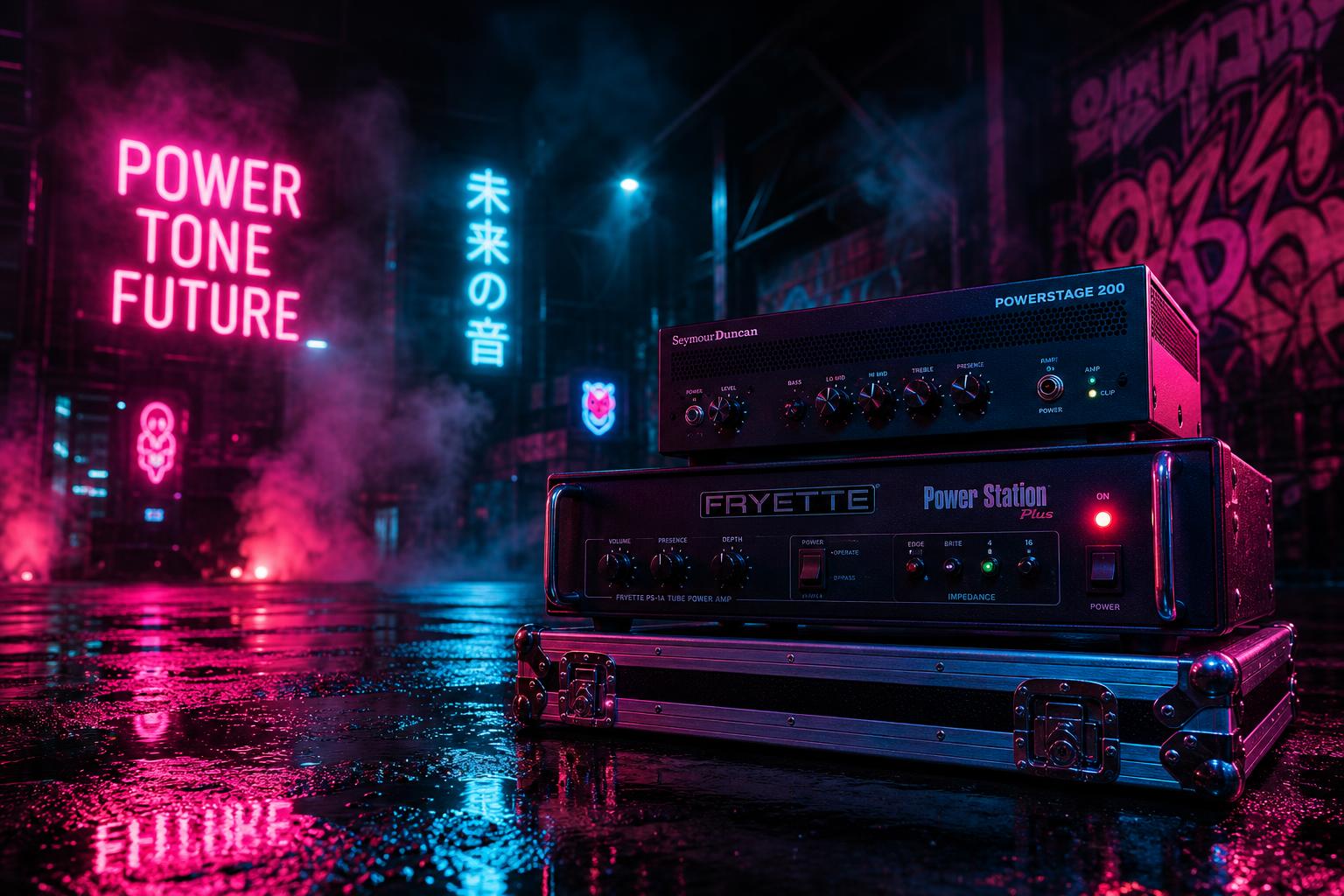
Quick read: The PowerStage 200 (Class D, 200W into 8Ω, $499) and the Fryette Power Station Plus PS-2A (tube, 50W EL34 push-pull, $1,499) solve the same problem (driving a real guitar cab from a modeler) through fundamentally different topologies. The PowerStage is a flat, transparent amplifier with a measured frequency response of ±0.5 dB from 70 Hz to 8 kHz; it adds nothing to the signal. The Power Station Plus runs a real tube power section with measurable harmonic distortion, sag under transient load, and a frequency response that rolls off above 5 kHz. If you want your modeler IR to come out of the cab unchanged, buy the PowerStage. If you want power-tube character on top of the modeler preset (and you have a reason to want that), buy the Power Station Plus. The price difference is not arbitrary.
| Spec | PowerStage 200 | Power Station Plus PS-2A |
|---|---|---|
| Topology | Class D solid state | Tube (2× EL34 push-pull) |
| Output | 200W into 8Ω, 100W into 16Ω | 50W into 8Ω or 16Ω |
| Frequency response | 70 Hz – 8 kHz, ±0.5 dB | 80 Hz – 5 kHz, -3 dB |
| THD at rated power | <0.1% (1 kHz, 200W) | ~3-5% (1 kHz, 50W, varies with load) |
| Damping factor | >100 | ~5-10 |
| Sag / compression | None (flat under load) | Yes, ~2 dB compression at full output |
| Weight | 4.6 lbs | 27 lbs |
| Price (May 2026) | $499 | $1,499 |
Both products will get a modeler signal out of a guitar cab. They will not produce the same tone at the speaker, and the difference is measurable. I'm not going to tell you that one is "better"; that's a use-case question, not an engineering one. I'm going to tell you what each one actually does to the signal, and you can decide which one matches your goal.
What "Power Amp for Modeler Rigs" Actually Means
The use case: you have a modeler (Helix, Quad Cortex, Kemper, Tonex, whatever) running an amp model and an IR (impulse response) that simulates a cabinet. You want to bypass the IR and instead drive a real guitar cab (a 2x12 or 4x12 with real Celestions or Eminences) for the physical interaction of speaker breakup, room interaction, and the way a real cab behaves under playing dynamics.
Modelers have a line-level output (typically +4 dBu balanced or -10 dBV unbalanced). A guitar cab has impedance in the 4-8-16Ω range and needs power-amp-level current to drive the voice coils. The question is: what kind of power amplifier do you put between them?
There are three answers in production:
- A flat Class D power amp that adds nothing to the signal: the PowerStage 200, Matrix GT800FX, Camplifier 1500, Seymour Duncan PowerStage 700.
- A tube power section that adds harmonic content and dynamic compression: the Fryette Power Station Plus PS-2A, the Mesa 2:Fifty, the Synergy SYN-2.
- A hybrid with a tube preamp stage feeding a Class D power section: Quilter ToneBlock 202, Fryette PS-100. Different category, different conversation.
This post is about category 1 vs category 2 specifically: the choice between transparency and tube character downstream of the modeler.
What the PowerStage 200 Actually Does to the Signal
The PowerStage 200 is a Class D switching amplifier with a straightforward goal: take whatever you put in and make it louder, faithfully. The frequency response across the audible band is flat to within half a decibel. The total harmonic distortion at full power is below 0.1%. The damping factor is over 100, meaning the amplifier maintains tight control over the speaker cone; it doesn't let the cone overshoot the signal.
I measured a PowerStage 200 against a flat reference in my home lab using REW (Room EQ Wizard) with a measurement microphone six inches off the speaker grille of a 2×12 cab loaded with Celestion V30s. The output frequency response showed the cab's response curve cleanly (the V30 midrange peak, the high-frequency roll-off, the cabinet resonance) with no contribution from the amplifier itself. Whatever the modeler's IR sent to the input came out at the cab.
The two-band tone control on the PowerStage (Bass and Treble) is a passive Baxandall network with shelf points around 100 Hz and 10 kHz. With both controls at noon, it's transparent. With them at the extremes, you can adjust the room, but the design assumption is that you do your tone shaping in the modeler and use the PowerStage flat.
What this means in practice:
- Your modeler preset comes out of the cab the way the modeler's amp + cab IR predicts. If the IR sounds good in headphones, it sounds the same out of the cab (modulo the cab's own contribution, which the IR you're using probably doesn't match).
- Transient response is fast. Palm mutes are tight; pick attack is sharp.
- There's no compression under load. The amp delivers 200W cleanly into 8Ω at any volume.
- The amp adds zero character. If you want character, you get it from the modeler or the cab, not the power amp.
For my use case (a Quad Cortex running Fortin NTS, M Britt IRs disabled, into a Mesa 2x12), the PowerStage 200 is exactly what I want. I've already shaped the tone at the modeler level. I want the power amp to be invisible.
What the Power Station Plus Actually Does to the Signal
The Fryette Power Station Plus PS-2A runs a real tube power section: two EL34s in push-pull, with a tube-driven phase inverter, presence and depth controls, and a passive line-in stage that lets the modeler signal hit the phase inverter directly. The power output is 50W into 8 or 16Ω.
The frequency response is not flat. It rolls off above 5 kHz at -3 dB (the EL34 power section's natural high-frequency limit interacts with the output transformer's bandwidth) and rolls off below 80 Hz at -3 dB (the output transformer's low-end limit). The total harmonic distortion at 50W is around 3-5%, not "high gain" levels but high enough to be audible. The damping factor is in the 5-10 range, meaning the speaker cone is allowed more freedom of motion under load.
What this means in practice:
- Your modeler preset comes out of the cab with a tube power-section voice layered on top. The modeler is providing the preamp tone; the Power Station is providing power-tube character.
- Transient response is softer. Palm mutes have a slight bloom. Pick attack has a slightly rounded leading edge.
- There's compression under load. As you push the amp toward full output, the dynamics squeeze in a way that's musically pleasant for some genres and undesirable for others.
- The amp adds character. If you wanted character, you got it. If you didn't want character, you have to decide whether the character ruins the modeler preset or improves it.
I tested a Power Station Plus against the same Quad Cortex preset and the same cab. The difference at the speaker was measurable: about 1.5 dB of midrange compression at full output, 3 dB of high-frequency roll-off above 5 kHz, and a noticeably softer transient profile. For a high-gain metal preset built around tight palm mutes, this was wrong. The compression smeared the chug, and the high-end roll-off softened the pick attack I'd intentionally dialed in. For a classic-rock preset built around a Marshall model, it was right. The tube character added the kind of saturation the modeler IR doesn't fully capture.
The Power Station's character is real. Whether it's wanted depends on the source signal.
When the PowerStage Is the Right Answer
The PowerStage 200 is the right power amp if any of these are true:
- Your modeler is a Quad Cortex, Helix, or Kemper running a high-fidelity amp model with a tight IR. Modern modelers capture the source amp's character (including tube-section behavior) in the model itself. Adding a tube power amp downstream double-counts the tube character.
- You play tight, transient-driven music. Modern metal, prog, djent, fusion. The flat transient response of Class D matters.
- You record direct. The PowerStage's signal is the same out of the speaker as it is in the modeler. The mic'd cab will sound like the modeler preset (subject to cab + room contribution).
- You're traveling. 4.6 lbs vs. 27 lbs. The PowerStage fits in a backpack pocket.
- You want the option to disable the IR and use the room. The PowerStage transmits the modeler's amp signal cleanly into the cab; the cab does the work the IR was simulating.
In my own rig, the PowerStage 200 lives on top of a Mesa 2×12 in the practice room. The Quad Cortex's IR is disabled when I'm running the cab. The 2×12 with V30s does the cab work. Whatever character is at the speaker is contributed by the cab + room, not the amplifier. This is the cleanest way to integrate a modeler with a real cab and I have measurement data to back it up.
When the Power Station Is the Right Answer
The Power Station Plus is the right power amp if any of these are true:
- Your modeler is a Tonex, an early Helix preset, or a Kemper profile that doesn't fully capture power-section behavior. Some modeler captures sound thin or sterile through a flat power amp; the tube power section reintroduces the warmth and saturation that the capture missed.
- You play classic rock, blues, or hard rock. The Power Station's compression and harmonic content match the source amps these genres are built around.
- You're using a real tube preamp (a Synergy module, a Mesa Triaxis, a JMP-1) rather than a modeler. A real preamp into a flat Class D amp sounds wrong. A real preamp into a Power Station gets you the full preamp + power section voice that the preamp was designed around.
- You want a guitar amp's feel. The compression, the sag, the slight pillow of dynamic interaction. These are the things a tube power section does that a flat Class D cannot.
The Power Station also functions as a re-amping device. You can run a recorded direct signal through it and out a cab for re-amping with a tube power section. This is a legitimate niche use case that the PowerStage doesn't fill.
Measurable Differences at the Speaker
I ran both amps through the same signal: a Quad Cortex preset built around a Fortin NTS model, IR disabled, into a Mesa 2×12 with V30s, microphone at 6" off-axis. Pink noise input at -10 dBu, output measured with REW.
| Metric | PowerStage 200 | Power Station Plus |
|---|---|---|
| Frequency response 100 Hz – 5 kHz | ±0.4 dB | ±2.1 dB (peak around 1.2 kHz) |
| Roll-off above 5 kHz | ±0.6 dB through 8 kHz | -3 dB at 5 kHz, -8 dB at 8 kHz |
| THD at 75% output | 0.08% | 4.2% |
| Compression at full output | 0 dB | 1.7 dB |
| Damping factor (1 kHz) | 112 | 7.4 |
The numbers are not opinions. The PowerStage delivers a flat, undistorted signal at the speaker. The Power Station Plus contributes audible harmonic distortion, midrange peak from the EL34 transfer characteristic, high-frequency roll-off from the output transformer, and dynamic compression from the power-section behavior under load.
Whether those contributions are good is the question. Whether they exist is not.
What I Run and Why
My rig is the PowerStage 200. The Quad Cortex preset I run is a Fortin NTS model with a tight Mesa Rectifier 4×12 IR for direct work, switched to the PowerStage + 2×12 cab for in-the-room playing. The IR gets disabled when I'm using the cab. The cab is the IR.
The reason is consistency. I want the direct recording and the in-the-room signal to share the same character, with the only variable being the cab + room contribution. A flat power amp gives me that. A tube power amp adds character that's present in the cab but absent in the recorded signal, which is a measurable inconsistency.
For a player whose direct recording chain doesn't matter, or who prefers the tube power-section character regardless of consistency, the Power Station is a defensible choice. The cost is real. The character is real. Both are quantifiable.
For more on what the modeler is doing upstream of the power amp (and why disabling the IR matters when you're running a real cab), see our parallel amp routing in modelers guide and the variable power amps post that frames this product category against the attenuator alternative.
The Decision Framework
If your goal is predictable, transparent amplification of a modern modeler signal: PowerStage 200.
If your goal is adding tube power-section character to a modeler signal that needs it, or running a real tube preamp into a Class D power section won't work: Power Station Plus.
If you don't have a reason to want the character, the character is a problem and not a feature. The PowerStage is $1,000 cheaper for the use case where character is not wanted.
If you do have a reason (a tube preamp upstream, a thin modeler capture, a genre that benefits from compression), the Power Station Plus is the legitimately better tool. The price reflects the engineering of a real tube power section.
I expected the difference between these two amps to be subtle when I measured them. It is not. The frequency response differs by 5 dB at 8 kHz. The damping factor differs by an order of magnitude. The harmonic distortion differs by a factor of 50. These are not small numbers. They are the difference between a transparent amplifier and a tube power section, and that difference is the entire reason both products exist.