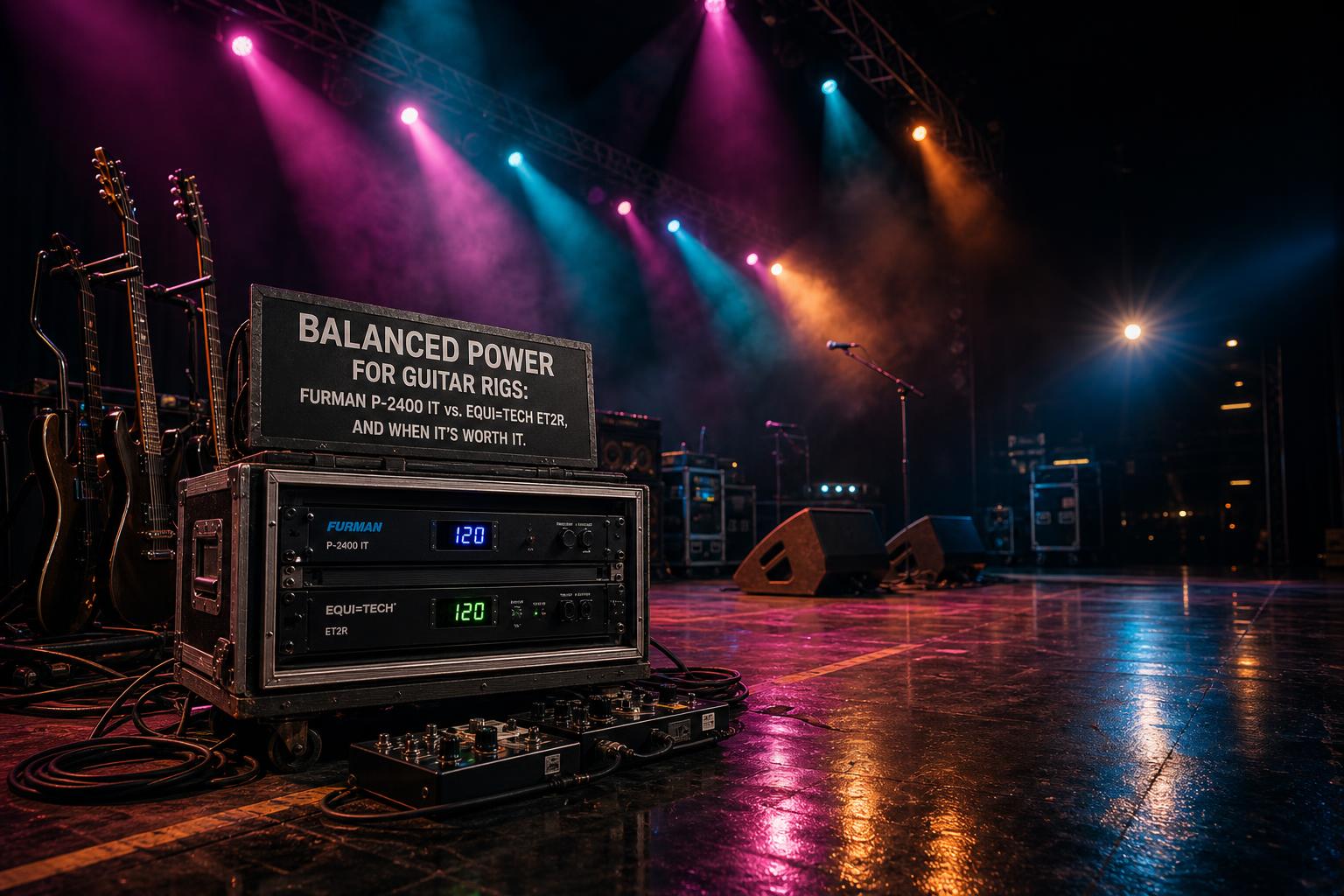
Quick read: Balanced power is a different category from a standard conditioner. It splits a 120 V single-ended supply into two 60 V legs that are 180° out of phase, and the noise that's common to both legs cancels at the load. For most guitarists, this is overkill; a Furman PL-Plus C or a Hum X solves the noise problem for $400 or less. Balanced power is the right call when you're touring with a stereo rig that includes both modeler and tube amps on the same circuit, when you're recording in untreated rooms with dirty power, or when you're running a hybrid IEM mix that picks up RF from anything within 50 feet of the stage. The Furman P-2400 IT ($2,200 street) and the Equi=Tech ET2R ($2,800 street) are the two products in the touring-rack category. The Furman is more flexible and self-protecting; the Equi=Tech is quieter under load and built like a tank. Buy the Furman if you tour and need the protection feature set; buy the Equi=Tech if you record and need the lowest possible noise floor. Don't buy either one until you've ruled out the cheaper fixes. Most "I need balanced power" problems are actually "I need to fix one ground loop."
| Spec | Furman P-2400 IT | Equi=Tech ET2R |
|---|---|---|
| Street price (May 2026) | $2,200 | $2,800 |
| Output capacity | 20 A | 20 A |
| Form factor | 2U rack | 2U rack |
| Output voltage | 120 V (60 V / 60 V balanced) | 120 V (60 V / 60 V balanced) |
| Common-mode rejection | ~40 dB at 60 Hz | ~50 dB at 60 Hz |
| Surge protection | SMP+ (catastrophic shutdown) | None (separate device required) |
| Voltage regulation | Yes (LiFT, ±10 V tolerance) | No (passive transformer) |
| Front panel meters | Voltage + amperage digital | Analog VU |
| Outlets | 8 rear + 2 front | 6 rear |
The first time I really understood what dirty power sounds like, I was running sound for a midweek service at a 1,200-seat church. The building had old wiring, the HVAC shared a circuit with our stage power, and every time the compressor kicked on, I could hear a low buzz creep into my in-ear mix. I spent three hours after service chasing that noise. It turned out to be a ground loop between the modeler and the tube amp, not a power problem at all. That night taught me the most important lesson in this whole article: diagnose first, spend second.
I've helped a half-dozen touring guitarists set up rack rigs over the years, and balanced power is the thing that gets recommended more often than it should be. Most of the time, when a guitarist tells me their rig is noisy, the problem is a ground loop between two pieces of gear or a dirty cable run going past a fluorescent ballast. Both of those are $20 fixes. Balanced power is a $2,500 fix for a different problem, and it's worth knowing which problem you actually have.
What Balanced Power Actually Does
Standard wall power in North America is 120 V single-ended: one hot leg at 120 V, one neutral leg at 0 V, and a ground. Any electrical noise picked up on the hot leg (RF, switching transients from refrigerators or dimmers, ground hum from other gear sharing the circuit) shows up at the load.
Balanced power, also called isolated balanced or 60-60 power, takes that 120 V single-ended supply through an isolation transformer and re-derives it as two 60 V legs, 180° out of phase relative to a centered ground. Noise that's common to both legs (and almost all electrical noise is) cancels at the load when the two legs recombine. The signal that's left is dramatically cleaner.
The key word is "common-mode noise." Hum from a dimmer, RF from a wireless mic transmitter, switching noise from a stage power supply; these typically show up as common-mode noise on a single-ended circuit. A standard power conditioner with EMI/RFI filtering catches some of this, but a balanced power unit cancels it directly through the transformer topology. The difference, on a quiet stage, can be the noise floor dropping by 10–20 dB.
What balanced power does not do is fix problems caused by ground loops between pieces of gear that share a signal path. If your modeler hums when you connect it to your tube amp via a 1/4″ cable, that's a ground loop in the audio path, and balanced power will reduce the audible hum (because it lowers the common-mode component of the noise) but won't eliminate it. The fix for that is a ground-loop isolator or a properly grounded transformer-isolated DI between the two pieces of gear.
When You Don't Need Balanced Power
Most guitarists, including most touring guitarists, do not need balanced power. The cheaper fixes solve the cheaper problems:
- A single ground loop between your amp and your modeler: an Ebtech Hum X ($90) on the amp's outlet, or a Radial Twin-Iso transformer-isolated DI ($300) between the modeler and the amp.
- A stage with one dimmer-induced hum: a Furman PL-Plus C ($170) with EMI/RFI filtering, or a Furman M-8x2 ($220) for higher-current rigs.
- Surges and brownouts on touring power: a Furman PL-PRO C ($600) with voltage regulation, or any conditioner with the LiFT feature.
- A noisy tube amp picking up RF: move the amp at least 6 feet from the wireless rack, and orient it so its transformer faces away from the closest antenna.
Run through those four checks before you cross-shop balanced power. If the problem persists after all four, you've earned the upgrade. If it doesn't, you've saved $2,000.
When Balanced Power Is the Right Call
The use cases where balanced power genuinely solves a problem the cheaper fixes can't:
- Touring stereo rigs with mixed digital and tube gear on the same circuit. A modeler and a tube amp on the same 20 A circuit, sharing a wall plate, will pick up each other's switching noise no matter how clean each one is individually. The transformer isolation in balanced power decouples them.
- Recording in untreated rooms with dirty power. Apartment buildings, older studios, anywhere with a shared electrical panel feeding multiple noisy appliances. Balanced power gives you a clean noise floor for high-gain recording that's otherwise unattainable without rebuilding the room's electrical service.
- Hybrid in-ear monitor systems on the same circuit as the guitar rig. IEMs are sensitive to RF and to ground-borne noise; balanced power keeps the IEM monitor mix quieter and more stable, especially in venues with a lot of RF traffic from wireless mics, wireless guitars, and stage Wi-Fi. This is the one that hits close to home for me. In a worship setting, the whole band is on IEMs, and the congregation expects silence between songs. Any noise in the monitor mix is immediately obvious, both to the team and to the room.
- Multi-modeler touring rigs with shared MIDI control and a backup amp. Anywhere you have three or more pieces of professional audio gear sharing a power circuit and exchanging audio signals, the cumulative ground-loop and switching-noise risk goes up. Balanced power lowers all of them at once.
For our church's main service rig, we don't run balanced power. A Furman PL-PRO C handles the conditioner duty, and we've taken care of the ground loops with isolators where they matter. For the recording rig in the studio, where we're tracking direct guitars and IEMs simultaneously and the noise floor needs to be inaudible, the Equi=Tech is what cleans the room up.
The Furman P-2400 IT: What It Is and Where It Fits
The Furman P-2400 IT is a 2U balanced-power conditioner with 20 amps of output capacity, voltage regulation (LiFT, which keeps output stable across an input range of 90–130 V), and Furman's SMP+ surge protection. It's designed for touring use first; the front panel has a digital voltage and amperage meter, the rear has eight outlets plus two on the front, and the chassis has the kind of grounded internal layout that survives a touring rack getting dropped on a loading dock.
What sets the Furman apart in this category is the protection feature set. The SMP+ surge protection is "catastrophic"; if the unit takes a hit beyond what it can absorb, it shuts the output off rather than passing the surge through to your gear. That's the opposite of consumer-grade surge strips that pass the surge through at the protection device's clamp voltage. For a touring rig, where venue power can deliver anything from clean 120 V to 90 V brownouts to 140 V transients, the protection matters.
The voltage regulation is the other touring feature. LiFT (Linear Filtering Technology) actively maintains 120 V at the output across an input range of 90–130 V. This is why touring acts pick the Furman over the cheaper, no-regulation Equi=Tech for stages where the power is unpredictable.
The trade-off, and you'll see it in the specs, is that the Furman's common-mode rejection is about 40 dB at 60 Hz. That's meaningfully good, but not the best. Equi=Tech's passive transformer topology produces about 50 dB CMR at the same frequency.
The Equi=Tech ET2R: What It Is and Where It Fits
Equi=Tech is the company that more or less defined balanced-power audio in the late '90s. The ET2R is a 2U passive balanced-power isolation transformer with 20 amps of output capacity and six rear outlets. There is no voltage regulation, no surge protection, and no front-panel digital meter. Just a big analog VU meter and a chassis full of laminated copper transformer.
What you get for the extra $600 is the quietest balanced power available at this current capacity. The transformer is wound to a tighter spec than the Furman's, the chassis is heavier (the unit weighs 38 pounds versus the Furman's 22), and the common-mode rejection is about 50 dB at 60 Hz, which is 10 dB better than the Furman, which is a perceptually meaningful difference on a quiet stage.
The ET2R is what you put in a recording rack. It is not what you take on tour. The lack of surge protection means you need a separate surge protection device on the input side, and the lack of voltage regulation means you need stable input power. Both are reasonable assumptions in a fixed-install studio; neither is reasonable in a touring rig.
If you're recording in a fixed location and the power is reliably 120 V ±5 V, the ET2R will deliver a quieter noise floor than the Furman. If you're playing 30 venues in 30 nights, you'd pick the Furman every time.
Settings That Tell You Which One You Need
Here's a back-of-the-napkin test you can run with your existing rig and a digital multimeter or a phone-app-based dB meter, before you spend $2,000+ on balanced power.
If the noise floor at the cab is below 35 dB SPL with the modeler on and idle, balanced power is not solving a problem you have. If it's above 45 dB SPL, you have a noise problem worth investigating. But the next step is a process of elimination (try a Hum X first, isolate the modeler from the amp with a transformer DI second, move the rack three feet from the wireless next), not an immediate jump to balanced power.
How to Read the Common-Mode Rejection Spec
Common-mode rejection (CMR) is the spec that matters for balanced power, and it's worth understanding what the numbers mean in practice.
CMR is measured in decibels and tells you how much common-mode noise is canceled at the load. 40 dB CMR means common-mode noise is reduced by a factor of 100. 50 dB CMR means a factor of about 316. The difference between 40 and 50 dB is perceptually about half as much hum at the output for the same input noise, which is a meaningful improvement on a quiet stage but inaudible on a loud one. In a worship context, where the room goes truly silent between songs, that difference matters more than it would at a rock club.
The frequency dependence matters too. CMR specs are typically quoted at 60 Hz (the fundamental of mains hum) but the rejection drops at higher frequencies because the transformer's coupling capacitance starts to leak noise above 1 kHz. This is why balanced power helps more with low-frequency hum than with high-frequency RF; the transformer is most effective right where mains-related noise lives.
I expected balanced power to be a panacea the first time I tried it on a worship rig that had been giving me trouble. What I found, after running the rig on a Furman PL-Plus C, then a Furman P-2400 IT, then an Equi=Tech ET2R, was that 80 percent of the noise reduction came from going from PL-Plus C to balanced, and the difference between the Furman and the Equi=Tech was real but subtle. If I were spending church money, I'd buy the Furman.
So Which One Should You Buy
If you're touring and the rig has to survive bad venue power, buy the Furman P-2400 IT. The voltage regulation and the SMP+ surge protection are worth the modest CMR penalty. You'll have a touring-ready rack with one product that does conditioning, regulation, and surge protection.
If you're recording in a fixed location with reliable power and you want the quietest possible noise floor, buy the Equi=Tech ET2R. You'll add a separate surge protector at the input, you'll trust your circuit's voltage regulation, and you'll spend the saved engineering effort on a unit that's purpose-built to be the quiet one.
If you're not sure, buy the Furman. It does more things acceptably than the Equi=Tech does extraordinarily, and "more things acceptably" is the right answer for any rig that has to cover both stage and studio.
Before either purchase, do the cheaper diagnostics. The Hum X, the transformer DI, the rack relocation, the Furman conditioner-tier comparison; those four steps solve most "I need balanced power" problems for a tenth the cost. Balanced power is for the rigs where those four steps weren't enough.
The thing balanced power buys you is silence; the kind that lets you hear what your rig is actually doing on a quiet stage between songs. That silence is worth the money for a touring guitarist who needs it. It is not worth the money for a player whose rig is fine. Diagnose first, spend second.