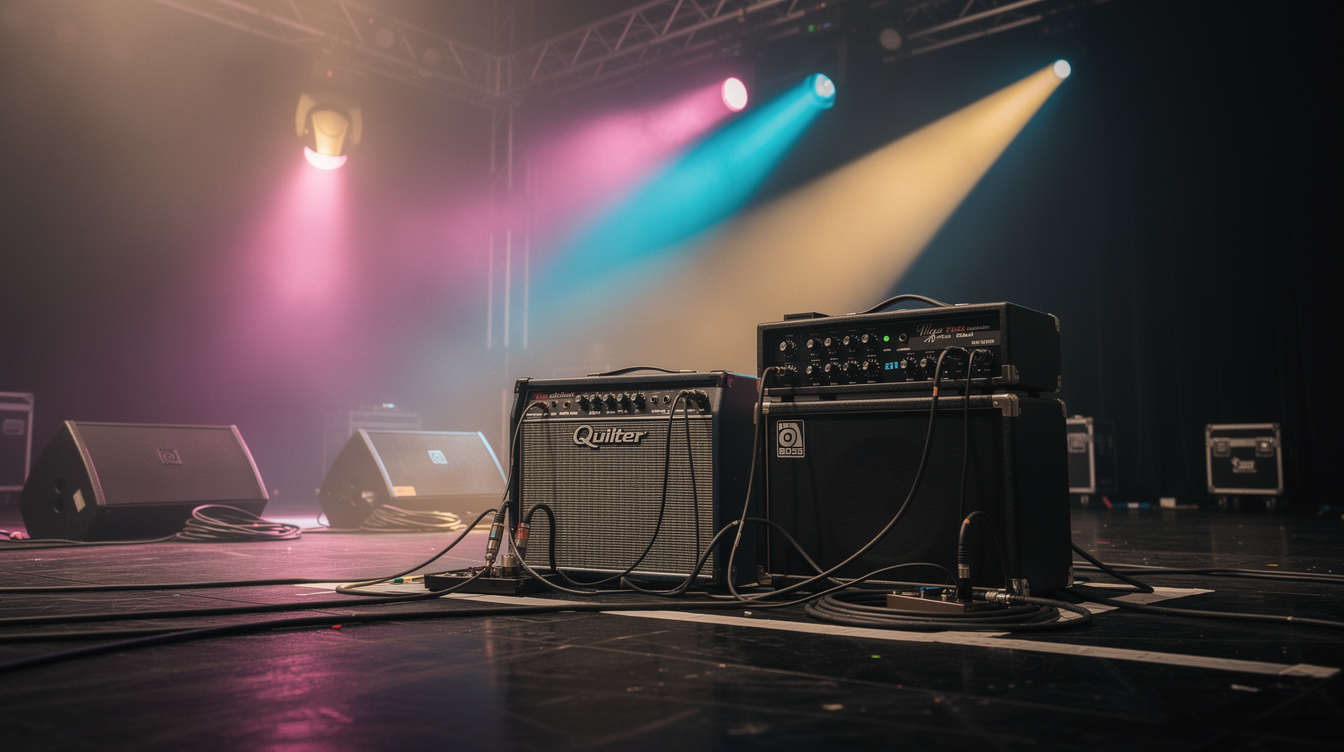
Two products aimed at guitarists who want to ditch the amp. One is a standalone power amp. One is a load box that captures and re-amplifies your existing amp's preamp section. They're not competing for the same use case, and buying the wrong one means spending another $400 to fix your rig six months later.
Here's the actual distinction, and which one you need.
The Decision in One Table
| Quilter Tone Block 202 | Boss Waza Tube Amp Expander | |
|---|---|---|
| Street price | ~$350 | ~$550–600 |
| What it replaces | Your whole amp | Your power amp section and cab |
| What you plug in | Guitar → (pedals/modeler) → Tone Block → cab/FRFR | Tube amp head → TAE → cab/FRFR/direct |
| Has its own preamp | Yes (basic EQ section built in) | Effectively yes (amp modeling section, plus captures your tube amp's preamp) |
| Load box function | No (cannot handle your tube amp's output) | Yes (reactive load up to 150W) |
| Recording direct | Yes (balanced XLR out with cab sim) | Yes (balanced XLR out with cab sim) |
| Headphone practice | No | Yes |
| MOSFET power amp character | Yes | Yes (via Waza-Tube analog circuit section) |
| Complexity | Low (plug in and set 3 knobs) | High (multiple routing modes, Waza-Tube section, COSM cab sims) |
| Best for | Direct rigs, modelers needing a power stage, pedalboards going to cab | Tube amp players who want to record/practice silently or control volume |
Quilter Tone Block 202: The One You Buy If You Don't Have a Tube Amp
The Tone Block is a Class D power amplifier with a basic preamp section. It puts out 200W into 4 ohms. It's not much bigger than a hardback book. It runs on standard 120V and draws almost nothing in power. You plug your guitar (or, more usefully, your pedalboard or HX Stomp or Quad Cortex output) into the input, run a speaker cable to a guitar cab, and you have an amp.
That's the whole pitch. And it's a genuinely good one.
The MOSFET preamp section isn't a tone-shaping powerhouse; it's a Bass, Middle, and Treble control with modest range and a clean input buffer. The power amp section is where the Quilter's design philosophy lives: Class D efficiency with an analog "feel" that the company calls their QSC-derived circuit. Whether it sounds "better" than a clean Class AB power amp is a matter of what you're driving it with and what you want from the cab interaction.
What it actually sounds like: Clean. Honest. Whatever your signal chain in front of it sounds like, that's what comes out the cabinet. It doesn't add warmth, doesn't compress, doesn't sag. The power amp section isn't trying to be a tube output stage. It's a transparent platform.
The real difference is the cab, not the power amp. I expected the Tone Block to feel lifeless compared to running through a tube power amp (that flat, digital-clean sensation). What I found instead was that running an HX Stomp into it into a 2x12 with Greenbacks felt more substantial and physically present than running the same HX Stomp into my FRFR. The cab interaction is real. The speaker does work that a flat-response monitor doesn't do: moving air differently, coloring the high end through the speaker's natural rolloff. The Tone Block's power amp isn't the amp you're missing. The cabinet is.
Where it works:
- Modeler or multi-effects users who want a real guitar cabinet on stage
- Direct rigs with extensive pedalboards that need a clean power stage
- Anyone replacing a modeling combo who wants to keep using guitar cabs
- Live situations where 200W into a 4-ohm load provides headroom nobody could complain about
Where it doesn't work:
- If you want to use your existing tube amp's preamp section and just silence/control the power amp, the Tone Block has no load box function. Your tube amp needs to see a speaker load; the Tone Block won't help with that.
- If you want headphone monitoring: no headphone output.
- If you want onboard cab simulation for direct recording: the balanced XLR output exists but is optimized for running into FRFR or a mixer with cab sim in the chain, not as a finished direct tone on its own.
Boss Waza Tube Amp Expander: The One You Buy If You Already Have a Tube Amp
The TAE does something structurally different. You plug the speaker output of your tube amp head into the TAE, which provides a reactive load. The amp sees something that behaves like a speaker cabinet, which is important because tube amps need that reactive load to operate correctly. The TAE then processes the signal from the amp's output, applies cabinet simulation and the TAE's own Waza-Tube analog amplifier section, and sends the result direct, to headphones, or to a real cabinet at controlled volume.
This means you can:
- Run a 50-watt tube amp at full power in your bedroom through headphones at 11 PM
- Record your tube amp's preamp character directly into a DAW without a mic or a cabinet in the room
- Use your tube amp live at controlled stage volume through a FRFR
The TAE's Waza-Tube section is worth understanding. It's not just a cab sim; it's an analog circuit that the Boss engineers describe as adding the harmonic character of a tube power amp to the load box output. How much this matters in practice depends on your source amp and your monitoring context. In direct-to-headphone use it's noticeable. In a live FRFR context with band volume it's subtle.
COSM cab simulation: The TAE includes multiple cab models. They're decent (well above what older Boss units sounded like in direct applications), but if you're a heavy cab-sim user with specific IR preferences, you may want to run the TAE's output through your own IR loader rather than using the onboard cabs.
Where it works:
- Tube amp players who love their amp's preamp character but need volume control
- Home recording situations where you want to mic your amp's tone without the mic or the volume
- Worship and live situations where consistent output-level control matters more than "crank it up"
- Players who want to A/B their real amp against captures and models without a mic in the room
Where it doesn't work:
- If you don't have a tube amp: the TAE's load box function is the only way into its processing chain; you can't just plug a guitar into it without an amp head providing the signal
- If you want to use it with a solid-state amp: the load box is designed for tube amp outputs; running a solid-state amp into it isn't recommended
- If you want truly simple: the TAE has multiple routing modes (direct, through FRFR + load box, through real cab + signal processing) and the manual is not short
The Use Case That Makes People Buy the Wrong One
The most common mistake: a guitarist who has an HX Stomp or Quad Cortex sees both products as "ampless solutions" and buys the TAE because it's more expensive and therefore seems more capable.
The TAE doesn't make an HX Stomp louder or more useful on stage. You can't plug an HX Stomp into a Tube Amp Expander's load box input. There's no amp providing a speaker-level signal. The TAE needs a tube amp. The Quilter Tone Block needs a guitar-level signal.
If you're going from modeler/pedalboard → something → cabinet or FRFR: get the Tone Block.
If you're going from tube amp → controlled environment (silent recording, volume control, headphone practice): get the TAE.
If you want to do both (keep a tube amp and also run a modeler into a cab), you need both, and they don't overlap in function.
Competitors Worth Mentioning
The Quilter Tone Block isn't the only MOSFET power amp worth considering. The Two Notes Le Clean and the Fryette Power Station (which also doubles as a reactive attenuator; it does serve both functions) are alternatives, though the Fryette sits at $600 and up and is targeting the tube amp market specifically.
The Boss TAE competes most directly with the Two Notes Captor X ($350 street) for reactive load/cab sim duties, and the Universal Audio OX ($900) for players willing to pay significantly more for better cab simulation and more routing flexibility. The TAE sits in the middle of that range and is a reasonable choice if you want Boss build quality and the Waza-Tube analog section.
Our solid-state amps roundup covers the broader "amps you don't need a load box for" category. The Quilter Aviator Cub, Boss Katana, and Roland JC-120 all represent different approaches to the question of what to use if you want to leave the tube amp at home.
What to Buy
Buy the Quilter Tone Block 202 if:
- You use a modeler, multi-effects unit, or extensive pedalboard
- You want to play through a real guitar cabinet on stage
- You want a clean, transparent power stage that stays out of the way
- Budget is a consideration ($350 is a strong value)
Buy the Boss Waza Tube Amp Expander if:
- You have a tube amp head you love and want to use its preamp character
- You need to practice silently with headphones at home
- You want to record direct from your tube amp without a mic in the room
- You're willing to learn a more complex piece of gear to get what it offers
There's no universal answer here; these are tools for different problems. Get the one that solves the problem you actually have.