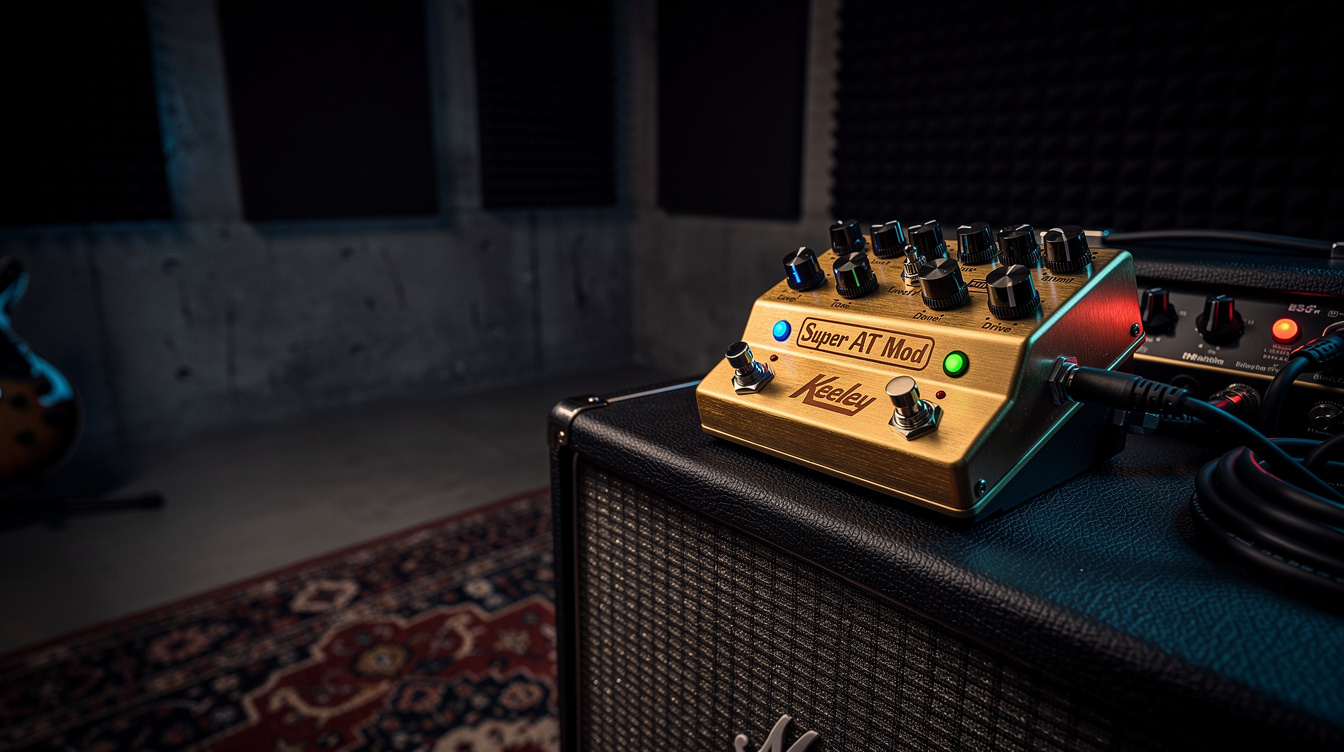
The Keeley Super AT Mod Overdrive is a standalone pedal (not a modification service) designed in collaboration with Andy Timmons. It's built on the same BD-2 Blues Driver circuit architecture that Keeley has been modding since the early 2000s, but engineered as a complete unit rather than a send-in modification. Street price is approximately $149 (street price as of April 2026).
It includes a two-mode switch: AT mode, voiced for humbuckers with a tighter, more transparent low-mid response; and PHAT mode, voiced for single coils with more low-mid fullness. This distinction matters because the BD-2's stock circuit behaves differently with humbuckers vs. single coils.
It is not the same circuit as the standard Keeley BD-2 Super Phat Mod, which has been available since the early 2000s and remains available as a send-in modification service for existing BD-2s. Before deciding whether the Super AT is right for you, it helps to understand what the circuit changes actually do.
| Version | Clipping Type | High End | Low Mid | Best For |
|---|---|---|---|---|
| Stock BD-2 | Silicon diodes (symmetric) | Harsh above 3kHz | Thin | Bright amps, cut tones |
| Keeley Ultra Mod | Improved silicon + output stage | Cleaned up, less harsh | Slightly fuller | General overdrive refinement |
| Keeley Super AT Mod | Silicon + MOSFET (asymmetric) | Gentle rolloff, present | Noticeably fuller | Sustained leads, touch-sensitive dynamics |
| BD-2W Waza (Custom mode) | Discrete transistors | Smooth, detailed | Fuller, more complex | Off-the-shelf upgrade |
What the Super AT Mod Actually Changes
The stock BD-2's clipping stage uses symmetric silicon diodes. Both halves of the audio waveform clip at the same threshold, producing a relatively even-order harmonic content. This gives the BD-2 its characteristic bright, slightly edgy sound. The edge is useful for cutting through a mix; it becomes harsh on bright amplifiers or single-coil pickups with active EQ.
The Super AT uses a combination of standard diodes and LED diodes to create asymmetric clipping. The positive and negative halves of the waveform clip at different thresholds. Asymmetric clipping produces odd-order harmonics (the harmonic content of a cranked tube amp's output stage) rather than the even-order harmonics of symmetric silicon clipping. The combination of standard and LED diodes means neither character fully dominates: the result is more complex than stock, with a distinctive texture that responds dynamically to pick pressure in a way that symmetric clipping doesn't.
What this sounds like in practice: the Super AT has what I'd describe as a textured attack: the note starts with a slight bite at the front edge, then settles into a sustained body that feels fuller and less aggressive than the stock pedal. Rolling the guitar volume back from 10 to 7 doesn't just make the Super AT quieter; it changes the harmonic balance in a way that feels like a different shade of the same color. The clipping character is more responsive to how hard you're playing.
The Other Circuit Changes
Beyond the clipping stage, the Super AT changes two more things.
Output section: The output capacitor is replaced with a higher-value component that restores low-mid content that the stock circuit rolls off. The stock BD-2 has a somewhat thin low-end response. That's useful if you're stacking it in front of a Marshall that already has a lot of bass, less useful if you want the pedal to stand on its own or pair with a clean Fender platform. The Super AT's low-mid restoration makes single-note lines fuller without adding muddiness to chord playing.
Input buffer and treble response: The input buffer is modified to smooth the entry into the clipping stage. The treble response (specifically in the 3-5 kHz range where the stock BD-2 has its harshest peak) is attenuated with a gentle high-pass filter that rolls off without losing pick attack definition. This is a more nuanced solution than simply filtering out the harsh range; it reduces the peak while preserving the presence that makes the pedal audible in a mix.
The combined effect: the Super AT sounds warmer than stock without being dark, and more complex without being muddy. The note onset (the first 50ms of a picked note) retains clarity; the sustain portion of the note fills out in a way that the stock pedal doesn't.
How It Compares to the Standard Keeley Ultra Mod
The standard Keeley BD-2 Ultra Mod, which has been available since around 2002, focuses primarily on cleaning up the stock circuit's excess noise and refining the existing character. It replaces capacitors and clipping diodes with higher-quality components, tightens the low-end response, and reduces the upper-midrange harshness. The result is a Blues Driver that sounds like a better version of itself: the same basic character, executed more cleanly.
The Super AT mod makes a more fundamental change. The MOSFET clipping introduces a different harmonic vocabulary: not just the same sound improved, but a different tonal texture built on the BD-2 platform.
If you play primarily rhythm guitar and want the BD-2 for its characteristic bright punch and quick response, the Ultra Mod is probably the right choice; it refines what the pedal already does. If you use overdrive primarily for sustained lead tones and want a pedal that responds expressively to pick dynamics and guitar volume, the Super AT addresses that specific need.
Who the Super AT Is and Isn't For
It's for:
Players whose overdrive use is primarily single-note lead playing with an emphasis on sustain and touch sensitivity. The Andy Timmons context is not incidental here. His playing style is built around smooth legato lines, singing bends, and pick dynamics that create contrast between verses and choruses. The Super AT was designed to support that kind of playing, and it does it well.
Players running the BD-2 into a clean Fender-platform amp will notice the difference most dramatically. The low-mid restoration fills out the sound in a way that makes the pedal feel like it belongs on a Deluxe Reverb or Twin Reverb, whereas the stock BD-2 can sound thin in that context.
It's not for:
Players who don't like the BD-2's fundamental character. The Super AT is still an op-amp overdrive with the BD-2's basic circuit as its foundation. If the stock pedal's harmonic character doesn't work for you, the mod refines it rather than replacing it.
Players looking for transparency (the Timmy, the Paul Cochrane design, the Klon-style buffers). These pedals approach overdrive from a different philosophy. The BD-2, even modded, has a more forward tonal personality.
Practical Considerations
Getting one: The Super AT Mod Overdrive is available from Keeley Electronics direct and from dealers including Perfect Circuit and Guitar Center. Street price is approximately $149 (as of April 2026). The older send-in modification service (Super Phat Mod) remains available for existing BD-2s at approximately $99 if you prefer to modify a pedal you already own, but the Super AT is the newer, more developed circuit.
AT mode vs. PHAT mode: Use AT mode if you're playing humbuckers; it reduces low-mid density for tighter response under the strings. Use PHAT mode with single coils, which need the extra low-mid to sound full. Switching between the two with the same guitar is like adjusting the pedal's tonal weight without touching the Tone knob.
Expected settings: The Super AT responds differently to the Gain knob than a stock BD-2. The useful range for smooth lead tones is roughly 9 to 11 o'clock. Below that the asymmetric clipping character doesn't fully develop, above that the odd-order content starts to read as rough on sustained single notes. The Level and Tone knobs function similarly to the BD-2 but the tonal balance point (noon on Tone) corresponds to a slightly warmer starting position.
Adjust Gain up to about 11 o'clock for more sustain and compression. Tone above noon adds back the BD-2's characteristic treble presence; below noon rolls it off toward a darker, more vintage character. The sweet spot for single-note leads is usually between 10 and 11 o'clock on Gain with Tone at or slightly below noon.
FAQ
Is the Super AT Mod Overdrive a modification of my existing BD-2? No. The Super AT Mod Overdrive is a standalone pedal that you buy. If you want to modify an existing Boss BD-2 you already own, Keeley still offers their Super Phat Mod as a send-in service.
Does it work with active pickups? Less effectively. The touch-sensitivity of the MOSFET clipping responds to the passive dynamics of a single-coil or PAF-style humbucker. Active pickups (EMG, Fishman Fluence) produce a hotter, more consistent output signal that compresses the dynamic range the mod is designed to respond to. The pedal still functions; it just doesn't flex the way Timmons' playing demonstrates.
What's the difference between the Super AT and the Andy Timmons signature Ibanez ATZ100? The ATZ100 is Timmons' current signature guitar, not a pedal. The Super AT mod was designed in collaboration with his playing style but is a modification to the Boss BD-2 Blues Driver, not guitar hardware.
How does this compare to the Wampler Tumnus or Paul Cochrane Timmy? The Timmy and Tumnus are low-gain, transparent overdrives that add minimal coloration to the source tone. The Super AT BD-2 is a moderate-gain overdrive that actively shapes the tone. They're different tools for different goals. If you want to push a slightly overdriven amp harder while maintaining your core tone, the Timmy or Tumnus is probably the right choice. If you want a pedal that stands on its own as the primary source of overdrive character on a clean amp, the Super AT addresses that better. For a direct comparison of the Timmy and Tumnus: Paul Cochrane Timmy vs. Wampler Tumnus.
Where does this fit in the BD-2 hierarchy? Stock BD-2 → Standard Keeley Ultra Mod → Super AT Mod → BD-2W Waza (Custom mode, separate circuit). The Waza's Custom mode uses a fully discrete transistor circuit redesigned from scratch; it sounds different enough from the BD-2 that it's essentially a separate pedal in a BD-2-shaped box. The Super AT is the most expressive BD-2 you can have without moving to a different circuit architecture entirely.
For the full Blues Driver comparison: What BD-2 Clones Are Actually Worth It: Keeley, Analogman, and the DIY Options. For the Andy Timmons budget approach this post follows from: Andy Timmons on a Budget: How to Get the Singing Lead Tone Without the Signature Gear.