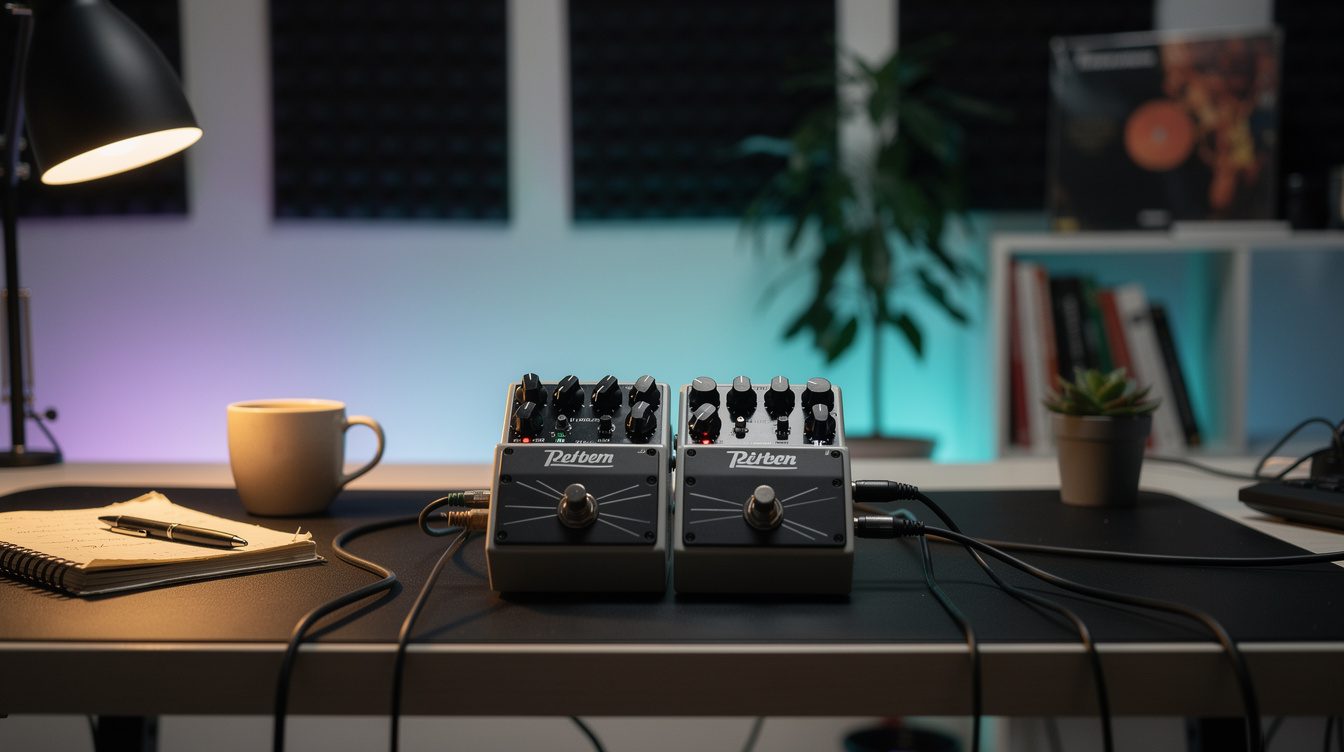
Most "best reverb pairings" lists recommend things based on vibes: "these two sound good together." What they don't explain is why, and why matters because understanding the mechanism means you can evaluate any pairing, not just the five someone else tested.
The mechanism is this: two reverbs create mud when they both process the same frequency range with similar temporal behavior. They create space when they each occupy distinct frequency territory and respond to note input at different times. The first reverb should add body to the signal without smearing the high-mid content that the second reverb needs to work with. The second reverb should build on what the first establishes, not compete with it.
There is a third axis, and it is the one most pairing lists leave out entirely.
The Third Axis: Diffusion
Frequency and timing are two ways two reverbs can differ. Density is the third, and in practice it separates the pairings that work from the ones that sound impressive for four seconds and then turn to fog.
Diffusion is how quickly a reverb's early reflections scatter into a continuous tail. A low-diffusion reverb leaves individual reflections audible and gives you a readable sense of the room's dimensions. A high-diffusion reverb smears them immediately into one smooth body.
Stack two high-diffusion reverbs and the smearing compounds. It does not average out — the second one is scattering a signal that has already been scattered, and what comes out has no discernible early structure at all. You can separate them perfectly in frequency, put a high-pass between them, and still end up with a large quantity of sound that has no shape. That is the specific failure people describe as "it sounds huge but I can't hear the guitar."
The rule: one of your two reverbs should be sparse and one should be dense.
Read back through the pairings below with that in mind and it explains more than the frequency story does. The Afterneath is a discrete-reflection machine — very low diffusion, individual repeats you can count. The Sloer is a continuous wash. That pairing is not primarily working because of attack timing; it is working because one unit is supplying structure and the other is supplying body, and neither is trying to do both. Valhalla Room's Spirit algorithm plus Supermassive is the same split in software, which is why that particular combination was the one that stopped sounding like one indistinct space.
If you want to hear what the control does on its own before deciding which of your two reverbs should be the sparse one, diffusion and what it does to a guitar part covers it in isolation — including the fact that most Helix reverb blocks don't expose the parameter, and what to use instead when they don't.
| Pairing | Cost | Character | Best For |
|---|---|---|---|
| Strymon BigSky + Boss RV-6 (Shimmer) | ~$480 | Realistic space + shimmer layer | Clean ambient, worship builds |
| Walrus Audio Sloer + EQD Afterneath v3 | ~$480 | Generative wash + discrete reflections | Post-rock, neo-shoegaze |
| Valhalla Supermassive + Valhalla Room | ~$50 plugin bundle | Shimmer + natural room | Bedroom production, lofi |
| Chase Bliss CXM 1978 + TC HoF 2 | ~$620 | Dark plate + modern hall | Recording-first, studio sessions |
| TC Hall of Fame Mini + MXR M300 | ~$135 | Plate + hall, no-frills | Budget ambient pedalboard |
Why These Pairings Work
Before getting to the hardware: the principles from Stacking Reverbs: When Two Reverb Blocks Sound Better Than One apply to all of these. Every pairing here follows the same two rules: the first reverb runs a low mix (20–25%) with a high-pass filter on its output at 150–250 Hz, and the first reverb's decay is shorter than the second reverb's pre-delay. If you're running hardware pedals, implement the high-pass either with an EQ pedal between the two reverbs or by using each reverb's built-in tone/low-cut control where available.
Pairing 1: Strymon BigSky + Boss RV-6
The BigSky is the reference ambient reverb for a reason: the algorithm quality in Hall, Room, and Bloom modes covers the "realistic physical space" part of the frequency spectrum with a lot of resolution. The problem is that when you push BigSky into shimmer territory, the shimmer overtones occupy the same upper-mid range as the original signal, and the result can feel crowded.
Running BigSky in Hall or Room mode at 25–30% mix and a 1–2 second decay, then following it with the Boss RV-6 in Shimmer mode at 20% mix, divides the work: the BigSky handles the body of the reverb space (the realistic part, the early reflections and decay), and the RV-6 handles the octave-up shimmer layer. The RV-6 is processing the BigSky's output, which means the shimmer is being generated from an already-spatialized signal, so it floats above the reverb rather than being baked into it.
Settings that work:
BigSky (Hall mode): Decay: 1.5 sec | Mix: 28% | Pre-delay: 15–20ms | Low Cut: 120 Hz (internal)
RV-6 (Shimmer mode): Reverb level: about 9 o'clock | Tone: noon | Effect level: about 8 o'clock
The shimmer from the RV-6 reads as a separate atmospheric layer, not as a muddy doubling of the hall reverb. I expected these two to fight (the BigSky's hall isn't exactly leaving open frequency real estate) but the shimmer's pitch shift to a different octave means it's literally not competing in the same frequency range. The shimmer lives above 1.5–2 kHz. The hall's body lives below it.
Pairing 2: Walrus Audio Sloer + EQD Afterneath v3
These two work for the opposite reason from the BigSky/RV-6 pairing: they have radically different temporal behaviors rather than different frequency characters.
The Walrus Sloer is a slow-attack reverb; it doesn't respond immediately to a picked note. The swell takes a fraction of a second to bloom, which means the Sloer functions almost like a textural pad that builds beneath the dry signal rather than a conventional reverb that responds to each note. Its attack behavior filters out the transient entirely. Mix: 35–40%. Decay: long (6–8 seconds).
The Afterneath v3 has the opposite character: extremely fast-responding discrete reflections that sound like the inside of a large irregular cave or tuned space. It responds immediately to the note's attack and creates defined reflections that feel physical rather than atmospheric.
In series, the Afterneath captures the attack and creates its distinctive reflection pattern, then the Sloer builds a slow-rising wash beneath all of it. They don't compete because they're responding to different parts of the note's temporal envelope.
Settings:
Afterneath (before Sloer): Length: about 10 o'clock | Drag: about 9 o'clock | Reflect: about 11 o'clock | Mix: 20%
Sloer: Attack: about 3 o'clock (slow) | Decay: about 3 o'clock (long) | Mix: 30–35%
Run a gentle high-pass at 200 Hz between the two if you have an EQ pedal in the chain. Without it, the combination works but the low-mid accumulates in dense chordal passages.
Pairing 3: Valhalla Supermassive + Valhalla Room (Plugin)
For anyone who records at home: two Valhalla instances in series is the most cost-efficient ambient pairing available. Supermassive is free. Valhalla Room costs $50. Together they do what the hardware pairings above do at a fraction of the cost.
The approach: Supermassive handles the shimmer and long-tail atmosphere. Room handles the body: realistic early reflections and a natural decay that sits underneath Supermassive's wash.
In a DAW: run Room first (Mix: 22%, Decay: 0.8 sec, algorithm: Spirit), route Room's output into Supermassive (algorithm: Gemini or Perseus, Mix: 18%, Decay: 8 sec). Add a low-cut at 180 Hz on Room's return channel before it hits Supermassive's input.
I spent a weekend running every Valhalla algorithm combination I could find trying to get two instances to stack cleanly without mud. The Spirit/Gemini combination was the first one that sounded like two distinct spaces rather than one indistinct wash. The high-pass at 180 Hz made the difference. Without it, the combination sounds thick and unfocused. With it, Room adds definition and Supermassive adds atmosphere and they stay separate.
Pairing 4: Chase Bliss CXM 1978 + TC Electronic Hall of Fame 2
The CXM 1978 models the Lexicon 480L plate, which means short, dense, professional-sounding early reflections with a natural decay that sits under the signal rather than washing over it. The Lexicon character is clinical in a useful way: it adds presence without bloom.
The TC Hall of Fame 2 with a custom TonePrint can be programmed to a large hall algorithm with a slow attack and a warm, rolling decay. Its job in this pairing is the long bloom that the CXM's plate character deliberately avoids.
This pairing works best for single-note lines recorded at home studio levels, the kind of guitar texture that sits under vocals in indie or folk recordings. The CXM keeps the initial note definition, the Hall of Fame 2 adds the depth that makes it feel large.
CXM 1978: Algorithm: Plate | Pre-delay: 12ms | Decay: 0.6 sec | Mix: 25%
HoF 2: TonePrint: Custom hall (slow attack, warm high-cut) | Mix: 22%
Pairing 5: TC Hall of Fame Mini + MXR M300 (Budget Pairing)
Under $135 total. The Hall of Fame Mini in Plate mode at 20% mix → MXR M300 in the Hall setting at 28% mix. The MXR M300's built-in high-cut is the reason this works at all; it rolls off the frequency range that would otherwise build up between the two units.
This isn't the most sophisticated pairing on the list. But it's the one that works on a tight budget, fits on a small board, and gets you genuinely usable two-reverb depth without fighting for shelf space.
The M300 in particular is an underrated reverb that the boutique pedal community tends to ignore. Its hall algorithm has natural early reflections and a warm tail that pairs well with the HoF's slightly glassy plate character.
For the mechanics of why these pairings work: Stacking Reverbs: When Two Reverb Blocks Sound Better Than One. For the looper integration question: Looper + Delay + Reverb Without Muddiness.