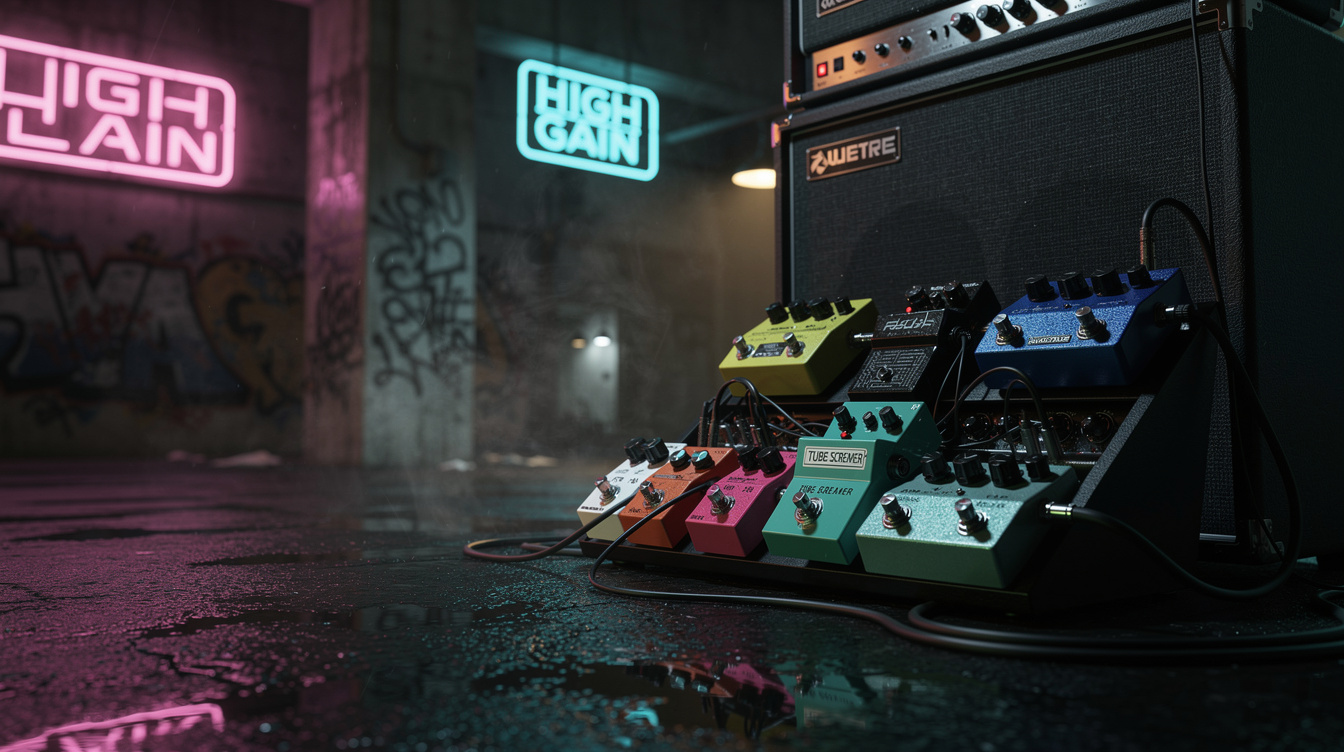
Start Here: A Tube Screamer in front of a high-gain amp is not a hack or a workaround. It is a deliberate gain-staging technique. The TS808 does three things to the signal before it hits the amp's preamp: it compresses transients, it boosts midrange (around 720Hz), and it raises the input level. Each of these interacts with the amp's gain structure in a way that produces a tighter, more focused, more mix-ready distortion tone than either the pedal or the amp can produce alone.
The Setup
Amp: High-gain channel of a Mesa Boogie Dual Rectifier, EVH 5150 III, or similar; or Helix/QC equivalent (Mesa Mk IIC+, US Pre models)
Pedal: Ibanez TS808, TS9, or any mid-hump overdrive (Boss SD-1, Maxon OD808)
Guitar: Any, but results are most pronounced on humbuckers, especially with active pickups
Position: TS808 goes in front of the amp input (first in the signal chain). Not in the effects loop.
This is not complicated. The complexity is in understanding why it works.
What the Tube Screamer Actually Does to the Signal
Before explaining the interaction with the amp, let's establish exactly what the TS808 adds.
The TS808's frequency response is not flat. The output filter network introduces a bandpass characteristic: it rolls off bass below approximately 200Hz and boosts the mid-frequency region centered around 720Hz by roughly 6-10dB relative to the original signal. The exact frequency center and boost amount vary by TS variant, but the mid emphasis is consistent across all Tube Screamers.
The clipping character is soft. The TS808 uses silicon diodes in the op-amp feedback loop. This produces asymmetric, gradual clipping. The signal starts to clip gently before it hard-clips. The result is compression and harmonic saturation that feels like a slight gain increase but behaves more like a natural limiter.
The level control can raise input level significantly. With Drive low and Level high, the TS808 hits the next gain stage harder without adding much of its own gain character. This is the "clean boost into high-gain amp" configuration.
Why These Properties Matter for High-Gain Tone
1. The Low-End Cut Tightens Everything
High-gain amps (especially high-output rectifier-based designs like the Dual Rectifier) saturate the low frequencies first. Feed a Dual Rectifier a full-range signal from a humbucker guitar and the sub-200Hz content turns the low strings to mud. You can hear every note above the 4th fret, but down low, everything blurs.
The TS808's passive bass rolloff enters the preamp with reduced sub-lows. Less energy below 200Hz means the preamp stages saturate the low-end region less aggressively, producing tighter, more defined low notes. Palm mutes at drop-D or drop-B have definition. Individual notes on the 6th and 7th strings have transient clarity.
This is the single most important reason the TS808 works in front of a high-gain amp. It's not adding gain. It's managing frequency content so the amp's gain structure operates in its tightest range.
The test: Run your amp on high gain without the TS808. Record a palm-mute riff at drop-D tuning. Then engage the TS808 (Drive low, Level raised). Record again. A/B the low-string definition. The difference is audible at 1kHz and below.
2. The Mid Boost Cuts Through a Mix
High-gain distortion has a known mixing problem. The amp's preamp stages compress and saturate the signal, which reduces dynamic contrast and tends to flatten the midrange frequencies. The result is distortion that sounds massive in isolation and disappears in a full-band context.
The TS808's midrange boost counteracts this directly. By raising the 700-800Hz region before it hits the amp's gain stages, the TS808 ensures those frequencies are amplified more aggressively in the preamp. The resulting distortion tone has a pronounced midrange presence that doesn't disappear when the bass and drums enter.
This is why Metallica's rhythm tone (TS808 into an overdriven amp) cuts through dense mixes. The guitar occupies the 600-1000Hz range aggressively. It's present in headphones at low volume. It doesn't get buried.
The test: Record a rhythm track with high-gain amp only, then with TS808 in front. Play both back at 40% volume with a drum and bass track. The TS808 version will remain audible at volumes where the amp-only version starts to blend into the low end.
3. The Compression Smooths Pick Attack
A high-gain preamp responds differently to inconsistent pick attack than a clean amp. Uneven picking (varying velocity between notes, inconsistent pick angle) gets amplified with the gain and creates audible dynamics variation in the distortion. Notes hit harder are noticeably louder and grainier than softer notes.
The TS808's soft-clipping compression reduces this peak variation before it reaches the preamp. Inconsistent pick attack becomes more consistent pick attack. The result: rhythm playing sounds tighter and more controlled, and lead playing sustains more evenly.
This is a secondary benefit compared to the frequency response effects, but it's real and measurable.
The Settings That Work
High-Gain Amp (Mesa-style, EVH-style)
| TS808 Control | Position | Reason |
|---|---|---|
| Drive | About 8 to 9 o'clock | You want the frequency shaping, not the TS808's own gain |
| Tone | About 10 to 11 o'clock | Slightly dark; the high-gain amp has its own presence |
| Level | About 2 to 3 o'clock | Pushing the amp's input stage hard |
Amp settings with TS808 engaged:
| Amp Control | Adjustment | Reason |
|---|---|---|
| Gain | Pull back 10-20% from your normal setting | The TS808 is now contributing to the front end |
| Bass | Pull back 5-10% | The TS808's bass rolloff plus the amp's own bass will double up |
| Mid | Push up 5% | Reinforce the TS808's work |
| Treble | Leave as set | Monitor for harshness; if fizzy, pull treble slightly |
Modeler Settings (Helix, Quad Cortex, HX Stomp)
The same logic applies to modelers. Place the TS808 block before the amp block.
| TS808 Block | Value | Notes |
|---|---|---|
| Drive | 20-25% | Low; frequency shaping only |
| Tone | 40-45% | Slightly dark |
| Level | 65-70% | Raising input to the amp model |
On the Helix: use the Scream 808 model. On the Quad Cortex: the Ibanez TS808 is in the Overdrive category. Set the amp model's input gain to its neutral position, then use the TS808's Level control to increase front-end saturation.
Why Drive Should Stay Low
This is the part that confuses most players.
Setting the TS808's Drive high and running it into a high-gain amp doesn't double the effect. It actually degrades the outcome. Here's why:
The TS808's own gain character at high drive is a mid-heavy, compressed, soft-clipping distortion. When that soft-clipping signal hits a high-gain preamp's own hard-clipping gain stages, the two distortion characters interact in a way that produces intermodulation distortion: additional harmonic artifacts that make the tone sound congested and undefined.
The technical term for this is harmonic aliasing between the two nonlinear systems. The practical result: it sounds like mud.
High Drive on the TS808 is appropriate for:
- Running into a clean amp where the TS808 is the sole distortion source
- Very low-gain amp settings where the amp contributes minimal distortion
For the high-gain-amp technique, Drive should be between 8 and 10 o'clock. Maximum at noon if the amp is at moderate gain. Not higher.
Amp-by-Amp Behavior
Different high-gain amps respond differently to the TS808 because their preamp architectures have different inherent gain structures and frequency responses.
| Amp | TS808 Response | Recommended TS808 Level |
|---|---|---|
| Mesa Boogie Dual Rectifier | Significant tightening. The Recto's loose bottom end responds well to bass rolloff. | Level: 2-3 o'clock |
| EVH 5150 III (Lead channel) | The 5150's own mid emphasis combines with the TS808's mid push; watch for congestion above 1kHz. | Level: 1-2 o'clock |
| Marshall JCM800 | Classic combination. The JCM800's preamp interaction with low-drive TS808 is the original application. | Level: 2 o'clock |
| Peavey 6505+ | Very responsive. The 6505's high input impedance amplifies the TS808's midrange push dramatically. | Level: 1-1:30 o'clock |
| Helix/QC high-gain models | Consistent with physical amps. US Pre (Mesa-style) and PV Panama (6505-style) respond as expected. | Level: 60-65% |
Common Mistakes
Using too much Drive: Covered above. Keep Drive at or below 10 o'clock for high-gain amp applications.
Putting the TS808 in the effects loop: The effects loop is after the preamp, so a TS808 there isn't boosting the preamp input. It's adding gain after the amp's gain structure has already been set. You lose the tight-low-end benefit. The TS808 goes in front of the amp, not in the loop.
Not adjusting the amp's bass after adding the TS808: The TS808's bass rolloff reduces low-end hitting the amp. The amp's Bass control still sets the amp's EQ. If you had the amp's Bass at 7 before adding the TS808, the combined result may be too thin. Start with Bass at 5-6 and adjust by ear.
Using the wrong TS variant: The TS808, TS9, and SD-1 all have the mid-hump characteristic. The TS9's mid-boost is centered slightly differently, but the technique works. The Tube Screamer Mini works. A Boss SD-1 works. What doesn't work: a flat-response overdrive like the Klon, which doesn't have the bass rolloff and mid-boost that make this technique effective.
Why It Works on Modelers
Amp modelers that accurately model the behavior of high-gain preamp circuits respond to the same techniques that physical amps respond to. The Scream 808 on the Helix and the TS808 model on the QC behave correctly. They apply the same frequency modifications to the signal before it hits the modeled preamp stages.
The advantage on a modeler: you can verify the interaction by using the Global EQ or a spectrum analyzer block to measure the frequency response before and after adding the TS808. The bass rolloff below 200Hz and the midrange lift around 700-800Hz are visible in the spectrum display. What you see is exactly what the amp model is receiving.
This is why I find the TS808-into-amp technique more controllable on a modeler than on a physical amp. On a physical amp, you're adjusting by ear. On a modeler, you can verify.
FAQ
Q: Does any overdrive work as a boost, or does it have to be a Tube Screamer? A: The Tube Screamer's specific combination of bass rolloff and mid boost is what makes it work optimally in front of high-gain amps. Flat-response overdrives (Klon, MXR Timmy, JHS Morning Glory) will raise the input level but won't provide the frequency shaping. They work differently (not necessarily worse), but the tightening effect on low-end comes specifically from the TS-style bass rolloff. Use a Tube Screamer-style mid-hump overdrive for the classic effect.
Q: What gain level should the amp be at when using the TS808 boost? A: Moderately high. The technique is most effective when the amp's own gain is already producing distortion. The TS808 enhances and shapes that gain. At very low amp gain, the TS808 is doing too much work alone. At maximum amp gain, the amp may already be too saturated to benefit from the TS808's front-end push.
Q: Hetfield, Dimebag, Adam Jones: who actually used this combination? A: James Hetfield (Metallica) used an Ibanez OD808 (identical circuit to the TS808) into a Mesa Boogie amp. That was the source of his Black Album rhythm tone. This is the most documented example. Dimebag Darrell used various boosts into high-gain Randalls. The underlying technique is consistent across their setups.
Q: Does it work for leads, or is it only a rhythm technique? A: Both. For rhythm, the benefit is tightness and mix presence. For leads, the TS808's compression and midrange boost help notes sustain evenly and cut through the mix over a full band. Many players keep the TS808 on for leads as well as rhythm, sometimes with the Level pushed slightly higher for the extra sustain.
Q: My amp has an OD channel and a Lead channel. Do I need the TS808 on both? A: Usually only the high-gain lead/rhythm channel benefits from the TS808 boost. The OD channel, if it has less gain, may work better without the additional front-end pushing. Test both configurations. The tightening effect is most pronounced on preamp stages designed for very high gain.