Why the Tube Screamer Works for Everything
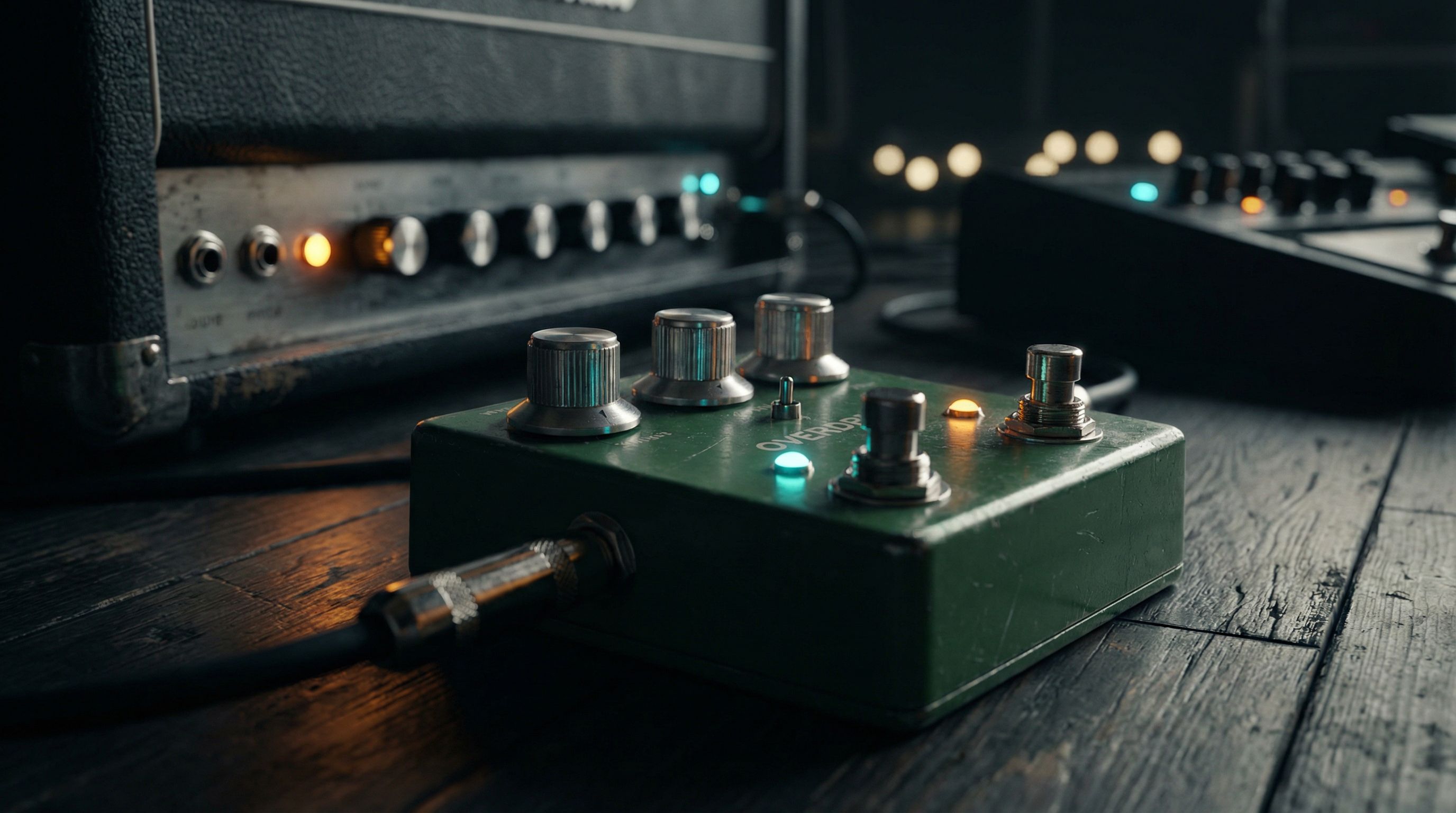
The Tube Screamer has been on more pedalboards than any other drive pedal. Not because of subjective tone preferences, but because of measurable versatility. The same three-knob circuit functions as a clean boost, a light crunch, a full overdrive, a high-gain tightener, or a recording tool. Five distinct applications from one circuit.
Each knob controls a specific parameter:
- Drive: Controls the amount of signal clipping. At minimum, the signal passes mostly clean. At maximum, thick, compressed soft clipping. The clipping diodes are in the feedback loop of a JRC4558 op-amp, which means the transition from clean to saturated is gradual. Gain staging starts here.
- Tone: A low-pass filter with a center frequency around 720 Hz. Counterclockwise cuts treble. Clockwise passes more high-frequency content. At about noon, it's flat relative to the circuit's voicing.
- Level (also labeled Output or Volume): Output volume. This is the gain staging variable most players underestimate. A Tube Screamer with Drive at minimum and Level at maximum will slam an amp's front end with a hot, mid-boosted signal. The drive circuit doesn't need to clip anything for the pedal to do its job.
The TS808 has a built-in midrange hump centered around 720 Hz, with bass rolloff starting below 300 Hz and treble rolloff above 4 kHz. This EQ curve is baked into the circuit. It boosts mids, cuts low-end mud, and rolls off fizzy highs regardless of knob positions. That frequency shaping is the reason the pedal works in five different contexts.
Here are five setups with exact knob positions, amp pairings, and song references.
1. The Clean Boost (SRV Style)
- Drive: About 7 o'clock (minimum to about 8 o'clock)
- Tone: Around noon to about 1 o'clock
- Level: About 3 o'clock to maximum
This is the most documented Tube Screamer application. SRV ran a TS808 with drive nearly off and level maxed. The pedal adds minimal clipping of its own. Instead, it hits the front end of a tube amp with a hot, mid-boosted signal, typically 10-15 dB of level increase.
The result: the amp's own tubes clip harder, the midrange thickens, the bass tightens (thanks to the TS's low-end rolloff), and the overall tone gets louder and fatter without the fizz that comes from turning the amp's preamp gain higher. No pedal distortion is being added. The front end is being slammed harder. One caveat worth being precise about: a boost like this drives the preamp harder by default — it only pushes the power section into harder compression if the amp is already cranked toward power-tube breakup, which is exactly why SRV ran loud. The full distinction is in our breakdown of whether a Tube Screamer gives you preamp or power-amp distortion. Either way, this is gain staging in its purest form.
Pair with: A Fender Deluxe Reverb or Twin Reverb (or modeler equivalent) set at the edge of breakup. The amp needs to be already working when the TS kicks in.
Song reference: Any SRV live performance. The Tube Screamer is always on, pushing the amp into that thick, mid-forward Texas overdrive. For the full Helix preset with amp settings, cab choice, and reverb, see our SRV tone on Helix guide.
2. Light Crunch (Mayer Style)
- Drive: About 9 to 10 o'clock
- Tone: Around noon
- Level: Around noon to about 1 o'clock
The "always-on" configuration. Low drive adds mild soft clipping from the pedal itself. Combined with the midrange hump and moderate output, the result is a slightly crunchy tone that cleans up when the guitar volume rolls back and pushes into satisfying crunch when pick attack increases.
John Mayer has used this approach extensively. A Tube Screamer (or Klon, which serves a similar gain-staging function) providing constant tonal coloring that adds body and mild grit without overriding the amp's character. The key difference between this and the clean boost: here, the pedal's own clipping circuit is contributing overtones. Below about 9 o'clock on the Drive knob, it isn't. That's the threshold.
Pair with: A clean-to-edge-of-breakup Fender-style amp. The amp should be mostly clean on its own. The TS adds the grit.
Song reference: The rhythmic crunch tones in Mayer's live performances: responsive, dynamically sensitive overdrive that sits between clean and dirty.
3. Full Overdrive (Classic Rock)
- Drive: About 1 to 2 o'clock
- Tone: Around noon to about 1 o'clock
- Level: About 10 to 11 o'clock
At these settings, the Tube Screamer's clipping circuit is doing the heavy lifting. Thick, compressed soft clipping with the characteristic midrange voice. Level is lower because the drive stage adds its own output gain, and keeping Level at about 3 o'clock here means pushing an amp with both clipped signal and excess volume. That's a different sound (sometimes useful, often muddy).
Standard classic rock rhythm territory. Enough saturation for power chords, enough sustain for basic leads, but note definition remains intact. The midrange hump keeps things focused and prevents low-end bloat. Rolling the guitar volume to about 6-7 cleans it up for verses. Pick attack is everything at these settings: light picking stays articulate, hard picking pushes into compression.
Pair with: Any amp set relatively clean. A Marshall on a low-gain setting works well; the TS provides the drive, the Marshall provides the midrange character. A clean Fender works for a less aggressive variant.
Song reference: Classic rock rhythm tones: saturated, mid-forward crunch that fills space without dominating the frequency spectrum.
4. The Metal Boost (Stacking into a Dirty Amp)
- Drive: About 7 to 8 o'clock
- Tone: About 1 to 2 o'clock
- Level: About 2 to 3 o'clock
This is the configuration that put the Tube Screamer on every metal board in the last two decades. Low drive, high level, pushed into a high-gain amp (Mesa Rectifier, EVH 5150, Revv, or modeler equivalents).
Here's why it works. High-gain amps produce significant low-frequency content below 150 Hz. The fizz lives at the extremes, and the mud lives in the low mids. The TS808's circuit rolls off bass below 300 Hz and boosts mids around 720 Hz. It functions as a surgical EQ: cutting low-end flub, pushing the midrange forward, and adding 8-12 dB of level to drive the preamp tubes harder.
I expected the Level knob to be the critical variable here (more signal hitting the preamp, more saturation). What I found was that the Tone knob matters more. The result: palm mutes tighten, chugs gain definition, and the low-end mud that makes high-gain amps sound unfocused gets filtered out before it hits the preamp. Less gain from the pedal, more mids, tighter response. This is why a Tube Screamer (TS9, TS808, Maxon OD808; the circuit variations are minor) appears on virtually every metal player's board.
The Tone knob at about 1 to 2 o'clock (slightly above center) preserves pick attack and note articulation through the amp's compression stage. Below around noon, clarity drops. Above about 3 o'clock, fizz creeps in.
Pair with: Any high-gain amp model. Mesa Dual Rectifier, EVH 5150, Peavey 6505, Revv Generator. They all benefit from this treatment. Understanding the difference between overdrive and distortion explains why a soft-clipping pedal tightens a hard-clipping amp so effectively.
Song reference: Modern metal rhythm tones from Periphery, Trivium, Killswitch Engage.
5. The Recording/DI Tone
- Drive: About 10 o'clock
- Tone: About 10 o'clock
- Level: Around noon
A less common but precisely useful configuration for recording direct or through a modeler. Drive is moderate (mild clipping, not saturated). Tone is rolled back to about 10 o'clock. This compensates for the brightness that direct signals and digital converters can introduce (typically a 2-3 dB bump above 5 kHz in most interfaces). Level is at unity gain.
The slightly darker tone setting tames digital harshness. The moderate drive adds second-order harmonics and mild compression without full saturation. It's a corrective application: smoothing the frequency response for direct recording rather than shaping tone for a live amp.
Pair with: A modeler amp model going direct to an interface, or the front of a clean amp model. Works especially well with Fender-style models and clean DI tones that need body.
Song reference: Studio rhythm tracks where subtle, smooth overdrive sits underneath mostly-clean tones. Not distorted; compressed and thickened.
Quick Reference
| Setup | Drive | Tone | Level | Use Case |
|---|---|---|---|---|
| Clean Boost | About 7 o'clock | Around noon | About 3 o'clock | Push a tube amp harder |
| Light Crunch | About 9 o'clock | Around noon | Around noon | Always-on warmth and grit |
| Full Overdrive | About 1 o'clock | Around noon | About 10 o'clock | Classic rock rhythm |
| Metal Boost | About 7 o'clock | About 1 o'clock | About 2 o'clock | Tighten high-gain amps |
| Recording/DI | About 10 o'clock | About 10 o'clock | Around noon | Smooth direct tones |
Variant Differences
Every Tube Screamer variant (TS808, TS9, TS10, and the dozens of clones) uses the same fundamental circuit topology with minor component value differences. The JRC4558 vs. TA75558 op-amp debate, the resistor tolerance variations, the diode specs. They produce measurable but subtle differences in clipping threshold and frequency response.
The knob settings and gain staging strategy matter more than which specific chip is inside the enclosure. Start with the five configurations above, adjust by ear for the specific variant and amp pairing, and let the 720 Hz midrange hump do what it was designed to do. For the full picture of where the Tube Screamer fits in your signal path, see our guide to signal chain order.