The 1959 Bassman on the bench had been through a recap, a new set of power tubes, and one previous shop's attempt at a "tighter" mod that involved bypassing the GZ34 rectifier with a silicon bridge. The owner brought it to me because, in his words, "it sounds like a different amp than my buddy's Bassman and I don't know why." It took me about an hour to find the silicon bridge, another hour to put it back to stock, and most of the rest of the day to explain to him what the previous shop had done and why it mattered.
That conversation was when I realized how much of the folk wisdom around rectifiers — "tube rectifiers sag, solid-state rectifiers don't, sag is what makes vintage amps sound good" — gets the right answer for the wrong reasons. The truth is more interesting and a little more useful, and it changes what you'd do with an old Fender amp if you owned one.
What a rectifier actually does
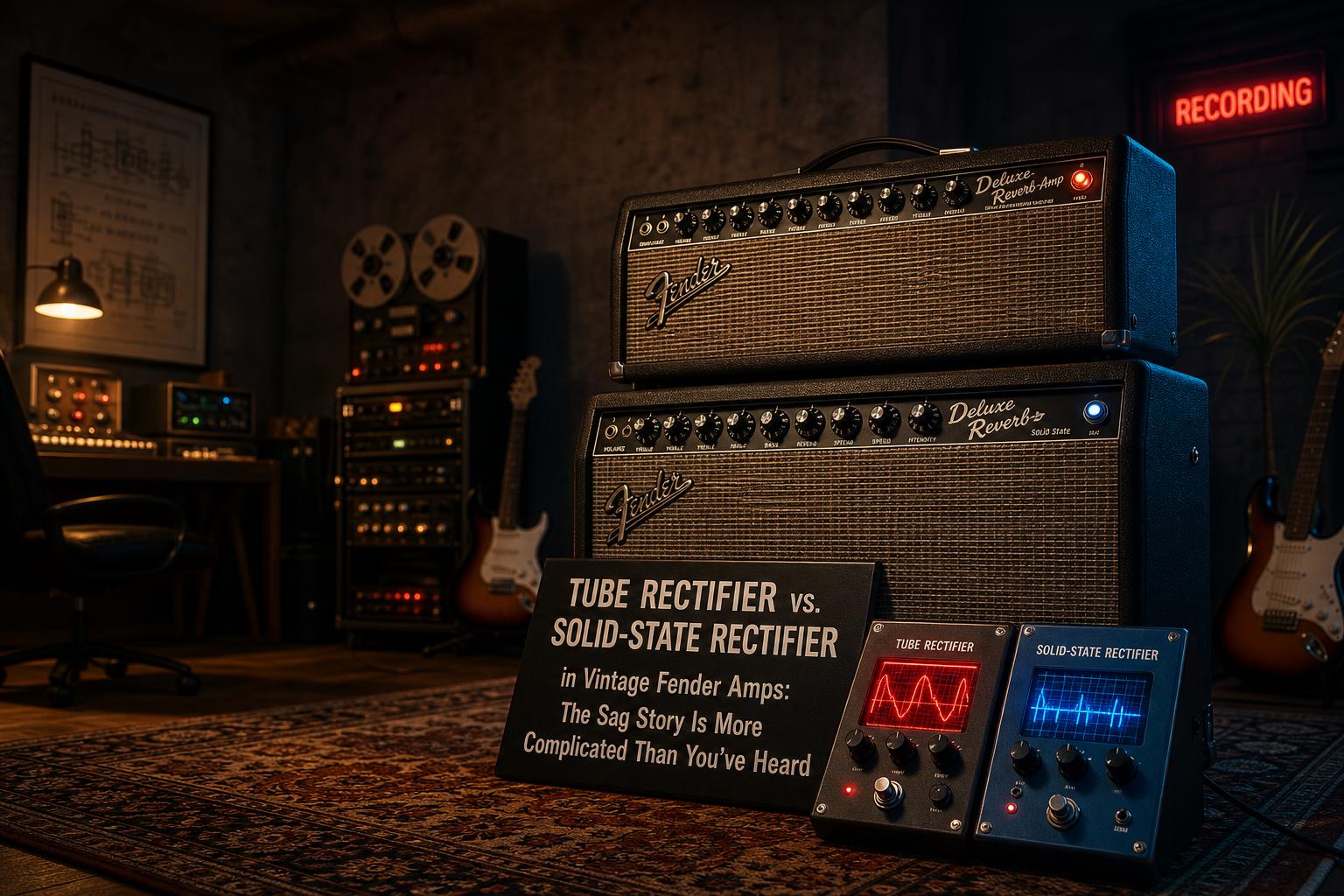
Every tube amp needs to convert wall AC into the DC plate voltage that the tubes run on. The rectifier is the part that does the conversion. Tube rectifiers — 5Y3, 5U4, 5AR4, GZ34 — were the standard until the mid-1960s, when manufacturers including Fender, Marshall, and others switched to silicon diode rectifiers for cost, reliability, and tighter regulation.
A tube rectifier has internal resistance. When the amp draws a lot of current — which happens when you hit a big chord and the power tubes are trying to push the speaker hard — the voltage across the rectifier drops, and that drop reduces the voltage available to the power tube plates. That voltage drop is called sag.
A 5Y3 in a Fender Champ might sag about 50V under peak load, dropping the plate voltage from 350V to about 300V momentarily. A GZ34 in a Bassman might sag about 30V, dropping plate voltage from 440V to 410V. A solid-state rectifier — a pair of silicon diodes in a bridge — drops maybe 2V regardless of current draw, so the plate voltage barely moves.
The result, when you hit a chord on an amp with a sagging tube rectifier, is a brief moment of reduced power output as the rectifier struggles to keep up with the current demand. The transient gets compressed. The pick attack softens. The sustain swells in slightly as the rectifier catches up. That's the "bloom" players talk about.
Where the folk wisdom is wrong
The simple version is "tube rectifier good, solid-state bad," and it's wrong in two important ways.
The first thing it gets wrong is that solid-state rectifiers don't make the amp "stiffer" by themselves. The total power supply impedance is the rectifier plus the power transformer plus the filter capacitors. Even with a perfect zero-impedance rectifier, the rest of the power supply has finite source impedance and the amp will still sag — just less. A 1972 Fender Bassman with silicon rectifiers and the original transformer still sounds compressed and warm at high volumes, because the transformer is doing some of the work the rectifier used to do.
The second thing the folk wisdom misses is that the audible character of "sag" is actually two phenomena, not one. The first is plate voltage droop, which softens transients. The second is increased power supply ripple — when the rectifier sags, the filter caps don't get fully recharged on each AC cycle, so there's more 120 Hz ripple in the B+ supply, which modulates the amp's output and adds a low-frequency bloom under the note. The bloom is part of what players hear as "warmth" and a tighter solid-state supply has less of it.
This is why a modern reissue Fender amp with a solid-state rectifier doesn't sound like a vintage Fender amp even when the rest of the circuit is faithful. The rectifier is a piece of the puzzle, but the rest of the puzzle — transformer choice, filter capacitor values, even the AC mains voltage in the wall — all contribute.
How the Fender catalog actually breaks down
The rectifier choice in vintage Fenders followed power output more than era.
| Amp | Era | Power | Rectifier | Sag character |
|---|---|---|---|---|
| Champ (5E1, 5F1) | 1955–1964 | 5W | 5Y3 | Heavy sag, classic tweed bloom |
| Princeton (5F2-A, AA964) | 1955–1979 | 4.5–12W | 5Y3 (tweed), 5U4GB/GZ34 (blackface) | Heavy sag at full volume |
| Deluxe (5E3) | 1955–1960 | 15W | 5Y3 | Significant sag, the tweed Deluxe sound |
| Bassman (5F6-A) | 1957–1960 | 50W | GZ34 | Moderate sag, fast recovery |
| Super Reverb (AA763) | 1963–1981 | 45W | GZ34 | Moderate sag with 6L6 power tubes |
| Twin Reverb (AB763) | 1964–1981 | 85W | Solid-state | No rectifier sag, transformer-limited |
| Showman (6G14-A) | 1961–1969 | 85W | Solid-state | No rectifier sag |
The pattern: low-power tweed amps used 5Y3 rectifiers and have a lot of audible sag. Mid-power blackface amps used GZ34 rectifiers and sag less. High-power blackface and silverface amps mostly used silicon and didn't sag in the rectifier at all.
This is why the Tweed Deluxe sounds the way it does and the Twin Reverb sounds the way it does. People sometimes attribute the difference to "the speakers" or "the 6L6s versus 6V6s" or "the volume," and those things matter, but the rectifier choice is one of the biggest single contributors to the difference between a Tweed Deluxe's sag-on-everything character and a Twin Reverb's headroom-for-days character.
What happens when you swap a tube rectifier for solid-state
This is the experiment I've run on customer amps probably a hundred times since the 1990s — pulling a tube rectifier and dropping in a Weber Copper Cap or a similar silicon plug-in replacement, then putting the tube rectifier back. The audible differences are predictable.
Faster transient response. Pick attack is harder and more defined. The compression that the tube rectifier was providing on each chord strike goes away.
Tighter low end. The amp's low-frequency response is more controlled because the power supply isn't sagging during loud bass notes. Notes don't bloom into the next note as much.
Higher headroom. Because the plate voltage doesn't drop under load, the amp runs at higher effective power and breaks up at a higher volume. A Tweed Deluxe with a 5Y3 might break up at volume 3; the same amp with a Copper Cap might not break up until volume 4.
More high-frequency content. The faster recovery time means the amp can reproduce higher frequencies more accurately, which sounds like more presence and more bite.
Less "bloom" on sustained notes. The power-supply ripple modulation that a sagging rectifier produces goes away, and notes sustain more cleanly without the slight wavering quality.
I expected the solid-state swap to sound objectively "better" on the amps I tried it in — tighter, cleaner, more responsive. What I found was that on the tweed amps it sounded different in a way that made the amps sound less like themselves. The Tweed Deluxe with a Copper Cap is a tighter, more controlled amp. It's also less of a Tweed Deluxe. That bloom and softening is what the amp is for, in the same way that the breakup is what a tweed amp is for.
On the bigger amps — Bassman, Super Reverb — the swap is more justifiable. The GZ34's sag is subtle to begin with, and a solid-state replacement makes the amp tighter without taking away its character. Some players swear by this on the Bassman; some swear at the players who do it.
What the modern reissues get wrong
The '59 Bassman reissue Fender sold from 1990 to 2004 used a solid-state rectifier even though the original used a GZ34 (the current '59 Bassman LTD finally put the tube rectifier back). That earlier reissue has the same transformer turn ratio as the original (close to it, anyway), the same speaker (Jensen P10R, more or less), and a circuit that's reasonably faithful to the 5F6-A schematic.
It still doesn't sound like the original. The most common explanations — "the wood is different," "the transformers are different," "the tubes are different" — get part of it. The rest of it is the rectifier. A 5F6-A with a GZ34 sags about 30V at full output. The reissue with silicon barely sags at all. That changes the entire feel of how hard chords compress, how transients soften, and how sustained notes bloom.
You can swap a GZ34 into a reissue Bassman if you have a tech rewire the rectifier socket and adjust the bias. People do this. It's an expensive mod for a partial fix, because the transformer and filter capacitors in the reissue aren't the originals either. The whole power supply chain is part of what makes a vintage Fender sound like itself.
If you want the vintage sound, buy the vintage amp. If you can't afford the vintage amp, the reissue is a good amp on its own terms, but understand that you're buying a Fender, not a 1959.
Practical advice for what to do with old amps
If you own a vintage Fender with a tube rectifier and it sounds the way you want it to, leave the rectifier alone. Don't let a tech "tighten it up" with a silicon bridge. That mod is reversible but it's a hassle to undo, and the moment you do it the amp stops sounding like the amp you fell in love with.
If you own a vintage Fender that's been modded to silicon at some point in its life and you're wondering why it sounds different from the same amp your friend has, put the tube rectifier back. Have a tech verify that the rectifier socket is intact and the heater winding on the power transformer is still good. The conversion back to tube is usually straightforward.
If you own a modern reissue or boutique amp with a solid-state rectifier and you're chasing the vintage sag character, the better path is usually in front of the amp rather than inside it — a compressor set slow and subtle gets you part of the compression, and a handful of boutique drives and fuzzes offer a "sag" or voltage-starve control that mimics a drooping supply. The pedal route is reversible and cheaper than rewiring the amp.
If you have an amp with a switchable rectifier — some Mesa Boogie amps, a handful of boutique builds — the tube setting is the "vintage" setting and the silicon setting is the "modern" setting. They're different amps in the same chassis. Use whichever fits the song.
The amp on the bench
That 1959 Bassman went back to its owner with the silicon bridge removed and the GZ34 reinstalled. He called me three days later. "It feels like a different amp," he said. "It's slower. It breathes."
That's the right answer. The Bassman is supposed to breathe. The rectifier is one of the parts that lets it breathe. The folk wisdom about sag isn't wrong about the existence of sag — it's just shallow about why sag matters and what it actually does to the sound. Once you understand it as voltage droop plus power-supply ripple plus transformer impedance, you can make better decisions about what to do with old amps and what to expect from new ones.
The 1958 tweeds and the 1964 blackfaces are the way they are partly because of the rectifiers in them. Take that piece out and you take part of what they are. Some of that is worth keeping. Some of it isn't. The choice belongs to the owner of the amp. The job of someone like me is to make sure they understand what they're choosing.