You bought a modeler. You spent a week building presets through headphones. Then you plugged into a speaker and everything sounded wrong. Thin, fizzy, or like your guitar was playing through a karaoke machine.
The speaker you choose matters as much as the modeler itself. And for most players using amp modeling with cabinet simulation, an FRFR (Full Range, Flat Response) speaker is the right call. If you're not sure whether FRFR is the right approach for your setup, the FRFR vs guitar cab deep dive covers that decision in detail.
This guide assumes you've made the FRFR decision and now you need to pick one. I've compared the most popular options across three price tiers, with honest notes on what each one does well and where it falls short.
What to Look for in an FRFR Speaker
Before we get into specific models, here's what actually matters when you're shopping:
Speaker size determines low-end response and projection. A 12-inch speaker moves more air than an 8-inch speaker. That sounds obvious, but the practical difference is significant. An 8-inch FRFR can feel thin at band volume, while a 12-inch fills a stage.
Wattage isn't about raw volume. A 2,000-watt PA speaker isn't necessarily louder than a 500-watt one. What higher wattage gives you is headroom; the ability to stay clean at higher volumes without compression or distortion. For guitar use, anything above 500 watts has plenty of headroom for any stage.
Weight matters more than specs suggest. You're carrying this to every rehearsal and gig. A 5-pound difference between two speakers is a 5-pound difference you feel every week.
Voicing is the wild card. Some FRFR speakers are general-purpose PA speakers. Others (like the Line 6 Powercab) include guitar-specific speaker modeling. Both approaches work. The question is whether you want your speaker to be transparent or to add its own character.
The Picks: 6 FRFR Speakers Compared
Budget: Headrush FRFR-108 MKII
- Price: ~$300
- Wattage: 2,000W peak (Class D)
- Speaker: 8-inch woofer + compression driver
- Weight: 21 lbs
- Best for: Bedroom players, small rehearsals, anyone testing the FRFR waters
The FRFR-108 MKII is the most common entry point into FRFR, and for good reason. At $300 and 21 pounds, the barrier is low. It gets loud enough for practicing at home and holding its own in a quiet rehearsal. The MKII revision added Bluetooth audio and a proper compression driver over the original 108.
The 8-inch speaker is the limiting factor. At band volume with a drummer, it starts to feel small. The low end thins out, and you lose the chest-thump that makes a guitar feel powerful on stage. It also doesn't project well across a large room. You'll hear it fine standing right in front of it, but move ten feet away and it disappears into the mix.
If you're playing at home, building presets, or using it as a personal monitor while going direct to the PA, the 108 is a smart first purchase. If you're the only amplification on stage, you'll outgrow it.
Mid-Range: Line 6 Powercab 112
- Price: ~$750
- Wattage: 250W
- Speaker: 12-inch custom coaxial
- Weight: 30 lbs
- Best for: Helix users who want speaker-modeling flexibility
The Powercab is a different animal. It runs in two modes: flat FRFR mode (like any other full-range speaker) and speaker-modeling mode, where it disables your modeler's cab sim and emulates specific guitar speakers (Greenback, Vintage 30, Jensen, and others).
That speaker-modeling mode is the selling point. It gives you the amp-in-the-room feel that standard FRFR speakers can't replicate, while still letting you go direct to the PA with cab sim for front-of-house. If you're deep in the Helix ecosystem, step up to the Powercab 112 Plus — it integrates over L6 LINK and MIDI, letting you switch speaker models per preset. The standard 112 is controlled from its front panel.
The trade-off is power. At 250 watts, it's the least powerful option on this list. For a loud stage with no PA support, it may not cut it. For rehearsals, small venues, and home use with the flexibility of speaker models, it's excellent.
The Powercab 112 Plus (~$950) adds additional IR loading, MIDI control, and stereo linking capability if you want to expand later. Line 6 also added a budget entry to the family in late 2025: the Powercab CL 112, at around $450.
Premium: Friedman ASM-12
- Price: ~$1,399
- Wattage: 500W
- Speaker: 12-inch coaxial + horn
- Weight: 37 lbs
- Best for: Players who want a wedge-style monitor that doubles as a backline speaker
Dave Friedman built the ASM-12 specifically for guitar modelers, and it shows. The voicing sits between a flat PA speaker and a guitar cab. It's neutral enough to reproduce your modeler's output faithfully, but it has a slight warmth in the midrange that makes guitars feel less clinical than a pure PA speaker.
The wedge design is practical. Tilt it back on stage like a floor monitor, or stand it upright as a traditional speaker. At 500 watts, it has enough headroom for most live situations.
The downside is price. At $1,399, it's the most expensive option on this list — you're paying boutique money for the Friedman name and voicing. And unlike the Powercab, there's no speaker modeling; it's a straight FRFR speaker with a guitar-friendly voicing. If you want pure flat response for production work, a PA speaker might be more accurate for far less money.
Premium: Yamaha DXR12mkII
- Price: ~$900
- Wattage: 1,100W (bi-amped)
- Speaker: 12-inch woofer + 1.75-inch compression driver
- Weight: 41 lbs
- Best for: Players who need a versatile speaker for guitar and double-duty PA use
The DXR12mkII is a professional powered speaker that happens to work extremely well for guitar modelers. Yamaha's DSP processing is refined, the frequency response is genuinely flat, and the build quality is a step above most options at this price.
What sets it apart is versatility. Use it as an FRFR guitar monitor at rehearsal, then turn it around as a PA speaker for vocals or keys at the gig. The 1,100-watt bi-amped design means it has headroom to spare, and it stays clean even when pushed.
For pure guitar use, some players find it too flat; it reproduces everything your modeler outputs, including the high-frequency content that a guitar cab would naturally roll off. You'll likely want to dial in a high cut around 8-10kHz on your modeler's output, or use the DXR's built-in EQ contour settings. The dial-in guide covers this EQ approach in detail.
Premium: QSC K12.2
- Price: ~$900–1,000
- Wattage: 2,000W (Class D)
- Speaker: 12-inch woofer + 1.4-inch compression driver
- Weight: 38 lbs
- Best for: Gigging players who need maximum volume, headroom, and reliability
The K12.2 is the industry workhorse. Sound engineers trust QSC because the speakers sound consistent, they're built to survive touring, and the onboard DSP is excellent. For guitar players, the K12.2 delivers the most headroom of any option on this list.
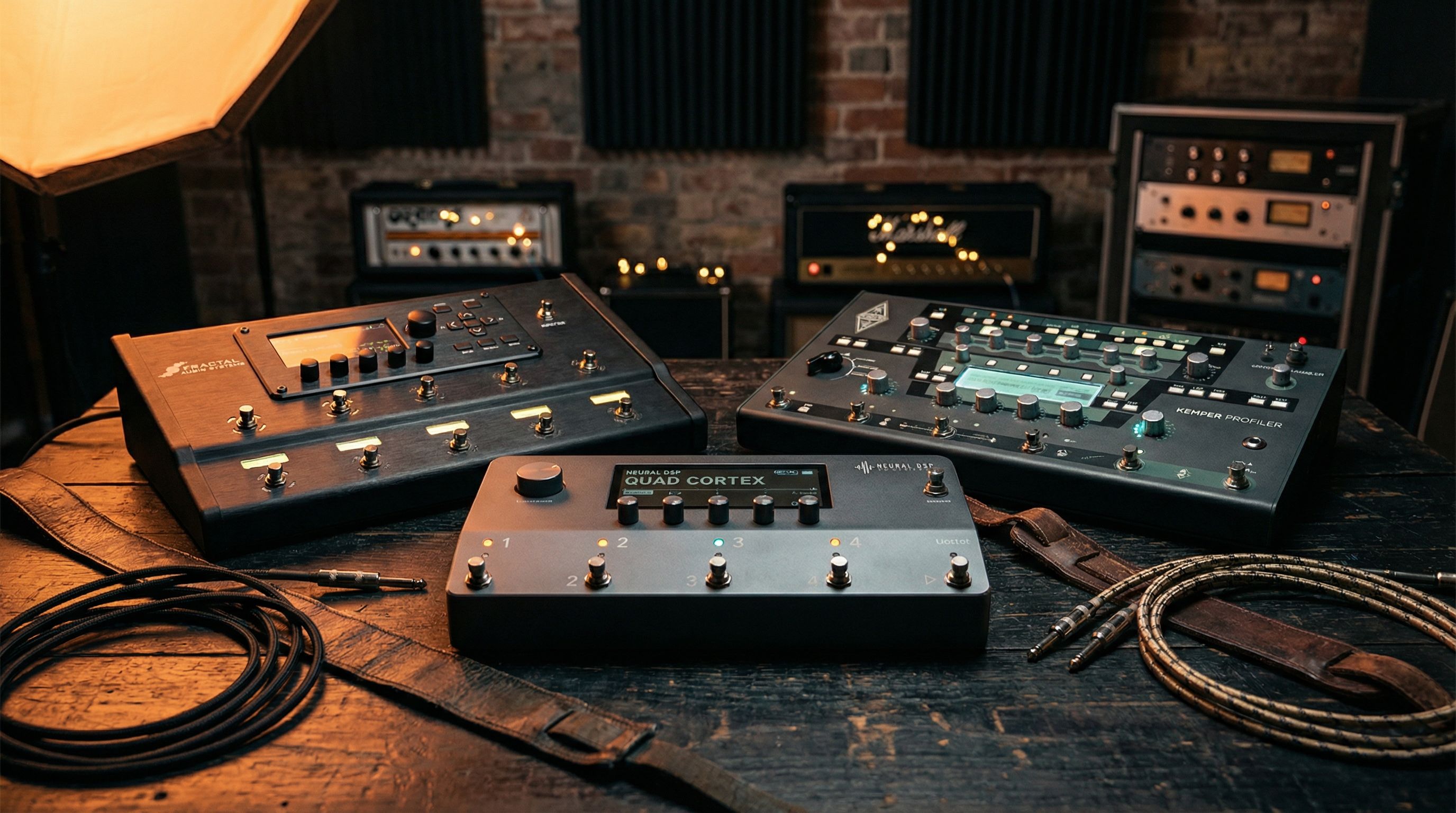
Pair it with a Quad Cortex and you've got a rig that can handle anything from a coffee shop to an outdoor festival. The QC's detailed amp models translate well through the K12.2's flat response, and the 2,000-watt power section means you'll never run out of clean volume.
The K12.2 also includes selectable voicing modes, including a monitor mode that adjusts the EQ curve for floor-wedge positioning. This is useful for guitar players who tilt the speaker back on stage.
The downsides: weight (38 lbs) and price. It's also very much a PA speaker in appearance. If aesthetics matter to you on stage, it looks like you're playing through the sound system rather than a guitar rig. Sonically, that's irrelevant. Visually, some players care.
Compact Option: Line 6 Catalyst CX 60/100/200
- Price: ~$399 (Catalyst CX 100)
- Wattage: 60W / 100W / 200W (depending on model)
- Speaker: 12-inch guitar speaker (Catalyst CX 100/200)
- Weight: ~34 lbs (Catalyst CX 100)
- Best for: Players who want an amp AND a powered cab for their modeler in one box
The Catalyst CX isn't an FRFR speaker at all — it's a modeling amp with a Power Amp In that bypasses the preamp, turning it into a powered guitar cab for your modeler. Disable your modeler's cab block: the Catalyst's 12-inch guitar speaker adds its own voicing, and there's no tweeter and no flat response. Used standalone, you've got an amp with Line 6's amp models built in.
This dual-purpose design makes it a compelling option if you want a backup amp on stage, a practice amp at home, and a powered cab for your main modeler rig. The 12-inch speaker in the Catalyst CX 100 and 200 models is capable enough for rehearsals and small venues.
The limitation is that it's not flat at all — you're hearing your presets through a guitar speaker's voicing, and it doesn't have the headroom of a QSC K12.2 or the refined DSP of a Yamaha DXR12. It's a jack-of-all-trades; good at everything, best at nothing. But if you only want to buy one piece of gear, the flexibility is hard to beat.
Comparison Table
| Speaker | Price | Wattage | Size | Weight | Best For |
|---|---|---|---|---|---|
| Headrush FRFR-108 MKII | ~$300 | 2,000W peak | 8" | 21 lbs | Bedroom, preset building |
| Line 6 Powercab 112 | ~$750 | 250W | 12" | 30 lbs | Helix users, speaker modeling |
| Friedman ASM-12 | ~$1,399 | 500W | 12" | 37 lbs | Wedge monitor, warm voicing |
| Yamaha DXR12mkII | ~$900 | 1,100W | 12" | 41 lbs | Versatile, double-duty PA |
| QSC K12.2 | ~$900–1,000 | 2,000W | 12" | 38 lbs | Gigging, maximum headroom |
| Line 6 Catalyst CX 100 | ~$399 | 100W | 12" | 34 lbs | Dual-purpose amp + powered cab |
The Verdict: Best For Each Situation
Best for gigging: QSC K12.2. The headroom, reliability, and build quality make it the safest bet for players who need their speaker to perform consistently at every venue. Pair it with a Quad Cortex or Helix and you've got a professional rig.
Best for bedroom and recording: Headrush FRFR-108 MKII. At $300 and 21 pounds, it's the lowest-commitment way to hear your modeler through a real speaker instead of headphones. If your presets sound good through the 108 MKII, they'll translate to any full-size FRFR or PA system.
Best overall value: Yamaha DXR12mkII. It splits the difference between the budget and premium tiers with professional-grade sound, enough power for any gig, and the versatility to serve as a PA speaker when you need it. At around $900, it punches above its price.
Best for Helix users: Line 6 Powercab 112. The speaker-modeling mode solves the amp-in-the-room problem in a way no standard FRFR can. If you're committed to the Helix platform, the integration alone justifies the price.
Best if you can only buy one thing: Line 6 Catalyst CX. It's not an FRFR, but between the built-in amp models and the Power Amp In that turns it into a powered guitar cab for your modeler, it covers two jobs, and for $399 that flexibility is valuable if you're building a rig on a budget.
Practical Tips: Getting the Most Out of Your FRFR
Buying the right speaker is half the equation. Setting it up correctly is the other half.
Placement Matters More Than You Think
FRFR speakers are directional. The high frequencies beam forward from the horn or compression driver. If the speaker is on the floor pointing at your knees, you'll hear mostly low-mid mush and wonder why your tone sounds nothing like it did through headphones.
Tilt it up. Most FRFR speakers and wedge-style monitors have an angled position for exactly this reason. Point the speaker at your ears, not your shins. If you're using a PA-style speaker on a pole mount, position it at ear height or slightly below.
Give it room. Stand at least 3-4 feet away from the speaker. FRFR speakers need distance for the sound to develop and the frequencies to blend. Up close, the high end can sound harsh and the low end weak. Step back and the whole picture comes together.
Volume Matching With Your Band
One of the biggest frustrations with FRFR is the feeling that it can't keep up with a real amp. A tube amp through a 4x12 moves a lot of air and fills a room in a way that a single 12-inch FRFR doesn't replicate, even at the same volume level.
The fix isn't cranking the FRFR until it distorts. It's adjusting your expectations and your EQ. Boost the low-mids (200-400 Hz) slightly on your modeler's output to add body and presence that helps your guitar cut through a band mix. And remember, if you're going direct to the PA, the audience is hearing you through the house system, not your stage monitor. The FRFR only needs to be loud enough for you to hear yourself.
EQ Adjustments for FRFR
Most modeler presets built through headphones or studio monitors need a slight adjustment for FRFR playback. The common fixes:
- High cut at 8-10 kHz on your cab/IR block to tame fizz and harshness
- Low cut at 80 Hz to remove sub-bass rumble that sounds fine on headphones but booms through a speaker in a room
- Slight midrange boost around 1-2 kHz to add presence and cut
- Reduce gain slightly. FRFR speakers reveal every detail, and gain that sounded smooth on headphones can sound saturated and messy through a speaker
Build your presets on the FRFR whenever possible. If you dial in your tones through the speaker you'll use live, there's no translation step. The complete preset workflow guide walks through this process step by step.
FAQ
Will an FRFR speaker sound like a real amp in the room? Not exactly. FRFR reproduces your modeler's output faithfully, including the cab simulation. But the physical experience of standing in front of a guitar cab is different. A 4x12 pushes air in a way a single 12-inch monitor doesn't. The Powercab's speaker-modeling mode gets closer to that feel than a standard FRFR, but it's still a different experience. Many players adjust to it quickly. Some never fully do.
Can I use one FRFR for both guitar and vocals? Yes, if it's a PA-style speaker like the QSC K12.2 or Yamaha DXR12mkII. Run your modeler into one channel and a vocal mic into another (or through a small mixer first). Purpose-built guitar FRFR speakers like the Powercab and Friedman ASM-12 are voiced more for guitar and may not be ideal for full-band PA use.
Do I need two FRFR speakers for stereo? You need two speakers if you want true stereo. A single FRFR plays back in mono. Whether stereo is worth the extra cost and weight depends on your setup. Stereo effects like ping-pong delay and wide chorus sound noticeably better through two speakers, but in a live band mix, the difference is subtle for the audience. Stereo is more impactful for home playing and recording.
Is it worth upgrading from the Headrush FRFR-108 MKII to a 12-inch option? If you're gigging, yes. The jump from 8 inches to 12 inches is the single biggest upgrade in FRFR quality: more low end, more projection, more volume before the speaker sounds strained. If you're only playing at home, the 108 MKII is fine.
Ready to start building presets that sound great through your new FRFR? Start with the tone dial-in guide, then browse tone recipes matched to your modeler platform.
Playing in a church or worship setting? FRFR is the standard for stage and in-ear monitoring there. Pair your speaker with the worship guitar tone guide for the Helix to dial the ambient cleans, swells, and dotted-eighth delays that need to translate cleanly through a flat-response speaker.