They All Sound Great. Now What?
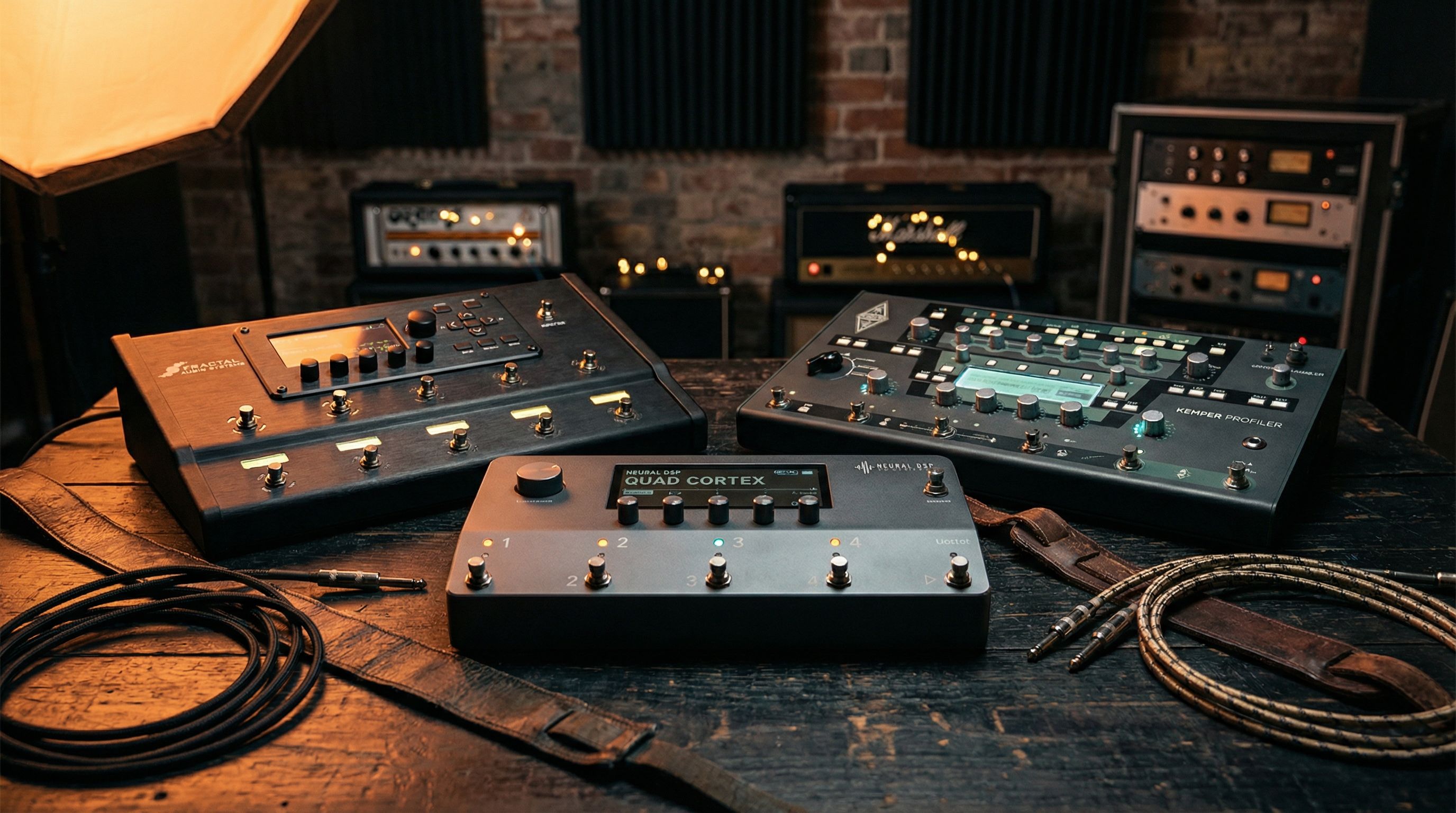
I need to get this out of the way before we go any further: the Line 6 Helix, the Neural DSP Quad Cortex, and the Kemper Profiling Amplifier all sound fantastic. In a blind test through a PA or studio monitors, most players cannot reliably pick one from the other. I have watched rooms full of experienced guitarists fail at this exercise, repeatedly, with money on the line.
So if they all sound great, why does the choice matter?
Because you are not buying a sound. You are buying a workflow, an ecosystem, and a relationship with a company's update philosophy. The modeler you pick will shape how you build presets, how you discover new tones, how you integrate with your rig, and how much time you spend reading firmware changelogs instead of playing guitar. Those differences are real, and they compound over months and years of ownership.
This is the comparison I wish someone had written for me before I bought all three.
Sound Quality and Feel
All three platforms have reached a level of maturity where the amp tones themselves are not the primary differentiator. But the way each unit gets to those tones is different, and those differences affect feel in ways that matter to players who care about touch sensitivity and pick dynamics.
Helix uses component-level circuit modeling. Line 6 simulates individual resistors, capacitors, tubes, and transformers. The result is an amp model that behaves like a real circuit, including how it responds when you roll back your guitar volume or stack a boost in front of it. With over 80 amp models and 300+ effects built in, the Helix gives you an enormous palette out of the box. If you want to explore what different classic amps feel like under your fingers, the breadth here is unmatched. For a deep dive into the blues side of that library, see our best Helix amp models for blues guide.
Quad Cortex takes a dual approach. It ships with factory amp models built on Neural DSP's acclaimed modeling technology, but the headline feature is neural captures: the ability to profile a real amp at specific settings using a trained neural network. The captures are remarkably accurate, and Cortex Cloud gives you access to thousands of community-shared captures of amps most of us will never own. The tradeoff: a capture is a snapshot of an amp at one setting. It does not have the full parameter range of a component-level model. Our captures vs models breakdown covers when each approach wins.
Kemper pioneered the profiling concept years before the Quad Cortex existed. The Kemper Profiling Amplifier analyzes a real amp's response and creates a profile that replicates its behavior at that setting. Kemper's profiling algorithm has been refined through over a decade of firmware updates, and the Rig Exchange library contains tens of thousands of free profiles from the community. Many professional touring guitarists have used Kemper profiles of their own amps for years because the technology is proven and stable. With the recent Kemper OS 14 public beta, the profiling engine continues to improve.
The honest take: If you put a gun to my head, I would say the Kemper's best profiles have a slightly more organic, amp-in-the-room quality that is hard to define but easy to feel. The Helix's models offer the widest range of tweakability. The Quad Cortex captures split the difference. But these are marginal distinctions. The EQ curve on your cab or IR will affect your tone more than the choice of platform.
Ease of Use
This is where the three units diverge sharply, and it is probably the factor that should carry the most weight in your decision.
Quad Cortex is the easiest to learn. The 7-inch touchscreen makes building presets feel like rearranging apps on a phone. You drag blocks onto a grid, tap to adjust parameters, and see your entire signal chain at a glance. A new user can build a gig-ready preset from scratch in under ten minutes. The Quad Cortex was designed for people who grew up with touchscreens, and it shows.
Kemper has a hardware-centric interface that revolves around a clear paradigm: pick a profile, add stomps in front, add effects after. The front panel is organized into sections (Stomps, Stack, Effects) that mirror a traditional signal chain. Once you internalize this layout, it is fast and logical. The learning curve is moderate; steeper than the QC but gentler than the Helix for basic operations.
Helix is the most powerful and the most complex. The combination of dual signal paths, extensive routing options, and deep parameter access means there is a lot to learn. Most serious Helix users end up building presets in HX Edit on a computer, because the desktop interface is more intuitive for complex routing than the hardware's button-and-joystick navigation. Once you are fluent, the Helix is incredibly fast. Getting fluent takes longer.
The honest take: If you hate reading manuals and want to be gigging in a weekend, the Quad Cortex wins. If you are patient and want maximum control, the Helix rewards the investment. The Kemper sits in a comfortable middle ground.
Ecosystem: Presets, Captures, Profiles, and Community
The ecosystem around each modeler is as important as the hardware itself. This is where you find new tones, troubleshoot problems, and stay inspired.
Helix has the most established ecosystem. CustomTone offers thousands of free presets. The YouTube tutorial library is deep. Third-party IR makers overwhelmingly support Helix first. Helix Native (the plugin version that runs the same models in your DAW) is a genuine differentiator for recording players. The community has had years to mature, and it shows in the quality and depth of available resources.
Quad Cortex has Cortex Cloud, which is integrated directly into the hardware. You can browse, download, and load presets and captures without ever connecting to a computer. The capture-sharing dimension is unique to the QC (and the Kemper, in a different form). You are not just sharing presets, you are sharing profiled amps. The community has grown rapidly, especially since the Quad Cortex Mini started shipping, which brought a wave of new users into the ecosystem.
Kemper has the Rig Exchange, one of the oldest and deepest tone-sharing libraries in the modeler world. Tens of thousands of free profiles, organized by amp type, genre, and contributor. Many professional profile makers sell curated packs for the Kemper, and the quality of the top commercial profiles is outstanding. The Kemper community skews slightly older and more established: less social media energy, more deep forum threads with genuinely useful information.
The honest take: Helix has the broadest third-party support. The QC has the most modern and friction-free sharing platform. The Kemper has the deepest back catalog of profiles. None of these ecosystems will leave you wanting for tones.
I/O and Routing
This is where technical needs start to dictate the choice.
Helix Floor is the I/O champion. Four effects loops, dual XLR outputs, a headphone jack, USB audio interface capability, MIDI in/out, variax input, and a microphone input with phantom power. The dual-path signal architecture supports complex configurations (wet/dry/wet, parallel amp chains, independent monitor mixes) that neither the QC nor the Kemper can match in a single unit.
Quad Cortex has two effects loops, stereo XLR and quarter-inch outputs, USB audio interface capability, MIDI, and an expression pedal input. The grid-based routing supports four parallel rows, which handles most real-world needs. Where it gets constrained is with very complex parallel routings that eat up grid space faster than you would expect.
Kemper has a main stereo output, a monitor output (great for sending a separate signal to a stage cab), a direct output for profiling, an effects loop, MIDI, and S/PDIF. The Kemper Stage adds more footswitches but the I/O remains the same. The routing is simpler than either competitor; it is fundamentally a single signal chain with a parallel path available for certain configurations.
| Feature | Helix Floor | Quad Cortex | Kemper Stage |
|---|---|---|---|
| Effects loops | 4 | 2 | 1 |
| XLR outputs | 2 (stereo) | 2 (stereo) | 1 main + 1 monitor |
| USB audio interface | Yes | Yes | Yes |
| MIDI | In/Out | In/Out | In/Out |
| Mic input | Yes (phantom power) | No | No |
| Parallel routing | Dual path, freeform | 4-row grid | Limited |
| Expression pedal | Built-in | Input jack | Input jack (Stage) |
The honest take: If you run a complex rig with multiple effects loops, external switching, and parallel signal paths, the Helix is the only unit that covers it all without compromise. If your needs are simpler, the QC and Kemper have enough I/O for most gigging and recording situations.
Build Quality and Form Factor
Helix Floor is a tank. Over 14 pounds of aluminum chassis, solid footswitches with scribble strips, and a built-in expression pedal. It feels like it could survive a tour bus rolling over it. The tradeoff is weight and size. This is not a unit you casually toss in a backpack. The HX Stomp and HX Stomp XL offer smaller options with the same sound engine but fewer switches and reduced block counts.
Quad Cortex is remarkably compact and light. Under 4 pounds, roughly the size of an iPad, with a sleek industrial design. The build quality is excellent (machined aluminum, solid footswitches), but the size means the switches are closer together, which can be a challenge for players with larger feet. The touchscreen is a fingerprint magnet and requires periodic cleaning, but it has held up well to touring use.
Kemper falls between the two. The toaster (head) form factor is unique and lives on top of an amp or on a desk. The Kemper Stage is a more conventional pedalboard format, heavier than the QC but lighter than the Helix Floor. Build quality is solid and Germanic; everything feels precisely engineered if not exactly glamorous.
The honest take: If you fly to gigs or need to fit everything in a carry-on, the QC's size and weight are a genuine advantage. If you want something indestructible that you set up once and leave on a pedalboard, the Helix is built for that. The Kemper Stage is a reliable middle ground.
Firmware Updates and Company Philosophy
This matters more than most buyers realize, because the modeler you buy today will be shaped by the updates it receives over the next several years.
Line 6 has an excellent track record of free firmware updates for the Helix. New amp models, new effects, routing improvements, and quality-of-life features have arrived consistently since launch. The Helix you buy today is substantially more capable than the one that shipped in 2015, and you never paid a dime for those improvements.
Neural DSP had a rocky start with Quad Cortex firmware. Early promises around desktop editor software and certain features took longer than expected. To their credit, they have caught up significantly. The desktop editor shipped, features have been added steadily, and the QC Mini launch demonstrates ongoing commitment to the platform. The pace has improved, but the early stumbles left some users cautious.
Kemper plays the longest game. Firmware updates arrive less frequently but tend to be substantial. The company has supported the same hardware platform for over a decade, continually improving the profiling algorithm and adding features. There is no other modeler company with this track record of long-term hardware support. If you are buying something you want to use for the next ten years, that history means something.
The honest take: Line 6 delivers the most frequent updates. Kemper delivers the longest support commitment. Neural DSP is the youngest company and has the most to prove, but the trajectory is positive.
Price Comparison
| Unit | Approximate Street Price (USD) |
|---|---|
| Helix Floor | $1,499 |
| Helix LT | $1,199 |
| HX Stomp XL | $799 |
| HX Stomp | $649 |
| Quad Cortex | $1,849 |
| Quad Cortex Mini | ~$999 |
| Kemper Stage | $1,899 |
| Kemper Head (toaster) | $1,799 |
| Kemper Player | $699 |
The Helix ecosystem offers the widest price range, from the $649 HX Stomp to the $1,499 Helix Floor. The Kemper Player and HX Stomp compete at the compact/affordable end. The full-size Quad Cortex and Kemper Stage are the most expensive options.
All three hold value well on the used market, which matters if you are the type who swaps gear every couple of years.
The Fourth Option: Fractal Audio
Any honest comparison has to mention Fractal Audio. The Axe-Fx III and FM9 compete directly with everything on this page, and many players consider Fractal's modeling to be the most accurate available. The reason Fractal is not given equal billing here is accessibility: their products are harder to buy (direct sales model, frequent waitlists), the interface has a steeper learning curve than any of the big three, and the community, while devoted, is smaller.
If you are the type of player who reads DSP white papers for fun and wants the absolute deepest parameter access available, Fractal deserves a serious look. For everyone else, the three units above are easier to buy, easier to learn, and easier to get support for.
The Comparison Table
| Category | Helix | Quad Cortex | Kemper |
|---|---|---|---|
| Modeling approach | Component-level circuit | Neural captures + models | Profiling + models |
| Built-in amp models | 80+ | Growing library | Growing library |
| Can profile/capture real amps | No | Yes (captures) | Yes (profiles) |
| Built-in effects | 300+ | Growing (~100+) | Growing (~100+) |
| Touchscreen | No | Yes (7-inch) | No |
| Signal routing | Dual path, freeform | 4-row grid | Single chain + parallel |
| Effects loops | 4 (Floor) | 2 | 1 |
| USB audio interface | Yes | Yes | Yes |
| Plugin version | Helix Native | No | No |
| Desktop editor | HX Edit | QC Editor | Rig Manager |
| Weight (floor unit) | ~14.5 lbs | ~3.5 lbs | ~10 lbs (Stage) |
| Tone sharing | CustomTone | Cortex Cloud | Rig Exchange |
| Street price (floor) | $1,499 | $1,849 | $1,899 |
| Budget entry point | HX Stomp ($649) | QC Mini (~$999) | Kemper Player ($699) |
Buy the Helix If...
- You build complex signal chains and need serious routing flexibility
- You want the largest built-in effects library on day one
- You value a plugin version for DAW recording (Helix Native is genuinely useful)
- You want multiple form factor options across a wide price range
- You prefer physical knobs and switches over a touchscreen for live use
- You like the security of Line 6's decade-long firmware update history
The Helix is the Swiss Army knife. It does more things than either competitor, and it does most of them at a very high level. The cost is complexity. You will spend more time learning the interface, and you may never use half of what it can do. That is fine. The half you use will be excellent.
Buy the Quad Cortex If...
- You want the fastest, most intuitive preset-building experience
- Capturing your own amps and pedals is important to you
- Size and weight matter for your gigging situation
- You want a modern, cloud-connected sharing platform built into the hardware
- You are coming from Neural DSP's plugins and want that sound in a floor unit
- You want something that feels current and is still rapidly evolving
The Quad Cortex is the iPhone of modelers: polished, intuitive, and designed around a touchscreen experience. The tradeoff is that you get less routing depth and a smaller effects library than the Helix. For most players, that tradeoff is worth it. Browse our QC tone recipes to see what is possible.
Buy the Kemper If...
- You want access to the deepest, most mature profile library available
- Long-term hardware support matters to you (10+ years and counting)
- You prefer a straightforward signal chain over complex routing
- You play live and value rock-solid stability above all else
- You trust profiles from professional profile makers over DIY tweaking
- You are a set-it-and-forget-it player who does not enjoy endless knob turning
The Kemper is the workhorse. It does not have the flashiest interface or the newest features, but it has a decade of proven reliability, a massive profile library, and an update philosophy that prioritizes stability over novelty. There is a reason so many touring professionals use Kempers. When the show matters more than the gear, the Kemper disappears and just works.
The Real Answer
Here is the uncomfortable truth that no comparison article wants to tell you: the best modeler is the one you will actually spend time programming. A Quad Cortex with thoughtfully built presets will sound better than a Helix with factory defaults. A Kemper loaded with great profiles and properly dialed in will beat a QC with captures you downloaded and never tweaked.
The tonal ceiling of all three units is higher than most of us will ever reach. The variable is not the hardware. It is you: your willingness to learn the interface, experiment with settings, and develop an ear for what sounds right in a mix versus what sounds impressive in a bedroom.
If you can, spend time with each unit at a store. Not five minutes; thirty minutes. Build a tone from scratch. The one that makes the process feel like playing music instead of operating software is your answer.
And if you are still paralyzed by the choice after all that, buy the one that is in stock, learn it deeply, and stop reading comparison articles. Including this one.