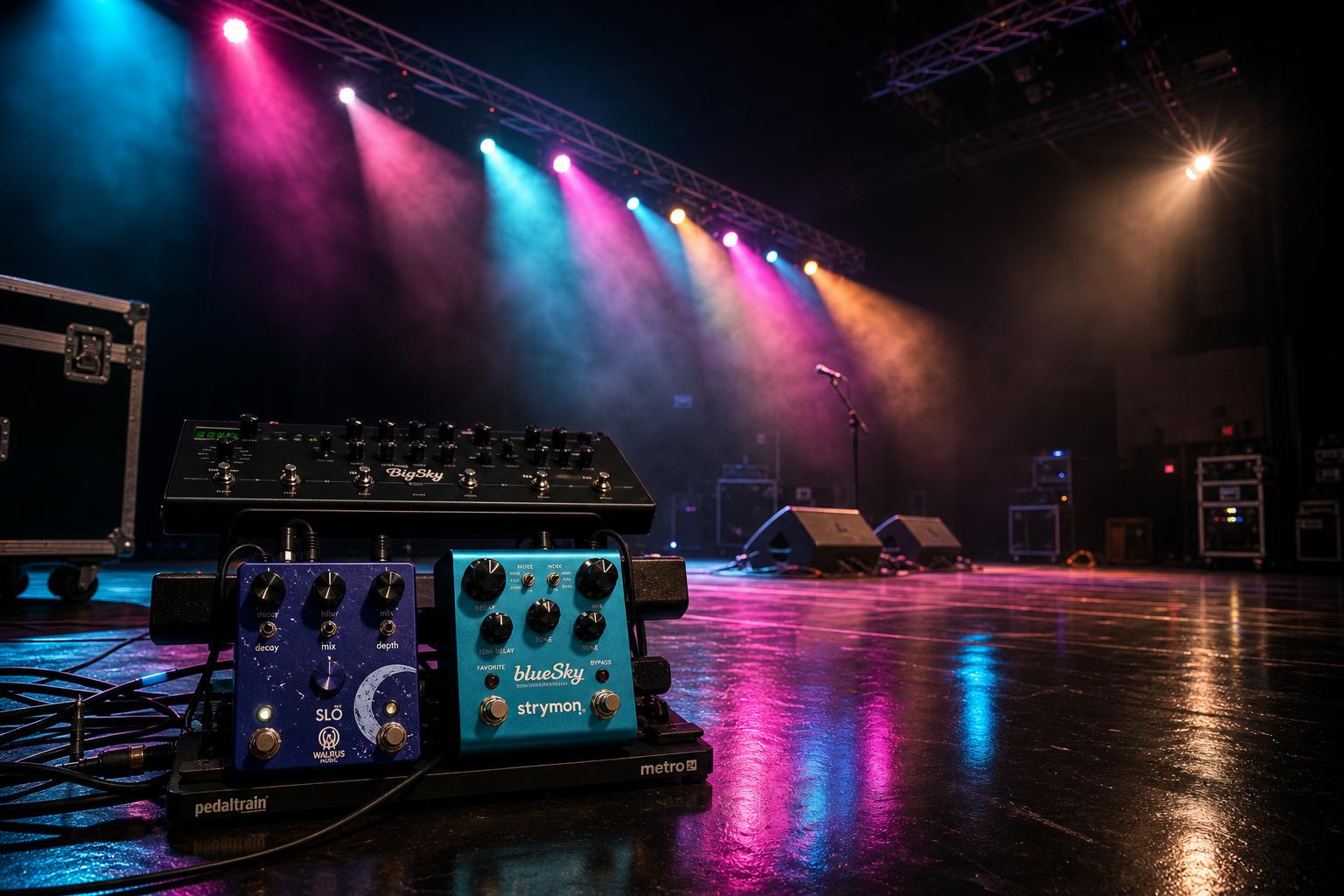
A pedalboard is a budget — square inches, watts of current, and seconds of preset-change time. The BigSky is one of the best reverbs ever made, and it costs all three of those budgets generously. When the board needs to shrink — for a smaller stage, a fly date, a backup rig, or a worship leader's "I just need something I can carry" board — the Slö and the BlueSky are the two reverbs most worship guitarists end up considering.
I've used both on services for the last year. One lives on my main board as a second reverb after the BigSky; the other lives on my backup board where space is tight. They're not the same pedal at smaller scale. They're two different pedals that happen to occupy a similar physical footprint.
The footprint and feature table
| Walrus Audio Slö | Strymon BlueSky | |
|---|---|---|
| Footprint | 3.6″ × 4.7″ (compact 125B) | 4.0″ × 4.5″ |
| Algorithms | 3 (Dark, Rise, Dream) | 3 (Spring, Plate, Room) with two character switches |
| Stereo | Yes, true stereo I/O | Yes, true stereo I/O |
| Presets | 9 via MIDI; 1 onboard | 1 onboard; MIDI optional |
| Tap tempo | No | No |
| Power draw | 100 mA at 9V | 300 mA at 9V |
| Current draw consideration | Easy on a Pedal Power 2 Plus | Needs an isolated 300 mA tap |
| Street price (May 2026) | $249 | $349 |
The current draw difference matters more than it might look. The BlueSky needs an isolated 300 mA output, which on smaller power supplies forces a current doubler or eats a tap that could power three other pedals. The Slö runs on 100 mA and can share a Voodoo Lab Pedal Power 2 Plus tap with a Boss tuner. On a tightly-engineered board, that's the difference between fitting and not fitting.
The Walrus Slö: character as the product
The Slö's three modes — Dark, Rise, and Dream — aren't named the way reverb algorithms are usually named. They're named for what they make you feel, which is fitting because the pedal's voice is the product.
Dark adds an octave-down pitch-shifted reverb tail underneath the main reverb. The result is a thick, slightly menacing pad sound that works well under quiet verses and bridges. It's the sound that made the original Slö famous on a thousand worship Instagram clips around 2019.
Rise is a swell algorithm — the reverb attack ramps up gradually after each note, so plucked notes bloom into the tail instead of striking it. It's the closest thing the Slö has to a "normal" worship reverb, and it pairs beautifully with volume swells from the guitar volume knob or a swell pedal.
Dream is a long, lush, octave-up shimmer-adjacent algorithm. It's not as bright as a true shimmer because the pitch shift is less precise than the BigSky's, but the result is a wider, more ambient version of a shimmer pad. It's the algorithm I reach for when the song needs the kind of texture that fills the room without being identifiable as a specific effect.
I expected the Slö to be a one-trick pedal — the Dark mode is what it's known for, and the other two algorithms felt like extras to me on the spec sheet. What I found, after a few months of regular use, was that Rise is the algorithm I actually use most. The swell-attack response makes my volume-swell technique sound bigger than it is, and that's a feature I didn't know I wanted until I had it.
What the Slö isn't great at: the default-state musicality the BigSky has. Plug into a Slö and the dry signal sounds the same; turn the mix up and the wet signal sounds like something specific, not like a generic finished reverb. That's a virtue for character and a liability for the kind of set where you need to set it once and forget it.
The Strymon BlueSky: the BigSky's voice in a smaller box
The BlueSky's three modes are Spring, Plate, and Room. Each has two switches — a Mod toggle (none, light, deep) and a Voice toggle (normal, shimmer, magneto-style modulation). The total combinatorial space is twenty-seven sounds, but in practice most worship guitarists use four or five combinations.
Plate, Normal, Mod Light is the closest thing to the BigSky's Plate algorithm at default settings. It's the sound I'd describe as a finished record — present in the mix, polite in the top end, with enough decay to feel like a space without smearing chord changes.
Spring, Normal, Mod None is a faithful spring reverb that pairs naturally under a dotted-eighth delay. It's the "U2 plus a Vox AC30" sound, which is to say it's the foundation of about 70 percent of contemporary worship lead guitar.
Plate, Shimmer Voice, Mod Light is the pedal's killer feature. The shimmer voicing adds a pitch-shifted octave-up reverb tail under the dry signal, and the result is the standard worship pad sound. It's not as clean as the BigSky's dedicated Shimmer algorithm, but in a service mix where the keyboard pads cover the rest of the harmonic content, it does what it needs to do.
Room, Normal, Mod None is a small-room reverb that I use as an always-on subtle space. It adds about 80 ms of early reflections under everything, which makes the guitar feel like it's in a space without making it feel like it's drenched in reverb. This is the setting I'd put under a dotted-eighth delay on a song where the room is already big and I just want a touch of glue.
The BlueSky's voice is the Strymon house voice — slightly polite, harmonically smooth, with a top-end rolloff above 7 kHz that flatters single-coils and Telecasters in a way most reverb pedals don't quite manage. If you've heard a BigSky on a worship record, you've heard most of what the BlueSky does.
How they actually sound on Sunday morning
Here's the test that matters: a service mix at moderate stage volume, in-ear monitors, a Tele or PRS Silver Sky on the bridge pickup, a JHS Morning Glory at edge-of-breakup, and a Strymon Timeline running a dotted-eighth at 110 BPM into the reverb under test.
The BlueSky disappears into the mix in the best possible way. The Plate algorithm with the Mod Light switch sits behind the delay without competing for space, and the high end stays out of the way of the vocals. When I switch to the Shimmer voice for the bridge, the pad voicing adds octave-up content that locks naturally with the keyboard pads. I can set the BlueSky once and forget it for the whole service.
The Slö is a different proposition. The Rise algorithm pairs beautifully with the Morning Glory and creates a swelling, blooming reverb under the lead lines that's more textural than the BlueSky's. But it doesn't disappear — the pad voice in Dream mode wants to live in the same frequency space as the keyboard pads, and on songs where the keyboards are doing a lot, the Slö can crowd the mix in the upper mids around 1.5–2 kHz. The Dark mode is wonderful for the quiet verses of a particular kind of song, but it's not a general-purpose worship reverb the way the BlueSky's Plate is.
The honest summary: the BlueSky is the safer choice for a generalist worship board. The Slö is the more interesting choice for a specific kind of ambient-leaning set, and a less safe choice for a worship leader who needs the reverb to be invisible.
Where each one wins
The Slö wins when:
- The set is ambient-leaning and the reverb is part of the composition, not a finishing touch
- You're a guitarist who values character over flexibility and wants the reverb to be yours
- The pedalboard is current-constrained and the Slö's 100 mA draw matters
- You already have a different reverb covering the standard Plate-and-Spring duties
- The Dark mode's pitch-down tail is a sound you actively want in your toolkit
The BlueSky wins when:
- The board needs one reverb that covers most Sunday-morning duties
- The Strymon house voice is what you're used to and want
- You're moving from a BigSky to a smaller format and want the closest possible voice match
- The Shimmer Voice setting is a sound you reach for regularly
- You need a pedal that sounds finished at the factory setting with no editing
Settings to try on each
Walrus Slö — Rise mode for swelling lead lines
This is the swell setting I use for the chorus of a slower ballad. The Filter knob rolls the high end off so the reverb tail sits under the vocals without competing for the 4 kHz region. Pair it with a clean Tele on the neck pickup and a volume swell from the guitar's volume knob.
Strymon BlueSky — Plate, Shimmer Voice, for the worship pad
Mod switch to Light, Voice switch to Shimmer. This is my main worship pad setting — the pre-delay leaves room for the dry attack of each chord change, the high damp keeps the shimmer from getting brittle, and the low damp keeps the pad from competing with the bass.
The board math
If your BigSky doesn't fit and the question is "which one replaces it for worship," the answer depends on what you used the BigSky for.
If you used the Plate, Spring, and Shimmer algorithms most of the time — which most worship guitarists do — the BlueSky is the smallest BigSky you can buy. You'll lose the Cloud, Magneto, and Chorale algorithms and the MIDI preset recall, but the voice that mattered to you will still be there.
If you used the Reflections, Nonlinear, or Magneto algorithms regularly, neither the Slö nor the BlueSky gets you there. You'd be better served by something like the Meris MercuryX in a smaller form factor, or by keeping the BigSky and shrinking somewhere else on the board.
If you're building a board where the reverb is meant to be a textural voice — under volume-swell pads, behind ambient sections, doing the work that a synth would do in a different ensemble — the Slö is the more interesting pedal. It doesn't try to be invisible. It has opinions. Those opinions can be exactly what a set needs.
The room needs to breathe. The reverb that helps it breathe doesn't have to be the biggest pedal on the board.