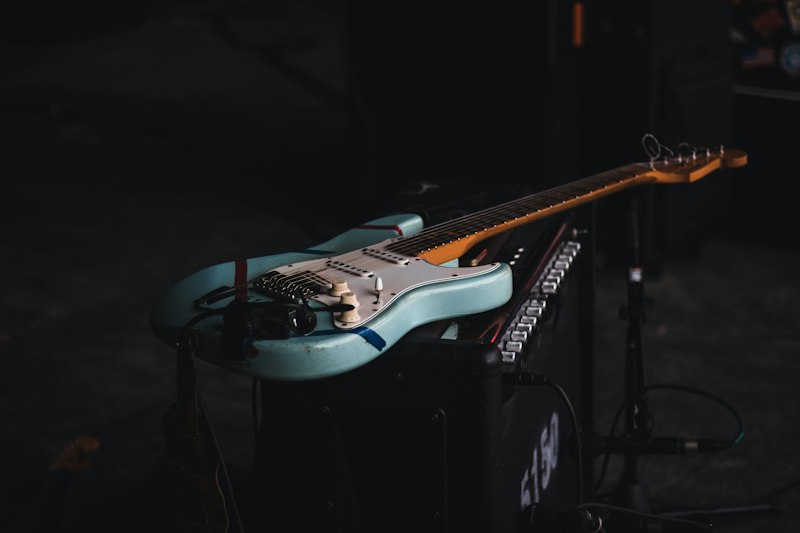
Reverend announced the Billy Corgan Infinite Sadness run this week — 60 guitars total, marking 30 years of Mellon Collie and the Infinite Sadness and the Pumpkins' Rat In A Cage tour. Corgan played the Z-One version during the band's Lollapalooza set this summer.
The split is 36 Z-One models at $1,899 and 24 Drop Z extended-scale models at $1,999. Both are alder-bodied, both are Black Sparkle with an ebony fingerboard and a Mellon Collie moon graphic on the body, both come with a two-tone soft case, a certificate and a poster. The Drop Z is the interesting one on paper: 26.25" scale, 24 frets, roasted maple neck with a medium oval profile.
I want to be clear about where I'm coming from before I say anything else. "1979" is one of my favorite songs ever recorded, I have exactly four presets on my HX Stomp and one of them exists solely so I can play Pumpkins songs after my kids go to bed, and if somebody handed me one of these I would not give it back. This is not a piece about how you shouldn't want it.
It's a piece about what the pickups will do to your presets, because most of the coverage is going to stop at the moon graphic.
The Pickups Are the Product
Everything else here is a finish and a headstock icon. The tonal claim is the Railhammer Billy Corgan Z-One set, and the spec sheet is specific enough to reason from:
- Bridge (BC2-B): 14.5k, ceramic magnet, 43-gauge wire
- Neck (BC2-N): 8.0k, ceramic magnet, 42-gauge wire
Railhammer's design puts rails under the wound strings and oversized poles under the plain strings. The stated intent is tighter lows and fatter highs — humbucker drive with some of a P-90's attack.
That 14.5k bridge number is the one that matters. A vintage-style Strat single coil sits somewhere near 6k with an alnico magnet. You are looking at roughly double the DC resistance and a ceramic magnet instead of alnico, which in practice means considerably more output, a fatter midrange, more low end, and a softer top.
And here is the thing the press release will never tell you: both of our Billy Corgan recipes are built on a Stratocaster with three single coils.
What Our Recipes Assume
Cherub Rock runs a 1988 '57 AVRI Strat in Eb standard through a Deluxe Comp, an Industrial Fuzz block standing in for the op-amp Big Muff at Gain 7 / Tone 6 / Level 7, into a Brit 2203 — Line 6's JCM800 2203 — at Drive 2, Bass 5, Mid 6, Treble 6, through a 4x12 Greenback 25 with the Low Cut at 80Hz.
Note that Drive: 2.0. Almost all of the distortion in that preset is coming from the Muff. The amp is providing midrange voicing and power-stage compression, not gain.
Bullet With Butterfly Wings is the same architecture with a Tycoctavia Fuzz at Gain 7.5 standing in for the Fender Blender, the Brit 2203 at Drive 4, and the cab's Low Cut at 85Hz.
Both presets are tuned for a signal that arrives thin, bright and low-output. That is the input the Muff-style circuit in front of them was voiced for. Feed those exact settings a 14.5k ceramic humbucker and three things go wrong at once.
The Four Numbers to Change
1. Industrial Fuzz Gain: 7.0 → 5.0.
This is the big one and it is counterintuitive. You are not lowering the gain because the guitar is hotter and you want less distortion. That fuzz block is already fully saturated at Gain 7 with a single coil in front of it — pushing it harder does not produce more distortion, it produces more low-frequency content arriving at a stage that cannot do anything with it except smear. Dropping to 5.0 puts the input back roughly where the preset was voiced. Our Big Muff settings guide covers why the gain control on these circuits stops behaving like a gain control past about the midpoint, and Muff vs. Fuzz Face covers how differently the two respond to a hotter pickup.
2. Industrial Fuzz Tone: 6.0 → 7.0.
The single coil was supplying top end the humbucker does not. A Muff-style tone control is a blend between a lowpass and a highpass with a scooped notch in between, so you are not adding treble so much as shifting where the notch sits. Go up one, listen, adjust. If it gets brittle, you went too far — the ceramic magnet's top end is soft but it is not absent.
3. Cab Low Cut: 80Hz → 105Hz.
The extra low end from a ceramic humbucker has to go somewhere. In a band it goes on top of the bass player. Raising the cab's Low Cut is a cleaner fix than pulling the amp's Bass control down, because it leaves the amp's tone stack interaction alone — and on a 2203 that interaction is most of the character. Leave Bass at 5, Mid at 6, Treble at 6.
4. Brit 2203 Drive: leave it at 2.0.
The temptation with a hot pickup is to also back the amp off. Don't. At Drive 2 the 2203 model is barely clipping — the gain you are hearing is the pedal. Take the amp down further and you lose the power-stage compression that glues the whole thing together, and the preset goes brittle. Our JCM800 settings guide walks through what that circuit does at low Drive settings and why it is not the same as "clean."
Then use the guitar. The Bass Contour control on these Reverends is a passive low-frequency rolloff right at the pickup, before anything else in your chain sees it. It is the correct place to solve a "too much low end into a fuzz" problem, and it beats re-EQing the preset because it is a knob you can move mid-song. Set your preset for the Contour fully open and roll it back for the heavy parts.
If You Buy the Drop Z
The 26.25" scale is a bigger change than the pickups, and it changes different things.
Longer scale at the same tuning means higher string tension, which means a faster, harder attack transient and a tighter low end before any processing. Two adjustments:
- Low Cut higher still — 115–125Hz if you are down in Eb or below. Long scale gives you real content under 100Hz that a 25.5" Strat in Eb simply does not produce, and the Greenback cab model will happily pass it into the mud.
- Deluxe Comp Threshold: -30dB → about -24dB. The recipes use -30 with a 2:1 ratio to even out a loose single-coil attack. A high-tension baritone with a ceramic humbucker is already even. Compressing it that hard flattens exactly the percussive attack you paid for the scale length to get. Our compressor placement guide covers the pre-amp vs. post-amp decision if you want to go further.
Also: keep the tuning honest. Both recipes are notated in Eb standard because that is where those songs live. A 26.25" baritone tuned to Eb is a very tight Eb, not a baritone tone — it is a different flavor of the same key, and it is a good one. If you drop it to B, you are no longer playing the record, you are playing a rearrangement, and you will need to rebuild the low cut and the gain from scratch rather than adjusting.
Is It Worth $1,899?
Here's my honest read, from someone whose guitar budget competes with a kid's shoe budget.
Sixty guitars is not a product launch, it's a memento. These will sell, they will end up on Reverb above retail, and the moon graphic is genuinely beautiful. If you want the object, buy the object — that's a legitimate reason and I'm not going to pretend otherwise.
But if what you want is the sound, understand what you're actually buying. The Railhammer Billy Corgan Z-One pickups are sold separately. They are the entire tonal argument of this guitar, and you can put them in something you already own for a fraction of $1,899. That's not a knock on Reverend — their standard Billy Corgan signature models carry the same pickups at a lower price and without the limited-run premium.
And the deeper thing: the records these guitars commemorate were not made with these pickups. They were made with single coils into a Muff into a Marshall, layered a dozen deep in a studio. The layering is doing at least as much work as the guitar. That's not a reason to skip the Reverend. It's a reason not to expect the guitar to hand you the record, and to spend twenty minutes with the two recipes above adjusting four numbers instead.
Constraints aren't the enemy here. They're just the terms of the deal — and at $1,899 for one of sixty, the terms are worth reading closely.


