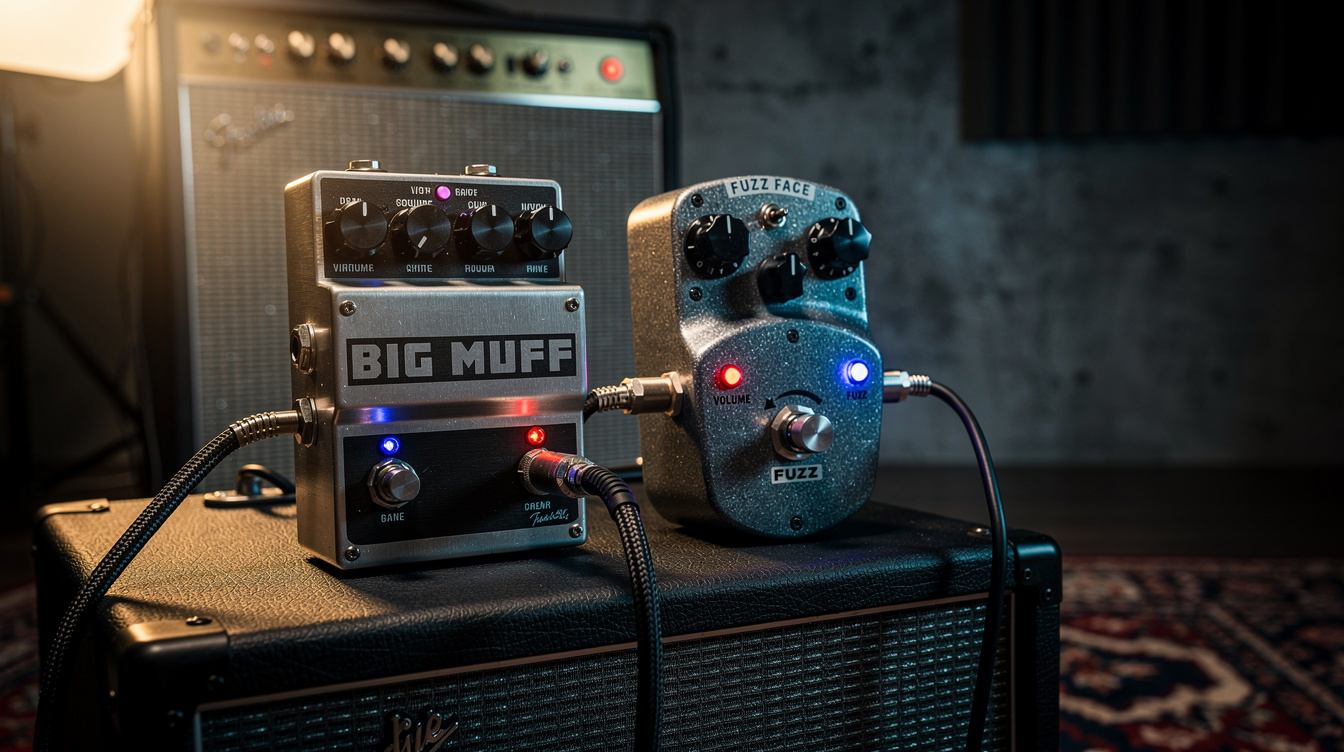
Start Here: The Big Muff and the Fuzz Face are both called "fuzz pedals," but the circuits do fundamentally different things and respond to your playing in opposite ways. If you're trying to choose between them: the Fuzz Face rewards gentle touch and guitar volume manipulation; the Big Muff is built for sustain, fullness, and mass. It doesn't negotiate with your dynamics the same way. The comparison table and genre guide are at the bottom.
Two Fuzzes, One Word
The word "fuzz" covers a lot of tonal territory. It describes the Hendrix wah-wah-fuzz explosions on "Voodoo Child," the infinite sustain of Gilmour's Big Muff leads on Animals, the brittle bite of early Jack White, and the shoegaze wall of sound that Kevin Shields built out of chorus and sustain. These sounds are related in the way that all drive pedals are related (they all involve clipping the signal), but the mechanism is different enough that one fuzz cannot do the other's job.
The Fuzz Face and the Big Muff represent two distinct philosophies about what fuzz is for.
The Fuzz Face: What It Is
The original Fuzz Face (Dallas Arbiter, 1966) uses two transistors in a simple circuit that was literally designed to fit inside a wah enclosure. The circuit is minimal: two gain stages, a couple of capacitors and resistors, and an output control. The transistor type (germanium in the early versions, silicon in later ones) dramatically affects the character, which is covered in a separate guide on germanium vs. silicon fuzz. But regardless of transistor type, the circuit behaves the same fundamental way: it clips early and interactively.
The key behavior: the Fuzz Face's input impedance is extremely low. This means it's enormously sensitive to what's driving it (specifically, to the output level and tone of the guitar pickups). When you roll your guitar's volume knob down, the Fuzz Face doesn't just get quieter. It cleans up. The transistors stop clipping as aggressively, and the pedal transitions from full saturated fuzz to a warm, slightly broken-up overdrive tone. Anywhere between 3 and 7 on your guitar volume, you're in a territory that most other drive pedals can't access at all.
The implication: a Fuzz Face rewards playing with your guitar's volume control as an expressive tool. Hendrix understood this intuitively. The way his guitar moved between clean rhythm and full-on fuzz within the same phrase, using the volume knob rather than his feet, is not a technique available with most modern drive pedals. It's built into the circuit.
The Big Muff: What It Is
The Big Muff Pi (Electro-Harmonix, 1969–present) uses a more complex topology: two clipping stages cascaded in series, a passive tone stack, and a recovery amplifier. Where the Fuzz Face has two transistors, the original Big Muff has four. The cascaded clipping stages are what give the Big Muff its characteristic infinite, compressed sustain.
The key behavior: the Big Muff compresses aggressively at high Sustain settings. When the signal hits the first clipping stage, it's already saturated before the second stage sees it. By the time it reaches the output, the dynamic range has collapsed substantially (not in a subtle, musical way, but in a massive, wall-of-sound way). Notes bloom. Sustain is effectively limitless at high settings. But the guitar volume rollback trick that works on a Fuzz Face? It doesn't work the same way on a Big Muff. Roll the guitar volume down and the Big Muff gets quieter. The fundamental fuzz character doesn't change much.
The implication: the Big Muff is not an interactive, touch-sensitive fuzz. It's a sustained, saturated wall generator. If you want to vary your fuzz character with picking dynamics and guitar volume, the Big Muff is the wrong tool. If you want a fuzz that keeps the sound consistent and massive regardless of how hard you dig in, the Big Muff is purpose-built for that.
How They Respond to Your Playing
Touch Dynamics
| Fuzz Face | Big Muff | |
|---|---|---|
| Light picking | Significantly cleaner, warmer | Moderately cleaner, still compressed |
| Medium picking | Mid-gain, bloomy | Full fuzz character |
| Hard picking | Full fuzz saturation | Full fuzz saturation, harder attack |
The Fuzz Face's response range is wider. You can access more distinct tonal territories through picking dynamics alone. The Big Muff's range is narrower; it moves from "fuzz" to "more fuzz," and the compression floor is higher.
Guitar Volume Rollback
| Guitar Volume | Fuzz Face | Big Muff |
|---|---|---|
| 10 (full) | Full fuzz, thick | Full fuzz, massive |
| 7 | Moderate fuzz, bloomy | Full fuzz, slightly quieter |
| 5 | Edge-of-breakup, warm OD | Moderate fuzz, audibly thinner |
| 3 | Nearly clean with harmonic bloom | Thin and somewhat weak |
The Fuzz Face at 5 is genuinely musical; it's sitting in a territory that feels like a vintage overdrive. The Big Muff at 5 is just a quieter, thinner version of itself. This isn't a flaw in the Big Muff; it's the nature of the cascaded-stage design. It was built for full saturation, not for dynamic range across the guitar volume knob.
Amp Pairing
Both fuzzes care about the amp they're driving into, but differently.
Fuzz Face into amplifiers: The Fuzz Face was designed for low-input-impedance amps with strong midrange character. A Marshall-style amp is the natural habitat. The Fuzz Face's impedance sensitivity also extends to what comes before it in the signal chain. A buffer before the Fuzz Face changes its impedance characteristics and can rob the circuit of its interactive, cleaning-up quality. This is why Hendrix's pedalboard had the Octavia and Fuzz Face placed before the Wah in the chain (or sometimes run in a way that minimized what came between the guitar and the fuzz). If you're using a buffered pedal (any Boss pedal, for instance) before a Fuzz Face, you'll lose some of the volume-rollback magic.
Big Muff into amplifiers: The Big Muff's mid-scoop (a pronounced dip in the 500 Hz–1 kHz range depending on variant and Tone knob position) means it needs an amp with some midrange presence to avoid disappearing in a band context. A bright Fender-style amp with natural upper-mid emphasis compensates for the scoop. A mid-heavy British amp can actually exacerbate muddiness. The Big Muff's own settings guide covers amp pairing in detail. The short version is that a Fender-style platform usually works better than a Marshall-style one, which is the opposite of the Fuzz Face's preferred environment.
Genre Applications
| Genre | Fuzz Face | Big Muff |
|---|---|---|
| Classic rock, Hendrix-influenced | Ideal (the original context) | Usable but different character |
| Shoegaze, My Bloody Valentine-influenced | Limited (not enough sustain) | Ideal (the original shoegaze fuzz) |
| Doom, stoner rock | Can work at maximum settings | Ideal |
| Blues lead | Ideal at moderate settings | Less dynamic but usable |
| Gilmour-style leads | Achievable but different character | Ideal (the original context) |
| Garage rock, White Stripes-influenced | Both work, different flavor | Both work |
| Post-rock ambient swells | Can work with volume manipulation | Better for sustained swells |
Which One Should You Get?
Get the Fuzz Face if:
- You play primarily with fingers or a light pick attack and value touch dynamics
- You use your guitar volume control as part of your playing
- Your musical reference is Hendrix, early Clapton, vintage blues-rock
- You're running a direct connection from guitar to fuzz with minimal buffering before it
Get the Big Muff if:
- You want sustained, massive, wall-of-sound fuzz that stays consistent
- Your musical reference is Gilmour, shoegaze, doom, or feedback-heavy rock
- You're playing in a context where consistent output matters more than dynamic range
- You want a fuzz that sounds enormous in isolation and is willing to work around its mid-scoop in a band
The honest answer for most players: these are not competing options. They occupy different sonic and functional territories, and a complete fuzz toolkit eventually includes both. The Fuzz Face is the interactive, dynamic, low-sustain fuzz. The Big Muff is the compressed, high-sustain, massive fuzz. If you only have room for one, start with the Fuzz Face if you play dynamic, feel-based music, and start with the Big Muff if you play sustained, layered, texture-forward music.
The Comparison at a Glance
| Fuzz Face | Big Muff | |
|---|---|---|
| Circuit type | Two-transistor, simple | Three-stage cascaded clipping |
| Sustain | Moderate | Massive, near-infinite |
| Touch dynamics | Highly responsive | Moderately responsive |
| Guitar volume rollback | Cleans up beautifully | Gets quieter, not cleaner |
| Mid character | Midrange-present | Mid-scooped (varies by variant) |
| Buffer sensitivity | Sensitive (avoid buffers before it) | Not buffer-sensitive |
| Best context | Blues, classic rock, Hendrix | Shoegaze, doom, Gilmour, sustained leads |
| Price range (current versions) | $80–$180 (silicon), $150–$300+ (germanium) | $80–$130 (standard/nano) |
Frequently Asked Questions
Can you run a Fuzz Face into a Big Muff? You can, but the result is usually more noise than usefulness. Both pedals want to be driving into an amp's input stage, and stacking them produces interaction that can sound interesting in experimental contexts, but it's not a standard tone-building technique.
Which fuzz did Jimi Hendrix use? Hendrix used both Fuzz Faces (primarily) and the Octavia (for the upper octave effect). He didn't use a Big Muff. The Muff came out in 1969, which was near the end of his career, and his signature sound was built on the Fuzz Face.
Does the Fuzz Face work well with humbuckers? The Fuzz Face was designed for single-coil pickups. Its input impedance and the way it responds to guitar volume and tone work best with single-coils. Humbuckers drive the Fuzz Face harder and reduce the guitar-volume-rollback cleaning effect. It still works, but the interactive magic is diminished.
Why do some Fuzz Face clones cost $250 and some cost $80? The price difference is primarily about transistor selection (NOS germanium transistors are expensive and require hand-matching), circuit board quality, and enclosure construction. A $250 Analogman Sunface with matched NOS germanium transistors will behave differently (and for many players better) than an $80 silicon Fuzz Face. For a first Fuzz Face experience, the silicon version is a reasonable entry point.
Can I get the Big Muff sustain out of a Fuzz Face by cranking the gain? Not quite. Cranking a Fuzz Face gets you more aggressive and less touch-sensitive, but the topology isn't built for the same kind of infinite, compressed sustain the Big Muff produces. They're different architectural solutions to different problems.