What Is the 4-Cable Method?
Your modeler has better effects. Your amp has better feel. The 4-cable method lets you use both.
Here is the deal. A good tube amp pushes back when you dig in. No modeler does that the same way. But running all your effects through the front of the amp is a mess. Delay and reverb in front of a cranked preamp? Mud.
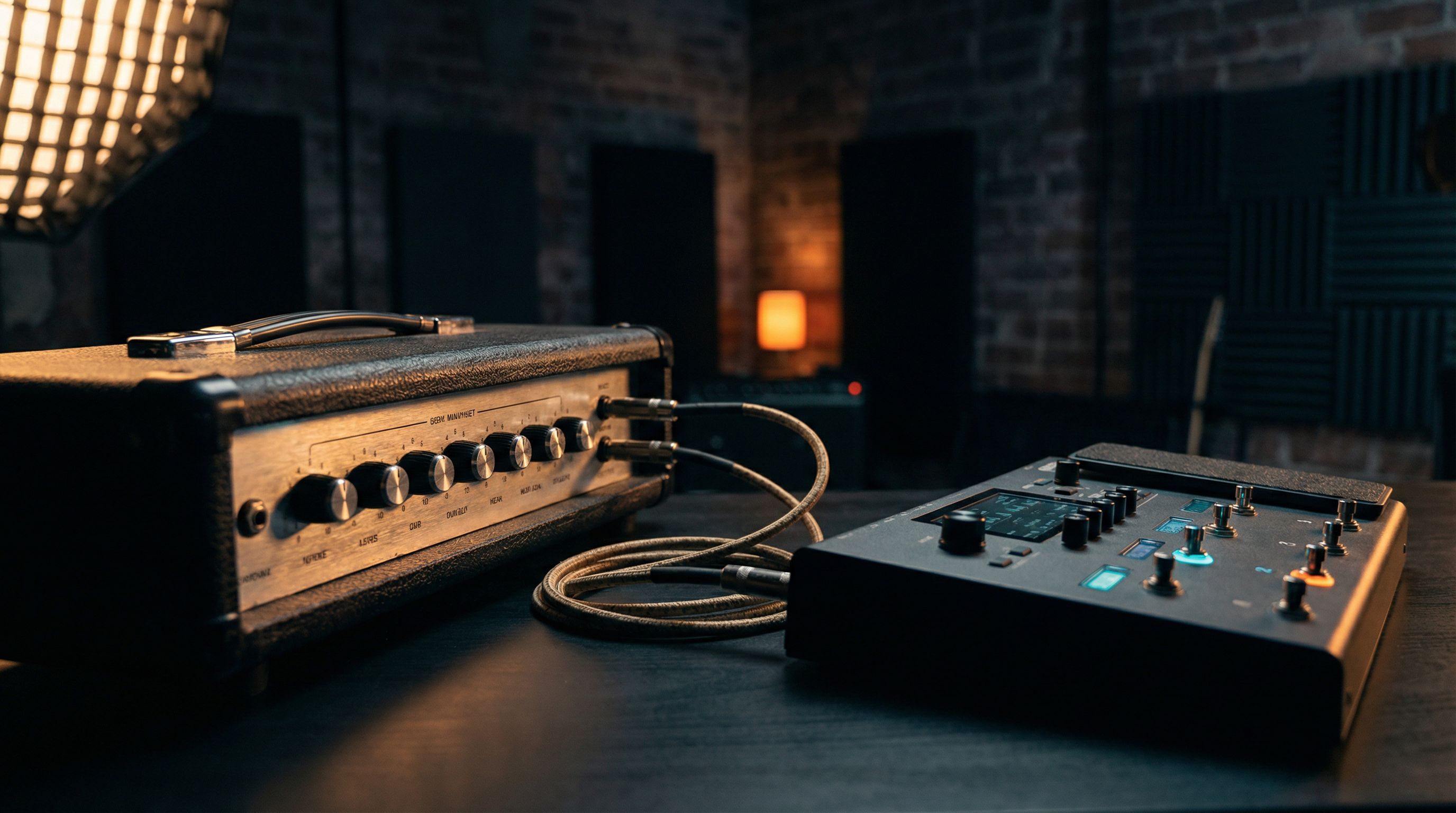
The 4-cable method (also called 4CM or 4-wire) puts some effects before your amp's preamp and others after it. Your amp's tone stays intact. The modeler handles the rest.
Helix delays and reverbs in your amp's effects loop. A Tube Screamer model into the front input. That is what this does.
Four cables. Four connections.
- Guitar to modeler input — your guitar signal enters the modeler first
- Modeler output to amp input — the modeler sends your processed signal to your amp's front end
- Amp effects send to modeler return — your amp's preamp signal comes back into the modeler
- Modeler second output to amp effects return — the modeler sends the final signal back to your amp's power section
Four cables. The modeler wraps around your amp's preamp. It sits in front of and behind the gain stage. Sounds complicated. It is not. Trace the signal once and it clicks.
Why Would You Use 4CM?
Because you love your amp but want better effects.
Most guitarists who own both a modeler and a tube amp hit the same wall. Going fully direct through the modeler gives you flexibility, but it does not feel like a real amp moving real speakers in a real room. Running the modeler straight into the front of the amp is limiting. Delay and reverb belong after the preamp distortion. Not before it.
The 4-cable method solves this by splitting your modeler's signal chain into two halves:
- Pre-amp effects (before your amp's preamp): wah, compressor, overdrive, boost — anything you would normally put on a pedalboard in front of your amp
- Post-amp effects (in your amp's effects loop): delay, reverb, modulation, EQ — anything that benefits from receiving an already-distorted signal
Not sure which effects go in front versus in the loop? Our guide to signal chain order covers it.
Your amp's preamp does what it does best. The modeler handles everything else.
This matters most when you have a tube amp with a voice you refuse to give up. A cranked Marshall JCM800. A Fender Deluxe Reverb on the edge of breakup. A Mesa Rectifier with that tight low end. If the amp has a feel no model has matched, the 4-cable method lets you keep it and surround it with whatever effects you want.
The 4 Cables Explained in Detail
Know what each cable does. That is how you troubleshoot when something goes sideways at soundcheck.
Cable 1: Guitar to Modeler Input
Your guitar plugs into the modeler's main input. Same as going direct. The modeler gets your raw signal first.
Why the guitar goes into the modeler and not straight into the amp? Because you want certain effects before the signal hits the amp's preamp. Plug into the amp first and you have no way to put modeler effects in front of it.
Cable 2: Modeler Send to Amp Input
The modeler processes your front-of-amp effects (wah, compressor, overdrive) and sends the signal to your amp's regular input. Your amp sees it the same way it sees a pedalboard. Instrument level. The preamp does its thing.
This cable runs from the modeler's send output to the front input of your amp. Not the effects return. The regular input jack.
Cable 3: Amp Effects Send to Modeler Return
This is where it gets good. Your amp's effects loop has a send jack. That is the signal after the preamp but before the power amp. This cable takes that signal and routes it back into the modeler.
Now the modeler has your amp's real preamp tone in its chain. Delay, reverb, modulation, EQ; whatever you put in the post-amp section of your preset hits the real amp signal.
This cable is what makes 4CM worth the trouble. Without it, you are just running effects in front of your amp like a normal pedalboard.
Cable 4: Modeler Output to Amp Effects Return
The last cable takes the fully processed signal and sends it back into the amp's effects loop return jack. This goes straight into the power amp, bypassing the preamp on the return trip.
The power amp pushes it through the speaker. You hear your amp's preamp tone, shaped by the modeler's effects, through your amp's power section and cabinet.
Step-by-Step Setup: Line 6 Helix
The Helix family — Helix Floor, Helix LT, HX Stomp — handles 4CM natively with its flexible routing. Here is exactly how to set it up.
Physical Connections
- Cable 1: Guitar into Helix Guitar Input
- Cable 2: Helix Send 1 (or FX Loop 1 Send on the back panel) to your amp's front input
- Cable 3: Amp's effects loop Send to Helix Return 1 (or FX Loop 1 Return)
- Cable 4: Helix 1/4" Output (left/mono) to your amp's effects loop Return
Signal Chain in the Preset
Build your Helix preset signal chain like this:
- Input block — set to Guitar Input
- Pre-amp effects — wah, compressor, overdrive, boost, or whatever you want before the amp
- FX Loop 1 block — this is critical. Insert an FX Loop block (Send/Return 1) at the point where you want the amp's preamp to sit. This block sends the signal out Cable 2 to your amp and receives the amp's preamp signal back via Cable 3
- Post-amp effects — delay, reverb, modulation, EQ, anything you want after the preamp
- Output block — set to 1/4" Output, which sends the final signal out Cable 4 to the amp's effects return
Do not include an amp or cab block in the preset. You are using your real amp and real cab. Adding a modeled amp on top of your real one sounds muddy, compressed, and wrong — like hearing a room through a photograph of that room. If you switch between 4CM presets and direct presets, make sure the 4CM presets have the amp/cab blocks removed or bypassed.
Signal Level Settings
This is where most people run into problems. Your Helix needs to communicate at the right signal levels with your amp, and there are two different standards at play:
- Instrument level — the low-output signal your guitar produces and your amp's front input expects
- Line level — the higher-output signal used in effects loops and professional audio gear
On the Helix, go to Global Settings > Ins/Outs and configure:
- FX Loop 1 Send: set to Instrument level (you are feeding your amp's front input, which expects instrument level)
- FX Loop 1 Return: experiment with Line or Instrument depending on your amp's effects loop (more on this below)
- 1/4" Output: set to Line level (you are feeding the amp's effects return, which typically expects line level)
Getting these levels wrong is the number one cause of tone suck, volume drops, and noise in a 4CM setup. If something sounds thin, quiet, or noisy — check these settings first.
Step-by-Step Setup: Neural DSP Quad Cortex
The Quad Cortex handles 4CM slightly differently because of its grid-based routing. The concept is identical.
Physical Connections
- Cable 1: Guitar into QC Input 1
- Cable 2: QC Send 1 to your amp's front input
- Cable 3: Amp's effects loop Send to QC Return 1
- Cable 4: QC Output 3 (or any available output) to your amp's effects loop Return
Signal Chain on the Grid
On the Quad Cortex grid:
- Start at Input 1 on the left side of the grid
- Place your pre-amp effects (drives, compressor, wah) in the first few columns
- Insert a Send 1 block — this routes the signal out to your amp's input
- On the next row or continuing on the same row, start from Return 1 — this picks up the signal from your amp's effects loop send
- Place your post-amp effects (delay, reverb, modulation) after the Return 1 block
- Route the end of the chain to Output 3 (or whichever output you connected Cable 4 to)
Level Matching on QC
In the Quad Cortex I/O settings:
- Send 1: set the output level so it does not overdrive your amp's front input. Start with the level at unity and adjust down if your amp sounds too hot.
- Return 1: match the input level to your amp's effects loop output. If your amp has a line-level loop, keep Return 1 at line level.
- Output 3: adjust to match what your amp's effects return expects.
The QC gives you per-output level controls. Use them. The goal is for the volume to stay consistent whether you bypass or engage the 4CM routing.
Signal Level Matching: The Details That Matter
Signal levels are the technical detail that separates a great 4CM setup from one that makes you want to throw the whole rig off the stage.
Instrument Level vs. Line Level
Instrument level is the signal your guitar pickups produce — typically around -20 dBu to -10 dBu. Weak signal. Your amp's front input is designed to receive this level and boost it through the preamp gain stages.
Line level is the stronger signal used by professional audio equipment, effects loops, and studio gear — typically around +4 dBu (professional) or -10 dBV (consumer). Your amp's effects loop operates at some version of line level, though the exact level varies wildly between amps.
When you set up 4CM, you have two critical level transitions:
-
Modeler to amp input (Cable 2): Your amp's front input expects instrument level. Send it a line-level signal and the preamp will be overdriven before you touch the gain knob. Everything sounds compressed and distorted even on clean settings. Set this send to instrument level.
-
Amp effects send to modeler return (Cable 3) and modeler output to amp effects return (Cable 4): These should both be at whatever level your amp's effects loop operates at. Most modern amps use line level. Some amps — especially vintage-style amps or amps with series loops — have lower-level effects loops.
How to Tell If Your Levels Are Wrong
- Too much signal into the amp input: Your clean channel sounds crunchy even with gain at zero. The amp distorts immediately. Turn down the send level or switch to instrument level.
- Too little signal into the amp input: Your tone sounds thin and weak. You have to crank the gain to get any response. Turn up the send level.
- Too much signal from the effects loop: The modeler's input clips, causing harsh digital distortion. Turn down the return level on the modeler or reduce the amp's effects send level (some amps have a send level knob).
- Too little signal from the effects loop: Your post-amp effects sound noisy because the signal-to-noise ratio is poor. Turn up the return level.
The FRFR Option Within 4CM
Some players run a hybrid setup — 4CM with the real amp for stage monitoring, plus a separate direct output from the modeler with amp/cab modeling going to the PA. You get the feel of your real amp on stage while front-of-house gets a consistent modeled tone. The Helix and Quad Cortex both support this with their multiple output routing. Smart approach if your sound guy appreciates consistency.
Common Problems and How to Fix Them
Ground Loop Hum
The most common 4CM complaint. Four cables creating a ground loop between the modeler and the amp. The result is a persistent 60Hz hum — 50Hz if you are gigging in Europe.
Fixes:
- Use a ground lift. The Helix has a ground lift switch on the XLR outputs. Some amps have ground switches too. Try lifting the ground on one device.
- Power both devices from the same power strip. Ground loops are often caused by different ground potentials between outlets.
- Use an isolation transformer or a quality DI box on one of the cables to break the ground loop.
- Check your cables. Cheap cables with poor shielding make ground loop problems worse.
Volume Drop When Engaging Effects Loop
If your volume drops when you activate the FX Loop block in your modeler, the signal levels are not matched. Adjust the send and return levels on the FX Loop block until bypassing and engaging the block produces the same volume.
On the Helix, you can adjust the FX Loop block's Send Level and Return Level parameters independently. Start with return level — bring it up until the volume matches.
Tone Suck
If your tone sounds duller or thinner when running 4CM compared to plugging straight into the amp, you are losing high-frequency somewhere in the signal chain. Common culprits:
- Cheap cables. Long cable runs with high capacitance roll off treble. Use quality, low-capacitance cables and keep lengths as short as possible.
- Wrong impedance settings. Some modelers have adjustable input impedance. For 4CM, set the guitar input impedance to match what your guitar expects (typically 1M ohm for passive pickups). Set the return input to a lower impedance suitable for the effects loop signal.
- Buffering issues. The modeler's input buffer changes your guitar's signal characteristics before it hits the amp. Some players notice a subtle difference in feel compared to plugging straight in. This is inherent to the method — the modeler is always in the path.
Sounds like a dealbreaker. It is not. Most players stop noticing within ten minutes. Set the impedance right on the modeler's input and it gets closer to the straight-in feel than you would expect.
Noise and Hiss
Four cables means more connections. More potential for noise. Keep cable runs short, use quality shielded cables, and place a noise gate block early in your preset chain — before the FX Loop block. You can also place a second noise gate after the FX Loop block to catch any noise from the amp's preamp.
When to Use 4CM vs. Going Fully Direct
The 4-cable method is not always the right answer.
Use 4CM when:
- You have a tube amp with a tone you love and refuse to replace with a model
- You play small clubs, rehearsals, situations where you need your amp on stage
- You want the physical interaction with a real amp and speakers — the push-back, the air, the way it responds to your picking dynamics
- You already own the amp and modeler and want the most out of both
Go fully direct when:
- Consistency is critical — you need the same tone every night regardless of venue, stage volume, or monitor situation
- You need silent practice or recording flexibility
- You are flying to gigs and cannot bring an amp
- You are happy with your modeler's amp tones — the modern ones have gotten genuinely close
- Simplicity matters — 4CM adds complexity, cables, and potential failure points
Fully direct has become good enough that many professional touring guitarists have abandoned real amps entirely. The 4-cable method is for players who genuinely prefer their real amp's character. But if you are setting up 4CM because you assume modeler amp models are not good enough — spend serious time dialing in the models first. Give them a fair shake. Then decide.
Alternatives to 4CM
2-Cable Method
The simplest setup. Guitar into modeler, modeler into amp's front input. You only get effects before the amp's preamp. Delay and reverb go in front of the amp, which works fine for some styles — shoegaze, lo-fi, certain ambient textures — but sounds messy for tight, articulate playing.
Modeler in the Effects Loop Only
Two cables. Amp's effects send into modeler input, modeler output into amp's effects return. You get post-preamp effects — delay, reverb, modulation — from the modeler, but no pre-amp effects. Your pedalboard handles everything in front of the amp. Good compromise if you already have a pedalboard you love and just want better time-based effects.
Wet/Dry/Wet
An advanced setup using three amplifiers. Your dry amp in the center with no effects, two "wet" amps on the sides carrying stereo delay and reverb. The modeler routes the dry signal to the center amp and the effected stereo signal to the side amps. This is the rig Alex Lifeson, John Petrucci, and many studio guitarists have used. Sounds incredible. Requires three amps, a stereo power amp, and careful level management. Not for the faint of heart — or the small of van.
Hybrid Direct + Amp
Run your modeler direct to front-of-house with amp/cab modeling while also sending a feed to a small stage amp or powered monitor for personal monitoring. You get direct-tone consistency for the audience and a real amp-in-the-room feel for yourself. Many touring pros use this approach.
Tips for Getting the Best 4CM Tone
Keep cables short. Every foot of cable adds capacitance, which rolls off high end. Use the shortest cables that reach comfortably. If you need a long run, use a buffer or active cable.
Label everything. Four cables going between two units gets confusing fast — especially when troubleshooting at a gig under red stage lights with the drummer soundchecking behind you. Use colored tape or labeled cable tags so you can instantly identify which cable goes where.
Build a dedicated 4CM preset. Do not try to modify a direct preset for 4CM. Start from scratch with no amp or cab blocks, insert the FX Loop block, and build around it. Save it as a template you can duplicate.
Test with headphones first. Before connecting to your amp, set up the Helix or QC with headphones and verify the signal chain works correctly. Make sure the FX Loop block is passing audio and that your pre and post effects are in the right positions.
Set your amp's effects loop to series, not parallel. Some amps let you choose between series and parallel effects loops. For 4CM, you want series — the entire signal passes through the loop. Parallel loops blend the dry and wet signals, which can cause phase issues and volume inconsistencies when using 4CM.
Save a bypass snapshot. On the Helix, create a snapshot that bypasses all effects blocks but keeps the FX Loop active. This gives you your raw amp tone as a reference point for dialing in effects levels.
The Bottom Line
The 4-cable method is the most powerful way to integrate a modeler with a real amplifier. Pre-amp effects. Post-amp effects. Your amp's real preamp tone. All in one system. The setup takes patience — especially getting signal levels right — but once it is dialed in, you have a rig that combines the organic character of a tube amp with the processing power of a modern modeler.
If your amp has an effects loop, invest in four quality cables and spend an evening getting the levels matched. The payoff is a rig that sounds like your amp, with effects that sound like a professional studio.