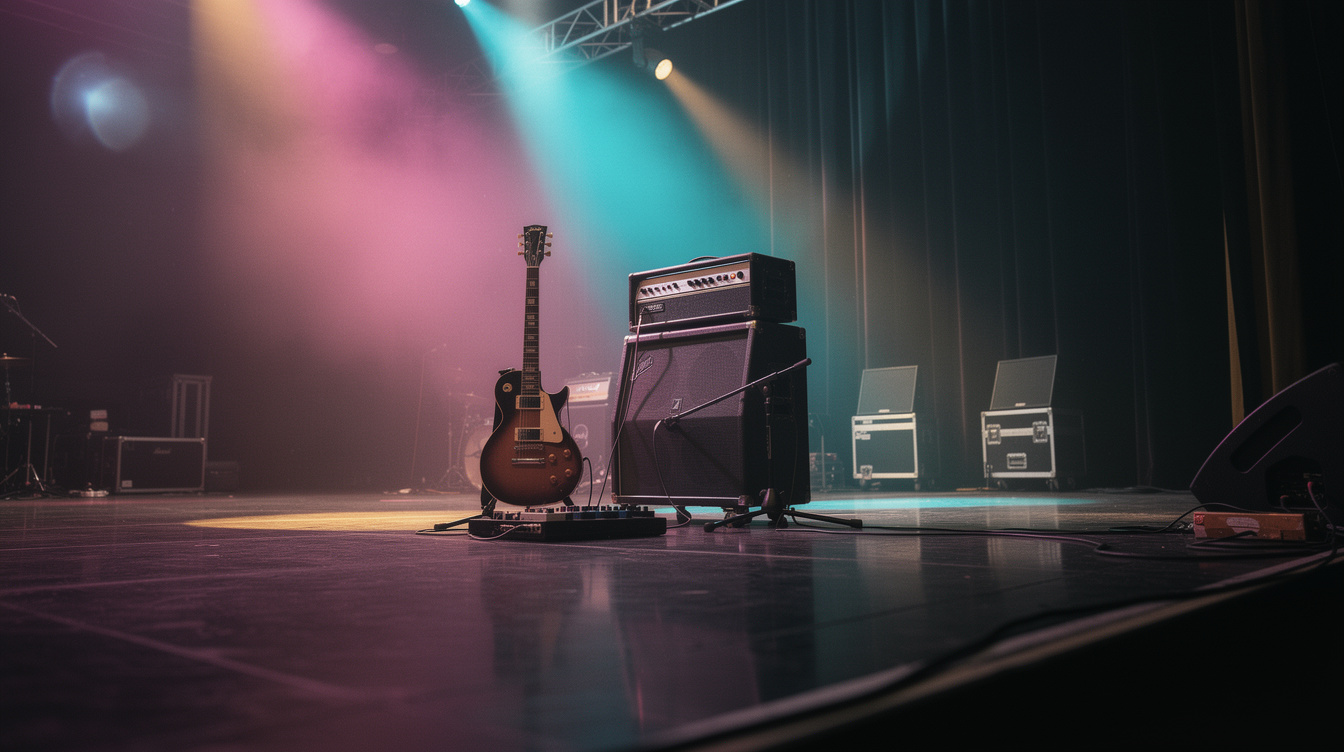
Quick read: Once you've sorted the voltage for a tour abroad, there's a second, quieter issue for old amps: mains frequency. A power transformer wound for US 60Hz runs closer to saturation on European 50Hz, so it draws more current and runs hotter — even at the correct stepped-down voltage. A modern amp doesn't care. A vintage amp with a cost-tight 1960s transformer, run hard for a two-hour festival set, is the case that matters. Frequency also drops your supply ripple from 120Hz to 100Hz, so tired filter caps hum a little more. A step-down converter fixes voltage but not frequency. Manage the heat: recap, ventilate, and don't cook an old amp for hours.
Most of the worry about taking an amp overseas lands on voltage, and rightly so — plug a 120V amp into 230V without a converter and the transformer is gone before you've struck a chord. But there's a second number on every outlet in the world, and it's the one almost nobody packs for. It's the frequency of the wall power itself, and for a vintage amp it can be the difference between a long set that's fine and a long set that leaves the transformer too hot to touch.
The Americas run on 60Hz. Most of the rest of the world — Europe, the UK, Australia, much of Asia — runs on 50Hz. That ten-cycle difference doesn't sound like much, and on a modern amp it isn't. On a fifty-year-old Fender, it's worth understanding before you load that amp onto a plane.
What the Transformer Actually Feels at 50Hz
A power transformer is a balancing act between voltage, frequency, and the iron core it's wound around. The magnetic flux swinging through that core each cycle depends on the voltage divided by the frequency — and here's the part that matters: lower the frequency, and the flux per cycle goes up. The core has more time to magnetize on each swing, so it pushes further toward its saturation point.
A transformer designed for 60Hz, run on 50Hz, sits closer to that saturation ceiling than its designer ever intended. When a core nears saturation it stops behaving — it draws a surge of magnetizing current, and that current turns into heat. The transformer runs hotter. Not in a dramatic, smoke-and-sparks way. In a slow, the-iron-is-warmer-than-it-should-be way that you only notice two hours into a set.
| Your amp | Plugged into | Transformer behavior | The verdict |
|---|---|---|---|
| US 60Hz | US 60Hz | As designed | Home. No issue. |
| US 60Hz | Europe/UK 50Hz | Closer to saturation, runs hotter | The case to watch on old amps |
| Europe 50Hz | US 60Hz | Further from saturation, runs cooler | Easy. More headroom, less heat. |
That table holds the whole point. The concern only runs one direction. A 60Hz amp on 50Hz is working harder; a 50Hz amp on 60Hz is loafing. If you're a European player bringing an amp to the States, your power transformer is having an easier night than it does at home. It's the American amp going the other way that earns the attention.
Why "Vintage" Is the Word That Matters
A modern reissue or a current production amp has a transformer with margin built in. Manufacturers wind them with enough core to handle both 50Hz and 60Hz markets, because they sell into both, and the part barely notices which side of the world it's on.
The amps that notice are the old ones — and they notice because of how they were built. A power transformer in a mid-'60s Fender was wound to a price, in an era when an amp sold in Fullerton was only ever expected to see Fullerton's 60Hz. There was no reason to give that transformer headroom for a frequency it would never see. So it has none. Run it on 50Hz and it sits right up against its limit, and the insulation on those windings is now sixty years old, baked by decades of heat, more brittle than the day it left the line.
I learned this the hands-on way on a European run with a blackface Deluxe I trusted completely. I'd done the homework on voltage — stepped it down from 230V properly, felt good about it. What I hadn't reckoned with was the heat. Two sets in, I pulled the chassis at the end of the night and the power transformer was hotter to the back of my hand than that same amp ever ran in Texas, voltage handled and everything. The amp sounded right. It just ran like it was working overtime, because it was. That heat is the thing the voltage conversation never mentions, and it's the thing that quietly ages an old transformer's insulation a little faster every hot set.
The Hum You Didn't Expect
There's a second, smaller symptom, and it lives in the speaker rather than the chassis. A tube amp's power supply rectifies the AC and then smooths it with filter capacitors. On 60Hz, full-wave rectification gives you 120Hz of ripple to filter out. On 50Hz, that ripple drops to 100Hz — and a lower ripple frequency is, by a small margin, harder for a capacitor to smooth, because the caps have a touch more time to sag between peaks.
On a fresh amp this is nothing. On a vintage amp whose filter caps are already tired — and on a sixty-year-old amp, they are tired whether or not they've been changed — that extra ripple shows up as hum. A little more than you're used to, and lower in pitch: a 100Hz throb instead of the 120Hz buzz you know from home. It's not a malfunction. It's the supply telling you the caps are working harder against the lower frequency. If your old amp hums more in a London backline than it does in your living room, that's why, and it's one more reason an overdue recap pays for itself before a tour.
What You Can and Can't Do About It
Here's the hard part: the converter you bought for the voltage does nothing for the frequency. A step-down transformer takes 230V to 120V and passes the 50Hz straight through untouched. True frequency converters — boxes that actually synthesize 60Hz from 50Hz mains — exist, but they're heavy, expensive, and you will not find one waiting at a club. For practical touring, you fix the voltage and you manage the frequency.
Managing it is mostly common sense applied with intent:
- Recap the power supply before the tour. Fresh filter caps handle the 100Hz ripple far better and take the hum off the table. On a sixty-year-old amp this is overdue regardless of where you're playing.
- Give the amp air. The whole problem is heat, so don't bury a hot-running amp against a back wall or stack a head into a closed space. Let it breathe.
- Don't run a marginal vintage amp flat-out for hours. A cranked old amp on 50Hz, mic'd through a long festival set, is the worst case. If you need that volume for that long, mic a cooler-running amp.
- Consider leaving the irreplaceable one home. The honest answer for a lot of players: a modern reissue on the tour, the prized vintage piece on the wall at home. The reissue runs cool on 50Hz and you sleep better. The road is hard on old transformers.
The full picture pairs with the voltage map for touring, which sorts the step-up-or-step-down direction by region, and the converter sizing math for getting the VA rating right so the converter itself isn't adding to your troubles. The 100V Japan and UK rundown covers the voltage end in more detail, and the low wall voltage guide handles the case where the room can't hold voltage even at home.
Voltage is the emergency — it kills in seconds and demands the converter. Frequency is the slow burn — it just runs an old amp warm and a little louder in the hum. Treat them as the two different problems they are. Get the voltage dead right, then keep the old iron cool, and that vintage amp will give you the same character on a stage in Manchester that it gives you in your living room. It'll just want a little more air to do it.