A Jensen P12R that spent fifty years in a tweed Deluxe and a JBL D130F that spent fifteen years bolted to a 200-watt steel amp can look identical on the repair bench — same alnico slug, same dust, same faded date code — and still be in very different magnetic health. The question owners ask is whether alnico wears out with age, and whether that recharge the reconer offers is worth paying for. The useful answer depends far less on how old the speaker is than on what it was plugged into.
| Cause | What it does to an alnico 5 speaker magnet | Source |
|---|---|---|
| Time on a shelf | 0.01 to 0.4 percent flux loss per 11.4-year log cycle | Indiana General data, via Seymour Duncan |
| Heat | About 1 percent at 100°F, and it comes back when cool | Greg Timbers, JBL |
| Large voice-coil current | Permanent loss, up to about 3 dB of level | Greg Timbers, JBL |
| Opening the magnetic circuit | Flux drops; alnico is meant to be magnetized assembled | Arnold Magnetic practice; Weber recone service |
| Shock, or iron touching away from the poles | Can reduce flux at the poles | Indiana General, via Seymour Duncan |
Do Alnico Speaker Magnets Weaken Over Time?
Barely. That is the part most forum advice gets backward.
The aging figures most worth trusting come from Indiana General, one of the big American magnet makers of the alnico era, and Seymour Duncan reprints them in its technical archive. They are given per "log cycle," which runs 11.4 years, and they depend on where on its curve the magnet is working:
| Magnet material | Loss per 11.4-year log cycle | Loss at 100,000 hours |
|---|---|---|
| Alnico 5, near residual | 0.01% | 0.06% |
| Alnico 5, near max energy | 0.15% | 0.9% |
| Alnico 5, near coercive | 0.4% | 2.4% |
| Alnico 3, near max energy | 0.4% | 2.4% |
| Ceramic | Negligible | Negligible |
A log cycle means the next equal step takes ten times as long. If a magnet loses 0.4 percent in its first 11.4 years, it loses roughly another 0.4 percent by year 114, not by year 23. The curve flattens almost to nothing. Greg Timbers, a longtime JBL engineer, put it more bluntly in a post on alnico re-magnetizing that collectors have kept in circulation: alnico magnets "will not change with time."
I expected the shelf to be the villain. Every repairman has a story about a tired old alnico speaker, and the natural assumption is that the magnet simply ran down like a battery. The published numbers do not support that. A P12R that lived its life in front of a tweed amp has, on the evidence, very nearly the magnet it left the factory with.
What Actually Demagnetizes an Alnico Speaker
Alnico 5 is strong but easy to push around. Its residual induction is high, around 12,800 gauss for cast material in Adams Magnetic's published property chart, but its coercivity — its resistance to an opposing field — is only about 640 oersteds. Ceramic 8 has under a third of the induction, about 3,900 gauss, but roughly 2,950 oersteds of coercivity in the same chart. Ceramic is a weaker magnet that is very hard to argue with. Alnico is a stronger one that gives ground when shoved.
In a speaker, the thing doing the shoving is the voice coil. Every time current flows through it, the coil makes its own magnetic field, and on half of each cycle that field opposes the magnet. Timbers described what happens when it gets big enough: alnico motors are easy to demagnetize with drive, the loss can reach up to 3 dB, 1.5 to 2 dB is more common, and the damage is permanent until the magnet is externally recharged. It does not creep. It happens when a large enough current hits and gets worse only if a larger one follows.
He was specific about which speakers are at risk. Underhung designs, where a short coil sits inside a long gap, do not generate enough back-field to hurt the magnet. The vulnerable ones are short-gap, long-coil designs, which describes most guitar speakers. Most of JBL's qualifying 4-inch-coil motors, he wrote, lose 1 to 1.5 dB unless they are pummeled.
And then the line that matters most for anyone who owns old amps:
"Most of these designs trace back to the 50's and 60's where 15 - 30 watt tube amps were the rule. They didn't have the current capability to hurt anything."
The trouble arrived with big solid-state power. That is the D130F that lived on a 200-watt steel amp, not the P12R that lived in a Deluxe. Age is not the risk. History is.
The Other Ways Flux Gets Lost
Taking the motor apart. Alnico's low coercivity means it holds its full strength only inside a closed magnetic circuit. Arnold Magnetic's long-standing guidance is that alnico is best magnetized after it has been assembled with its pole pieces into the final circuit. Open that circuit — pull the top plate, knock the magnet off center, separate the assembly to clean out rust and debris — and the magnet falls back to a lower operating point that it will not climb out of by itself. That is why Weber's recone service for vintage USA Jensens, as described by Weber's Brian Spane to Legendary Tones, includes demagnetizing, realigning and re-energizing the magnet when the assembly needs it. A recone where the motor never comes apart does not need it for this reason.
Shock and stray iron. The same Indiana General notes warn that dropping a magnet on a metal surface can reduce its flux, and that touching it with ferromagnetic material anywhere other than the poles can lower the flux at the poles. A speaker frame that has been dropped on a concrete floor has a plausible reason to read low.
Heat, which does not count. Timbers puts alnico's temperature dependence at maybe 1 percent at 100°F, and it returns when the speaker cools. Ceramic is far worse on this point — about 1.5 dB down at 100°F by his figure — but it also recovers. Neither is permanent damage.
What a Recharge Restores, and What It Can't
A recharge puts the assembled motor in a magnetizer, hits it with a pulse far stronger than the magnet's coercivity, and drives it back to saturation. What comes back is the flux in the gap. Nothing else changes.
That flux is one of the terms in speaker sensitivity, and an important one. From the same efficiency relationship used in our alnico vs ceramic spec comparison, sensitivity rises with the square of the motor strength. Work Timbers' numbers backward:
| Level lost | Motor strength remaining |
|---|---|
| 1 dB | about 89% |
| 1.5 dB | about 84% |
| 3 dB | about 71% |
A 1.5 dB loss is the motor running about 16 percent short. That is not subtle on a speaker built for efficiency. Less motor strength also means less electromagnetic control over the cone near resonance, which is why a demagnetized woofer tends to read as both quieter and looser in the bottom octave. Timbers made the same observation from the other direction, describing a hot ferrite motor as behaving "as though the BL was reduced by about 18%."
What a recharge cannot do is just as important. It does not touch the cone, the voice coil, the spider or the surround, which are the parts that set a speaker's resonance and moving mass. Our recone vs replace guide covers how much those parts decide. A speaker with a tired suspension and a perfectly healthy magnet will not be improved by a recharge, and a speaker that sounds dull because of a cracked or softened cone will still be dull afterward.
How to Tell Whether a Speaker Needs One
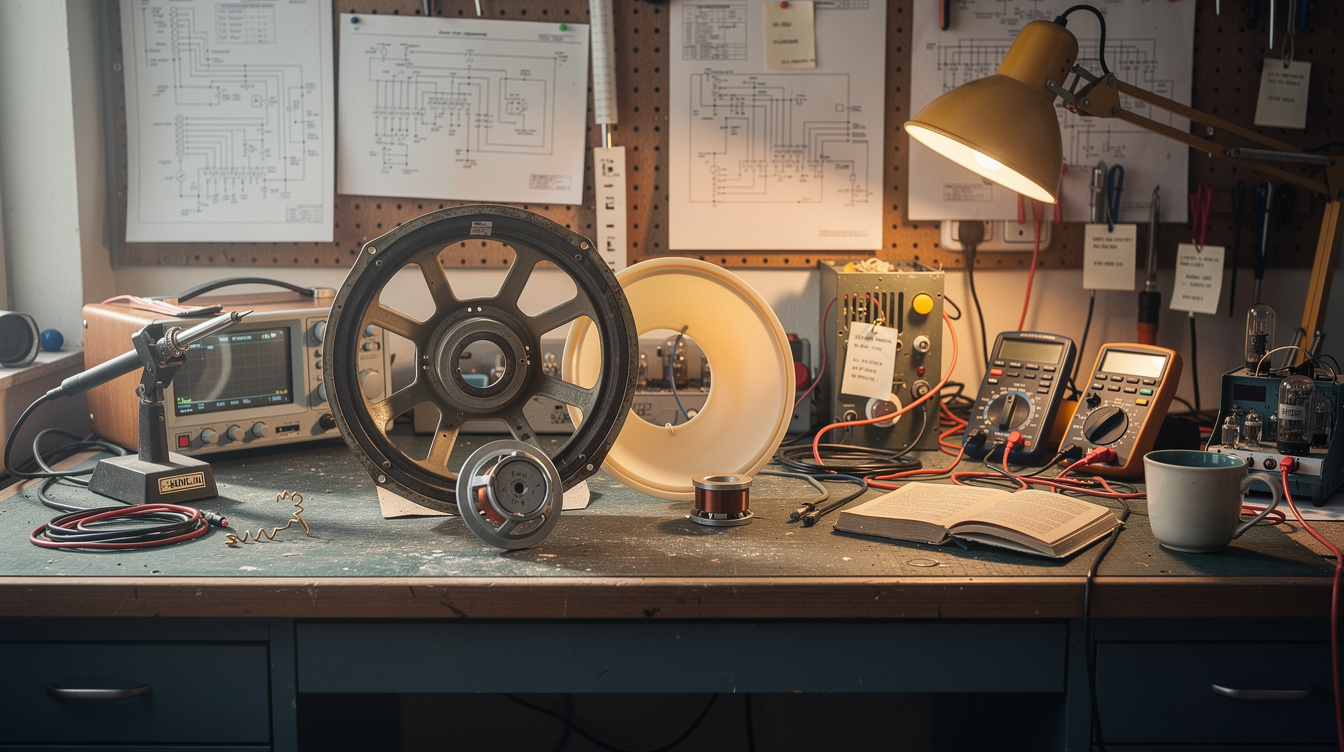
The honest measurement is a gauss meter probe in the magnetic gap, and the probe only fits with the cone out. That makes the recone the natural time to check, and the reconer the natural person to ask.
| Situation | What to do |
|---|---|
| Alnico speaker lived in a low-powered tube amp, motor never opened | Leave the magnet alone. Recone or replace based on the cone and coil. |
| Alnico speaker being reconed, motor stays assembled | Ask for a gap flux reading with the cone off. Recharge only if it reads low against a known-good example. |
| Motor is being taken apart for cleaning or realignment | Expect a recharge as part of the job. Ask the shop to quote it up front. |
| Alnico woofer or full-range driver with a history on a big solid-state amp | Assume some loss is possible. Measure before deciding. |
| Speaker was dropped, or has iron debris stuck to the magnet | Have it measured. |
| Ceramic speaker | No recharge needed. Ceramic does not demagnetize with drive or age. |
Ask for the reading before and after, in writing. A recharge with no numbers attached is a service you have to take on faith, and on a collectible speaker, a documented flux reading belongs in the same folder as the recone receipt.
Where This Leaves the Vintage Buyer
A few practical consequences for anyone shopping old speakers or old amps.
The date code tells you the magnet's age, which turns out to matter very little. The amp it lived in tells you much more. A 1950s alnico speaker in an original low-wattage combo is the safest bet on the magnetic side. An alnico 15 that came out of a steel rig, a bass rig or a PA cabinet run by a powerful solid-state amp is the one to measure. If you're putting a vintage JBL behind a modern 200-watt amp, our guide to how much clean headroom a pedal steel actually needs covers why steel players run that much power and where the low-end demand comes from.
If you play through a modeler and an impulse response of a vintage alnico speaker, the same logic applies at one remove: the IR captures that particular speaker on the day it was shot, magnet and all. Two "P12R" IRs from different sources can differ by the health of two different magnets.
Most old alnico speakers do not need their magnets recharged. The ones that do usually earned it in front of a lot of current, and a gauss reading during the recone is the only way to know which kind you own.