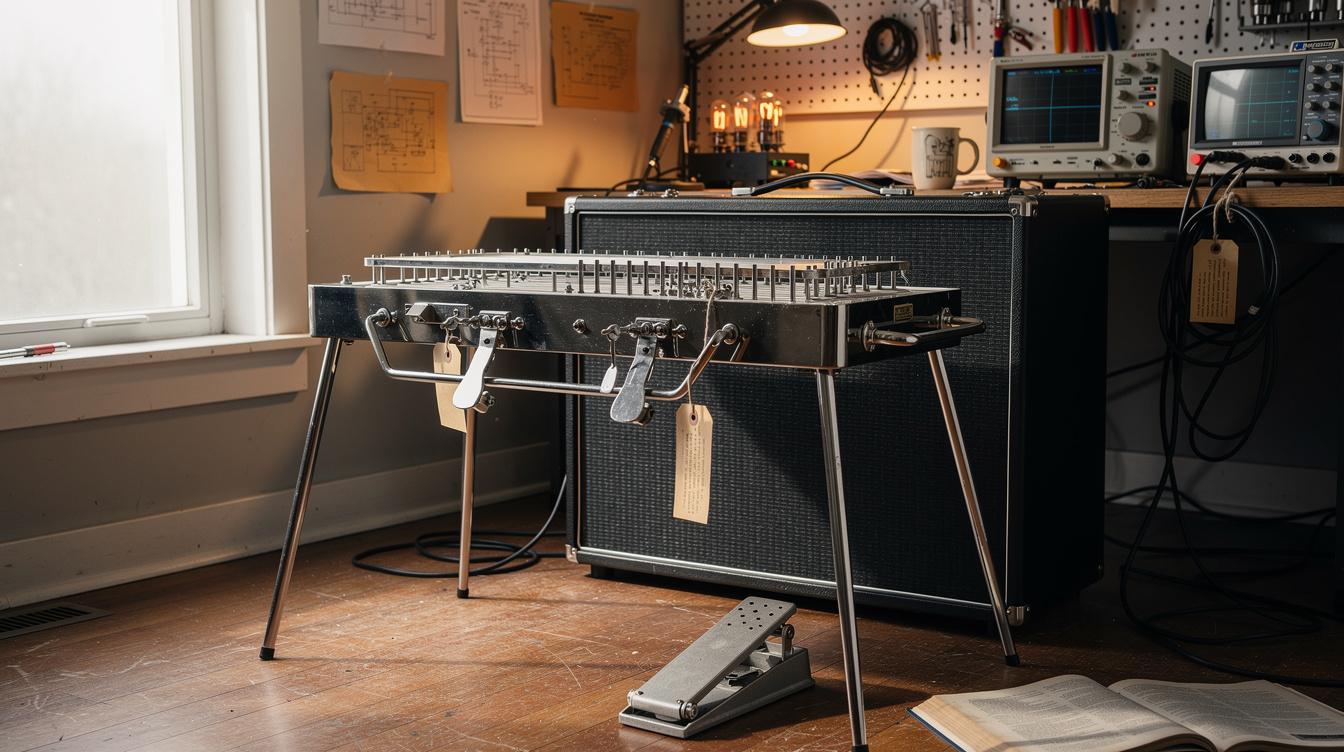
A pedal steel asks something different of an amp than a guitar does. The notes do not die. Chords ring for bars at a time. The volume pedal brings every note in from nothing and holds it there. And steel players want all of that clean, with no hair on it, at a volume that keeps up with a drummer.
That is why steel amps are big. The question is how big, and what the watts are actually for.
What the Usual Steel Amps Are Rated At
These are the amps steel players name most, with the maker's published ratings.
| Amp | Rated output | Speaker | Source |
|---|---|---|---|
| Peavey Nashville 112 | 80 W RMS into 4 Ω | 1 x 12 | Peavey spec, via retailer listings |
| Fender '65 Twin Reverb reissue | 85 W into 4 Ω | 2 x 12 Jensen C-12K | Retailer listings of Fender spec |
| Fender Steel-King | 200 W into 4 Ω | 1 x 15 Eminence, based on the JBL D130F | Fender listing; Blue Book dates it 2004 to 2009 |
| Quilter Steelaire | 200 W ("400 W internal headroom") | 1 x 15 Eminence neodymium | Quilter Labs |
| Peavey Nashville 400 | 210 W RMS into 4 Ω | 1 x 15 | Peavey spec sheet and manual |
Every one of those figures is at 4 ohms. Run a 4-ohm-rated amp into an 8-ohm extension cab and you will not see the full number. Peavey's later Nashville 400 spec page, for example, lists 130 watts RMS into 8 ohms at clipping.
What the Watts Buy, in Decibels
Watts sound like a lot more than they are. Doubling power gets you 3 dB. That is a clear step, not a different league.
| Going from | To | Extra clean room |
|---|---|---|
| 80 W (Nashville 112) | 210 W (Nashville 400) | about 4.2 dB |
| 85 W (Twin reissue) | 200 W (Steel-King or Steelaire) | about 3.7 dB |
| 85 W | 340 W (four times the power) | about 6 dB |
So the jump from a Twin to a dedicated 200-watt steel amp is under 4 dB. Worth having. Not magic.
Where the Demand Really Comes From
I expected the answer to be the attack. A picked guitar has a sharp spike on every note, and spikes are what usually run an amp out of room. A steel has a picked attack too, but most of it is buried under the volume pedal swell.
The maker's manual says otherwise. Peavey's Nashville 400 manual says its Low EQ has more than 15 dB of boost or cut, and that each 3 dB of boost doubles the amount of power necessary. It goes on to say even this amp's 200-watt-class power section may be overloaded by excessive low end boost at high volume.
That is the real story. Bass costs power. A 6 dB bass boost needs four times the power in that range. A 15 dB boost, the whole range of that knob, needs more than thirty times. No amp on that table has thirty times anything to spare.
And the steel spends a lot of time down there. The bottom string on a standard 10-string E9 neck is a B at about 123 Hz, just above a guitar's open A, and C6 necks reach lower. The difference is that a steel holds those low notes inside full chords for bars at a time. Add that, a pickup that is hot to begin with, and a player who likes a full bottom, and the amp spends most of its power on the lowest octave.
How to Set Any Amp So a Full-Pedal Chord Stays Clean
Steel players set the amp loud and play with the pedal partly down. That means the amp only gets tested when the pedal hits the floor. Set it for that moment.
- Start with the amp's bass flat or low. On a Twin Reverb, a starting point is Bass at 3, Middle at 4, Treble at 6, Bright off. On a Peavey with a center-detent EQ, start the Low at center.
- Put the volume pedal all the way down.
- Play the lowest full chord you use, with pedals and knee levers engaged. Not a single note.
- Bring the amp's volume up until that chord starts to flatten out or blur at the bottom. Then back it off a step.
- If you need more volume than that, cut bass before you look for more watts. Every 3 dB of bass you do not boost is half the power back.
- Now play the gig with the pedal. Anything below the floor is clean by definition.
On a 200-watt amp you will likely have room left over. On a Twin you may not, and the fix is usually the Bass knob, not a new amp.
The Volume Pedal Matters Too
The pedal is between the steel and the amp. It changes what the amp sees.
Steel pickups run hotter and higher impedance than most guitar pickups, so steel-specific passive volume pedals generally use a 500K pot. Goodrich sells a 500K audio-taper replacement pot for its 120, L120, H10K and L10K pedals. One retail listing for the current L120 names a 470K pot instead, so check yours. Guitar volume pedals often use 250K. A 250K pot loads a hot steel pickup harder and takes top end with it.
A passive pot also has its own quirk. Its output impedance peaks at a quarter of its value when the pedal is halfway, so about 125K on a 500K pot. That is where the cable's capacitance takes the most treble. If the sound dulls when the pedal is half down, a short cable from pedal to amp, or a buffer before the pedal, is the fix. An active pedal does that job for you.
Home, Small Rooms and Going Direct
At home, an 80-watt Nashville 112 will never be pushed. The same bass rule still decides how clean it stays.
If you go direct to a PA through a preamp or a modeler, the headroom question moves to the PA. A low cut on the steel's channel does the same job the Bass knob does on a combo.
And if you run a vintage alnico 15, like a JBL D130F, from a big solid-state steel amp, read up on what high voice-coil current can do to an alnico magnet first. The amp's extra headroom is not free for an old speaker. For why Fender once sold Twins with JBLs to the players who wanted the cleanest bottom, see the JBL D120F option. For the same clean-room problem on a regular Fender, see clean headroom on a Fender amp, and for how power ratings relate to the speakers, see speaker power handling.
The watts are mostly for the bottom. Turn the bass down first.