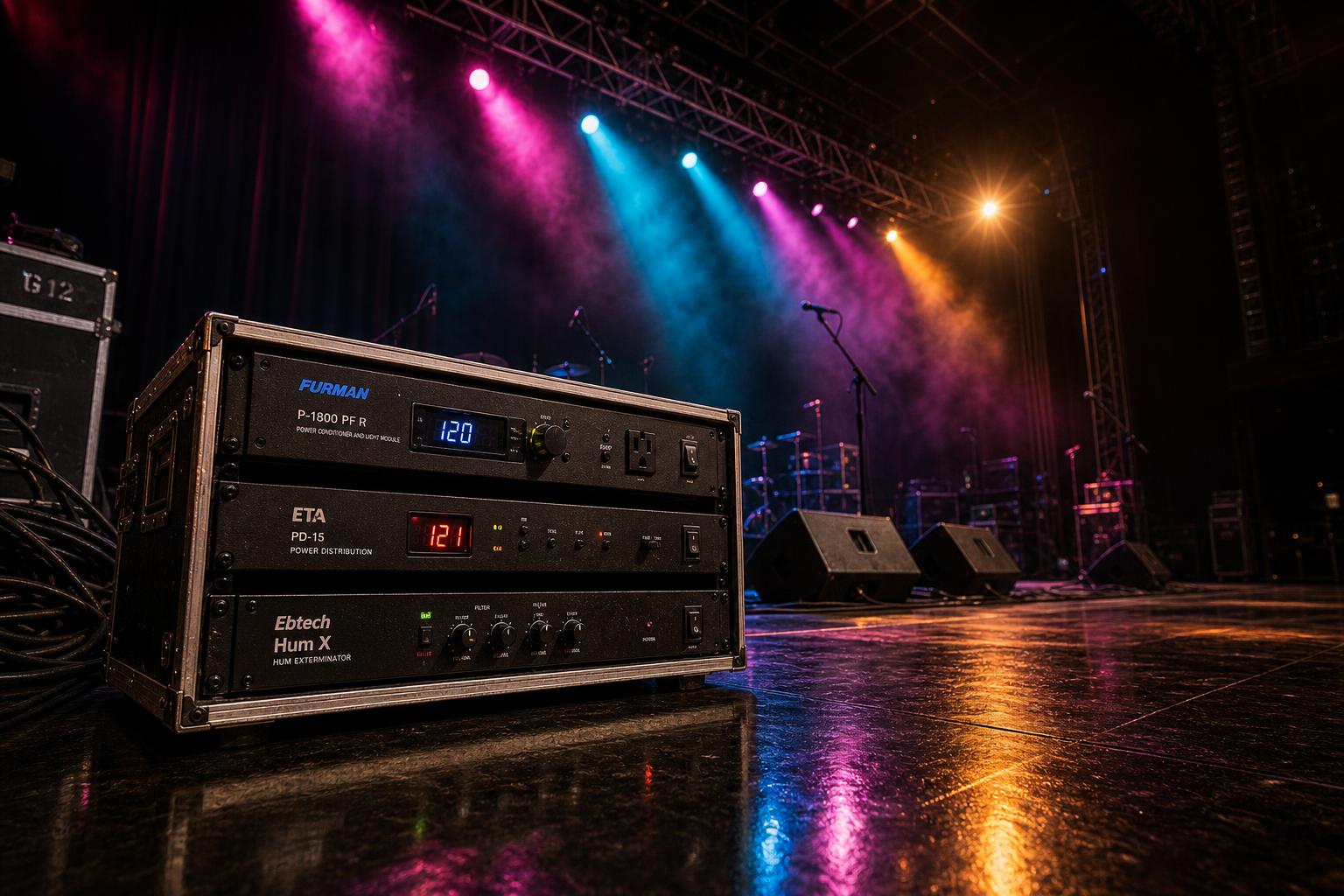
Quick read: A power conditioner does not solve every stage hum problem, and the conditioner you actually need depends on the kind of hum you're hearing. Ground loops are solved by isolation transformers (Furman P-1800 PF, ETA Systems PD-15) or by an inline ground lifter (Ebtech Hum X). Voltage spikes and dirty AC are solved by protection-only conditioners (Furman M-8x2, Furman PL-Plus C). RF interference and switching-supply noise are solved by linear-filtering conditioners. Buying the wrong tier is the most common mistake. Most touring guitarists who spend $400 on a Furman M-8x2 wanted the $100 Ebtech Hum X. Diagnose the noise first, then buy.
| Product | Price (May 2026) | What It Solves | What It Doesn't |
|---|---|---|---|
| Ebtech Hum X | $100 | Ground loop hum from a single device | Voltage spikes, RF, dirty AC |
| Furman M-8x2 | $200 | Voltage spikes, surge events | Ground loops, RF |
| Furman PL-Plus C | $400 | Spikes, surges, light RF filtering | Strong ground loops |
| Furman P-1800 PF | $1,300 | Ground loops, spikes, RF, voltage drop | Most things (this is the touring tier) |
| ETA Systems PD-15 | $900 | Ground loops, spikes, balanced power option | Bedroom-rig overkill |
I've toured worship rigs into 200 different rooms over the last decade, and the hum at front-of-house is never the same problem twice. Sometimes it's a 60-cycle ground loop and any cheap inline lifter would have cleared it. Sometimes it's a switching power supply on a fixture two rooms away coupling into the lighting circuit and a $1,300 isolation transformer is the only thing that'll touch it. The conditioner is not the solution; it's the tool for a specific solution. Pick the wrong tool and you're paying $400 for a glorified surge strip.
This piece is the honest cost-benefit on three real products at three price tiers, and how to know which one actually fits your rig.
What a Power Conditioner Actually Does
The category name is misleading. "Power conditioner" covers four very different functions, and most products do one or two of them. Confusion here is why people buy the wrong unit.
The four functions:
- Surge protection. Diverts voltage spikes to ground via metal-oxide varistors (MOVs). This is the cheapest function and almost everything in the category does it.
- EMI/RFI filtering. Filters high-frequency noise from radio interference, switching power supplies, and dimmer packs. This is mid-tier: the Furman PL-Plus C and the M-8x2 do basic versions; the higher Furman tiers do better.
- Ground loop isolation. Breaks the loop using either an isolation transformer (full isolation) or a ground lifter (partial isolation). This is the most expensive function and the one most stage-hum problems actually need.
- Voltage regulation. Boosts low voltage or trims high voltage to keep the output at a consistent 120V. This matters for tube amps in venues with brownout-prone grids. Only the highest tiers do this (the Furman P-2400 IT and similar).
The hum on your stage is almost certainly a ground loop. That's function 3. If you buy a product that doesn't do function 3 (and most products at the $200-400 tier don't), you spent money on the wrong tool.
Function 3 in Detail: Why Ground Loops Hum
A ground loop happens when two pieces of equipment share a ground reference through more than one path. The most common case: your guitar rig is grounded through the wall outlet, and your amp's signal output is grounded through the cable to the PA, and the PA is grounded through its wall outlet, and the two ground paths are at slightly different voltages. The 60-cycle difference between them shows up as a sustained hum at frequencies of 60 Hz and its harmonics (120, 180, 240 Hz).
The fix is to break one of the ground paths. There are two ways to do that:
- Lift the signal ground. A DI box with a ground-lift switch, or an inline isolator like the Ebtech Hum X, breaks the signal-cable ground while keeping the wall-outlet ground intact. The wall-outlet ground is the one that protects you from electrocution. Never lift it. Lifting the signal ground is safe; lifting the AC mains ground (with a 3-to-2 prong adapter or a ground-lift switch on the amp itself) is potentially fatal. Lift the signal ground.
- Isolate the AC supply. An isolation transformer in the power feed to your rig breaks the loop on the power side instead of the signal side. The transformer takes 120V in and provides 120V out, but the output is electrically isolated from the input. There's no ground path back to the source. This is what the Furman P-1800 PF and the ETA PD-15 do. This is the touring-grade solution and it works on all the rigs at once.
Both fixes work. They cost very different amounts of money.
The Ebtech Hum X: $100, Solves One Problem
The Hum X is a 4-inch-long box with a male IEC plug on one end and a female IEC outlet on the other. You plug it between your amp's power cable and the wall. Inside is a passive isolation circuit that breaks the safety ground loop while preserving fault-current paths, meaning it's safe (UL listed) and it's effective on the most common form of stage hum.
It does one thing. It does that one thing well. It does not provide surge protection, RF filtering, or voltage regulation.
When the Hum X is the right answer:
- The hum is a sustained 60-cycle drone (or 120 Hz harmonic) that goes away when you unplug your amp and stops when you plug it back in
- The hum is louder when you touch the strings (counterintuitively; touching the strings should reduce hum on a properly grounded rig; if it makes it worse, you have a loop)
- You're playing a single venue and the hum is consistent across visits
When the Hum X is the wrong answer:
- The hum is intermittent, modulated, or scratchy (that's RF, not a ground loop)
- You play multiple venues with multiple hum profiles (you need a touring solution, not a per-room fix)
- You also have voltage problems (lights dimming when the band kicks in is a brownout, and a Hum X doesn't help)
I have a Hum X in my touring kit. It's lived in the bottom of my pedalboard case for six years and it has cleared the hum at probably 30 churches and small venues. At $100, it's the highest-leverage hundred dollars in the kit. But it's not the only thing I carry.
The Furman M-8x2: $200, Doesn't Solve the Problem You Have
The Furman M-8x2 is the entry point of the Furman rack-mount line. Eight outlets, surge protection, basic EMI/RFI filtering, a 15A breaker, two front-panel pull-out lamps. It's the unit you see in 80% of touring rigs and 90% of home-studio racks.
It does not break ground loops.
I want to be specific about this because it's the single most common buying mistake in the category. The M-8x2 is great surge protection. It will save your amp from a lightning strike in a storm. It will not solve your stage hum. The protection circuit is between hot and ground, not between ground and ground. There's no isolation transformer in the M-8x2.
If you bought an M-8x2 because the rack guy at the music store told you it would help with hum, you got bad advice. Return it and buy a Hum X for half the price, or step up to the P-1800 PF (which has the isolation transformer that actually breaks loops).
When the M-8x2 is the right answer:
- You have a rack rig and you want surge protection plus a tidy power distribution point
- You don't have hum problems but you want to protect the gear
- You like the front-panel work lights (they're genuinely useful in dark venues)
The Furman PL-Plus C ($400) is a slight step up: better RFI filtering, voltage meter on the front. Same fundamental limitation: no isolation transformer. Same conclusion: doesn't fix ground loops.
The Furman P-1800 PF: $1,300, Solves Most Problems
The P-1800 PF is the touring-tier conditioner. Eight outlets, surge protection, sequential power-up (so the amp doesn't pop when you switch the rack on), voltage regulation, low-voltage and high-voltage protection, and (critically) Power Factor Correction with an isolation transformer.
The isolation transformer is the part that matters. It breaks ground loops at the power input level, which means every device plugged into the conditioner sees a clean isolated ground. One unit, one solution, every rig in the rack benefits.
The voltage regulation is the secondary feature that justifies the price for touring. Bad venue power (voltage sagging from 120V to 105V when the lighting console kicks in, or spiking to 135V when the AC compressor turns off) kills tube amps slowly. The P-1800 PF maintains the output at a regulated 120V regardless of what the venue is delivering, within a wide input range (97V to 141V).
When the P-1800 PF is the right answer:
- You're touring multiple venues per week and the hum profile changes constantly
- You have a tube amp rig (or two) that you want to protect from venue voltage swings
- You're running a multi-source rack (keys, guitar, IEM rack, drum triggers) and you want one conditioner to handle all of them
- The cost is amortized over a touring schedule, not a single living-room rig
When the P-1800 PF is overkill:
- You play one church or one venue consistently (the Hum X solves the recurring problem)
- You're a bedroom player (no stage hum, no venue voltage problems, no need)
- Your rig is small enough to fit on a pedalboard (look at the pedalboard power supply isolation guide instead; that's a different problem solved by a different product)
I bought a P-1800 PF in 2020 after a tour where we played five venues in five nights and dealt with hum problems at four of them. The math worked out at about $5 per venue night for the first year. That's reasonable for a touring rig. It would not have been reasonable for a single church.
The ETA Systems PD-15: $900, the Audio-Engineer Pick
The ETA Systems PD-15 is the conditioner that touring FOH engineers buy. Same core function as the Furman P-1800 PF (isolation transformer, surge protection, voltage regulation) but with a few audio-engineering features the Furman doesn't have. Balanced power output is the big one. Balanced power runs each leg of the AC at half the voltage relative to ground (60V positive, 60V negative, sum = 120V), which dramatically reduces common-mode noise on connected gear.
For a guitar rig, balanced power is overkill. For a recording studio with a dozen mic preamps, balanced power matters. The PD-15 is the right call if you're sharing your power conditioning between a guitar rig and recording gear.
I borrowed a PD-15 from a FOH engineer for a session once. It cleared a slight hash I'd been hearing at the input of my Strymon Iridium that I'd never noticed before. The Iridium is now silent. I'm not buying a PD-15 (the P-1800 PF I already own does enough), but I understand why studio guys do.
How to Diagnose Before You Buy
A quick decision tree, in the order I run it:
- Is the hum present at home? If yes, your rig has a self-contained ground loop. Solve that first. It's usually a bad cable, a grounding issue in a pedal, or a guitar with shielding problems.
- Is the hum present only at one venue? That venue has a ground problem and the Hum X probably fixes it for $100. Try the Hum X before you spend more.
- Is the hum present at multiple venues with different profiles? You need an isolation transformer. The Furman P-1800 PF or ETA PD-15 are the touring-grade options.
- Do you also have voltage drop problems? (Lights dim when the band kicks in, amp gets quiet on a sustained chord.) You need voltage regulation, which means the P-1800 PF or higher.
- Are you also dealing with switching-supply noise from in-ear systems or stage lighting? You need EMI/RFI filtering, which the P-1800 PF and PD-15 both provide.
For most working guitarists at the regional touring level, the answer is the Hum X for one venue plus a P-1800 PF for the touring rack. For a one-church worship rig, the answer is the Hum X alone. For a bedroom rig, the answer is none of the above. Your rig isn't the problem and a power conditioner isn't the fix.
We covered the four-step diagnostic for ground loop hum in detail at how to remove 60-cycle hum without a noise gate, and the stage ground loop diagnostic walkthrough goes deeper on the touring context. The conditioner isn't always the right answer. Sometimes the answer is a different DI box.
What I Actually Recommend
If you've never had hum problems, you don't need a conditioner. The Furman M-8x2 will not improve your tone. Don't buy one because the touring guys have one.
If you have hum at one venue, buy a Hum X and call it done. $100 fixes one problem and that's enough.
If you tour and the hum profile changes weekly, buy a Furman P-1800 PF or an ETA PD-15. The cost is real but the variable is consistent across rooms.
If you also want surge protection for a rack rig, the same units do that. You don't need a separate M-8x2.
The piece of advice I wish I'd gotten ten years ago: diagnose the hum, then buy the conditioner. The conditioner doesn't define the solution. The solution defines the conditioner.