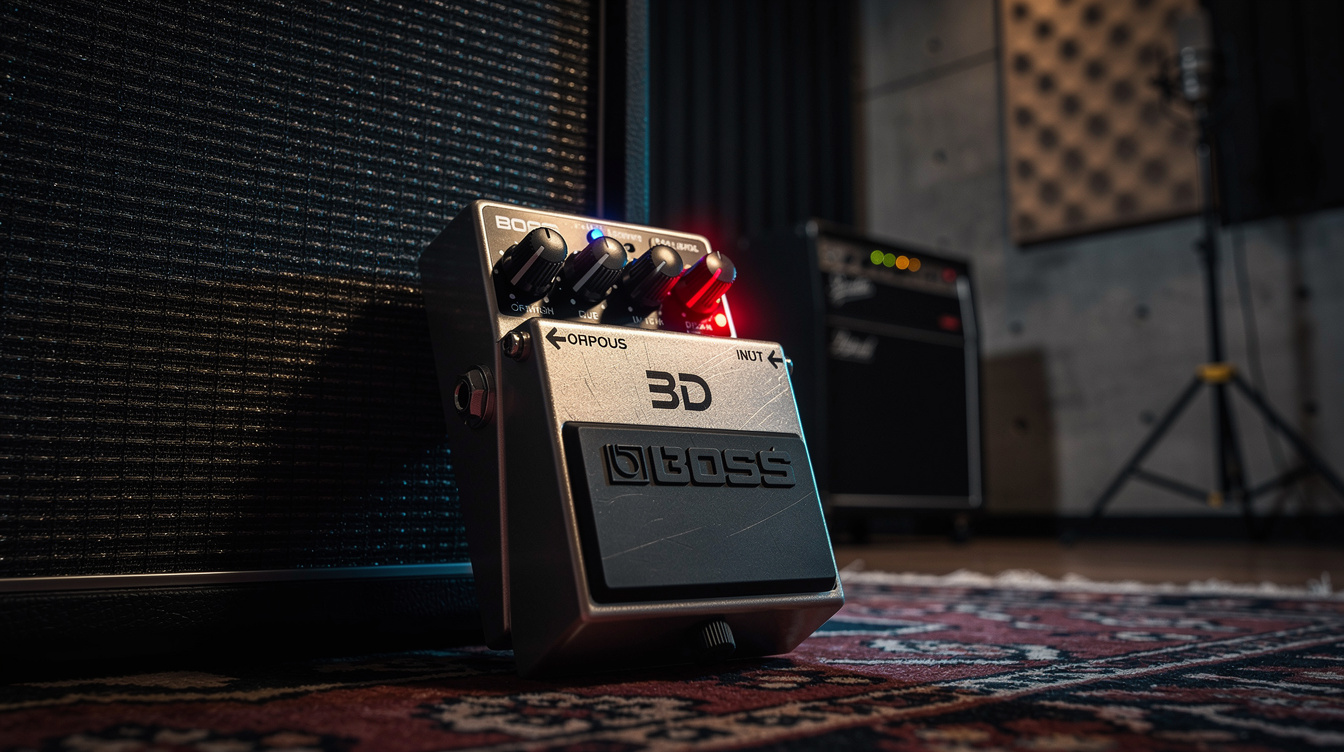
Start Here: The actual difference between the BD-2 and BD-2W — before you spend $80 more:
- S mode on the BD-2W sounds almost identical to the stock BD-2 — Boss changed almost nothing
- Custom mode is the reason to buy the Waza — different component values, different clipping character, noticeably more touch-responsive
- The upgrade is not about the pedal sounding "better" — it's about Custom mode sounding different in ways blues players specifically will prefer
- If you use the BD-2 as a bright boost into a cranked amp, stay with the stock pedal — the circuit difference matters less in that application
- If you use the BD-2 as a standalone drive on a clean amp, the Custom mode is worth it
Quick Comparison Table
| BD-2 (Standard) | BD-2W S Mode | BD-2W Custom Mode | |
|---|---|---|---|
| Street price | ~$100 | ~$180 (includes both modes) | ~$180 (includes both modes) |
| Clipping type | Uneven clipping (sounds more natural) | Near-identical to BD-2 | Modified component values; softer, warmer clipping character |
| Gain character | Bright, aggressive, wide range | Same as BD-2 | Warmer, more even-harmonic, more amp-like |
| Clean-up with guitar volume | Decent — rolls back acceptably | Same as BD-2 | Very good — responds like a driven amp |
| Feel under the pick | Slightly stiff at low gain | Same as BD-2 | More give — attack compresses differently |
| Best application | Bright boost into a driven amp, classic rock rhythm | Legacy compatibility | Blues lead on a clean amp, dynamics-dependent playing |
The short version: if you're boosting into a cranked amp, save your money and buy the standard BD-2. If the BD-2 IS your drive sound, the Waza Custom mode is worth hearing.
What Is the BD-2 Actually Doing?
The Boss Blues Driver has been a confusingly named pedal since 1995. It's called a Blues Driver but it's got more gain than you'd expect from a blues pedal, and it behaves more like a dirty boost than the classic blues overdrive sound. Put it next to a TS808 and the difference is stark: the TS has a pronounced midrange hump, softer clipping, and a compressed feel. The BD-2 has a flatter frequency response, wider gain range, and a brightness that doesn't appear in most tube-based overdrive circuits.
The BD-2's best applications are:
- Bright boost into a cranked tube amp — SRV-style, pushing the amp's front end harder
- Rock rhythm at moderate gain — the flatter EQ response lets the amp's natural character come through
- Clean(ish) platform for single-note work — at low Drive settings, the BD-2 is a relatively transparent overdrive
What the BD-2 is less good at: the kind of dynamics-responsive, "you can hear the player's touch" character that the word "blues" implies. At moderate gain settings on a clean amp, the BD-2 can feel slightly static — it doesn't clean up with guitar volume rollback as smoothly as a Tube Screamer, and the bright clipping character can become harsh on single notes at medium-to-high Gain settings.
The Blues Driver BD-2 settings guide covers the full range of the standard pedal's sweet spots — worth reading before investing in the Waza version if you haven't fully explored the stock BD-2.
S Mode: The Safety Net
Boss included S mode on the BD-2W for players who want upgrade-path access without losing familiarity with their existing tone. It uses component values close to the original BD-2 with a few refinements in tolerances and matching.
In practice, S mode sounds almost identical to the stock BD-2. If you're buying the BD-2W specifically to have S mode, you're spending $80 for essentially nothing. The distinction between S mode and a stock BD-2 requires A/B testing at the same settings with careful listening — it is not obvious, it does not improve the pedal substantially, and it is not the reason to buy the Waza.
S mode exists so that players who already own a BD-2 and primarily want Custom mode can switch back to something familiar when needed. It's a transition feature, not a selling point.
Custom Mode: The Circuit Change That Matters
Custom mode is where the BD-2W earns its price. Boss changed the internal components to produce a different harmonic character. The clipping is uneven, which is why it sounds more natural, and the whole circuit responds differently to pick dynamics.
The result: at the same Gain setting, Custom mode feels less compressed than S mode or the stock BD-2. Notes have more headroom at the attack before the clipping engages, and the clipping itself rounds off more gradually rather than hitting a hard ceiling. This produces a response that's closer to what a naturally driven tube amp does — the signal stays clean through the first part of the pick attack, then saturates as the signal peaks, then recovers cleanly.
This sounds like a small difference described in technical language. In practice, it's the difference between a pedal that feels like an effect and a pedal that feels like part of the instrument. Custom mode, at low to moderate Gain, responds to how hard you pick in a way that lets the player's dynamics shape the sound rather than the pedal imposing a character on every note.
Blues players and dynamics-focused players generally hear this immediately. Players who run high Gain and focus on rhythm work may not notice or care.
Settings: BD-2 and BD-2W Compared
Blues Lead on a Clean Amp
This is where the Waza's Custom mode earns its price difference. Running into a clean Fender-style amp, neck or middle pickup, moderate picking attack.
BD-2 Standard:
| Control | Position | Notes |
|---|---|---|
| Gain | About 10 o'clock | Low gain — above this, it gets stiff |
| Tone | About 10 o'clock | Pulled dark — manages the BD-2's brightness |
| Level | About 1 o'clock | Slight boost over unity |
BD-2W Custom Mode:
| Control | Position | Position |
|---|---|---|
| Gain | About 11 o'clock to noon | Can run more gain — the softer clipping handles it better |
| Tone | About 11 o'clock | Less aggressive pulling-back needed — the Custom mode circuit is warmer |
| Level | About 1 o'clock | Same unity boost |
The Tone difference is notable. On the stock BD-2, running Tone above about 11 o'clock starts introducing a brittleness on single notes that requires compensating with amp EQ or careful picking. On Custom mode, Tone at noon is comfortable — the softer clipping character doesn't produce the same harsh edge at the frequency peaks.
Classic Rock Rhythm
For this application, the gap between the BD-2 and BD-2W narrows. Classic rock rhythm playing is less touch-sensitive by nature — the attack is more consistent, the playing is more aggressive, and the dynamics-response advantage of Custom mode matters less.
| Control | BD-2 | BD-2W (S or Custom) |
|---|---|---|
| Gain | About 1 o'clock | About 1 o'clock (S) or noon (Custom) |
| Tone | About noon to 1 o'clock | About 1 o'clock |
| Level | About noon | About noon |
Both pedals work well here. The BD-2 might actually be the better choice for classic rock rhythm because its brighter character cuts through a full band mix more aggressively. Custom mode's warmer response can sit slightly behind the mix in dense arrangements.
TS808 Into High-Gain Amp (Front-End Boost)
The BD-2 is used as an OD boost into a driven amp — the classic Stevie Ray Vaughan configuration where the pedal pushes the amp harder rather than acting as a standalone distortion. In this application, both the BD-2 and BD-2W behave similarly because the amp's natural saturation dominates the character.
Settings for boost application:
| Control | Position | Notes |
|---|---|---|
| Gain | About 8 to 9 o'clock | Minimum gain — just pushing the front end |
| Tone | About noon to 1 o'clock | Flat or slightly bright — the amp's EQ is doing the real shaping |
| Level | About 2 to 3 o'clock | Significant volume increase — this IS the boost |
For this specific application, save the $80. The stock BD-2 at minimum Gain and maximum Level is a clean boost with mild coloring, and the clipping character difference between S and Custom mode doesn't meaningfully affect the tone because the amp's saturation is the primary distortion source.
When the Waza Upgrade Makes Sense
Buy the BD-2W if:
- You use the BD-2 as a standalone drive on a clean or edge-of-breakup amp
- You play with a lot of pick dynamics and want the pedal to respond to them
- You regularly use the BD-2 for blues lead playing where individual note character matters
- You're running the BD-2 into headphones or a modeler and the Custom mode's warmer character helps compensate for the clinical quality of those signal paths
Stick with the stock BD-2 if:
- You primarily use it as a boost into a driven amp
- You run high Gain settings for rock or hard rock rhythm work
- You play in a dense band context where the BD-2's brighter character helps you cut through the mix
- Budget is a constraint and the $80 difference matters more than the Custom mode character
The BD-2W is not a "better" pedal than the BD-2 in every application. It's a different pedal that's specifically better for the touch-responsive, low-to-moderate gain applications where the clipping circuit change produces meaningful results.
One Unexpected Finding
I expected the BD-2W's Custom mode to sound noticeably warmer and more "amp-like" at moderate gain. It does. What I didn't expect was how much the difference matters at low picking velocities rather than high ones.
At high picking attack — digging in hard, playing aggressively — the distinction between S mode and Custom mode narrows. Both clip hard enough that the character difference is minimized. At light to medium picking attack — playing with restraint, letting the dynamics breathe — Custom mode stays clean and opens up in a way S mode doesn't. It sustains differently on soft-picked notes. The harmonics develop without the initial clipping flattening them.
This is specifically a blues and dynamics-oriented playing discovery. Metal players and hard rock rhythm players picking at full attack most of the time would not necessarily hear this as a meaningful difference. Blues players, country players, and anyone working in the dynamic range between "barely touching the strings" and "digging in aggressively" will notice.
Which Settings Translation Works Between Modes?
If you've been using the stock BD-2 with specific settings and want to know where to start on the BD-2W Custom mode:
| BD-2 Stock | BD-2W Custom Mode Equivalent |
|---|---|
| Gain: 8 o'clock | Gain: 9 to 10 o'clock (can handle slightly more gain before harshness) |
| Gain: noon | Gain: 11 o'clock to noon (Custom mode at noon sounds like stock at noon or slightly above) |
| Gain: 2 o'clock | Gain: 1 to 2 o'clock (near-identical at high gain) |
| Tone: 9 o'clock | Tone: 10 to 11 o'clock (Custom mode is warmer — don't need to pull as dark) |
| Tone: noon | Tone: noon (similar behavior at center) |
The pattern: Custom mode can tolerate more gain and more Tone than the stock pedal before the brightness and harshness arrive. This gives you more of the pedal's range to work with rather than avoiding the upper half of the Gain and Tone dials.
FAQ
Is the BD-2W S mode an improvement over the stock BD-2? Marginally at best. The component matching in the Waza series is tighter than standard production tolerance, which can produce a slight improvement in consistency and frequency response. In a blind A/B test, most players would not reliably identify S mode as different from a stock BD-2 in good condition.
Can I modify a stock BD-2 to sound like the Custom mode? The Keeley BD-2 modification is the most commonly recommended path — it changes the clipping diodes and some passive components to produce a softer, warmer character similar to what Boss did with the Custom mode. Keeley mod pricing runs $50 to $75 to send your pedal in, which brings the total close to the BD-2W price. At that point, the BD-2W is a cleaner solution.
How does the BD-2W compare to a Tube Screamer for blues? Different flavors of the same application. The TS808 has a more pronounced midrange hump that compresses the signal more consistently — it's warmer, more forgiving, and pushes the amp differently. The BD-2W Custom mode is flatter in frequency response and more touch-responsive — it feels more open and less colored. Neither is objectively better; they serve different taste preferences. Rick's take: the TS into a Marshall hits harder; the BD-2W Custom into a Fender stays cleaner under your fingers.
Does the BD-2W work well on a Helix or Quad Cortex as a virtual pedal? The Helix doesn't currently include a BD-2 model. The Blues Breaker (Marshall Blues Breaker) is sometimes used as a BD-2 substitute in modeler signal chains, but it's a different pedal. For modelers, a Klon clone model or a TS-style model at low gain often serves the BD-2 role better than trying to approximate the specific BD-2 character.
What amp does the BD-2W sound best through? A clean, open-sounding amp that has some natural warmth — a Fender Deluxe Reverb or Blues Junior, a Vox AC30 at clean settings, or a tweed-style amp with moderate headroom. The Custom mode's touch-responsive quality is most audible on amps that contribute their own natural compression and harmonic complexity rather than purely clean solid-state platforms.