Start Here: Settings tables for every major context (blues, rock, country, and stacking) are throughout this guide. If you just bought a BD-2 and want to start playing, the quick-start table below covers four useful positions. If you already know the pedal and you're chasing a specific tone, jump to the genre section that fits. If you're trying to understand why the BD-2 sounds different from a Tube Screamer, the comparison section has that answer.
Quick-Start: What Are the Best BD-2 Settings?
Four starting points. Dial these in, then adjust by ear.
| Style | Gain | Tone | Level | Notes |
|---|---|---|---|---|
| Classic blues | About 9 o'clock | Around noon | Around noon | Touch-sensitive, cleans up with guitar volume |
| Chicago blues | About 8 o'clock | About 10 o'clock | About 1 o'clock | Lighter, more dynamics, nearly clean |
| Classic rock | About 1 o'clock | Around noon to about 1 o'clock | About 11 o'clock | Single-coil crunch, Angus territory |
| Country/chicken pickin' | About 8 o'clock | About 9 o'clock | About 1 o'clock | Clean edge of breakup, sparkly |
All positions are approximate. The BD-2 is a touch-sensitive pedal; these settings will behave differently depending on your pickups, amp, and how hard you pick. Start here, then move from there.
What Is the Boss BD-2?
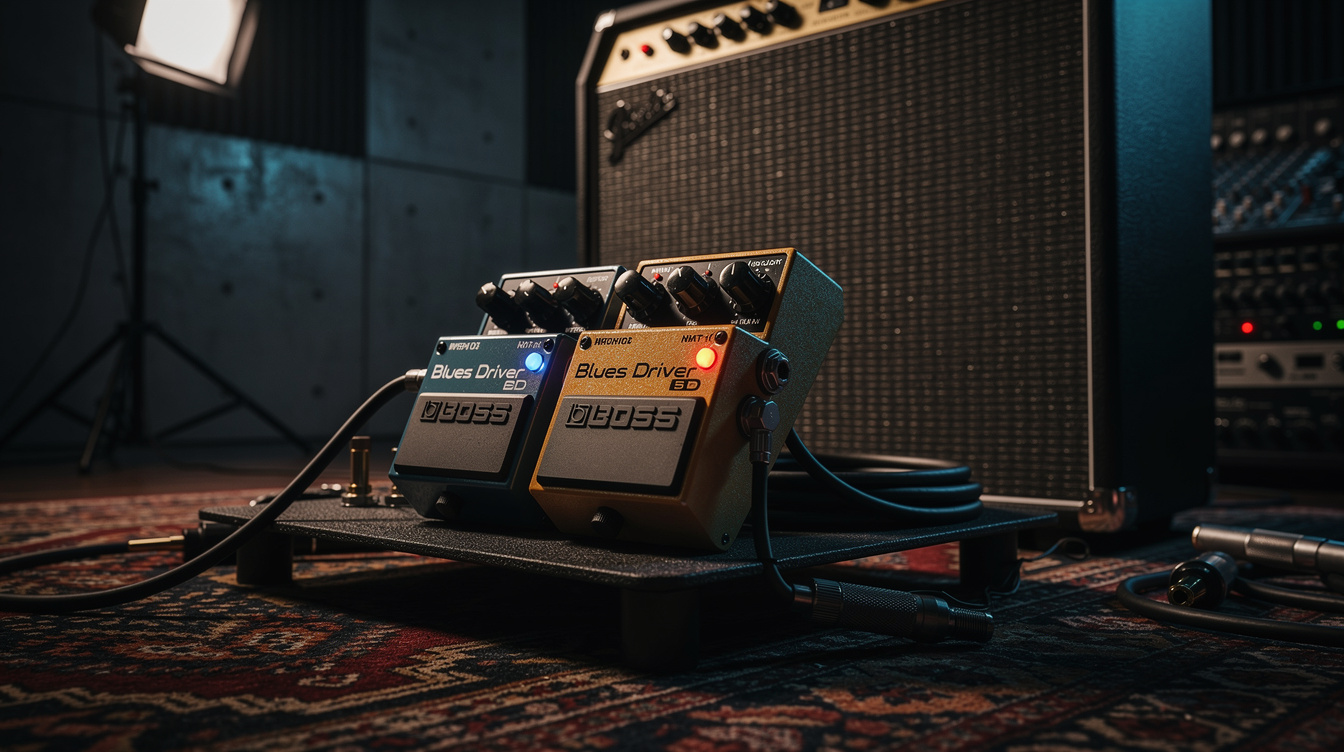
The Boss Blues Driver came out in 1995 and has been on professional pedalboards ever since. It sounds like a pushed tube amp; not a fuzz, not a distortion box, but the sound of an amplifier working hard. The harder you pick, the more it breaks up. Back off and it cleans up. That responsiveness is the whole point.
The BD-2 can operate as a light overdrive at low gain settings or push into heavier distortion territory with Gain turned up. It doesn't stay strictly in one lane. That range is part of why it's been on professional pedalboards for three decades; one pedal covers a lot of ground.
For the full picture of where overdrive circuits like this fit relative to distortion and fuzz, see the overdrive vs. distortion vs. fuzz guide.
What Do the Three Knobs Actually Do?
The BD-2 has three controls. Nothing else.
-
Gain: Controls the amount of clipping the circuit applies. At minimum (about 7 o'clock), the signal passes almost clean; the pedal adds mild saturation and some tonal coloring. At maximum (about 5 o'clock), it's a full distortion circuit with heavy compression. The sweet spot for most applications is somewhere between 8 o'clock and noon. Past noon, the gain starts to compress dynamics aggressively.
-
Tone: A treble-focused filter. Counterclockwise cuts high frequencies and darkens the sound. Clockwise adds brightness and presence. The BD-2's Tone control is more sensitive than most; half a turn makes a meaningful difference. Worth sweeping slowly while playing to find where it sits right in your rig.
-
Level: Output volume relative to your bypassed signal. Set it so the pedal doesn't change your overall volume when you kick it on or off. The BD-2 can push a significant amount of level when Gain is high, so Level may need to come down to stay at unity.
How Does the BD-2's Tone Character Work?
This is where the BD-2 is different from a Tube Screamer, and the difference matters.
The Tube Screamer has a well-known midrange hump centered around 720 Hz. It cuts bass, boosts mids, and rolls off high-end fizz. It sounds warm, fat, and slightly compressed. Players who love it describe it as "singing." Players who don't love it call it "nasal."
The BD-2 is brighter. It doesn't have the same aggressive bass rolloff or the same midrange emphasis. The result is a pedal that sounds more open and present, closer to the character of a pushed British amp than the Tube Screamer's American-blues-voiced quality. At low gain settings, the BD-2 is also more touch-sensitive than a Tube Screamer. Less compressed. More responsive to how hard you pick.
That openness works in its favor for single-coil tones, Telecaster work, and anything that wants to sound raw. It works against it if you need a thick, compressed boost, the Tube Screamer does that job better. They're different tools for different purposes. For a modern blues player who leans into that Tube Screamer midrange push, the Gary Clark Jr. Bright Lights recipe shows how that voicing works through a Fender Vibro-King.
Classic Blues Settings
What settings work for SRV-style blues?
SRV-style tone requires moderate gain, heavy dynamics, and a pedal that responds to pick attack. The BD-2 handles this well at lower gain settings. The asymmetrical clipping produces harmonics that behave like a pushed amp, and rolling the guitar volume back cleans things up noticeably. Hear this approach in action on our SRV Pride and Joy tone recipe, which pairs a Tube Screamer with a Fender amp for that classic Texas blues voice.
| Control | Position | Notes |
|---|---|---|
| Gain | About 9 o'clock | Enough saturation to sing on bends; not so much that dynamics compress |
| Tone | Around noon | Balanced; adjust toward 11 o'clock if it gets too bright for your pickup |
| Level | Around noon | Set to unity with your bypassed signal, then adjust up slightly |
Pickup consideration: This setting works particularly well with neck or middle pickups. Bridge pickup on a Strat may want Tone rolled back to about 10 or 11 o'clock. Single-coils add brightness on their own, so compensate at the Tone knob rather than fighting it later.
Guitar volume: At about 9 o'clock on the Gain knob, rolling your guitar volume back to about 6 or 7 cleans the tone up substantially. This is the BD-2's best trick at low-to-moderate gain settings. Use it.
What settings work for Chicago blues?
Chicago blues style (think Buddy Guy or early Clapton) wants a cleaner, more dynamic sound than Texas-style. For a real-world example of Clapton's blues overdrive approach, see the Layla tone recipe. The pedal is more of a presence enhancer than a full-on overdrive. Light, airy, responsive.
| Control | Position | Notes |
|---|---|---|
| Gain | About 8 o'clock | Nearly clean, just a hint of saturation at peak attack |
| Tone | About 10 o'clock | Slightly dark; this style doesn't want a bright, cutting edge |
| Level | About 1 o'clock | Slightly louder than unity, so hitting the pedal adds perceived presence |
At these settings the BD-2 functions closer to a clean boost with tonal character. The amp is doing most of the work. The pedal adds subtle body and harmonic complexity without aggressively distorting the signal.
Classic Rock Settings
What BD-2 settings work for classic rock?
The BD-2 can handle cranked single-coil tones: Angus Young territory, Malcolm Young's rhythm work, early Stones. The Gain control needs to come up, but not as far as you might think. The brightness of the circuit at higher gain settings means the tone can get thin if Gain goes too high without the amp adding its own saturation underneath.
| Control | Position | Notes |
|---|---|---|
| Gain | About 1 o'clock | Heavy enough for power chords and leads; note definition still intact |
| Tone | Around noon to about 1 o'clock | The pedal's brightness works in this application |
| Level | About 11 o'clock | Gain stage adds output; Level needs to come down to stay near unity |
Amp interaction: Works best into an amp that's already working, like a slightly pushed Marshall, a Vox with the master up. The BD-2 at 1 o'clock into a fully clean amp is a different result than into an amp that's contributing. The latter is the classic rock sweet spot.
Single coils vs. humbuckers: Humbuckers may want Gain at about 11 o'clock instead of 1 o'clock, since pickup output does some of the gain work on its own.
Country and Chicken Pickin' Settings
What are the best BD-2 settings for country?
Country players want the edge of breakup: clean but with character, articulate enough for hybrid picking, with a sparkle on top. Low gain, slightly dark Tone to tame the Telecaster's natural bite.
| Control | Position | Notes |
|---|---|---|
| Gain | About 8 o'clock | Clean edge; the pedal is barely clipping |
| Tone | About 9 o'clock | Dark enough to tame Tele bridge pickup brightness |
| Level | About 1 o'clock | Slightly hot to add presence |
The BD-2 at these settings is doing what a good tube amp does in its first inch of travel on the volume knob. Just a hint of warmth and compression, with the guitar's natural character intact. For Telecaster players, this is a more practical everyday setting than the blues or rock configurations. It's always on, subtle, doing its job quietly.
Rock Crunch and High-Gain Settings
Can the BD-2 do heavier rock tones?
It can get into crunch territory, enough for rhythm rock, not really enough for anything approaching hard rock or metal without help from the amp or a second pedal. Used as a preamp pusher, it's more useful than used as a standalone distortion.
| Control | Position | Notes |
|---|---|---|
| Gain | About 2 o'clock | Near the top of its useful range for stand-alone distortion |
| Tone | Around noon | Prevent the high-gain setting from getting too thin |
| Level | About 10 o'clock | Gain stage at this position produces significant output |
Past about 2 o'clock on Gain, the BD-2 gets thinner and more compressed without adding useful saturation. It's not a high-gain circuit. Stacking with a second overdrive or pushing the amp gets you further than maxing the Gain knob.
BD-2 vs. Tube Screamer: What's the Actual Difference?
This comparison comes up constantly. Here's the short version.
| Characteristic | BD-2 | Tube Screamer |
|---|---|---|
| Midrange character | More open, less pronounced hump | Strong midrange emphasis (~720 Hz) |
| Bass response | Retains more low-end | Rolls off bass significantly |
| Compression | Less compressed at low gain | More compressed throughout |
| Touch sensitivity | High at low-to-moderate gain | Moderate |
| Brightness | Brighter | Warmer |
| Best with | Bright amps, single coils, British-voiced rigs | Dark amps, humbuckers, Fender-voiced rigs |
| Character | More like a pushed amp | More like a classic studio overdrive sound |
Neither is better. They're voiced differently for different applications. If you're already running a Tube Screamer and wondering if the BD-2 is an upgrade, it's not an upgrade. It's a different tool.
Some players run both. More on that below.
Stacking: BD-2 Into a Dirty Amp or Alongside Another Overdrive
How does the BD-2 work as a boost into a dirty amp?
Well. Low-to-moderate gain with Level pushed to about 1 to 2 o'clock, into an amp at the edge of breakup. The BD-2's relatively flat low-end response means it pushes the amp harder without stripping the bass the way a Tube Screamer does. Different push. More full-bodied from the amp's perspective.
| Control | Position | Notes |
|---|---|---|
| Gain | About 8 to 9 o'clock | Pedal contributes character, not distortion |
| Tone | Around noon | Neutral; let the amp's character come through |
| Level | About 1 to 2 o'clock | Hot enough to push the amp harder |
For the full logic behind stacking and signal placement, the gain staging guide covers the mechanics in detail.
Can you stack the BD-2 with a Tube Screamer?
Yes. A common approach: Tube Screamer first (low drive, moderate level), BD-2 second (moderate gain, bright tone). The TS shapes the frequency content before the BD-2 clips it, producing more body than either pedal alone. The reverse order produces something more compressed and warm. Try both. For placement questions, the signal chain order guide covers that.
Amp Pairing
What amps work best with the BD-2?
The BD-2 is most at home with British-voiced amps. Marshalls, Vox AC30s, Orange amplifiers. The pedal's brightness complements those circuits naturally. A Fender-style clean amp can get thin at moderate-to-high Gain settings; roll the amp's Treble back a bit and it works fine. Not a hard rule. A tendency.
| Amp Type | BD-2 Behavior | Notes |
|---|---|---|
| Marshall (JCM800, Plexi) | Excellent; amp and pedal complement each other | Lower Gain on pedal, let amp contribute |
| Vox AC30 | Excellent; both circuits share brightness and chime | Tone around noon or slightly below |
| Orange | Good; amp's natural midrange adds body | Gain can go higher here |
| Fender (Deluxe, Twin) | Workable; roll Tone back slightly | Watch for thinness at moderate-high Gain |
| Mesa (clean channel) | Good for boost applications | Gain low, Level high |
The Keeley Mod
Robert Keeley has offered a modified version of the BD-2 for years. The Keeley BD-2 mod changes the clipping character by replacing the internal diodes, moving from silicon diodes to a combination that produces softer, warmer clipping. It also opens up the bass response slightly and smooths out the Gain knob's response in the upper range.
The practical result: the modded BD-2 sounds less compressed at higher Gain settings, has more warmth in the low mids, and covers a different tonal range than the stock pedal. Stock BD-2 is brighter and more aggressive. Keeley mod is warmer and more Tube Screamer-adjacent. Keeley also produces a production Blues Driver variant (the Keeley Blues Driver) that incorporates these changes.
If you own a stock BD-2 and you're happy with it, there's no pressing reason to mod. If you find the stock pedal too bright or thin at moderate-to-high gain settings, the Keeley mod addresses exactly that.
BD-2 Settings on Modelers
How do you dial in the BD-2 on a Line 6 Helix?
The Helix includes a Blues Driver model, and Gain, Tone, Level map directly. Two things to know: the Tone control becomes more sensitive above noon than on the hardware, so start around 10 to 11 o'clock and work up. And the amp model selection matters. The same BD-2 settings behave differently in front of a Plexi model versus a clean Fender model. Treat amp selection as part of the dialing process.
Using the model as a boost into an already-driven amp model (Gain at 8 o'clock, Level at 1 to 2 o'clock) gets closer to real-hardware behavior than running it as a standalone drive at high Gain.
Quad Cortex users: the Neural Capture library includes BD-2 captures from hardware units, including Keeley-modded versions. A capture will behave closer to the real circuit than the DSP model if accuracy matters to you.
FAQ
What is the best Boss BD-2 setting for blues?
Gain around 9 o'clock, Tone around noon, Level at unity. This gives enough saturation for blues leads and bends while keeping the pedal responsive to guitar volume and pick attack. Roll your guitar's volume knob back to about 6 or 7 for cleaner rhythm passages without touching the pedal.
How is the BD-2 different from the Boss DS-1?
The BD-2 is an overdrive with asymmetrical clipping that responds dynamically to picking touch, especially at lower gain settings. The DS-1 is a harder-clipping distortion circuit with less touch sensitivity and a more aggressive character. The BD-2 is for blues and classic rock; the DS-1 is for harder rock and metal applications.
Can the BD-2 work as a boost pedal?
Yes. Set Gain low (about 8 o'clock), Level at about 1 to 2 o'clock, and Tone to taste. This pushes the amp's input harder and adds the BD-2's tonal character without aggressively distorting the signal on its own. It's a different character boost than a Tube Screamer in the same role: brighter, less compressed, more open.
Where should the BD-2 go in my signal chain?
Early in the chain, after any wah or tuner, before modulation and time-based effects. If you're running it into an amp with an effects loop, the BD-2 goes in front of the amp, not in the loop. For stacking questions, the signal chain order guide covers placement logic.
Is the Boss BD-2 worth buying in 2026?
It's been in production for thirty years for a reason. The circuit is simple, it's reliable, it covers a lot of tonal ground for the price, and it's available everywhere. If you need a versatile overdrive that sits between a clean boost and a crunch pedal (and you don't need heavy distortion) the BD-2 is still one of the most practical options on the market.