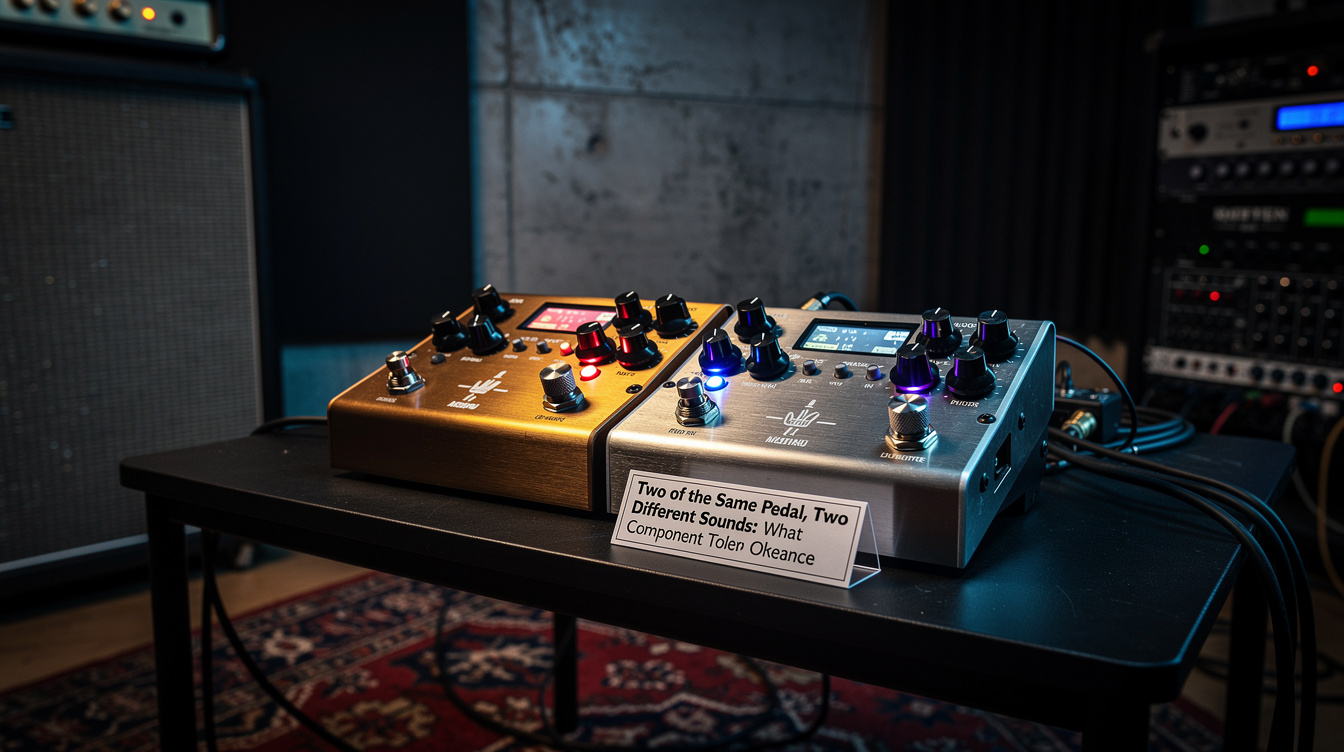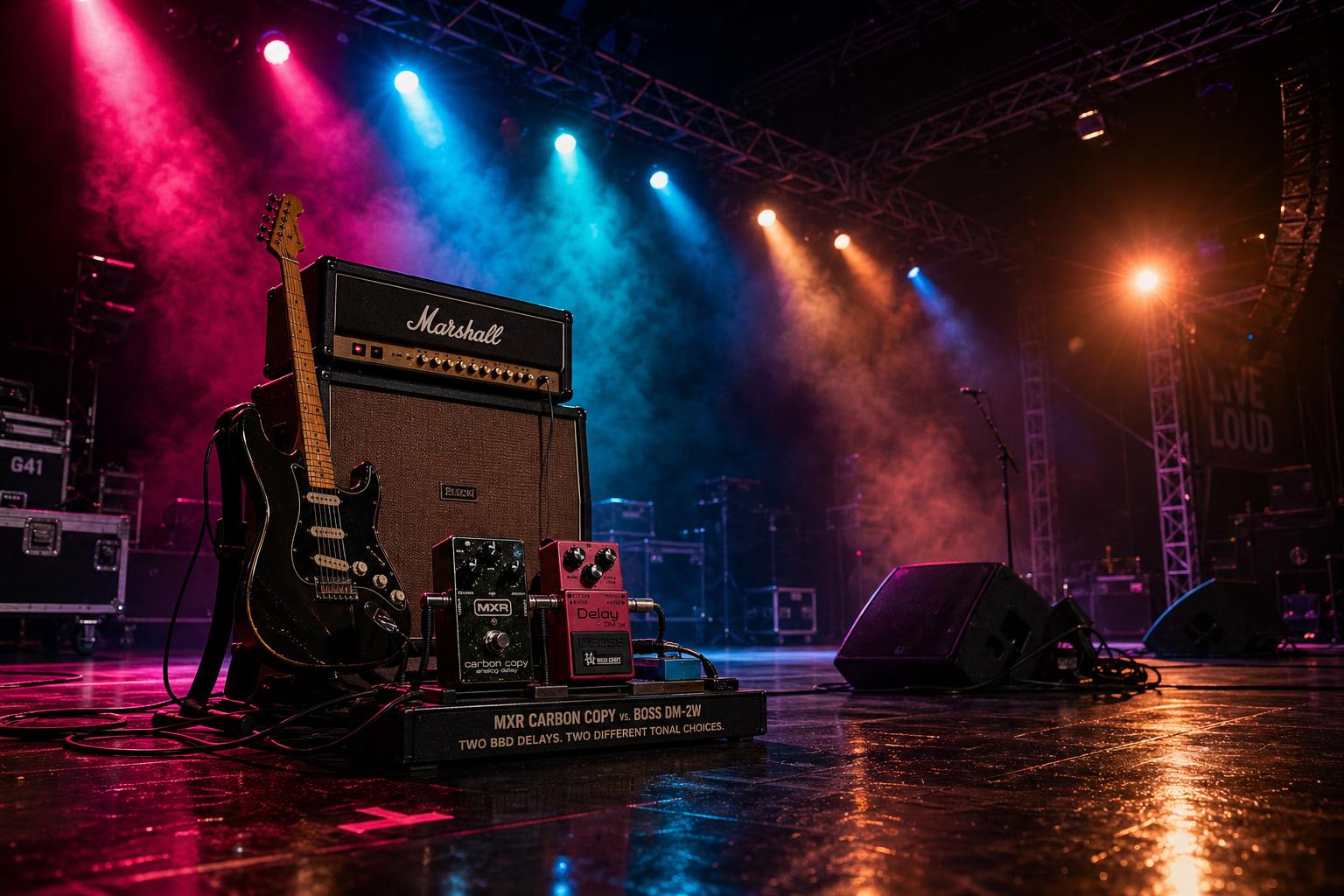
The short version: Both are BBD analog delays. The Carbon Copy has a darker, dirtier, more atmospheric character with built-in modulation that's always slightly there. The DM-2W is cleaner, more transparent, has standard and "custom" voicings, and offers expression pedal control. If you want one always-on ambient delay that washes the background, get the Carbon Copy. If you want a versatile slap-back-to-medium-rhythm delay that stays out of the way, get the DM-2W. The DM-2W is more useful in more contexts. The Carbon Copy is more characterful in the contexts it suits. Both are around $150 street and both are made well enough to last decades.
I've owned both of these. The Carbon Copy first, because it was on every pedalboard demo I watched in college. The DM-2W second, because I sold the Carbon Copy and missed having an analog delay around. I've now had the DM-2W on my live board for two years.
People ask me which is better. The honest answer is "they do different things." But that's not useful if you're trying to decide which one to spend $150 on. So let me actually compare them, point by point, and tell you which one to pick.
This is the follow-on to our BBD vs. PT2399 chip comparison, which establishes why BBD-based pedals sound different from the PT2399-based budget options. If you've already decided you want a BBD, the question becomes which one. Here's the answer.
What's in Each Pedal
Both pedals use the MN3005 family of BBD chips, which is the higher-spec end of the bucket-brigade line. Both have an analog signal path. The differences are in what each pedal does around the chip.
| MXR Carbon Copy | Boss DM-2W | |
|---|---|---|
| BBD chip | MN3005 (longer delay, lower noise) | MN3005 (same family) |
| Max delay time | ~600 ms | ~300 ms (standard) / ~800 ms (custom) |
| Modulation | Always available, on/off switch + width/rate trim pots inside | Tape-style modulation in custom mode |
| Voicing modes | Single voice | Standard (1981 DM-2 reissue) + Custom (extended range) |
| Controls | Delay, Mix, Regen, Mod toggle | E.Level, F.Back, D.Time, Mode toggle |
| Expression input | None | Yes (controls D.Time) |
| Power | 9V DC, ~25 mA | 9V DC, ~75 mA |
| Build | Made in USA, brushed metal enclosure | Made in Japan, classic Boss housing |
Both are roadworthy. Both are around $150 new. Both have been in continuous production for over a decade. The DM-2W is functionally a Boss DM-2 reissue with a modern voicing added on top. The Carbon Copy is its own thing. MXR designed it new in 2008 to occupy the space where the discontinued Memory Man and DM-2 had lived.
How They Sound
The chip is the same. The character is not. Here's why.
The Carbon Copy has a darker top end and a built-in modulation that's always doing something even when the toggle is off. The repeats start out dark and get darker; by the third or fourth repeat, the high frequencies are gone and the sound is a low-mid wash that sits behind the dry signal like a smudge of charcoal. The modulation, when engaged, pushes this character further into chorus territory. It's the pedal that taught me what "ambient" delay means as a guitar tone.
The DM-2W is cleaner. The repeats hold their high-frequency content longer, the noise floor is lower (it's perceptibly quieter at the same regen setting), and the standard mode is a faithful clone of the 1981 DM-2 (which was already cleaner than most of its contemporaries). The custom mode extends the delay time and adds a subtle tape-style modulation, but it's still cleaner than the Carbon Copy at any setting. This is a delay you can run with the regen at noon and have the repeats sit alongside the dry signal without smearing it.
The way I describe this to people who haven't tried both: the Carbon Copy sounds like an old tape echo that's been lightly damaged in a way you don't mind. The DM-2W sounds like a tape echo that's been kept in good condition.
When to Pick the Carbon Copy
There are specific contexts where the Carbon Copy is the right call.
Always-on ambient atmosphere. The dark, slightly modulated character of the Carbon Copy makes it the kind of pedal you can leave on for an entire set and the audience won't notice it as a "delay." They'll hear it as part of your overall guitar sound. This is how you use it for shoegaze, dream-pop, slowcore, and post-rock; anywhere the delay should be the cushion, not the rhythm element.
Long, washed-out repeats with character. The Carbon Copy starts to oscillate at higher regen settings in a way that's musical rather than chaotic. The Mod toggle adds a wobble that imitates the wow-and-flutter of a real tape delay. Push the regen past 2 o'clock and you get an evolving texture that feeds back on itself in the way classic ambient guitar records use. That musical-rather-than-chaotic oscillation is also why the Carbon Copy is the better of the two for riding the feedback knob as an instrument — its BBD path darkens and degrades as the howl builds, so the runaway turns into a usable drone instead of an ice-pick squeal.
A second delay in a stacked rhythm setup. The Carbon Copy works beautifully in front of a cleaner digital delay (a DD-7, a Strymon Timeline, an HX Stomp delay). The Carbon Copy provides the texture; the digital pedal provides the rhythm. The two combine into something neither one does alone.
The look of having an MXR pedal. This is real. The brushed metal enclosure, the slightly oversized footswitch, the green "carbon" stencil. These are part of why people buy this pedal. I'm not above admitting that.
When to Pick the DM-2W
The DM-2W earns its place in different contexts.
Slap-back delay (75-150 ms range). The cleaner repeats and the standard-mode voicing make the DM-2W the better choice for rockabilly slap-back, country chicken-pickin' delay, and any application where you want the repeat to be audible as a discrete echo behind the dry signal. The Carbon Copy at slap-back settings often sounds like the repeat is fighting the dry signal because of the modulation; the DM-2W just steps out of the way.
Dotted-eighth rhythm work in dense mixes. When the delay is a rhythmic element (U2-style, modern indie rock, worship rhythm parts), the cleaner repeats keep their definition in the mix where the Carbon Copy's repeats would muddy. This is the application that sold me on the DM-2W after I'd been using a Carbon Copy.
Setups where the delay needs to disappear. If your rhythm playing benefits from a subtle quarter-note delay that just adds depth without imposing character, the DM-2W standard mode at low mix is the right tool. The Carbon Copy can't do this; every Carbon Copy setting has the Carbon Copy character.
Players who want expression pedal control over delay time. The DM-2W has a TRS expression input that lets you sweep delay time with a foot pedal, which opens up dub, reverse, and sustained-pitch-bend techniques the Carbon Copy can't do. The Carbon Copy has no expression input at all.
What Surprised Me in the Direct Comparison
I kept both pedals on a single board for two weeks before I sold the Carbon Copy. A few things weren't what I expected.
I expected the DM-2W's noise floor to be obviously cleaner. It is, but the gap is smaller than reviews suggested. At normal regen settings (noon and below), both pedals are quiet enough to be unnoticeable. The Carbon Copy gets noisy at maxed regen; the DM-2W doesn't. But at gig-realistic settings the difference is small.
I expected the Carbon Copy's modulation to be a bigger deal than it is. The Mod toggle adds a subtle wobble, not a chorus. Even with the internal trim pots cranked (you have to open the pedal to access them), the modulation is more "lightly drifting" than "pronounced wobble." This is good (the modulation works in a wide range of settings), but it's not the dramatic effect some demos suggest.
I expected the DM-2W's custom mode to sound markedly different from standard mode. It doesn't, in a way that's hard to describe. The custom mode extends the delay time and adds the tape modulation, but the underlying voicing is the same DM-2 character. The two modes are useful in different contexts but they're cousins, not opposites.
Side-by-Side Decision Matrix
| If you're looking for... | Pick |
|---|---|
| Always-on ambient atmosphere | Carbon Copy |
| Slap-back at clean settings | DM-2W |
| Long washed repeats with character | Carbon Copy |
| Tight dotted-eighth rhythm in a mix | DM-2W |
| Modulated tape-style flavor (subtle) | Either (DM-2W custom mode or Carbon Copy with mod on) |
| Expression pedal control of delay time | DM-2W |
| Lowest possible noise floor | DM-2W |
| Self-oscillation that doesn't fall apart | Carbon Copy |
| Most versatile single delay | DM-2W |
| Most distinctive character | Carbon Copy |
If I had to pick one for an all-around player who wanted analog warmth without committing to a specific style, I'd pick the DM-2W. It does more things, it stays out of the way more easily, and it adapts to more genres. If I had to pick one for a player who already knew they wanted an ambient texture machine, I'd pick the Carbon Copy. It has more personality.
What Neither One Does
Both pedals are short-to-medium delay tools. Neither is a long ambient delay (1+ second), neither does multi-tap, neither does pristine repeats, neither has tap tempo. If you need any of those features, the BBD analog category is the wrong category. You're looking at a digital delay like a Boss DD-200 or an HX Stomp.
Both are also single-mode tools in the practical sense. Yes, the DM-2W has standard and custom modes, but they're variations on the same theme. If you want one delay that does pristine digital, dotted-eighth, slap-back, and ambient all from the same box, you want a Strymon Timeline or an HX Stomp delay block. The trade-off is the analog character; neither digital pedal has it.
The strength of these two pedals is that they do one thing (analog BBD delay) and do it well. That's also their limitation. Don't buy either one expecting it to replace a more featured digital delay.
Two pedals, two genuinely different tools. The Carbon Copy gives you character; the DM-2W gives you flexibility. Neither one is wrong. The version of you who's looking for an ambient cushion will be happiest with the Carbon Copy. The version of you who needs a delay that disappears into the mix will be happiest with the DM-2W. I went DM-2W. If you spend most of your playing time on shoegaze and ambient, you'll probably go the other way. The pedal that fits the music you actually make is the right pedal.
For more on analog delay, see the BBD vs. PT2399 chip comparison and our guide to stacking delay and reverb.