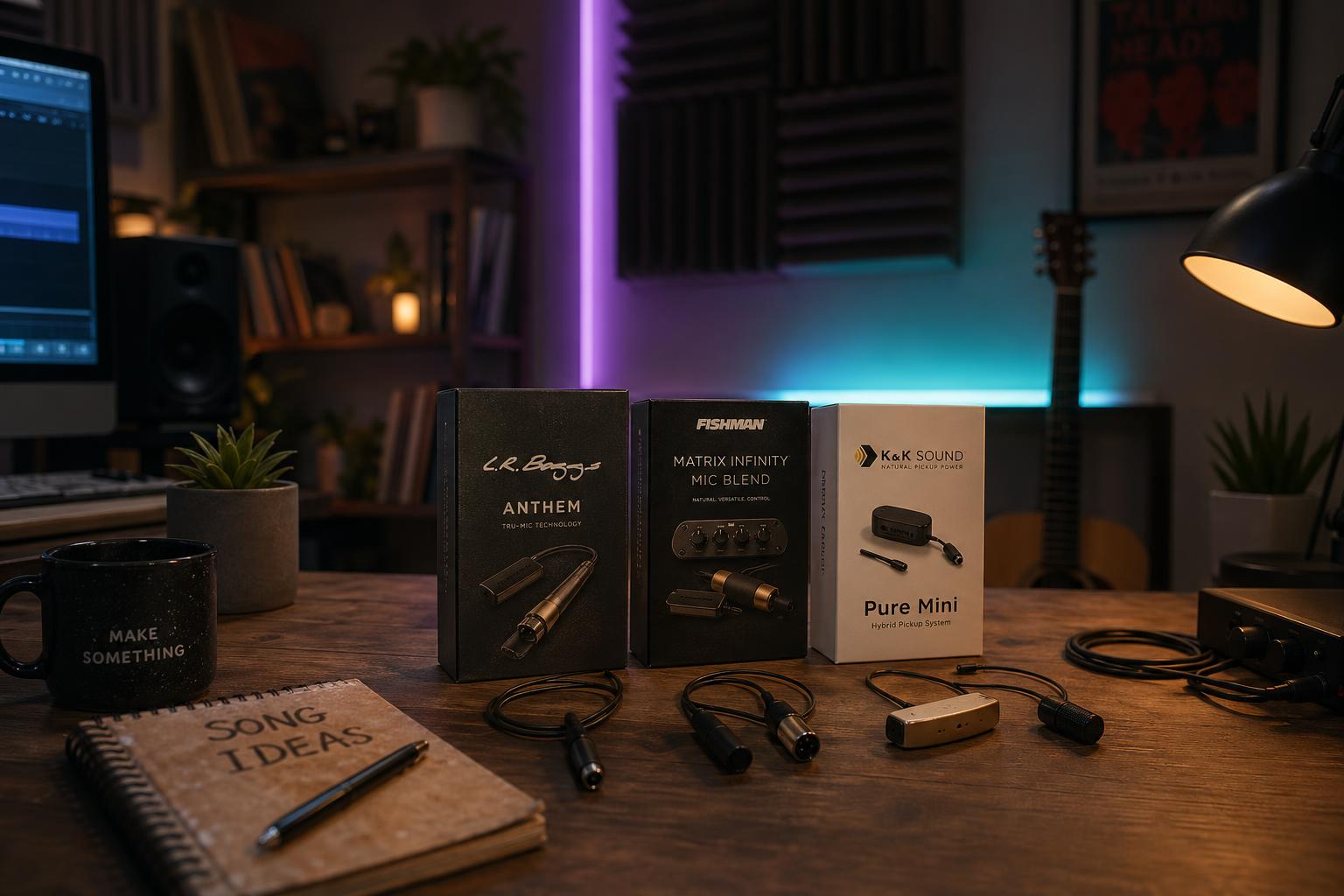
The short version: All three of these systems improve over a plain undersaddle pickup. Each one improves it differently. The LR Baggs Anthem combines an undersaddle pickup with a small internal microphone (most natural sound, biggest install, around $300 street). The Fishman Matrix Infinity Mic Blend is an undersaddle with a soundhole-mounted mic, easier install, around $250 street. The K&K Pure Mini is three soundboard transducers (no mic, no undersaddle); simplest install, around $100, sounds the most "wood-y" but least feedback-resistant. If you play unamplified at home and occasionally plug in for a small acoustic gig, K&K. If you play at church or open mic and want the best balance of sound and feedback resistance, Anthem. If you want most of the Anthem's quality at a lower price, Matrix Infinity Mic Blend.
I've had an acoustic pickup install on my list for about two years. The kids are at an age where they sleep through me playing softly in the next room, but if I want to plug in and run through a small amp or an interface (even at quiet volumes), I need a pickup. My acoustic is a Taylor 214ce, which came with the Taylor ES2 system from the factory, but I wanted to know what else was out there before I committed to keeping the stock pickup.
So I borrowed three guitars from friends and from the music shop down the street, each fitted with one of the three most-recommended hybrid systems, and spent two weekends playing them. What follows is what I learned, written for people who don't have time to spend two weekends comparing pickups.
This is the follow-on to our acoustic pickup-and-microphone blend recording workflow, which covers running a separate microphone alongside an internal pickup. The integrated systems below are the all-in-one approach: one device, one output, one cable. Different solution to the same fundamental problem.
What "Hybrid" Actually Means
A hybrid acoustic pickup combines two or more transducer types in a single system. The reason these exist is that no single pickup type captures the full character of an acoustic guitar.
| Pickup type | What it captures well | What it misses |
|---|---|---|
| Undersaddle piezo | Note attack, string definition, anti-feedback | Body resonance, room interaction, woodiness |
| Soundboard transducer (SBT) | Body resonance, percussive elements, woodiness | High-frequency clarity, anti-feedback |
| Internal microphone | Air, room interaction, the "real" acoustic sound | Feedback resistance, consistency at higher volumes |
| Magnetic soundhole pickup | Single-coil clarity, anti-feedback | Acoustic character (sounds more like an electric) |
A hybrid system blends two or more of these to capture more of the guitar's true character. The blend can be fixed (a designed ratio set by the manufacturer) or adjustable (you set the ratio yourself with a control on the guitar or a preamp). The trade-off is always more parts, more install complexity, and more cost.
Now to the three systems.
LR Baggs Anthem: Undersaddle + Internal Microphone
The Anthem is the most-recommended hybrid for serious players. It's an Element undersaddle pickup combined with a small TRU-MIC microphone mounted inside the body, blended with an onboard preamp that lets you set the ratio.
What it sounds like: Plugged into a Fender Acoustasonic 30, the Anthem-equipped Martin D-15 I borrowed sounded immediately like an acoustic guitar in a room, not a "piezo'd" version of an acoustic. The microphone captures the body resonance and the brushed string sound that the undersaddle alone can't get. Set the mic blend at about 50% and the guitar has natural body weight. Push the mic blend higher and the body sound dominates; push it lower and the system reverts toward straight piezo.
What surprised me: I expected the internal mic to be feedback-prone in any setup with a wedge monitor. It wasn't, mostly. The TRU-MIC is positioned to favor the guitar's own resonance over external sound, and the preamp has a phase switch that helps when you do encounter a feedback frequency. I tested it at moderate stage volume in a small room and the system held together with a 2 dB cut around 200 Hz on the EQ.
Install: Significant. The undersaddle requires a saddle removal and a bridge plate routing for the wire. The microphone mounts inside the body and routes to the preamp module, which is endpin-jack mounted. The control wheel for the mic blend is mounted in the soundhole. This is a luthier install; count on $80-$120 in install labor on top of the pickup cost. Not a DIY job unless you're comfortable with bridge work.
The sweet spot: Anyone who plays an acoustic at any kind of amplified volume and wants the sound to be the actual sound of their guitar, not a piezo approximation. The 50% mic blend works for almost everything.
Street price as of 2026-04: Around $300 for the pickup, $80-$120 for install.
Fishman Matrix Infinity Mic Blend: Undersaddle + Soundhole Microphone
The Matrix Infinity is Fishman's flagship undersaddle, which on its own is excellent. The Mic Blend version adds a small condenser microphone that mounts in the soundhole on a flexible gooseneck. The blend is controlled by a small wheel on the preamp.
What it sounds like: The Matrix Infinity by itself is one of the cleaner undersaddle pickups on the market, with less of the harsh piezo "quack" than older systems. Adding the mic blend gives the sound depth and body. With the mic at 50%, a Taylor 214ce sounded fuller than the same guitar with just the stock ES2. The mic captures more of the high-frequency air than the Anthem's TRU-MIC does, which works well for fingerstyle but can get bright on aggressive strumming.
What surprised me: The soundhole-mounted mic is more feedback-resistant than I expected. The proximity to the strings (rather than to the guitar's resonant body) means the mic picks up the strings' direct vibration more than the guitar's air resonance, which is the part that feeds back. Tested at the same stage volume that gave the Anthem trouble, the Matrix Infinity Mic Blend was actually a little more stable.
The trade-off: The mic mounts visibly in the soundhole on a gooseneck. Some players don't like the look; it's noticeable from the front. If you care about the visual aesthetic of an unmodified-looking acoustic, this is a real consideration. The Anthem's TRU-MIC is invisible from the outside.
Install: Easier than the Anthem. The undersaddle and preamp install is the same labor; the soundhole mic clamps in and routes through the soundhole rather than requiring internal mounting. Many players install this themselves with patience and an Allen key. Budget $40-$80 if you have it installed professionally.
The sweet spot: Players who want most of the Anthem's quality at a lower price and don't mind the visible mic. Particularly good for fingerstyle players where the high-frequency air matters.
Street price as of 2026-04: Around $250 for the pickup.
K&K Pure Mini: Three Soundboard Transducers, No Mic
The K&K Pure Mini is the simplest of the three: three small piezo transducers epoxied to the inside of the bridge plate, no undersaddle, no microphone, no battery. Passive output.
What it sounds like: Different from both of the above, in a way that's hard to describe without comparing to a third option. The K&K captures the soundboard's vibration, which means the sound is dominated by body resonance and the percussive elements (fingertaps, slaps, brushed strings) rather than by individual string definition. The result is a "wood-y," organic sound that some players love and some find muddy. On a small-bodied guitar like a Martin 0-15 it sounded perfect; every percussive technique came through, every note had body. On a larger dreadnought it could get boomy in the lower mids.
What surprised me: The output level is lower than the other two and it's passive (no battery, no preamp inside the guitar). You'll need either a high-input acoustic amp, a preamp pedal (LR Baggs Para DI or similar), or an interface with enough gain. I tested it through a Fender Acoustasonic 30 and the output was usable but quieter than the Anthem at the same setting.
The trade-off: Limited feedback resistance at higher volumes. The soundboard transducer essentially turns the entire guitar top into a microphone. When you put that signal back through a speaker, the speaker's vibrations excite the top, which feeds back. At quiet volumes this is fine. At small-room amplified volume it's manageable with EQ. At gig volume on a wedge monitor, it's a problem.
Install: The simplest of the three. The transducers epoxy to the bridge plate, the wire runs to an endpin jack. No undersaddle work, no preamp module mounting. Many players install this themselves. Some do it professionally for $40-$60.
The sweet spot: Home recording and quiet amplified contexts (small acoustic gigs, intimate venues, songwriter rounds). Not for stage volume. Particularly good for fingerstyle and percussive players where the soundboard pickup captures the playing technique.
Street price as of 2026-04: Around $100 for the pickup.
Side-by-Side Comparison
| LR Baggs Anthem | Fishman Matrix Infinity Mic Blend | K&K Pure Mini | |
|---|---|---|---|
| Architecture | Undersaddle + internal mic | Undersaddle + soundhole mic | Three SBTs only |
| Sound character | Most natural, balanced body and string | Bright, airy, fingerstyle-friendly | Wood-y, body-dominant, percussive |
| Feedback resistance | Good | Very good | Limited at stage volume |
| Install complexity | Significant (luthier required) | Moderate (DIY-able with patience) | Simple (DIY-able for most players) |
| Battery | Required (9V) | Required (9V) | None (passive) |
| Output level | High | High | Lower (preamp recommended) |
| Visible from outside | TRU-MIC invisible; control wheel in soundhole | Mic visible in soundhole | Endpin jack only |
| Street price | ~$300 | ~$250 | ~$100 |
| Typical install cost | $80-$120 | $40-$80 | $40-$60 |
| Best for | Any amplified context, especially live | Fingerstyle, mid-volume amplified | Home recording, quiet gigs |
How to Decide
The three systems target overlapping but distinct use cases. Here's a decision framework that worked for me.
If you'll be plugging in at any volume above small-room (open mic, church service, songwriter night with monitors), the Anthem is the safest choice. The internal microphone gets you closer to the actual sound of your guitar, and the feedback resistance holds up where the K&K won't. The cost is real but justified.
If you want most of the Anthem's quality at a lower price and don't mind a mic visible in the soundhole, the Matrix Infinity Mic Blend is the value pick. I came close to going this direction myself. The sound at home is excellent, the install is more accessible, and the lower price leaves room for a small acoustic amp or a preamp pedal in the same budget.
If you play primarily at home or for quiet recording and only occasionally amplify, the K&K Pure Mini is the right answer. The sound is genuinely beautiful for the right kind of guitar (smaller bodies, fingerstyle players), the install is approachable, and the passive design means no batteries to manage. You'll want a preamp pedal, but that's a one-time addition that pays off in tone shaping flexibility.
What I picked, after all this: I'm leaning toward the Matrix Infinity Mic Blend for my Taylor. The visible mic doesn't bother me, the price-to-performance is right for someone who plugs in maybe twice a month, and the install is one I can have done at the local shop in an afternoon. If I were gigging weekly I'd pay the additional $50 for the Anthem. I'm not, so I'm not.
What None of These Solve
A pickup is half the equation. The other half is what's at the other end of the cable. Even the best hybrid system needs:
- A preamp or DI with proper acoustic-friendly EQ shaping (the LR Baggs Para DI is the standard recommendation; the Fishman Aura series is excellent for shaping the sound to match a microphone reference)
- A speaker designed for full-range frequency response (a guitar amp colored for electric guitar will not flatter an acoustic; use an acoustic amp, FRFR speaker, or PA)
- Some EQ work in the room (the pickup tone fix guide covers the five most useful EQ moves for any acoustic pickup)
A great pickup into a bad signal chain will still sound bad. A decent pickup into a thoughtful chain will sound great.
How Much EQ Repair Each One Needs
Here's the part I wish someone had put in a table before I started shopping, because it reframes the whole price question. Every system here still has a contact element in the blend, which means every system still produces some amount of the two classic undersaddle problems: the boxy honk around 200-350 Hz and the brittle quack between 2.5 and 4 kHz. What the money buys is how much of that you have to fix downstream, not whether you have to fix it.
| System | Low-mid box (200-350 Hz) | Quack (2.5-4 kHz) | Body resonance |
|---|---|---|---|
| LR Baggs Anthem | Mild — the internal mic fills in around it | Mild at low mic blend, minimal at high blend | Genuinely present from the mic |
| Fishman Matrix Infinity Mic Blend | Moderate — the mic helps but sits further from the top | Moderate; still wants a cut | Partial, blend-dependent |
| K&K Pure Mini | Low — soundboard transducers don't have the saddle-pressure signature | Low; this is the K&K's main advantage | Some, from the top itself |
Two things fall out of that. First, the K&K's reputation for sounding natural isn't marketing — it isn't an undersaddle pickup at all, so the quack that defines the piezo sound is largely absent from the source. Its weaknesses are feedback resistance and output level, not tone color. Second, the Anthem's price is buying body resonance specifically, and body resonance is the one thing on this list that EQ genuinely cannot manufacture. That's a real reason to spend the money, and it's a different reason than "it sounds better."
If you're deciding between spending on a better pickup and spending the time to EQ the one you have, that distinction is the whole decision. A tone problem — honk, quack, brittleness — is a cut or two away and costs nothing. A missing-body problem is a hardware problem, or an acoustic IR problem, and no EQ curve will solve it. Figure out which one you actually have before you spend $300.
Whatever you land on, the signal path after the pickup matters as much as the pickup: the acoustic-through-a-modeler walkthrough covers the DI routing, the compressor, and the feedback notch in order.
These three systems all work. The choice is about matching the system to your actual playing: how often, how loud, and into what. The most expensive option is not automatically the best for your situation. A K&K Pure Mini in a fingerstyle player's home recording rig is the right pick over an Anthem that would be overkill. An Anthem in a worship leader's monthly service rig is the right pick over a K&K that would feed back. Buy the system that fits the room you actually play in.