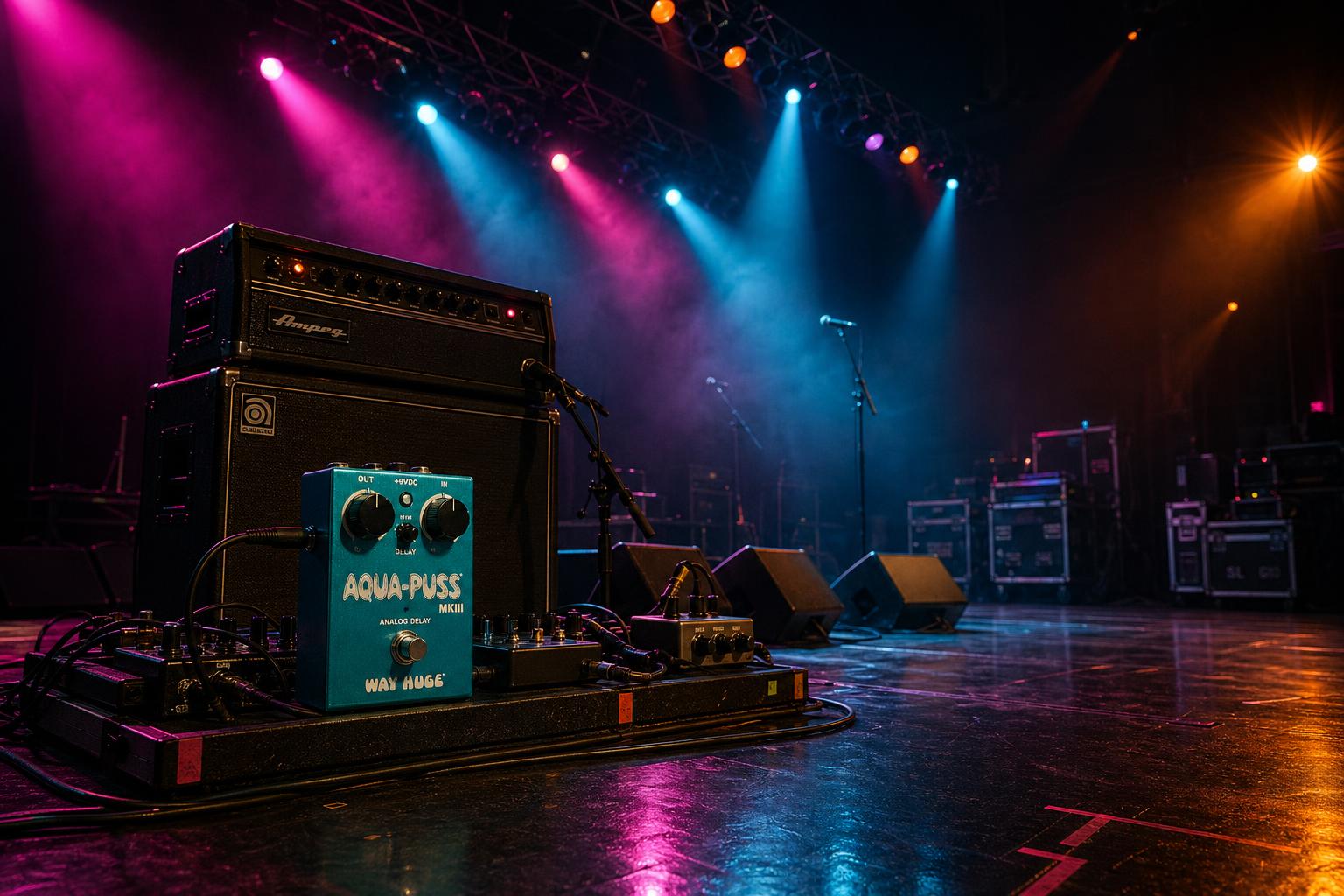
Start Here: The Aqua-Puss MkIII is a 20-300ms BBD analog delay with three knobs (Speed, Depth, Mix) and a longer, darker repeat than either the Carbon Copy or the DM-2W. It costs $150 new and shows up on Reverb between $90 and $115 used. If you want analog slap-back and short ambient, the Carbon Copy is the safer name. If you want a delay that sounds like the repeats are receding into a hallway, the Aqua-Puss is the one.
| Pedal | Price (new / used) | Max Delay | Modulation | Repeat Character |
|---|---|---|---|---|
| MXR Carbon Copy | $150 / $90 | ~600ms | Optional, mild | Bright-ish, defined |
| Boss DM-2W (Custom) | $170 / $130 | ~800ms | None | Tight, slightly extended |
| Way Huge Aqua-Puss MkIII | $150 / $100 | ~300ms | Always-on, rich | Dark, longer-tailed |
| Behringer VD400 (clone) | $30 / $20 | ~300ms | Always-on, rich | Same chip family, plastic enclosure |
The Pedal Most BBD Comparisons Skip
Every "best analog delay" list runs the same lineup: Carbon Copy, DM-2W, maybe the EHX Memory Boy if the writer is feeling adventurous. The Aqua-Puss almost never makes the cut. There are reasons: Way Huge as a brand is smaller, it's been discontinued and re-released twice over the years, and Jeorge Tripps' design philosophy is weirder than what most reviewers want to deal with.
That weirdness is the whole point. The Aqua-Puss does something the other two BBDs don't, and at the used price, it's the easiest BBD pedal to recommend to someone who already owns a Boss DD-3 and wants something different.
What the Three Knobs Actually Do
Three knobs, no menus, no hidden mode switches. This is the entire interface.
Speed sets the delay time, from about 20 ms at minimum to about 300 ms at max. That's the first thing to know: the Aqua-Puss does not do long delays. If you want 500-800ms ambient repeats, this is the wrong pedal. Carbon Copy gets you 600 ms and the DM-2W extends to about 800 ms in Custom mode. The Aqua-Puss is short and short-ish, end of story.
Depth controls modulation rate and intensity simultaneously. There's no separate width control. At minimum, the modulation is barely there. Past noon, the repeats start to wobble noticeably. Past 3 o'clock, you're in chorus-leaning territory. This is where the Aqua-Puss lives. It sounds best with the Depth knob doing real work, not parked at minimum trying to sound like a tape echo.
Mix is wet/dry blend, not feedback. There is no feedback knob. The number of repeats is fixed by the circuit. You get about three to four audible repeats at higher Mix settings, fewer at lower Mix. This is the single most controversial design decision in the pedal: there is no way to dial in self-oscillation, no way to get long trailing repeats. You either accept the fixed feedback amount or you don't buy this pedal.
How It Sounds Different from a Carbon Copy
I A/B'd both pedals at length running into a Plexi model on my HX Stomp, with a Jazzmaster on the bridge P-90. Same Speed setting (about 11 o'clock, which lands around 220 ms), same Mix at noon. The Carbon Copy modulation switch off.
The Carbon Copy's repeats sit higher in the frequency spectrum. The first repeat is clearly audible as a separate event from the dry signal. The high end stays present across all the repeats; you can hear the pick attack on each one. By the third repeat the signal has lost some upper detail but it's still recognizably the same note.
The Aqua-Puss does almost the opposite. The first repeat is already darker than the dry signal, like you're hearing the dry signal in the room and the wet signal through a wall. The second repeat is darker again. By the third repeat, the note has lost most of its high-end and turned into a soft pulse rather than a defined echo. The cumulative effect is a delay that pushes the repeats into the background instead of stacking them on top of the dry signal.
This is what BBD delays were originally supposed to sound like. The bucket-brigade chip degrades signal quality with each pass, which is the whole texture story. The Carbon Copy applies a brighter low-pass filter and tighter feedback control to make the repeats more usable in modern mixes; the Aqua-Puss leans into the chip's natural rolloff. Both are valid. Neither is "more analog" than the other; they're different tunings of the same underlying technology.
Where It Earns Its Place
I expected the Aqua-Puss to be a one-trick pedal, a slap-back machine that I'd use for rockabilly and nothing else. That's not how it's worked out on my board.
The setting that surprised me: Speed at about 9 o'clock (around 80 ms), Depth at about 1 o'clock, Mix at about 11 o'clock. This is too short for a noticeable echo and too modulated to sound clean. What it does is add a moving thickness to the dry signal; the repeats are buried enough that you don't hear them as repeats, but the modulation creates a chorus-like motion that an actual chorus pedal does not produce. It sounds like a 1960s amp with a slightly broken tremolo circuit. I use it on clean indie verse parts where a chorus pedal would be too obvious.
The slap-back setting still works the way you'd expect: Speed at noon (around 200 ms), Depth at minimum, Mix at about 10 o'clock. This is the rockabilly use case, and the Aqua-Puss handles it as well as anything. The fact that the high-end rolls off on the repeats is actually a feature here; it pushes the slap into the past rather than letting it compete with the dry signal.
The setting I expected to like and don't: long modulated washes. The Aqua-Puss's max delay time is too short for an ambient setting, and the heavy modulation muddles the repeats when they overlap. If you're trying to do shoegaze or worship-pad delay work, this is the wrong pedal. The Carbon Copy is better at that, the Strymon El Capistan is way better, and a pedal that can do long delay times will always win for that use case.
The Used-Market Angle
Where the Aqua-Puss really earns its place is on the used market. New, it's $150, about the same as a Carbon Copy. Used, it consistently sells for $90 to $115 on Reverb because the brand recognition is lower and the discontinuation/re-release cycle keeps secondhand prices soft.
At $90 used, this is the cheapest decent BBD delay you can buy that isn't the Behringer VD400, and I'll get to the Behringer in a second. For comparison: a used Carbon Copy in good shape sits at $90 to $110, a used DM-2W is $130 to $150, and a vintage Boss DM-2 with a real original BBD chip is $250+ and may need a recap. The Aqua-Puss at $90 is the value pick of the BBD category, full stop.
What About the Behringer VD400?
The Behringer VD400 is the elephant in the room for any analog delay conversation. It's $30 new, it uses a BBD chip from the same family as the Aqua-Puss (a Cool Audio V3205, which is the modern reissue of the classic Reticon SAD1024), and it sounds genuinely close to the Aqua-Puss in side-by-side tests. The difference is build quality: the VD400 is plastic, the switch feels like a click pen, and the input/output jacks will eventually fail.
If you're not gigging and you want to know if you like BBD delay before spending real money, buy the VD400 first. It's $30. If you decide BBD is your sound, then the Aqua-Puss at $90 used or the Carbon Copy at $100 used is the upgrade path. Don't skip the VD400 step if you've never used a BBD pedal. You may decide you actually want a digital delay with longer repeats and never need to spend anything more.
I do not gig with my VD400. I have one on a backup board for emergencies. The build is the issue, not the sound.
The HX Stomp Question
A predictable question: if I run an HX Stomp, why do I own a hardware BBD delay at all? The Stomp's Vintage Digital, Adriatic, and Cosmos delay blocks all do BBD-style emulation. The Adriatic in particular is modeled on the Boss DM-2W and gets impressively close to the real thing.
Two reasons. First, the Stomp's analog delay models are good but they emulate cleaner BBDs. They default to the Carbon Copy character, not the Aqua-Puss character. Getting the Stomp to sound like the Aqua-Puss requires layering modulation onto a delay block and dialing back the high-frequency response with EQ. It's possible. It's not as easy as turning three knobs on a real pedal.
Second, the Aqua-Puss lives in front of the Stomp on my board, and the order matters. Running an analog delay into a digital amp model produces a slightly different texture than running a digital delay block inside the model. The analog delay's repeats hit the modeled preamp and get processed through the amp's gain stage, which colors the repeats in a way the in-the-box delay doesn't. For low-key indie textures where the delay should feel like part of the amp rather than an effect on top of the amp, that ordering matters.
This is a defensible "I want a real pedal for this specific job" argument. It is not a "you need the real thing" argument. If your modeler signal chain works for you, you do not need to buy a BBD pedal.
Who Should Buy It
The Aqua-Puss MkIII is the right pedal for you if:
- You want short, dark, modulated delay: slap-back, vintage tape-style, indie verse texture
- You're building a budget board and the used price gets you a real BBD pedal under $100
- You already own a Carbon Copy and you specifically want a darker, more modulated alternative
- You hate menu-diving and want three knobs that do exactly three things
It is the wrong pedal for you if:
- You need long delays (over 300 ms) for ambient or worship use
- You need feedback control or self-oscillation
- You want clean, defined repeats that sit on top of the dry signal
- You want a pedal you can fully tame; the always-on modulation is not adjustable separately from rate
That last bullet is the biggest gotcha. Players who try the Aqua-Puss and don't like it almost always don't like it because they want a "clean" analog delay and the Aqua-Puss refuses to do clean. That's the design. If you want clean, the Carbon Copy modulation switch goes off, the DM-2W exists, and the Maxon AD-9Pro is genuinely transparent. Don't buy the Aqua-Puss expecting it to be those pedals.
The Bottom Line
The Aqua-Puss MkIII isn't a Carbon Copy alternative; it's a different pedal solving a different problem. The Carbon Copy gives you usable analog delay across slap-back, dotted-eighth rhythm, and short ambient. The Aqua-Puss gives you dark, modulated, short-and-medium analog delay that pushes repeats backward instead of stacking them forward.
At $150 new the Carbon Copy is probably still the safer first BBD purchase because it does more things competently. At $90 used the Aqua-Puss is the value pick of the entire BBD pedal category and a genuine alternative voice in a space where most pedals try to sound the same. If you've already got the Carbon Copy and want to know what else is out there, this is the next pedal to try.
FAQ
Is the Aqua-Puss true bypass?
Yes. The MkIII is true bypass with mechanical switching. There's no buffer in the signal path when the pedal is off, which matters if you're running it after fuzz or in front of a fuzz that doesn't like buffered inputs.
What chip does it use?
The current MkIII uses a modern reproduction of the Reticon SAD1024 BBD chip, likely a Cool Audio V3205 or equivalent reissue. Earlier versions of the Aqua-Puss (the original Way Huge era and the Dunlop reissue) may have used different chips depending on availability. The tonal character is consistent across the production runs in my experience, but vintage-collector buyers may want to verify the production date.
Does it work in an effects loop?
Yes, and it should be in your loop if you're running it after a high-gain amp's preamp section, the same as any time-based effect. In front of the amp, it'll cause the delay repeats to be amplified by the amp's gain stage, which produces a distorted, layered effect that's a feature for some genres (shoegaze, indie) and a problem for others (clean ambient).
Why is it called the "Aqua-Puss"?
Jeorge Tripps' naming is its own thing. Way Huge has the Saucy Box, the Pork Loin, the Swollen Pickle, and the Red Llama. Don't think too hard about it.
Is the Aqua-Puss MkIII the same as the original Way Huge Aqua-Puss from the 1990s?
The MkIII is a Dunlop-era reissue of the original. The circuit is faithful to the original design but uses modern components and PCB construction. Vintage Way Huge pedals from before the Dunlop acquisition (pre-2008) sell for $300-500 used. The MkIII gets you 95% of the sound for a fraction of the price.