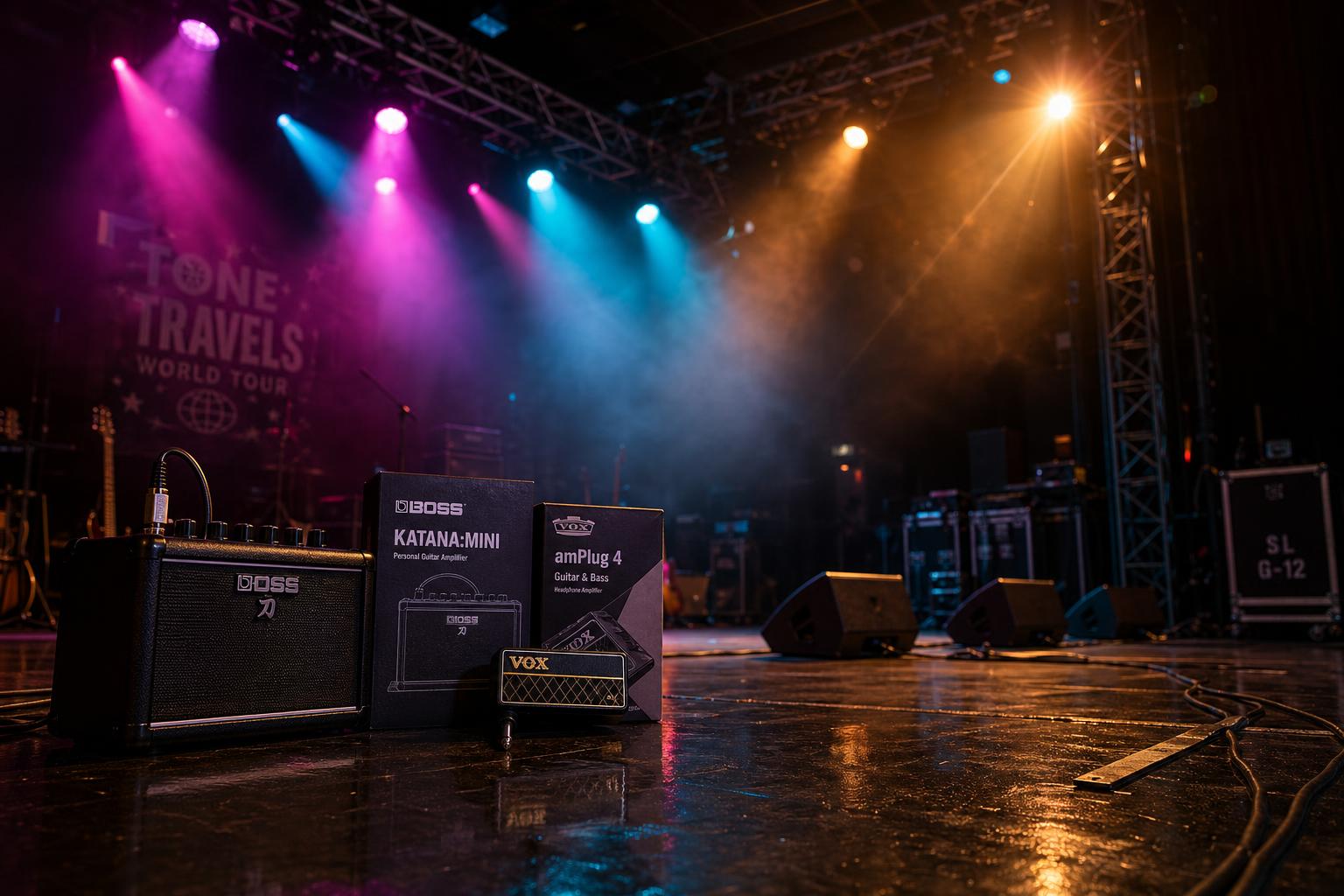
The decision in one paragraph: If you want to practice with sound in the room (alone, with a partner sitting next to you, in a hotel room without bothering the next guest), the Katana Mini at $130 is the answer. It has a real speaker, three usable channels, and a tape jack for backing tracks. If you want to plug your guitar into your head with zero footprint and a 1-second setup time, the Vox amPlug 4 at $50 is the answer, and the Lead and Clean models are genuinely good. They are not direct competitors despite the price overlap. Pick by whether the sound needs to leave your skull.
I've owned both of these. The Katana Mini lives on a shelf in my apartment for the times when my partner is watching TV and I want to noodle in the next room without putting headphones on. The amPlug 4 lives in my gig bag for hotel rooms, soundcheck downtime, and the occasional plane ride when I want to run scales without committing to a full setup.
They solve different problems. The reviews that compare them spec-for-spec miss this and end up declaring a winner that only makes sense for one use case. So here's the frame: which problem do you actually have?
The Two Units, Side by Side
| Spec | Boss Katana Mini | Vox amPlug 4 (Lead model used here) |
|---|---|---|
| Street price | ~$130 | ~$50 |
| Power | 7W battery (6× AA) or DC adapter | 2× AAA, no adapter option |
| Output | Internal speaker + 1/8" headphone jack | 1/4" guitar input → 1/8" headphone jack only |
| Battery life | ~7 hours | ~17 hours |
| Channels | 3 (Brown, Crunch, Clean) | 1 amp model per device, 9 effects (chorus/delay/reverb combos) |
| Tone controls | Gain, Volume, Bass, Mid, Treble | Gain, Tone, Volume |
| Aux/backing track input | 1/8" tape input (mono) | None (the amPlug IS the input chain) |
| Footprint | About the size of a hardcover book | About the size of a chunky USB charger |
| Made for | Practice with sound in the room | Practice in headphones with no setup |
These aren't competing products. They're competing categories. The Katana Mini is a small amp. The amPlug 4 is an interface. Confusing the two is the most common mistake in this corner of the gear conversation.
What the Katana Mini Actually Sounds Like
The Katana Mini runs on the same Boss DSP that powers its bigger Katana siblings, scaled down to a single 4-inch speaker and 7 watts. Three channels: Brown (high gain), Crunch (medium gain), and Clean. Each channel has a Gain knob, a Volume knob, and a three-band EQ.
The Brown channel is good. Genuinely. It's a JCM800-adjacent voice with enough gain for hard rock and modern punk, and the EQ has enough range to dial in either an aggressive scoop or a midrange bark. I've practiced parts for actual band rehearsals on this thing: riffs from a Rise Against song, a couple of chord progressions for an indie rock cover I was working on. The muscle memory translated to my Jazzmaster-into-HX-Stomp gig rig without me having to relearn anything. That's the test that matters for a practice amp.
The Crunch channel is where the unit lives for most of what I actually do at home. It's a low-gain breakup voice that responds to guitar volume; roll back to 6 and it cleans up to an edge-of-breakup chime, push back to 10 and it gets into Marshall-territory crunch. This is a useful range and most of the tones on my last band's record could be approximated within it.
The Clean channel is fine. Not exceptional. The 4-inch speaker can't move enough air to get a true clean tone to feel three-dimensional, and the headphone-out version of the clean is better than the speaker version. If you're a country or jazz player who lives on cleans, this is not your amp.
The tape input is the killer feature people forget. You can run a phone playing a backing track into the side jack and the practice experience becomes "real practice" instead of "noodling alone." This is the part of the unit that justifies the $130 price for me.
What the Vox amPlug 4 Actually Sounds Like
The amPlug 4 is a complete signal chain (preamp, EQ, effects, headphone amp) packed into a plug that connects directly to your guitar's output jack. You then plug headphones into the other side. That's the whole rig.
The current generation comes in nine flavors: Lead, Clean, AC30, Bass, Acoustic, Classic Rock, Metal, Cabinet, and a couple of effects-heavy variants. Each is essentially a fixed amp model with a few preset effects you can cycle through. I've used the Lead, Clean, and AC30 versions extensively. The Lead is what I'll talk about first because it's the one most readers are going to consider.
The Lead amPlug is a cranked Marshall voice with enough gain for rock and hard rock. It has the family resemblance to a Plexi pushed past noon: slightly compressed, midrange-forward, with a useful bass roll-off so it doesn't get muddy under headphones. The Tone knob is more useful than I expected; it's not just a high-shelf, it actually shifts the midrange focus in a way that lets you dial in either a darker rhythm tone or a brighter lead voice from the same setting.
The AC30 amPlug is the surprise of the line. Vox knows what an AC30 sounds like, and the tube-amp character (the early compression, the upper-midrange chime) translates better in this little plastic plug than I'd expected. It's the model I reach for most often when I'm running clean-to-edge-of-breakup material.
The Clean amPlug is genuinely good for what it is. Not Twin Reverb-level dimensionality, but a usable clean platform that responds to picking dynamics and doesn't get harsh in headphones. The built-in chorus voicing is dated (it's very 1980s) but the delay and reverb settings are fine for practice.
What you don't get with any amPlug: real low-end. Headphones reproduce low frequencies differently than speakers, and the amPlug's voicing is tuned for that. There's a high-pass roll-off built in to keep things from sounding boomy in the cans. If you switch from the amPlug to a real amp, the low-end difference will surprise you. Plan for it.
The Setup-Time Difference (And Why It Matters More Than You Think)
This is the part most reviews skip and the part that determines whether you'll actually use the thing.
Katana Mini setup time: Take off the strap, set guitar down, plug guitar cable into amp, plug other end into guitar, turn amp on, set channel, set volume. Maybe 30–45 seconds if you don't have to dig the cable out of a drawer. If you want to use headphones instead of the speaker, add another step: plug headphones in.
amPlug 4 setup time: Plug amPlug into guitar, plug headphones into amPlug, turn it on. Maybe 8 seconds. No cable to manage. No surface to set the amp on.
The 30-second difference doesn't sound like much in the abstract. In practice (when you have a five-minute window before your kid wakes up from a nap, or fifteen minutes between meetings, or the moment you actually feel like playing something) that 30 seconds is the difference between picking the guitar up and not. The amPlug wins setup time decisively, and setup time is one of the most underrated specs in the practice amp category.
The Katana Mini wins room sound. There is no version of headphones that gives you the spatial experience of a small amp moving air across a room. If you want the guitar sound to exist outside your head, no plug-in-the-jack solution will get you there.
So the question becomes: which constraint is actually limiting your practice? If you're not playing because you don't want to bother housemates, the amPlug solves that. If you're not playing because the setup feels too final ("I committed to a real practice session, now I have to do one"), the Katana Mini's friction can be a feature. It's a small ceremony that says "I'm playing now."
The Backing-Track Question
The Katana Mini has a 1/8" stereo input that mixes a phone or laptop signal into the speaker output. The amPlug 4 (current generation) has Bluetooth audio in some models (the AC30 amPlug specifically supports it), which lets you play along with backing tracks streamed from your phone.
Both work. Both have caveats.
The Katana Mini's tape input is mono and the volume isn't matched to the guitar, so you'll need to set your phone's volume manually relative to the amp's master, and the speaker is small enough that a backing track at meaningful volume can wash out the guitar. This is fine for jamming over chord changes, less fine for working on lead lines where you need the guitar to sit on top of the mix.
The Bluetooth amPlug works well for streaming backing tracks but has a perceptible latency (usually 150-200ms), which is enough to feel weird when you're playing along. For loose noodling it doesn't matter. For tight rhythm work it's a problem. The Katana Mini's wired input has zero latency.
If backing tracks are central to your practice, lean Katana Mini. If you only want them occasionally, either works.
The Stuff That Doesn't Matter (But the Internet Pretends Does)
A few things you'll see in reviews of these units that you should ignore:
"The Katana Mini sounds boxy." It's a 4-inch speaker in a plastic cabinet. Of course it does. This is a practice amp, not a recording rig. If you want a non-boxy small amp, you're spending three times as much.
"The amPlug feels cheap." It IS cheap. It's $50. The plastic enclosure is appropriate to the price. The internal DSP is what matters and the DSP is good.
"The amPlug doesn't have good effects." The effects are fine for practice. If you want professional-grade reverb and delay you want a different category of product. The amPlug is for getting amped tone in headphones with one connection. The effects are a bonus, not the point.
"The Katana Mini doesn't have effects you can save." It doesn't have presets. That's correct. It has three channels with three knob positions you have to remember. For a $130 practice amp that's appropriate. If you want preset memory you want a Katana Air or a Spark Mini.
The thing both of these products do well is the thing they were designed to do. Don't expect them to do anything else.
What I Actually Use More Often
When I bought my amPlug 4 (the AC30 version, specifically, before I owned a Katana Mini), I assumed it would be a stopgap, a thing I'd use occasionally on the road and then upgrade to a "real" headphone solution within a year. Two years later I still use it more than the HX Stomp on the rare days I need a one-minute practice setup, because the friction of pulling the HX Stomp out, plugging in the cable, plugging in the headphones, and powering up isn't worth it for a five-minute window.
The lesson: the bottleneck for practice isn't tone quality. It's setup time. The amPlug exists in a category where it's the only product that gets the setup time low enough to convert "I have five minutes" into "I'm actually playing." That's a real and underrated value, and no amount of higher-tier modeling is going to compete with it for that specific use case.
The Katana Mini surprised me in the opposite direction. I assumed a 7-watt practice amp would feel like a toy. It doesn't. The Brown channel translates to my real rig in a way I didn't expect, and the speaker (for what it is) moves enough air that the room-sound experience is genuinely useful. It's not pretending to be a bigger amp; it's confidently being a small one, and that confidence is the thing that justifies the $130.
If I had to pick one and only one for a player I'd never met, I'd ask exactly one question: do you have a quiet space where you can leave a small amp out? If yes, Katana Mini. If no (apartment with thin walls, partner who watches TV, kids who nap), amPlug 4. The right answer is the one that removes the friction between you and your guitar. Everything else is taste.