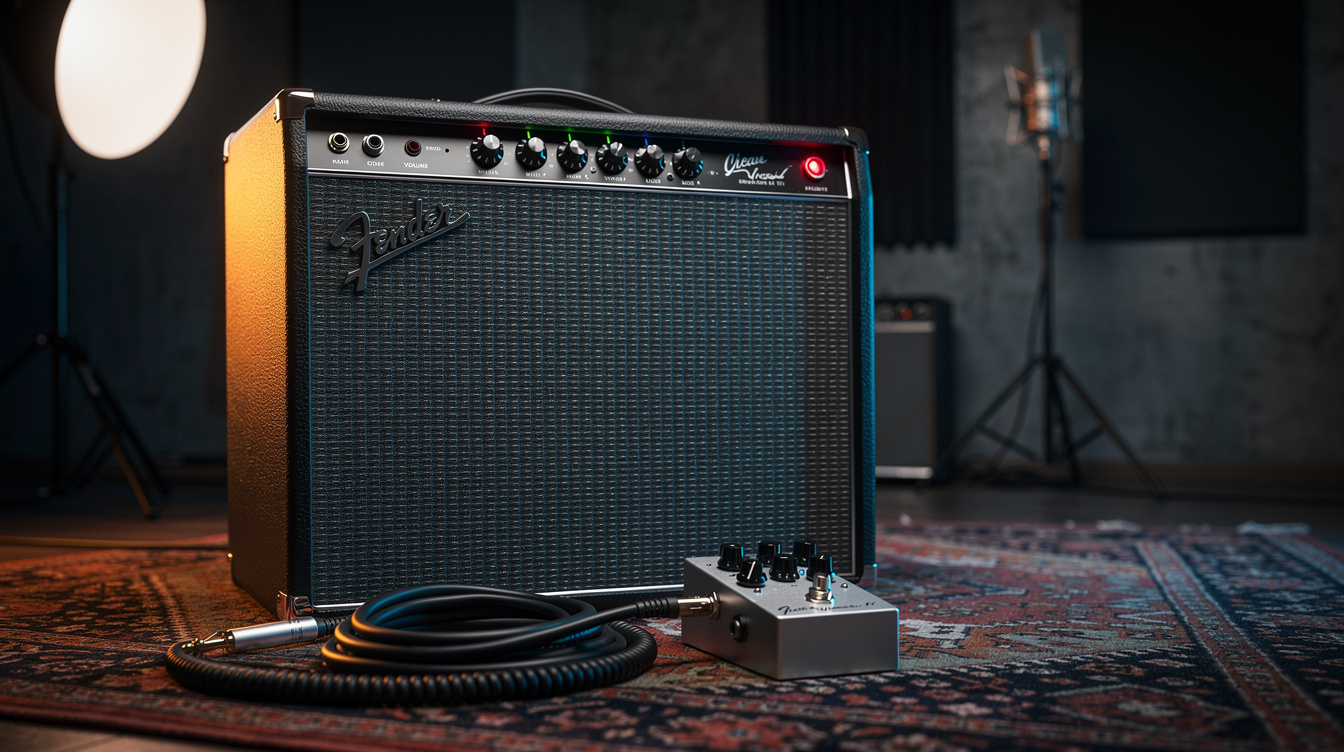
There's a specific sound I'm chasing when I plug a Jazzmaster into a blackface Fender and strum an open chord — the one where all six strings ring out separately, each note holding its own shape, the whole thing shimmering without ever folding into grit. That sound has a name in amp terms: clean headroom. It's the territory below the point where the power section gives up and starts to break up, and knowing how to find it — and extend it — is the difference between a clean tone that blooms and one that turns to mud the second a chorus arrives.
What Is Clean Headroom?
Clean headroom is the range of volume where the amp reproduces your signal linearly. Inside that range, the power tubes track your pick attack faithfully: hit harder, get louder, but the tone stays articulate. Push past the ceiling and the power section starts to sag and compress — first as a soft, springy give on the loudest notes, then as full overdrive.
On a classic blackface-voiced Fender, that ceiling lives roughly where the Volume control crosses 4 to 5, depending on the amp's wattage and your pickups. Below it, chords stay defined. Above it, they start to crunch. The whole craft of a Fender clean is living in the half-inch of knob travel just under that line.
The Surprise: It's the Bass That Breaks First
Here's the thing I expected to be wrong about and wasn't. I always assumed treble was the enemy of a clean tone — that brightness was what got harsh and broke up. What actually pushes a Fender into breakup first is the low end. A loud, fundamental-heavy bass note draws far more current from the power supply than a high note does, so it's the bottom strings that sag the power tubes and trigger the breakup. Roll the Bass control back from 6 to 4 and the clean ceiling climbs noticeably — same volume, more headroom, and the chords snap back into focus. It's the single most effective move on this whole list, and it's the least intuitive.
How to Maximize Clean Headroom
Quick-Reference Table
| Move | What it does | Cost |
|---|---|---|
| Lower the Bass control to ~4 | Reduces power-supply current draw on low notes | Slightly thinner low end |
| Roll guitar volume to ~8 | Lowers signal into the input stage | A touch less sparkle |
| Drop pickup height | Reduces output overdriving the front end | Marginally quieter |
| Use the neck/middle pickup | Smoother attack, less aggressive transient | Less bite |
| Go to a higher-wattage amp | More power-section reserve before sag | Weight, volume, money |
Set the Amp for Headroom
Start with the Volume at about 3 and inch upward, listening for the moment a hard-strummed open chord starts to compress on the downbeat. That's your ceiling. Set your loudest clean rhythm sound just below it. A workable blackface clean starting point:
The Treble at 6 keeps the top end glassy — that bell-like ring you hear on the intro of John Mayer's "Gravity," where every note has air around it. If it crosses into glassy-harsh, the speaker is probably brighter than the amp was voiced for; pull Treble back half a notch rather than killing it.
Let the Guitar Do Half the Work
An amp can only stay clean if the signal arriving at its input isn't already too hot. A set of vintage-output single coils — say, 6 to 7k — keeps its clean far higher than a pair of hot humbuckers slamming the front end with twice the output. If your chords crumble early and you're playing humbuckers, the input stage is the culprit, not the power tubes.
Two fixes, no money spent. Lower the pickups a few turns so they sense less string motion. And get comfortable with the guitar's volume knob — rolling it to 8 cleans up the signal before it ever reaches the amp, and the top end you lose is small. This is the lever the great clean-tone players lean on constantly; it's most of how someone like Bill Frisell keeps an amp glassy at real volume. For more on how pickup choice colors a clean Fender voice, the Silver Sky versus Strat comparison gets into the single-coil details.
Clean Headroom on a Modeler
Digital clean is the same physics, expressed as routing. The most common reason a modeler clean breaks up too early is that someone turned up the Drive knob to get louder, when Drive is the gain into the virtual preamp — turning it up is literally asking for breakup.
Do it the other way. Pick an amp model with headroom in its DNA — a Twin Reverb or a Deluxe normal channel — set its Drive low, around 3 on a 0–10 scale, and raise loudness with the amp block's Master and the preset's Channel Volume. If the model exposes a Sag parameter, lower it: Sag simulates the power supply sagging under load, so less of it means a tighter, higher clean ceiling. A starting point for a modeler:
| Parameter | Setting | Why |
|---|---|---|
| Amp model | Twin / Deluxe normal | High-headroom voicing |
| Drive / Gain | About 3 | Stays below the breakup point |
| Master | 7–8 | Loudness without added gain |
| Bass | ~40% | Same current-draw logic as a tube amp |
| Sag | Low | Tighter power section, later breakup |
The thin modeler tone fixes cover the flip side of this — when a clean is too sterile rather than breaking up — and the two posts are worth reading together.
When You Shouldn't Maximize Headroom
A confession, since it complicates everything above: maximum headroom is not always the prettiest clean. The most beautiful Fender clean tones in the world live right at the edge of breakup — that zone where the power tubes are just beginning to give, adding a faint compression that makes single notes bloom and sustain instead of simply decaying. Julien Baker gets a whole emotional register out of an amp sitting in exactly that spot. So the goal isn't always to push the ceiling as high as possible. It's to know where the ceiling is, and then decide — deliberately — whether you want to sit safely below it or lean into the edge. The settings above get you headroom. What you do with it is the actual music.