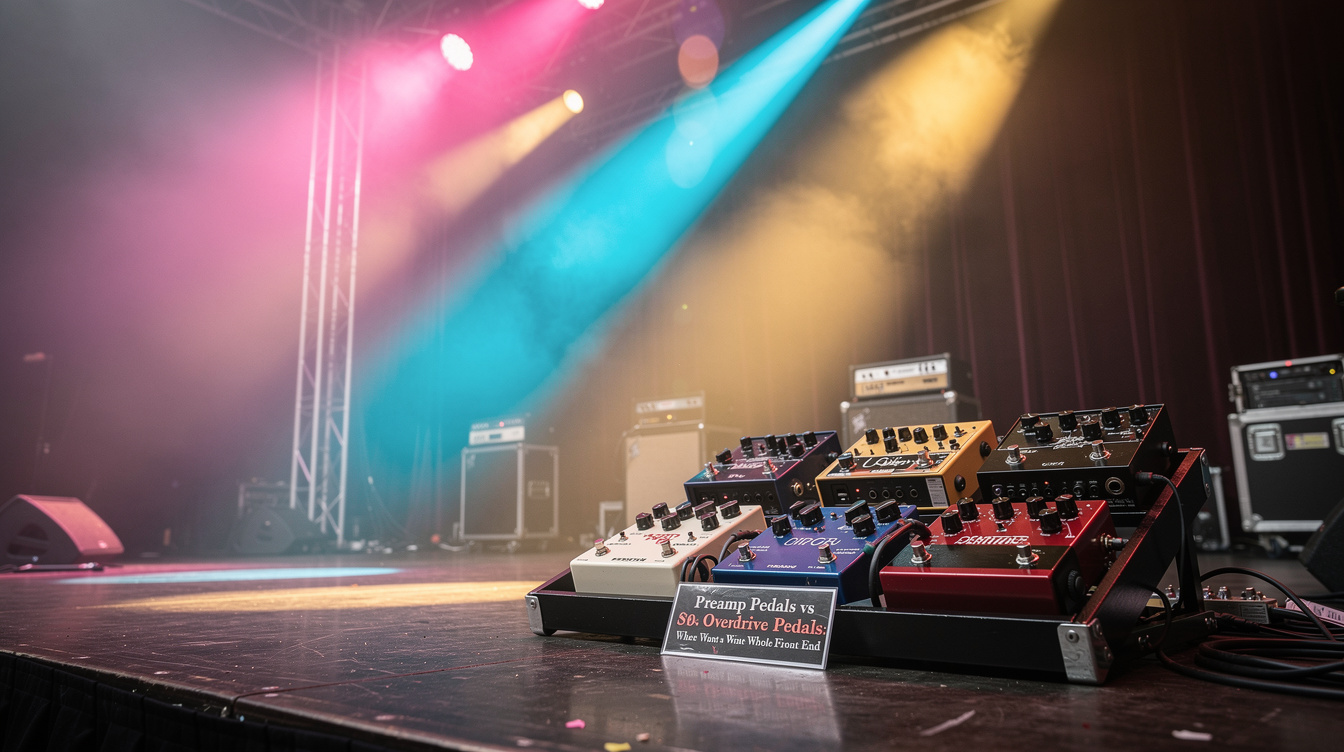
Somebody on a forum tells you to get "a preamp pedal" for your direct rig, you go shopping, and half the results are overdrive pedals. Cool. Super helpful. The two get lumped together because they both live in a small box and both have a gain knob, but they do completely different jobs — and if you grab the wrong one for going ampless, you'll find out the hard way at soundcheck. A preamp pedal can be your whole rig. An overdrive can't. Here's the actual difference, what the cab sim has to do with it, and how to pick.
The Short Answer
| Preamp pedal | Overdrive pedal | |
|---|---|---|
| What it is | A full amp front end (gain + voiced EQ) | A clipping/dirt circuit |
| Cab simulation | Usually yes | No |
| Balanced DI out | Usually yes | No |
| Can run direct to PA | Yes, on its own | No, needs a cab sim |
| Needs an amp behind it | No | Yes |
One sentence: a preamp pedal is a destination, an overdrive is a seasoning. You can finish a meal on a preamp pedal. An overdrive is salt.
What a Preamp Pedal Actually Is
A preamp pedal gives you the part of an amp that lives before the power tubes — the gain staging and the tone-shaping EQ, voiced to sound like a specific style of amp (a Tweed, a Plexi, a Rectifier, whatever the maker chose). The Tech 21 SansAmp line is the granddaddy here; the JHS Colour Box, the BOSS IR-2, the Universal Audio amp-emulator pedals, and the little Victory and Mooer preamps are all the same species. The thing that separates them from a dirt box is two-fold: a cabinet simulation and a balanced output built to drive a mixing desk.
That combo is the whole point. It means the pedal isn't waiting for an amp to complete it. Plug it into the PA, the interface, your headphones — anything full-range — and it's a finished guitar sound. No head, no cab, no nothing. That's why it's the backbone of every "I show up with a pedalboard and an XLR cable" rig, including the kind of silent-stage setup that lets you run straight to front-of-house with no backline at all.
What an Overdrive Is (and Isn't)
An overdrive is a clipping circuit. It takes your signal, squashes the peaks to add harmonics and compression, maybe nudges the midrange, and sends it on. That's it. It's a fantastic flavor — it's most of what I keep on my board — but it is not a front end. There's no cab sim. There's no voiced full-amp EQ. There's no DI. It assumes there's an amp downstream to do all of that.
Which there usually is! An overdrive in front of an amp is doing exactly what it's supposed to: pushing the amp's preamp into more breakup. If you want the full breakdown of dirt types and where they sit, the overdrive vs. distortion vs. fuzz guide sorts that out. But ask an overdrive to be the amp and it falls on its face, because being the amp was never the job.
The Surprise: The Cab Sim Is the Entire Difference
I used to think the gap between "preamp pedal" and "overdrive" was about how much gain or how good the EQ was. So one night, packing a fly rig, I tried to cheat — RAT straight into the interface, no amp, figured a little dirt direct would be punk-rock enough. It was unlistenable. Not "lo-fi cool." Ice pick. All wasp, no cabinet — a thin, buzzing top end that made my ears flinch.
Then I ran a SansAmp GT2 into the same input, cab voicing engaged, and it sounded like a 4x12 mic'd from a few feet back — there was actual wool up top, a rounded edge where the RAT had a razor. Same room, same interface, same guitar. The only meaningful difference was the speaker simulation. A real guitar speaker is a giant low-pass filter; it dumps everything above roughly 5 kHz, and that rolloff is most of why a mic'd amp sounds like music instead of a buzzing transformer. The preamp pedal's cab sim is that filter. The overdrive has nothing standing in for it. That's the whole story. Not gain. Not EQ snobbery. The speaker.
Cab Sim On or Off — Don't Get This Wrong
Because the cab sim matters so much, the one setting that wrecks more direct rigs than anything is leaving it in the wrong state.
- Full-range destination → cab sim ON. PA, audio interface, studio monitors, headphones. Nothing else is providing speaker character, so the pedal has to.
- Real guitar power amp + cab → cab sim OFF. The speaker is already the filter. Stack a cab sim on top of an actual cab and you've got two cabinets in series — boxy, dark, and dead, like a blanket over the grille.
This is the same trap modeler players hit when they run into a real power amp and forget to kill the cab block; the rebuild-your-patch-for-a-real-speaker walkthrough is the modeler version of the exact same fix. If your preamp pedal is going into the Power Amp In jack of an amp, cab sim off, same reason.
A Starting Point for Going Direct
If you're setting a preamp pedal up direct to a desk for the first time, this is a no-surprises starting point on a SansAmp-style pedal (Character/voicing controls vary by model, but the gain/level/EQ logic holds):
Start the Drive low — direct rigs expose fizz that a loud amp in a room hides, so you almost always want less gain than you think. Pull the highs back a touch; a desk is flat and honest and will hand you all the top end the cab sim didn't catch. Add dirt from there with an overdrive in front of the preamp pedal if you want more grind — that's the right division of labor: overdrive pushes the preamp, preamp voices and filters the whole thing, exactly like a pedal into a real amp's input. And if you're running this into a board over a long cable or a stage box, a proper DI for the balanced send keeps it quiet.
So Which Do You Buy?
Decide by what you're plugging into.
- No amp, going to a PA or interface? Preamp pedal. It's the only one of the two that's a complete rig. An overdrive alone will not do it.
- You've got an amp and want more dirt or a different flavor? Overdrive. A preamp pedal in front of an already-voiced amp is usually overkill — two preamps fighting.
- You already run a modeler? You own the concept already; the amp + cab blocks are a preamp pedal with a hundred voicings. A standalone preamp pedal is then a backup play — a tiny fly rig or a no-boot-up safety net, which is genuinely why I keep one in the gig bag even though the HX Stomp does it all. One box, one cable, zero things to crash mid-set. Good enough is great.
The trap is treating them as competitors. They're not. An overdrive in front of a preamp pedal is a tiny, complete amp rig in two boxes — the dirt does the pushing, the preamp does the voicing and the filtering, and you walk in with an XLR and walk out without ever touching a backline.