Start Here: The Two-Sound Worship Katana
- Sound 1 — Ambient Clean (pads + rhythm): Clean voice · Gain ~9 o'clock · Bass ~9 · Middle ~1 · Treble ~11 · Booster: mild mid boost, on · Delay: dotted-eighth, 2–3 repeats · Reverb: Hall, long
- Sound 2 — Driven Lead (leads + swells): Crunch voice · Gain ~1 o'clock · Booster: Tube Screamer-style, on · same Delay + Reverb
- Store each as a channel memory, footswitch between them, and go line out to front of house.
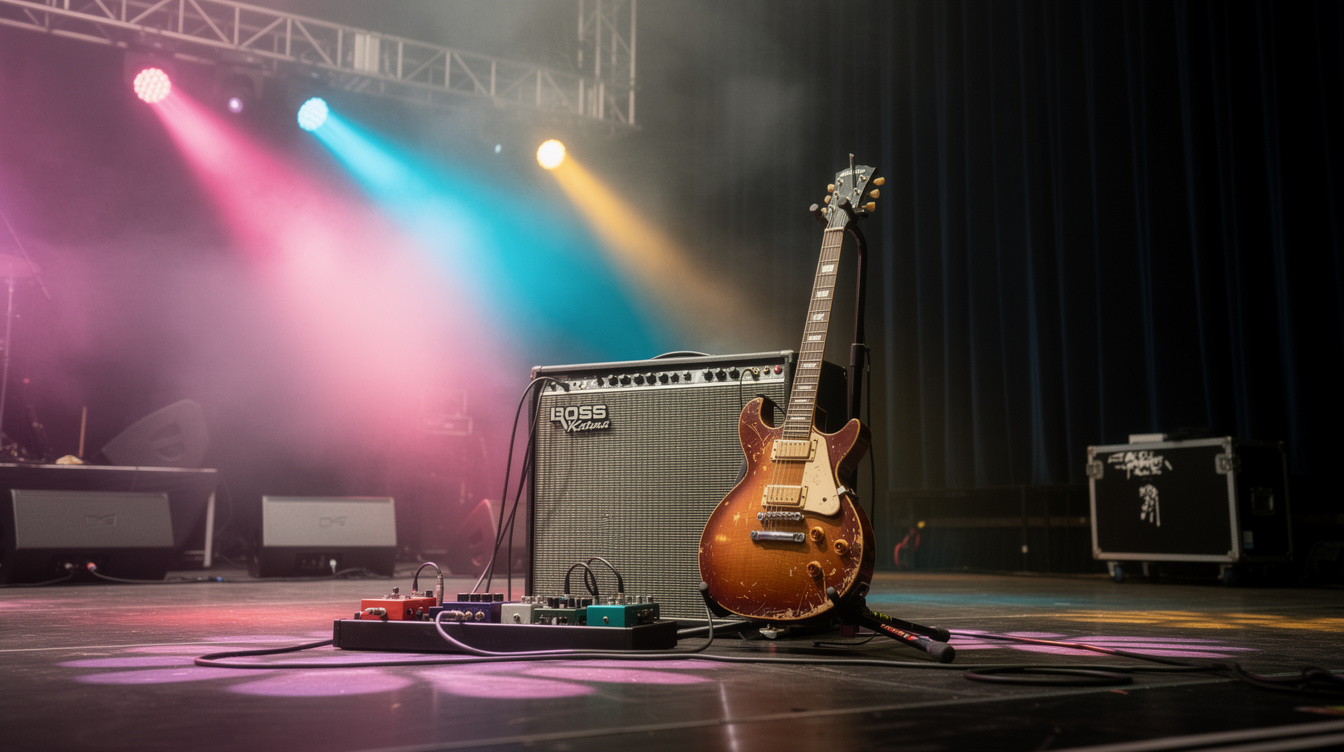
You do not need a $1,500 modeler to cover a Sunday. You need two sounds — a clean you can pad and strum on, and a driven tone you can lead and swell with — and a Boss Katana already has both sitting inside it. The Katana is the amp half the volunteers in your rotation already own, which makes it the most useful worship amp nobody writes a real guide for. Here's the whole thing, block by block, plus the one EQ move that keeps it from getting brittle the second it hits the PA.
Why Two Sounds Is the Whole Job
Watch what a worship guitarist actually does across a 25-minute set. Verse: quiet, chimey, maybe a swell into the chorus. Chorus: a little dirt, a lead line up top, more delay. Bridge: the big ambient wash. Turnaround: back to clean. That's two core sounds — a clean and a driven — plus your volume knob and your delay doing the transitions.
The Katana gives you channel memories you can store and recall with the footswitch buttons (or an external switch like the GA-FC). Put your clean in one, your driven in the other, and you never crouch down to turn a knob mid-song. That's the same idea as snapshots on a Helix worship rig or snapshots on a POD Go — the Katana just calls them channels and gives you fewer of them. For two sounds, fewer is plenty.
Sound 1: The Ambient Clean
This is the sound you'll live in 70% of the set. Start on the Clean amp voice.
The counterintuitive part is the EQ. Most people crank Bass to make a clean tone sound full, and it works great in the room you're standing in. Then it hits the PA and turns into cardboard. Keep Bass low — around 9 o'clock — push Middle up past noon so the guitar has something that cuts through a full band, and keep Treble just under noon so it chimes without getting glassy. You want the jangle of a chimey AC30, not the scooped smile of a blackface clean. The reverb, not the amp, is what makes it sound big.
Booster slot: turn it on and set it as a low-gain mid boost (a Tube Screamer-style "Overdrive" in BOSS Tone Studio, Drive low, around 8–9 o'clock). This isn't dirt — it's the thing that gives a clean strum some cut and gives your swells somewhere to bloom. Left off, the clean is polite. On, it leans forward.
Delay: this is where a worship clean comes alive. Set the Delay to the song tempo with tap tempo, and in Tone Studio choose a dotted-eighth division. Keep the feedback low — two or three audible repeats, not a runaway. Level around 10–11 o'clock so it's felt more than heard. For the exact dotted-eighth timing on specific songs, the Way Maker Helix breakdown does the millisecond math; the note division is the same on any platform.
Reverb: Hall, long decay, level up around 1 o'clock. This is the pad. On a Katana the built-in Hall holds together further than people expect.
Sound 2: The Driven Lead
Store this as your second channel. Move to the Crunch voice — it reacts to your pick and your guitar volume the way a pushed lead needs to, where the Lead voice can get a little too compressed and same-y for swells.
Leave the same Booster engaged — now it's pushing the front of a dirtier amp, so you get more saturation and more sustain for held notes and volume swells. Keep the Delay and Reverb the same so the transition between your two sounds doesn't change the space, only the grit. A lead that suddenly has a different reverb than the verse pulls the ear the wrong way.
The critical thing: match the Master volume between your two channels. The single most common Katana worship mistake is a lead sound that jumps 4 dB louder than the clean because it was dialed in solo. Set them so your driven sound is slightly louder — maybe 1 dB — for lead cut, and no more.
The One Move That Fixes "Harsh Through the PA"
Here's the thing I got wrong the first time I set a Katana up for a room. I expected the built-in reverb to be the weak link — that a long worship-sized Hall would smear into mush through the mains. It didn't. What smeared was the low end of the amp itself the moment I pushed Bass past noon chasing "warmth." The reverb was fine; the amp was flubbing. Rolling Bass back to 9 o'clock and letting the Hall do the size fixed a problem I'd blamed on the wrong block for twenty minutes.
The second thing a bright church PA does is expose fizz — that brittle sizzle up top that sounds fine in the room and like an ice pick out front. Open BOSS Tone Studio, add a parametric or graphic EQ inside the amp, and pull everything above roughly 7 kHz down a few dB. If it's still harsh, the problem usually lives lower than you think — around 2.5–4 kHz — which is a different cut entirely. That whole diagnosis is worth its own read: why worship tone turns harsh through the PA.
Get It to Front of House Right
Whenever the room has a PA, run the Katana's line out or USB to the console, not a mic on the speaker. The DI is cab-simulated, it's consistent every week, and — this is the point — it skips the part of the Katana's tone that doesn't scale to a big room. The power-amp push and the speaker coloration are what you're feeling on stage; front of house doesn't need them, and mic'ing them in just adds a variable your sound tech has to fight. Use the amp's speaker for your own monitoring if you're close to it; send the line out to the room.
None of this requires spending another dollar. It's the amp you have, two channels, and about ten minutes in Tone Studio. Save your two channels, and if you want a faster start, every recipe in our library ships a Katana preset you can load and tweak from there.
If you want to go deeper on the amp itself, the Katana's hidden Tone Studio settings and our guide to making the Katana sound like a real tube amp both cover ground that makes these two worship sounds better.