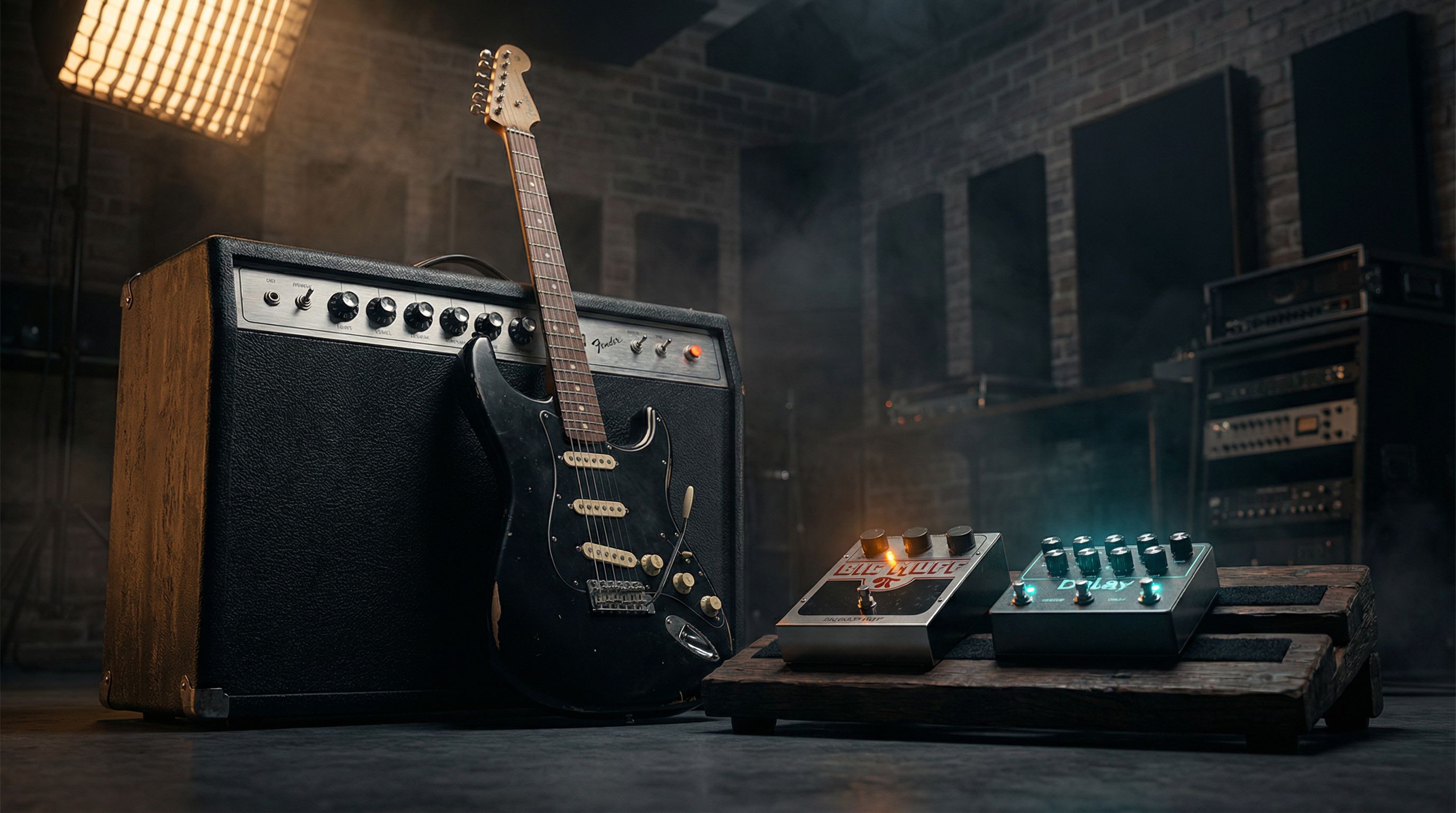
Start Here: Gilmour's tone is built on four interlocking elements: a Stratocaster with exceptional pickup character, a Hiwatt DR103 pushed hard enough to breathe but not to break, a Big Muff Pi set lower than you expect, and delay with enough trails to give every note a room to live in. The single most common mistake people make with this tone is running the Big Muff's Sustain at maximum. Don't. The amp is doing more of the work than the pedal, and the pedal needs the amp's headroom to deliver note definition rather than pure compression. Start with Sustain around noon, set your delay first, and build everything else around the space you're trying to fill.
What Makes David Gilmour's Guitar Tone Different?
There's a quality to the best Gilmour lead tone (particularly on The Wall and Wish You Were Here) that sits in a register that's hard to describe without resorting to the language of weather or light. Notes don't just sustain; they swell. They grow in volume after the attack, take on body, and decay into the delay trails in a way that feels less like a guitar being played and more like something organic breathing in a large, quiet space.
That quality isn't accidental, and it isn't primarily the result of a single pedal. It's the interaction of six elements in a specific sequence, each one doing a specific job:
- A Strat (the neck or middle pickup, with the output characteristic of vintage-wound single coils)
- A Hiwatt DR103, 100 watts, driven harder than it looks, producing natural compression without breakup
- A Big Muff Pi, Ram's Head or NYC variant, with Sustain considerably lower than most Muff users expect
- An EQ stage, often a Boss GE-7 in a mid-boost configuration to compensate for the Muff's characteristic scoop
- A delay: the Binson Echorec in the studio and early touring years, later the Boss CE-2 chorus and various rack delays; long trails, moderate feedback
- Reverb: long decay, spacious, architectural in function rather than ornamental
Understanding how these elements interact is more useful than memorizing specific knob positions, though the specific positions matter too, and we'll get to all of them.
For the full history and circuit breakdown of the Big Muff, the Big Muff settings guide covers every major variant with sweet spots by era and genre; it's the companion piece to this article. For a deeper look at reverb types and how they function differently in a signal chain, the reverb types guide is worth the detour.
What Signal Chain Does David Gilmour Use?
The core signal chain, across most of the Pink Floyd era, runs in this order:
Guitar → Compressor → Big Muff Pi → EQ → Chorus/Vibrato → Delay → Reverb → Amp
A few important notes on that chain:
The compressor (most often the MXR Dynacomp on clean or lightly driven tones) appears before the Big Muff, not after. On the heavy fuzz tones, particularly the Comfortably Numb solo, the compressor often drops out of the chain entirely. The Big Muff's own clipping stages already compress aggressively at moderate-to-high Sustain settings; adding a compressor upstream of a Muff at high gain is redundant at best and dynamically flattening at worst.
The EQ stage (typically the Boss GE-7) sits after the Muff and addresses the pedal's pronounced mid-frequency scoop. The classic Gilmour GE-7 configuration boosts slightly at 400 Hz and 800 Hz to restore the midrange presence that the Muff removes, without adding brightness or harshness in the upper frequencies.
The Hiwatt is a critical and frequently underappreciated part of this sound. At 100 watts, a Hiwatt DR103 has a clean headroom ceiling that most amplifiers can't match, but "clean" at Hiwatt volumes means driven, not pristine. The amp's power section contributes a natural, musical compression that adds density and bloom to notes coming off the Big Muff. Running a Big Muff into a small-wattage amp often produces a thin, buzzy result; the Muff needs an amplifier large enough to absorb its output and respond rather than just clip.
Comfortably Numb Solo: What Are the Settings?
The solo from "Comfortably Numb" (both the studio version on The Wall (1979) and the live version from The Wall Live at Earl's Court (1980/81)) is the benchmark Gilmour lead tone and the one most players come here to find. Here are the settings.
Comfortably Numb: Studio Settings Table
| Element | Setting | Notes |
|---|---|---|
| Pickup | Neck pickup | The bloom depends entirely on this choice |
| Amp volume | About 2 to 3 o'clock | Driven hard; natural power-section compression |
| Amp EQ | Bass about noon, Mid about 1 o'clock, Treble about 10 o'clock | Warm, dark, slightly scooped |
| Big Muff Sustain | Around noon to 1 o'clock | Lower than most expect; see note below |
| Big Muff Tone | About 2 o'clock | Recovers upper-mid presence |
| Big Muff Volume | About 2 to 3 o'clock | Running hot into the amp |
| EQ (GE-7) | +3 dB at 400 Hz and 800 Hz | Mid recovery after the Muff's scoop |
| Delay time | About 400–420ms | Long, spacious trails |
| Delay feedback | About 9 to 10 o'clock | 2–3 repeats, fading |
| Delay mix | About 10 to 11 o'clock | Present but not dominant |
| Reverb decay | Long (about 2 to 2.5 seconds) | Plate or large hall character |
| Reverb mix | About 11 o'clock | Ambient, not washy |
The surprised discovery here (and it's one worth testing before you dismiss it) is that Gilmour's actual Sustain position on the Comfortably Numb live tone is significantly lower than most players assume. The tone is so huge, so sustained, so legendarily fat, that the instinct is to push the Big Muff's Sustain to maximum. When you actually do that, you get more compression and more harmonic density, but you lose something critical: the shape of each note. The attack softens into mush. The notes stop speaking individually and merge into a continuous wall of saturation.
On the Earl's Court live recording, the Muff is behaving more like a medium-gain fuzz than a maximum-everything wall of sound. The Hiwatt's volume and the long delay feedback are doing the work of filling the space. The sustain is coming from the amp's response and the long note decay in the room, not from the pedal crushing every dynamic out of the playing.
Test this: dial your Sustain to about noon, run the Muff's Volume control high enough to push the amp hard, set a delay at around 400ms with two to three repeats, and play the opening notes of the solo slowly. Let the amp breathe. The note will swell. That's the tone.
Going Big Muff full throttle gives you more compression, but less note definition and less of the vocal, swelling quality that makes that solo sound like it's singing rather than just sustaining. It's one of those cases where restraint is the technique.
How Do You Get the Money Tone?
"Money," from Dark Side of the Moon (1973), is a fundamentally different context, and it calls for a fundamentally different approach. This is not a Big Muff tone. The solo on "Money" is cleaner, tighter, and mid-forward in a way that sounds almost aggressive by comparison to the hazy grandeur of Comfortably Numb.
The key differences: the compressor is in the chain here, the Big Muff is either bypassed or set to very low gain, and the character of the delay shifts from long atmospheric trails to a more present, rhythmic repeat pattern that interacts with the 7/4 time signature of the track.
Money: Settings Table
| Element | Setting | Notes |
|---|---|---|
| Pickup | Middle or neck/middle blend | Slightly brighter than Comfortably Numb |
| Compressor (MXR Dynacomp) | Sensitivity around 10 o'clock, Output around 2 o'clock | Glue and sustain without heavy limiting |
| Amp volume | About 2 o'clock | Similar drive, slightly less pushed |
| Big Muff Sustain | About 8 to 9 o'clock (light fuzz) or bypassed | Decide based on how much edge you want |
| Amp EQ | Bass about 11 o'clock, Mid about 1 o'clock, Treble about noon | More mid presence than Comfortably Numb |
| Delay time | About 300–330ms (roughly dotted-quarter at the track's tempo) | Rhythmic; interacts with the time signature |
| Delay feedback | About 9 o'clock | 1–2 repeats max |
| Reverb | Shorter decay (about 1 second) | Room rather than hall |
The rhythmic delay here is worth spending time on. At around 300ms, repeats land in a way that doubles up the phrasing rhythmically, a technique that Gilmour shares with The Edge's signature delay approach, though the application is different. Where The Edge uses delay as harmonic texture, Gilmour here uses it to make his phrasing feel more confident and inevitable than it would without the repeats. The delay is doing compositional work.
How Do You Get the Time Solo Tone?
"Time" (from Dark Side of the Moon, 1973) and "Shine On You Crazy Diamond" (from Wish You Were Here, 1975) represent what I think of as the second and most considered period of Gilmour's tone development, a period where the focus shifted from the raw sustain of the early Big Muff approach toward something cleaner, more expansive, and more reliant on the interaction between the guitar's neck pickup, a lower-gain fuzz, and space.
On "Time," the solo tone has an openness that the The Wall-era Muff tones don't share. The fuzz is present but not thick; there's air between notes. The Strat's neck pickup resonance comes through clearly, meaning the Muff isn't compressing the signal into homogeneity. The Binson Echorec's particular delay character (warm, slightly wobbly, with repeats that fade into each other rather than repeating discretely) is central to why this tone sounds the way it does.
Time / Shine On You Crazy Diamond: Settings Table
| Element | Setting | Notes |
|---|---|---|
| Pickup | Neck pickup | Essential; nothing else produces this bloom |
| Amp volume | About 1 to 2 o'clock | Less drive than The Wall era |
| Big Muff Sustain | About 9 to 10 o'clock | Low; the fuzz is a colorist here, not the primary source of gain |
| Big Muff Tone | Around 11 o'clock to noon | Darker than the Comfortably Numb setting |
| Big Muff Volume | About 2 o'clock | Moderate push |
| Delay time | About 380–420ms | Warm, long; Echorec-style wobble if available |
| Delay feedback | About 10 to 11 o'clock | Slightly more feedback than Money; the trails are visible |
| Reverb decay | Long (2+ seconds) | Hall or plate |
| Reverb mix | About noon to 1 o'clock | More prominent here than on The Wall |
Shine On You Crazy Diamond adds one element that doesn't appear elsewhere in Gilmour's catalog: the slide. The opening phrase (a single note bent upward on the neck pickup, then resolved) uses a glass slide on the pinky with the guitar held in standard playing position. The tone is very clean here, very dark, and the fuzz is either absent or operating at its lowest useful setting. The famous opening phrase is about the instrument and the technique, not the signal chain.
For players attempting the slide passage: the key is getting all the gain out of the chain except what the Hiwatt's volume contributes naturally. Any Big Muff gain at that level will round off the attack transient that gives the slide its precise, crystalline quality.
What Is the Volume Swell Technique and Why Does It Matter?
There is one performance technique that runs through almost everything Gilmour does with a lead tone, and it shapes the signal chain requirements more than any individual piece of gear: the volume swell.
The approach is this: you hit a note or a chord, and as the attack decays, you fade the guitar's volume control up from near-zero to full. The result is a note with no audible attack transient. It begins as silence and grows into a full, sustained tone. On a long delay, the swelled note then feeds delay repeats that carry the phrase forward while the guitar volume can drop again for the next note.
This is not a unique technique; it appears in pedal steel and lap steel playing, in certain orchestral playing, and in the work of countless guitarists, but Gilmour uses it with an architectural intentionality that's specific to him. It's why many of his phrases feel like they're arriving rather than starting. It's why the space in the music feels inhabited rather than empty.
The signal chain implication: the Big Muff and delay need to have consistent, predictable response to notes that begin at low input level and rise. A Muff at maximum Sustain won't respond well to this; the gate threshold is too high and the compression too aggressive for a volume swell to develop cleanly. A Muff at moderate Sustain, feeding a long delay and a reverberant amp, responds exactly right: the note blooms into the delay, the delay sustains it, and the reverb gives it a room to live in.
This is the technique. The gear is built around it.
How Do You Get This Tone on a Helix or Modeler?
The Helix and Quad Cortex have both improved substantially in their modeling of high-headroom British amplifiers, and a passable Gilmour tone is genuinely achievable without a Hiwatt and a vintage Big Muff. Here's the signal chain architecture for a modeler:
| Block | Model/Type | Setting Notes |
|---|---|---|
| Compressor | Dyna Comp or equivalent | Low ratio, glue only; bypass for heavy Muff tones |
| Fuzz | Big Muff Pi simulation (NYC or Ram's Head variant if available) | Sustain around noon, Tone about 2 o'clock |
| EQ | Parametric or graphic | +2 to +3 dB centered around 500–800 Hz |
| Amp | Hiwatt DR103 model ("WhoWatt 100" on Helix) | Volume high, Master around noon; push the preamp |
| Chorus/Vibrato | CE-2 simulation | Rate slow, Depth low; subtle modulation on trails |
| Delay | Digital or tape-style | 400ms, feedback at 2–3 repeats, mix about 25–30% |
| Reverb | Plate or large hall | Decay 2+ seconds, mix about 20–25% |
The WhoWatt 100 responds well to being pushed hard in the gain staging; set the amp's Channel Volume fairly high before the Master Volume, which lets the amp model produce the natural compression behavior that the real DR103 contributes at high volume. For more on getting modeler tones to translate like tube amps, the fix thin modeler tone guide covers the gain staging principles in detail.
How Do You Get This Tone on a Pedalboard?
For a hardware pedalboard, the minimum viable setup for a convincing Gilmour lead tone looks like this:
Guitar → [Optional: MXR Dynacomp] → Big Muff Pi (Ram's Head or NYC) → Boss GE-7 → Boss DD-series delay → Room/plate reverb pedal → Amp
Component notes by element:
Big Muff: The original Ram's Head and Triangle variants are expensive and variable. The Electro-Harmonix Ram's Head reissue is the most consistent current option. The Wren and Cuff Pale Green or Triangle Buff are excellent boutique alternatives. The standard Nano Big Muff Pi is workable; it doesn't have the Ram's Head's specific harmonic character, but it responds to the same settings approach.
Delay: The Binson Echorec is out of reach for most players and unreliable in live situations. A Boss DD-7 or DD-8 set to a warm analog mode (or an Electro-Harmonix Memory Man for authenticity) captures the character well enough. Set the delay time around 400ms and keep the feedback conservative. For more on delay settings and their tonal implications, the delay settings guide covers the parameters in depth.
Reverb: A Boss RV-6 in Room or Hall mode works well here. The reverb on the Comfortably Numb solo is large (not cathedral-overwhelming, but it gives every note room to breathe and decay). For a deeper understanding of how different reverb types respond differently in a chain, the reverb types guide is the reference.
Amp: This is the hardest element to substitute. A Fender Twin or Bassman-style amp provides similar clean headroom if a Hiwatt isn't available, but the character is different. Fender EQ responds differently to a Big Muff, and the power section compression behaves differently. Acceptable. Not identical. If you're working with a lower-wattage amp, back the Big Muff's Volume knob off accordingly; you'll reach the headroom ceiling faster, and the Muff overdriving the amp's input stage adds a kind of gain that isn't what you're after.
Era-by-Era Reference: Gilmour Tone Across Pink Floyd
| Era | Album | Primary Fuzz Character | Delay Style | Defining Element |
|---|---|---|---|---|
| Early Syd-era transition | Ummagumma, Atom Heart Mother | Light fuzz or clean; Muff not yet central | Echo, tape-style | Experimentation; less useful as a recipe |
| Dark Side era | Dark Side of the Moon (1973) | Lower-gain Muff; compressor in chain | Binson Echorec (warm, wobbly) | Midrange clarity; rhythmic delay interplay |
| Wish You Were Here era | Wish You Were Here (1975) | Ram's Head, moderate Sustain | Echorec + Yamaha RA-200 rotary | Slide technique; spacious reverb; most "open" tone |
| Animals era | Animals (1977) | Ram's Head pushed harder | Rack delays | More aggressive; closer to rock tone |
| The Wall era | The Wall (1979) | NYC Big Muff, Sustain at noon | Boss CE-2 + long rack delay | Biggest tone; most studied; Comfortably Numb |
| Division Bell era | Division Bell (1994) | Modern Big Muff variants; more EQ | Rack digital delays | More pristine; controlled; less raw |
The Wish You Were Here era (particularly "Shine On You Crazy Diamond") is where I find the tone most musical in the sense that it's the least saturated, the most responsive to dynamics, and the most revealing of the instrument and the player. The The Wall era tones are more immediately impressive and more recognizable. But the craft is clearer in the earlier period.
I acknowledge I've spent an unreasonable amount of time with this particular distinction, and I stand by it.
FAQ
What Big Muff does David Gilmour use?
Gilmour used several Big Muff variants across his career. The most documented and studied is the Ram's Head variant (produced 1973–1977), which he used extensively on Wish You Were Here and portions of The Wall. He also used NYC-style Big Muffs and various clones and reissues in later years. The Ram's Head has a brighter, tighter character than the earlier Triangle variant and a different tonal peak than the Op-Amp variant. For a full comparison, the Big Muff settings guide covers the variant differences in detail.
What amp does David Gilmour use?
The Hiwatt DR103 (a 100-watt British amplifier with unusually high clean headroom and a very stiff, responsive power section) is Gilmour's signature amp from the early 1970s onward. He typically used multiple DR103 heads running in parallel, which contributes to the width and density of his live tone. The Hiwatt's specific character (particularly its upper-midrange response and the way its power section compresses at high volume) is central to how the Big Muff behaves in his chain. A Marshall or Fender will produce a related but meaningfully different result.
Why does the Comfortably Numb tone sound different live versus in the studio?
Several factors contribute. The studio version on The Wall was produced with multitrack editing and layering that the live version can't replicate exactly. The live Earl's Court tone is slightly more raw and dynamic. The delay trails are more prominent relative to the dry signal, and the Muff's interaction with the room ambience is different from a controlled studio environment. Neither is more "correct" as a reference; they're different performances with different technical contexts. For most players, the Earl's Court live version is actually a more useful starting point because the individual elements (the fuzz, the delay, the reverb) are more audibly separable.
Do I need a volume pedal or guitar volume technique for this tone?
You don't need a volume pedal, though Gilmour uses one in his live setup. The guitar volume knob works for the swell technique and is more immediate for single-note work. The important thing is that the volume knob on your Stratocaster responds smoothly and has a taper that allows gradual fade-in. Some guitars have volume pots that go from almost-off to full in a small range of rotation, which makes the swell technique difficult to control. If your guitar behaves that way, replacing the volume pot with an audio-taper 250k pot is a cheap improvement that makes the technique viable.
Can I get a convincing Gilmour tone without a Strat?
With different character, yes. The Strat's neck pickup has a specific resonant frequency peak that contributes to the bloom and swell quality of the tone. A humbucker-equipped guitar will produce a fuller, thicker low-mid response without that peak, and single-note lines won't develop in quite the same way. A Telecaster neck pickup is closer but still different. If you're working with humbuckers, roll the pickup volume back slightly, set the Big Muff's Tone knob lower than noon to compensate for the added low-mid weight, and accept that the character will differ; it can still be excellent guitar tone, it just won't be Gilmour's guitar tone.
Is the Boss CE-2 chorus essential for the Comfortably Numb tone?
More for the live tone than the studio recording. The CE-2 chorus appears prominently in Gilmour's late-1970s and 1980s live signal chain, adding a subtle pitch modulation to the delay trails that gives them the slight shimmer and width present on the Wall Tour live recordings. On the studio version of "Comfortably Numb," the width comes more from stereo recording technique and reverb than from the CE-2. For a home or stage rig, a chorus pedal with the Rate and Depth both low (creating movement rather than obvious modulation) adds the right texture to the delay trails without making the tone feel 1980s-specific.