The Space a Guitar Lives In
Reverb is not an effect. Or rather, it is (technically, categorically) but calling it an effect undersells what it actually does. A delay repeats what you played. A chorus thickens it. Reverb defines where you played it. It places your guitar in a room, a cathedral, a studio, a universe that doesn't exist yet. Change the reverb and the same riff, the same chord, the same single sustained note becomes a fundamentally different emotional statement.
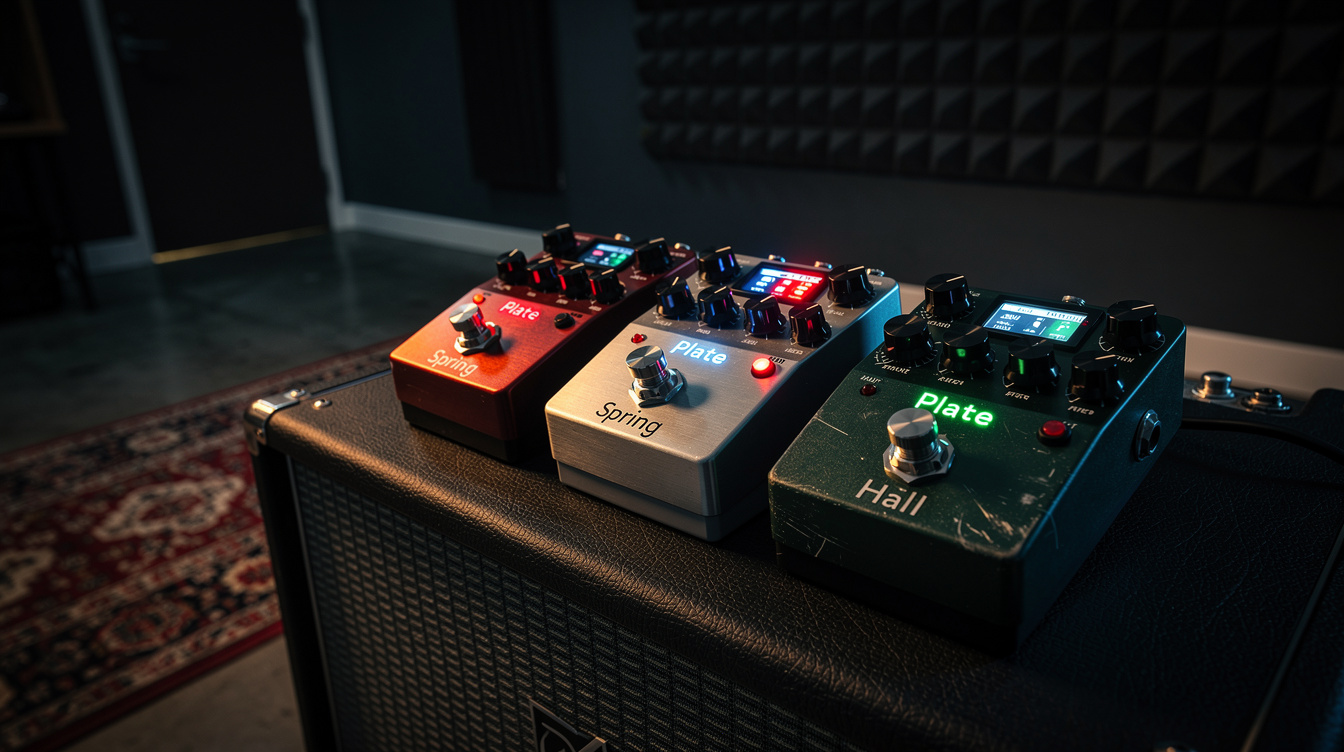
The difference between spring reverb and hall reverb isn't a matter of more or less. It's a difference in architecture: the size and shape and material of the imaginary room your guitar is inhabiting. Each type has a character, a history, a set of musical contexts where it does its best work, and a set of contexts where it actively undermines the music. Knowing which is which saves time, saves frustration, and opens up sounds you didn't know you were missing.
Spring Reverb: The Sound of the Tank
Spring reverb has a sound so specific that even people who don't know they're hearing it recognize it instantly. It's the drip. That splashy, metallic bounce that lives inside a Fender Deluxe Reverb or a Twin. It's the sound of a literal spring vibrating in a metal tank, converting electrical signal into mechanical energy and back again.
What It Actually Sounds Like
The character is bright, bouncy, and slightly metallic; a reflective shimmer that sits on top of the dry signal without overwhelming it. The decay is short to medium, and it has a particular splash on the attack that no other reverb type produces. Hit a chord hard through a spring tank and you get that distinctive metallic crash, what surf players chase and what country players lean into. The low end stays relatively clear because spring tanks naturally roll off bass frequencies, which is part of why they sit so well with overdriven amp tones.
Think of the reverb on Dick Dale's "Miserlu," that drippy, splashing quality where the reverb feels like part of the note's attack, not just its tail. Or the spring wash behind John Mayer's clean tones on Continuum, where the reverb adds dimension without ever stepping in front of the guitar.
Mechanical vs. Digital Spring
Real spring tanks (the kind built into Fender amps) have an imperfection that digital emulations struggle to capture fully. The springs resonate unevenly at different frequencies, creating a slightly irregular decay that sounds organic, almost alive. Bump the amp and the springs crash. Play a low E hard and the tank protests with a metallic shudder. These aren't flaws. They're the personality.
Digital spring emulations have gotten remarkably close. The spring modes on the Strymon Flint and the Source Audio Ventris nail the drip and the decay character. On modelers, the Helix's '63 Spring model and the Quad Cortex's spring algorithms both capture the bounce convincingly. Where they sometimes fall short is that physical interaction: the way a real spring responds to the vibration of the speaker it's sitting next to, creating a feedback loop between the reverb and the amp that digital can approximate but not fully replicate.
When to Use Spring Reverb
- Surf and instrumental rock: this is its native habitat, the sound the genre was built around
- Country and Americana: spring reverb behind a Telecaster on the bridge pickup is a foundational texture
- Blues: a touch of spring, mixed low, adds dimension to clean and lightly overdriven tones without cluttering them
- Classic rock: Hendrix, Clapton, and most '60s and '70s players used whatever spring was built into their Fender amp
When NOT to Use Spring Reverb
Spring gets into trouble with high-gain tones. The bright, metallic character of spring reverb emphasizes the fizzy upper harmonics that heavy distortion already generates, and the short decay creates a splashy mess instead of a smooth tail. For high-gain rhythm tones and modern distortion, plate or hall reverbs serve the sound better.
Suggested Settings
For a classic surf drip: Mix at about 2 o'clock (you want the reverb present, not subtle). Dwell or decay at around 1 o'clock. Tone bright, about 2 o'clock if your pedal has a tone control. Clean amp, bridge pickup, and let the springs do the work.
For a subtle clean texture (Mayer-style): Mix at about 9 o'clock, barely there, more felt than heard. Decay short, around 10 o'clock. You should notice the reverb only when you turn it off.
Pedal recommendations: Strymon Flint ('70s Spring mode), Source Audio True Spring (dedicated spring reverb that gets eerily close to a real tank), Boss FRV-1 (discontinued but findable used). On a modeler, the Helix '63 Spring or Quad Cortex spring algorithms are strong starting points.
Plate Reverb: The Studio Standard
Plate reverb comes from the EMT 140, a massive steel plate suspended in a wooden frame, roughly the size of a refrigerator laid on its side. A transducer vibrates the plate with the audio signal, and pickups capture the resulting resonance. Studios in the 1960s and '70s kept these behemoths in basement rooms and closets. They defined the sound of recorded music for decades.
What It Actually Sounds Like
Dense, smooth, and diffused, like the note is dissolving into a fine mist rather than bouncing off walls. Plate reverb has an immediacy that hall reverb doesn't: the early reflections arrive almost instantly, creating a sense of closeness even as the tail extends. There's an almost silky quality to the decay; the higher frequencies shimmer and the mids fill out without getting muddy. The result is a reverb that surrounds the guitar without pushing it backward in the mix.
The decay on a plate is more even and uniform than spring reverb. Where spring has that bouncy, irregular character, plate is controlled and elegant. Every frequency decays at roughly the same rate, which produces a smoother, more cohesive tail. It flatters the source material instead of imposing its own personality.
Listen to the guitar on Pink Floyd's "Comfortably Numb" solo, that enormous, sustaining space around David Gilmour's tone is plate reverb (and delay, and more plate reverb). Or the vocals and guitars on virtually any Motown record from the '60s. The EMT 140 was the reverb of choice for Berry Gordy's studio.
When to Use Plate Reverb
- Lead guitar: plate reverb adds sustain and dimension to single-note lines without cluttering them, because the dense, even decay supports the note instead of competing with it
- Recording and mixing: plate sits beautifully in a studio context; it's the reverb that flatters without drawing attention to itself
- Overdriven tones: the smooth decay character handles gain better than spring, because it doesn't emphasize the fizzy upper harmonics the way a bright spring does
- Ballads and slower tempos: the longer, more graceful decay of a plate has room to breathe when the tempo allows it
When NOT to Use Plate Reverb
Plate can make fast, rhythmic playing feel sluggish. The dense early reflections and sustained tail work against tight, percussive riffs. If the part relies on rhythmic precision (funk, fast alternate picking, palm-muted chugging), plate reverb smears the timing. Go with room reverb or turn the reverb off entirely.
Suggested Settings
For lead guitar: Mix at about noon, enough to feel the space, not so much that the guitar sounds distant. Decay at about 1 o'clock for a medium tail. Pre-delay at around 30-50ms (this separates the dry attack from the reverb onset, keeping the notes articulate while the reverb fills in behind). Roll the high frequencies back slightly if the shimmer competes with the pick attack.
For rhythm guitar in a mix: Mix at about 9 o'clock. Decay shorter, around 11 o'clock. You want just enough to take the dryness out of the tone without adding a noticeable tail.
Pedal recommendations: Strymon BlueSky (plate mode), Walrus Audio Slotva (lush plate character with modulation), Electro-Harmonix Holy Grail (the Small Stone of reverb pedals: simple, effective, everywhere). On modelers, the Helix Plateaux and Quad Cortex plate algorithms both handle this well.
Hall Reverb: The Cathedral
Hall reverb simulates the acoustics of a large physical space (a concert hall, a cathedral, a gymnasium). The defining characteristic is the long, evolving tail: early reflections arrive with distinct timing (because the imaginary walls are far away), followed by a gradual buildup of dense reverberations that can sustain for several seconds.
What It Actually Sounds Like
Expansive and enveloping. Hall reverb creates the sensation of physical distance. The guitar sounds like it's being played in a vast room, with the reverb tail washing outward in every direction. The early reflections are more spaced out than plate (because the "walls" are farther away in the simulation), which creates a sense of depth that plate and spring can't match.
I expected hall reverb to be the easiest type to dial in; just turn up the decay and let it wash. What I found was that hall reverb is actually the most demanding of the five types covered here. The long tail and complex reflection pattern mean that every imperfection in your playing gets magnified and sustained. A slightly sloppy chord change echoes around the hall for seconds. A buzzing string becomes a haunting reminder of technique that needs work. Hall reverb is unforgiving precisely because it gives every note so much space to exist.
The quality that distinguishes great hall reverb from mediocre hall reverb is the shape of the tail: how the reflections build, how they interact, how they decay. Cheap hall algorithms sound like a wash of noise that fades out. Good ones sound dimensional, as though you can hear the reflections arriving from different distances and directions.
Listen to the guitar on Sigur Ros's work, massive, glacial hall reverb that places the instrument in an imaginary space the size of an Icelandic valley. Or the ambient guitar on U2's "With or Without You," where the hall reverb works alongside the dotted-eighth delay to create that enormous, floating texture.
When to Use Hall Reverb
- Ambient and atmospheric guitar: hall reverb is the foundation of ambient guitar, the space that post-rock and shoegaze and worship guitar inhabit
- Slow, spacious arrangements: when the music has room to breathe, hall reverb fills that space beautifully
- Clean arpeggios: individual picked notes through a long hall decay create cascading, harp-like textures
- Swells and volume-pedal work: the long tail means swelled notes bloom into sustained clouds of sound
When NOT to Use Hall Reverb
Anything fast or rhythmically tight. Hall reverb and palm-muted metal rhythm tones are adversaries. The long tail turns precise rhythmic playing into an indistinct soup. Even moderate-tempo rock can get washed out if the hall decay is too long. The rule: if the part relies on silence between notes, hall reverb fills that silence in and destroys the feel.
Suggested Settings
For ambient guitar: Mix at about 2 o'clock (or higher, if the goal is a wash). Decay long, about 3 o'clock. Pre-delay at around 60-100ms to keep the attack clear. Low-cut at about 100Hz to prevent low-end buildup. Pair with delay for the full atmospheric effect.
For subtle hall on a clean tone: Mix at about 10 o'clock. Decay at about noon. Pre-delay at 20-40ms. This adds a sense of space without the obvious "I'm using hall reverb" wash, just enough that the guitar doesn't feel like it's in a closet.
Pedal recommendations: Strymon BigSky (the benchmark for hall algorithms), Empress Reverb, Neunaber Immerse. On modelers, the Helix Searchlights and Glitz models and the Quad Cortex's hall algorithms all deliver convincing results. The MicroCosm by Hologram also creates extraordinary ambient hall textures, though it's more of a compositional tool than a straight reverb.
Room Reverb: The Invisible One
Room reverb is the type most people overlook, and the type that arguably matters most for everyday playing. It simulates the natural acoustic reflections of a small to medium room: a studio, a practice space, a bedroom. The decay is short, the reflections are subtle, and the effect is less "reverb" and more "the guitar doesn't sound like it was recorded in a vacuum."
What It Actually Sounds Like
Natural and understated. Good room reverb is barely perceptible on its own. You notice it most when you turn it off, and the guitar suddenly sounds flat and one-dimensional. The decay is short enough that it doesn't add a tail to your notes, but the early reflections add enough dimension to make the tone feel three-dimensional, as though the guitar exists in physical space rather than a direct-injection sterile nothing.
The character varies based on what kind of room is being simulated. A tiled room is brighter and more reflective. A carpeted room is darker and more absorbing. A wood-paneled room sits somewhere between: a slightly colored space with gentle high-frequency diffusion. The best room reverb algorithms let you adjust these parameters, essentially letting you design the imaginary room.
Think of the guitar tone on most well-recorded rock albums: the guitar doesn't sound drenched in reverb, but it doesn't sound dry either. That's room reverb. The guitar on Rumours-era Fleetwood Mac, the rhythm parts on Tom Petty records, a subtle room sound that makes the recording feel alive.
When to Use Room Reverb
- Always (or close to it). Room reverb is the baseline. Unless a bone-dry sound is specifically the goal, a small amount of room reverb makes almost any tone sound more natural and three-dimensional.
- Recording direct or through a modeler: modelers bypass the natural room reflections that a real amp in a real room produces. Room reverb puts those reflections back, which is why so many direct-recorded tones sound better with a touch of room at the end of the chain.
- Band contexts: room reverb adds dimension without competing for sonic space the way longer reverb types do.
When NOT to Use Room Reverb
Honestly, almost never. The only scenario where room reverb actively hurts is if the goal is a deliberately dry, in-your-face tone (the Nile Rodgers funk approach, for instance, where absolute dryness is part of the rhythmic impact). Or if the real room you're playing in already provides enough natural reflection that adding more makes things muddy.
Suggested Settings
The "always-on" room: Mix at about 9 o'clock, barely there. Decay very short, about 8 o'clock. You shouldn't hear the reverb as an effect. You should hear the guitar sounding more natural.
Pedal recommendations: Most reverb pedals have a room mode. The Strymon Flint's room setting, the Boss RV-6 room mode, and the TC Electronic Hall of Fame's room algorithm all handle this well. On modelers, the Helix has several room models; start with Simple Room or Tile Room and keep the mix low.
Shimmer and Modulated Reverb: The New Architecture
Shimmer reverb doesn't simulate any real acoustic space. It's a purely digital creation: reverb with pitch-shifted octaves mixed into the decay, creating ethereal, almost choral tails that bloom upward. It didn't exist before digital processing made it possible, and it doesn't have a physical analog. It is, in the truest sense, a new instrument.
What It Actually Sounds Like
Otherworldly. The pitch-shifted octaves in the reverb tail create a sound that's closer to a synthesizer pad or a choir than a traditional reverb. Notes seem to ascend as they decay, the reverb tail climbing through octaves and fifths while the original note sustains underneath. At subtle settings, shimmer adds an angelic glow above the guitar. At higher settings, it becomes a swirling, evolving texture that obliterates the source material in the most glorious way.
Modulated reverb is shimmer's more restrained cousin: standard reverb algorithms with chorus or vibrato applied to the wet signal. The result is a reverb tail that gently shifts and moves, avoiding the static quality that can make digital reverb sound lifeless. The modulation adds a sense of motion, a slow breathing quality that keeps the tail alive.
Listen to the opening of Radiohead's "Everything in Its Right Place," that shimmering, ascending quality. Or the guitar textures on Bon Iver's 22, A Million, where reverb becomes a compositional element rather than an effect. The Edge's guitar on "One Tree Hill" has a shimmer quality to it; the reverb tail seems to lift upward, adding a transcendent dimension.
When to Use Shimmer/Modulated Reverb
- Ambient and post-rock: shimmer is a foundational texture in ambient guitar, the sound of Sigur Ros and Explosions in the Sky and the entire post-rock genre
- Worship pedalboard: shimmer reverb is a primary tool in modern worship guitar tone, providing the atmospheric wash that supports congregational singing
- Intros and outros: shimmer can transform a simple chord into a moment
- Swells and pad-like textures: volume swells into shimmer reverb produce evolving, synth-like pads
When NOT to Use Shimmer Reverb
Subtlety is not its strength. Shimmer in a full band mix with drums and bass and vocals can turn into a competing wall of overtones that fights everything around it. It works best in sparse arrangements or as a momentary texture, not as a constant wash behind a five-piece band. And it can tip into saccharine quickly. Like perfume, a little goes a long way, and too much becomes suffocating.
Suggested Settings
For atmospheric swells: Mix at about 2 o'clock. Decay long, about 3 o'clock. Shimmer intensity at about noon to start. Clean tone, neck pickup, volume swells. Let the reverb be the event.
For subtle modulated reverb: Mix at about 10 o'clock. Decay at about noon. Modulation depth low, about 9 o'clock. Speed slow. This adds gentle movement to the reverb tail without the obvious pitch-shifting of full shimmer.
Pedal recommendations: Strymon BigSky (shimmer mode is the industry benchmark), Walrus Audio Slo (designed specifically for ambient and modulated reverb textures), Neunaber Immerse (the shimmer algorithm is refined and musical in a way that avoids the cheap-organ sound of lesser implementations). The EarthQuaker Devices Astral Destiny pushes shimmer into truly experimental territory. On modelers, the Helix Searchlights and Glitz and the Quad Cortex shimmer algorithms all deliver usable results, though dedicated shimmer pedals still hold an edge in the complexity and organic quality of their pitch-shifted tails.
Shaping the Tail: Gated and Ducking Reverb
Spring, plate, hall, room, and shimmer are all answers to one question — what kind of space is the guitar standing in. There's a second question none of them touch: what the tail does once it's there. Two techniques answer it, and both work on any of the types above.
A gated reverb takes a big, dense tail and cuts it off at a fixed point, so the space arrives full and then stops dead instead of decaying — the percussive, hard-edged sound that defined the drums on every 1980s record. A ducking reverb keeps the whole tail but lowers its volume while you play and lets it bloom back up in the gaps, so a long wash stays out of the way of your notes. Neither one is a type of reverb. They're ways to control the tail of whichever type you've already chosen — the difference between a part that's big and a part that's big and legible. I've pulled the two apart in full in gated vs. ducking reverb; if a hall or a shimmer keeps swallowing your playing, the fix is usually one of those two rather than a different reverb.
Choosing by Context, Not Preference
The mistake most players make with reverb is treating it as a single-setting, always-on effect, finding one type they like and leaving it there regardless of context. A better approach:
Playing alone in a room? Hall or plate, mixed higher than you'd use in a band. The reverb fills the space a band would otherwise occupy.
Playing with a band? Room or short plate, mixed low. Long reverb tails compete with the drummer and bassist for space in the low-mids. Keep the decay short and the mix modest.
Recording direct? Room reverb as a baseline, always. Then add plate or hall on top for specific songs or sections, automating the mix to open up for spacious passages and pull back for tight ones.
Playing ambient or atmospheric? Hall or shimmer, mixed higher, with delay before the reverb in your signal chain. The delay feeds into the reverb, creating cascading textures that are greater than either effect alone.
The Reverb That Isn't There
The most important reverb setting on any board is the one where you've dialed the mix back just far enough that you can't hear the reverb as a distinct effect, but the guitar sounds alive, dimensional, and present. That's the room reverb set at about 9 o'clock with a short decay. It's the invisible architecture that gives the guitar a sense of space without announcing itself. Most of the best recorded guitar tones in history have reverb on them. Most listeners would never identify it. That's the point.
The reverbs that draw attention to themselves (the long hall washes, the shimmer swells, the drippy spring splashes) are tools for specific moments. The reverb that makes every moment sound better is the one nobody notices.