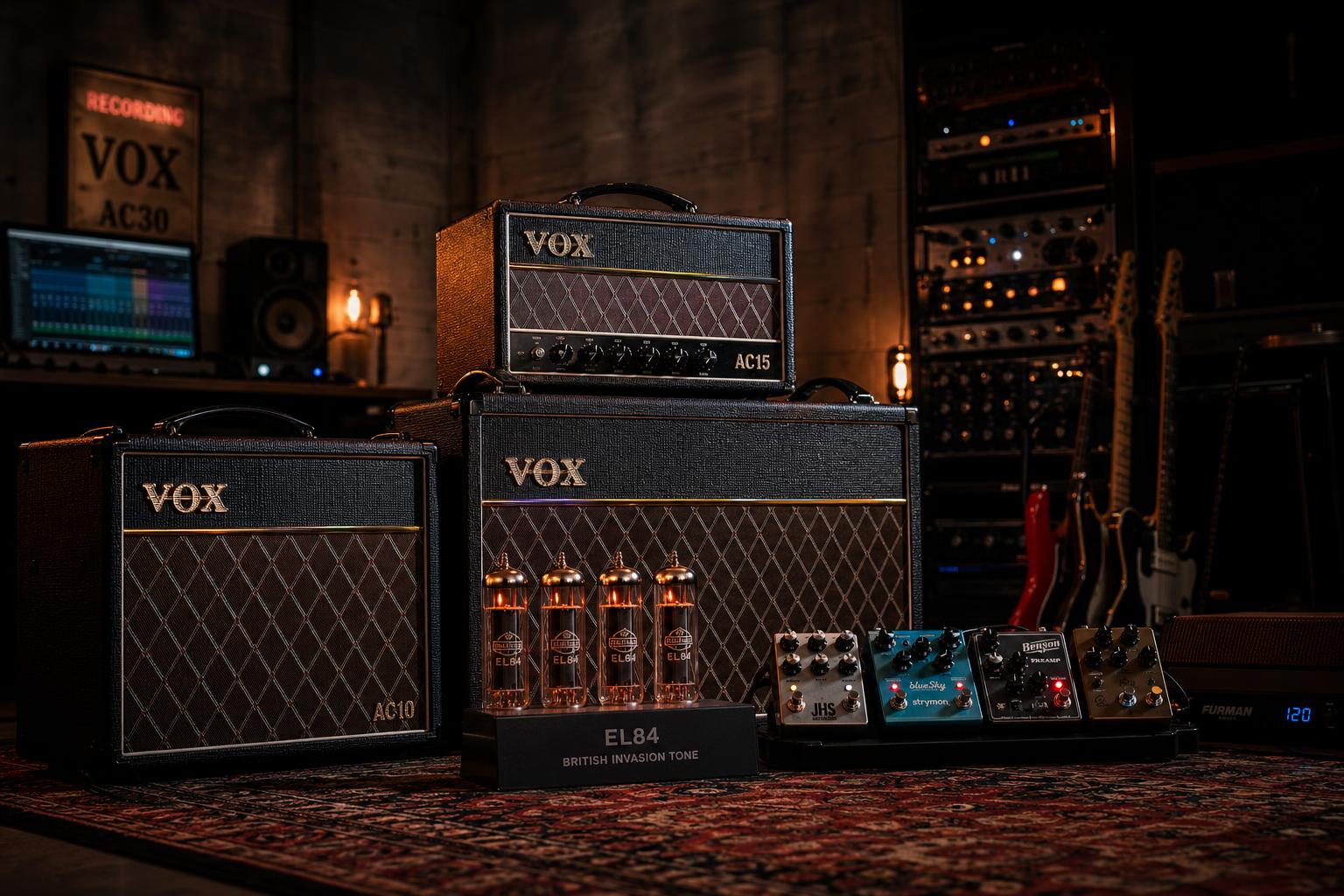
The short version: The EL84 is a cathode-biased pentode that runs at lower plate voltages than the EL34 or 6L6, which is why it compresses early, chimes brightly in the upper midrange, and develops a distinctive ringing harmonic structure when pushed. A pair makes 15 watts and powers an AC15. A quartet — four EL84s in a Class A-ish cathode-biased configuration — makes 30 watts and powers an AC30, and the four-tube interaction is the reason no two-tube amp ever quite sounds like one. This is the tube that gives you Brian May, the Edge's clean rhythm tones, and most of what the modern American boutique world means when it says "British chime."
When the 6V6/6L6/EL34 power tube post ran, I had a stack of emails asking why the EL84 wasn't in there. The honest answer is that it didn't fit the conversation. The other three tubes are typically run as a push-pull pair with a fixed-bias supply and Class AB topology. The EL84 in its most famous applications is run as a cathode-biased quartet in something approaching Class A. It's not a smaller version of the same animal — it's a different animal entirely.
That difference is why a Friedman Pink Taco, a Tone King Imperial, a Carr Mercury, and a vintage Vox AC30 share a tonal family despite being designed across sixty years and three continents. They all use this tube, and the tube is doing most of the heavy lifting on the character.
The EL84 at a Glance
| Spec | EL84 | EL34 (for comparison) | 6V6 (for comparison) |
|---|---|---|---|
| Class | Pentode | Pentode | Beam tetrode |
| Typical plate voltage | 250–320 V | 400–500 V | 350–450 V |
| Pair wattage (Class AB) | 15–18 W | 50 W | 15–22 W |
| Quartet wattage (cathode-biased Class A-ish) | 30 W (AC30) | rare | rare |
| Bias style most common | Cathode (self) | Fixed | Both |
| Compression onset | Early — usually around 1/3 of master volume | Late — much higher headroom | Moderate |
| Tonal signature | Bright, chimey, upper-midrange forward | Mid-forward, complex, "singing" | Warm, soft, early breakup |
| Famous in | Vox AC15, AC30, Matchless, Friedman PT, Carr | Marshall, Hiwatt, Diezel | Fender Deluxe, Princeton |
The EL84 is the smallest of the common guitar amp power tubes. That smallness is the entire story. Smaller plate, lower operating voltages, less headroom, and a faster onset of saturation. Every tonal characteristic the tube is known for traces back to those four facts.
What the EL84 Actually Sounds Like
The defining EL84 character is upper-midrange compression with audible harmonic ringing above it. Where a 6L6 stays linear under load and a 6V6 softens into a warm sponge, the EL84 develops a distinct chiming bell-like harmonic content as it begins to break up.
The tube has a perceptual emphasis around 2.5–4 kHz that builds as you push it. This is why a clean AC30 with the volume up sounds bright and forward without sounding harsh — that band is where vocal sibilance lives, where a Telecaster's bridge pickup snap lives, where the distinguishing "voice" of an electric guitar usually sits. The EL84 doesn't add EQ to that band so much as it adds harmonic complexity inside it. A note hits the speaker with more partials than it had at the input.
I've owned three AC30s over the years — a vintage AC30/6 with the Top Boost circuit, a hand-wired AC30HW2, and a Custom Shop AC30CC2 from the early 2000s. They all do this. The vintage one does it loudest and earliest; the modern reissues do it cleaner and later. But it's the same fundamental color across all three, and it's a color you don't get from any other power tube I've spent serious time with.
The other thing the EL84 does is compress early and noticeably. A Vox AC15 with a single pair of EL84s will be visibly compressing the signal at 4 on the master volume knob. By 6, it's solidly in saturation. By 8, it's at full breakup with very little additional volume to give. Compare that to a Twin Reverb (a pair of 6L6s, fixed bias) where the master volume goes to 10 and the amp barely breaks a sweat above 5.
That early compression is a feature for some players and a problem for others. It's the reason Vox amps got a reputation as "great for chord work, hard to use for cleans on a loud stage." Both are true.
The Two-Tube vs. Four-Tube Question
This is where the EL84 conversation usually loses people, and it's the single most important thing to understand about the tube.
A pair of EL84s — two tubes, push-pull, cathode-biased — makes about 15 watts. That's an AC15. That's a Tone King Imperial. That's a Friedman Pink Taco. The character is what I've described above: chimey, early-compressing, harmonically rich, with a clear power ceiling.
A quartet of EL84s — four tubes, two pairs in parallel push-pull, cathode-biased — makes about 30 watts. That's an AC30. That's most of the original Matchless DC-30. That's a Carr Mercury V running its 30-watt mode.
The wattage doubles. The character does not.
A four-tube EL84 amp doesn't sound like a two-tube EL84 amp turned up. It develops a more complex saturation onset, a different sag character (because there's twice the current draw on the same kind of power supply), and an upper-harmonic interaction between the two pairs that produces what people describe as the "AC30 chime" — a kind of ringing density above the fundamentals that a two-tube amp can suggest but never quite reach. The Edge built a career on that specific quartet character. So did Brian May. So did Justin Hayward and a long line of British rhythm players whose tone you've heard a thousand times — and it's the same quartet chime under most of modern worship guitar, which is why a tone like What a Beautiful Name leans on an AC30 held at the edge of breakup rather than a bigger, cleaner amp.
If you've A/B'd an AC15 against an AC30 at matched volume and thought they sounded "different in a way I can't describe," that's what you were hearing. The four-tube interaction is doing work that the two-tube version can't.
Why Cathode Bias Matters (Here, Specifically)
I covered the cathode-bias vs. fixed-bias question in detail recently, and the EL84 is the tube where that distinction has the loudest audible consequence.
Most EL84 amps run cathode-biased. The cathode resistor is the simplest possible biasing circuit, it tracks tube wear automatically, and it produces a softer compression character than a fixed-bias circuit at the same operating point. Cathode bias also means the amp self-regulates as the tubes age — you don't need a tech to rebias when you swap tubes, which is the practical reason cathode bias became standard on lower-power amps where the convenience matters more than the headroom efficiency.
The combination of EL84 + cathode bias is the British low-watt formula. It's what makes a Carr Mercury V respond the way it does at 8 watts. It's why a Friedman Pink Taco has the "feel" reputation it has. The tube and the bias style are doing complementary jobs.
A handful of amps — most notably the Marshall 1974X reissue and certain Bad Cat designs — run EL84s in fixed-bias configurations to extract more headroom and a tighter response. They sound more like little Marshalls than like little Voxes. Useful for some players, but not what most people mean when they say "EL84 sound."
Brand and NOS Differences in Current EL84 Production
Brand-to-brand differences in current production EL84s are, in my experience, larger than the differences within any other common tube type. The smaller the tube, the more variability you hear from the same nominal spec.
| Brand | Character | Best for |
|---|---|---|
| JJ EL84 | Slightly compressed, smooth, durable | Daily players who don't want to swap often |
| Tung-Sol EL84 reissue | Brighter, more upper-midrange forward | Players chasing the Vox chime literally |
| Mullard EL84 reissue | Slightly warmer, fuller low-mids | AC30 players who find stock tubes too aggressive |
| Genalex Gold Lion EL84 | Tighter low-end, more modern feel | Boutique amp owners who want headroom |
| Sovtek EL84M | Rugged, slightly muddy, very long-lasting | High-volume players who need durability |
Vintage NOS (new old stock) Mullard, Telefunken, Amperex, and GE EL84s from the 1950s and 1960s are a different conversation. They cost between $80 and $300 per tube depending on brand and date code, and a matched quartet for an AC30 will run you $400 to over $1,000. The character difference is real — I've owned a few NOS Mullard sets and the harmonic complexity above 3 kHz is something current production can suggest but doesn't fully reproduce. Whether that's worth the cost is up to you. For most players, a quartet of Tung-Sol or Mullard reissues at $25 a tube gets you 90% of the experience for 5% of the money.
The Boutique Amp Connection
The reason EL84s show up in so much modern American boutique design — Carr, Friedman's smaller amps, Tone King, Bad Cat, Dr. Z, Matchless — is that they let a builder produce a low-watt amp with British character without copying a Vox. The tube does the heavy lifting on the voice; the builder's circuit choices around it determine the specific personality.
Carr's Mercury V uses two EL84s in a power-scaling circuit so you can run it at 8, 4, or 2 watts. That circuit only works because the EL84 compresses gracefully at low operating points; the same scheme with 6L6s would sound choked.
Tone King's Imperial uses two EL84s and adds the Ironman attenuator. That combination — early-compressing tube plus reactive load attenuator — gets you cranked-amp character at apartment volumes in a way that a 6L6-based design has trouble matching, because the 6L6 is too clean too late in the volume range.
Friedman's Pink Taco runs two EL84s through a Marshall-style preamp. The result is an amp that has the gain structure of a Marshall but compresses like a Vox, which is a combination that didn't exist commercially before Friedman built it.
These amps share a tonal DNA not because their builders copied each other, but because the EL84 is doing a recognizable thing in each one. You can't avoid the tube's character. You can only frame it.
What the EL84 Does Not Do Well
Honesty cuts both ways. The EL84 is not a universal tube.
It does not deliver American clean. If you want the firm, scooped, headroom-rich Fender Twin sound, the EL84 is the wrong tube. The compression curve is not designed for that job, and pushing an EL84 amp into that territory is fighting the tube. Use a 6L6.
It does not deliver modern high-gain. The EL84 doesn't have the headroom or the low-end firmness for modern metal. A Diezel VH4 has EL34s for a reason — they stay tight where the EL84 collapses into mush. Use an EL34 or a 6L6 for high-gain rhythm work.
It does not stay clean at high volumes on a loud stage. A 30-watt AC30 is not as loud as a 30-watt 6L6 amp because the EL84s are spending more of their wattage budget in compression. If you need clean headroom at gig volumes, you'll need a bigger amp or a different tube.
What the EL84 does well, almost no other tube can do. What it does badly, almost any other tube can do. Pick by use case.
The Surprised Finding
I went through a phase in the early 2000s where I thought I was done with Vox amps. I'd had a 1965 AC30 that I sold during a lean year, and the modern reissues at the time felt like cardboard imitations of the real thing. I assumed the EL84 sound was something that died with the original British production tubes and the original Celestion Blue alnico speakers, and that what current builders were doing was a pale facsimile.
A friend lent me a Friedman Pink Taco around 2013. Two EL84s, Marshall-style preamp, modern construction, modern tubes. I expected it to sound like a small Marshall. What I actually heard was something I hadn't experienced since the AC30 — that ringing upper-midrange harmonic content, the early-compressing feel, the way a chord just sat in the air with more partials than it should have had.
The lesson, which I've had to learn more than once: the magic isn't in the era. It's in the tube and the circuit topology around it. When a modern builder gets the operating point right and uses cathode bias and respects what the EL84 wants to do, the character that lives in those tubes comes through whether the chassis was built in 1965 or last year.
I bought a Carr Mercury V six months later. Still own it. The Vox AC30 of 1965 is gone, but the sound it was famous for is still available, and a lot of it is hiding inside small American boutique combos that don't have "Vox" written on the front.
If you're choosing an amp around the EL84, here's the framework I give people: a two-tube design (AC15, Pink Taco, Carr Mercury, Tone King Imperial) for home, recording, and small rooms with PA support. A four-tube design (AC30, Matchless DC-30) for the chime that only the quartet produces and for situations where you need stage volume from a British-character amp. Don't expect the small one to do the big one's job, and don't expect either to behave like a Twin. The tube is doing what the tube does, and for the right player it's the only tube that does it.