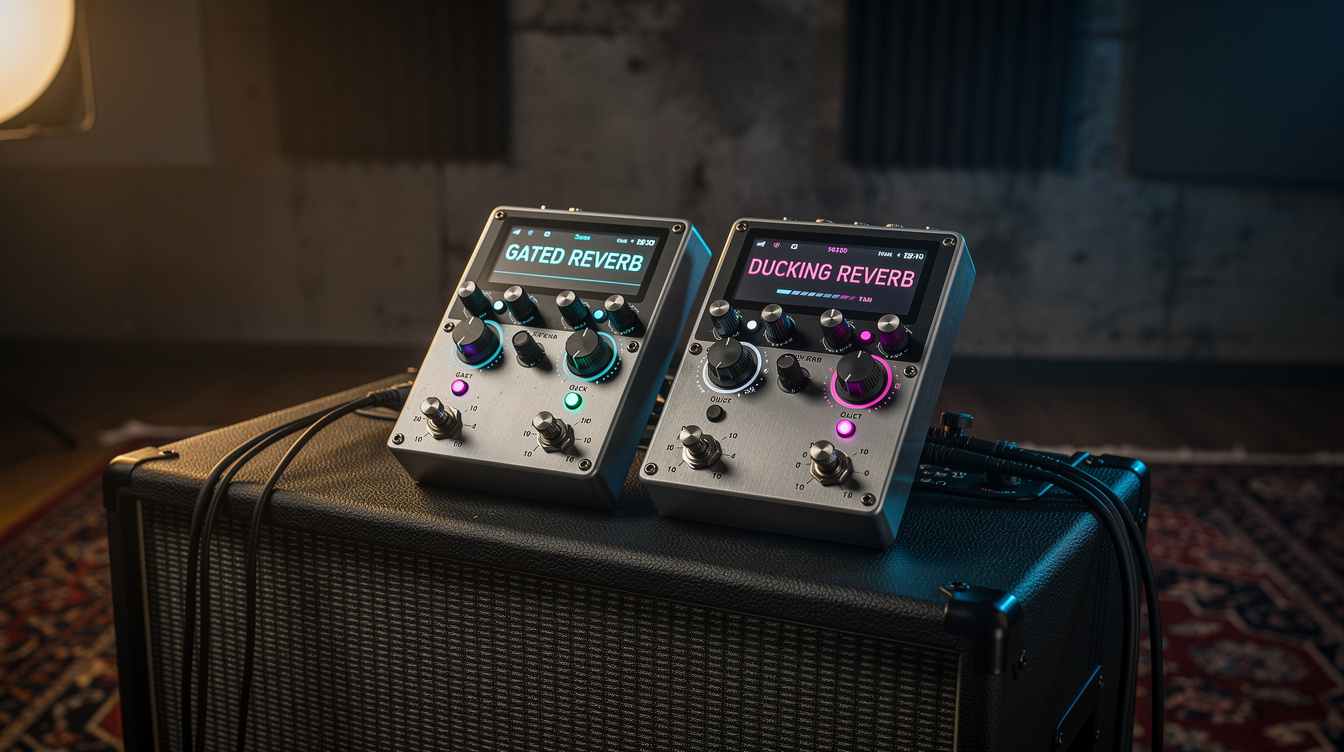
Two of the most useful things you can do with a reverb have nothing to do with the reverb itself — they're about what you do to the tail. You can chop it off at a fixed point so it ends with a hard edge, or you can pull it down while you play and let it rise in the gaps. The first is gated reverb. The second is ducking reverb. They get mentioned in the same breath because both are answers to the same complaint — this tail is too much — but they solve it from opposite directions, and the difference between them is the difference between a timer and a living dynamic.
The Short Version
| Gated reverb | Ducking reverb | |
|---|---|---|
| What controls the tail | A fixed hold time, then a hard cutoff | Your playing dynamics, continuously |
| The tail's shape | Loud and dense, then it stops dead | Full decay, but pushed down while you play |
| The feeling | Percussive, rhythmic, a hard edge | Atmospheric, breathing, gets out of the way |
| Classic use | 1980s drums, staccato stabs, rhythmic parts | Pads, ambient washes, worship swells |
| Technical name | Nonlinear reverb | Sidechained / dynamic reverb |
Gated reverb is about shape — it imposes a fixed silhouette on the tail. Ducking is about behavior — it lets the tail change in real time against what your hands are doing. Once you feel that distinction, you stop reaching for the wrong one.
What Gated Reverb Actually Is
A gated reverb is a big, dense reverb running into a gate that slams shut after a set length of time. The reverb itself doesn't decay the way reverbs normally do — instead of trailing off into the distance for two or three seconds, it stays loud and full for a few hundred milliseconds and then simply stops, as if the room were switched off mid-bloom. That hard ending is the entire character. It's space with a guillotine on it.
The sound was an accident before it was a technique. Around 1980, engineer Hugh Padgham was working on drums — the story always lands on Phil Collins, and the most famous example is "In the Air Tonight" — and routed a heavily compressed room mic through a noise gate. The gate cut the natural decay off abruptly, and instead of a normal roomy ambience you got this enormous, explosive burst that ended the instant the drum did. Hardware later canonized it: the AMS RMX16's "NonLin" program and Lexicon's nonlinear reverbs turned the studio trick into a knob, which is why the proper engineering name for a gated reverb is a nonlinear reverb — the decay envelope isn't the smooth exponential curve a real room produces.
On guitar it does something a long reverb can't. Hit a staccato chord through a gated reverb and you get a percussive whump of dense space that arrives and leaves with the note — there's a quality to it that's closer to a snare hit than to ambience. It's rhythmic. It punctuates. Where a hall or plate smears one chord into the next, a gated reverb keeps each one in its own box, which is why it survives in busy arrangements that a long tail would turn to fog.
What Ducking Reverb Does Instead
A ducking reverb keeps the entire natural tail. Nothing gets chopped. What changes is the tail's volume, and it changes continuously based on how hard you're playing. While your pick is moving, the wash drops into the background so your dry notes stay defined; the moment you leave a gap, the tail swells back up and fills the silence. The reverb lives in the spaces you leave rather than on top of the notes you play.
I've written about how to dial a ducking reverb in full, so I won't relitigate the threshold-depth-release controls here. The point that matters for the comparison is this: ducking is dynamic. The size of the space responds to your hands in real time. Play softly and the tail stays up; dig in and it ducks away. There's no fixed length, no hard edge — the tail comes and goes like breath, and a long natural decay is the whole point rather than something to be cut.
That's the cleanest way to hold the two in your head. Gated reverb ends the tail on a timer. Ducking reverb lowers the tail with your dynamics. Same problem — a tail that's too much — answered by a stopwatch versus a dimmer.
Which One the Part Wants
The choice isn't about taste so much as about what the part is doing.
- Staccato, rhythmic, percussive parts want gated reverb. Chord stabs, muted single-note figures, anything where the guitar is functioning rhythmically. The hard cutoff reinforces the rhythm instead of blurring it. This is also where the explicit 1980s flavor lives — if you want a part to sound like it was tracked in 1984, a gated reverb on a bright, compressed clean is most of the way there.
- Sustained, atmospheric, legato parts want ducking reverb. Pads, swells, ambient beds, the slow build under a vocal. You want the size of a long tail and the clarity of your notes, and ducking gives you both because the wash only surfaces in the gaps. A worship pad is the textbook case.
- A dense mix can take either, for different reasons. Gated reverb survives because its tail length is fixed and short, so it never piles up past the point you set. Ducking survives because the tail is only ever loud when you've stopped playing. A long static reverb is the one that drowns in a busy track — and the reason both of these techniques exist.
Here's a settings starting point for the gated side, since the ducking values live in the other post:
The hold time is your single most important control: it sets how long the burst lasts before the cutoff. Shorter is more percussive and more obviously gated; longer starts to sound like a normal reverb that someone interrupted. The release wants to be fast — the entire effect depends on the tail ending abruptly, so a slow release just smears the edge you're trying to create.
The Part I Expected to Be a Gimmick
I'll admit my bias going in: I assumed gated reverb was a period costume. A fun 1980s reference, useful for exactly one drum sound and one Phil Collins homage, and otherwise a novelty I'd never put on a part I actually cared about. Ducking felt like the serious technique — subtle, restrained, the one a tasteful player reaches for — and gated felt like the kazoo of reverbs.
What changed my mind was a tight, staccato single-note part over a busy track, the kind of thing St. Vincent does where the guitar is functioning as percussion. I tried a ducking reverb first, on principle, and it did nothing useful — the notes were already short, so there were no sustained tails to duck and nothing to push out of the way. The ducking had no material to work with. Then I dropped a gated reverb on the same part and it snapped into place: each note got this dense little explosion of space that arrived and vanished with the note, locked to the rhythm, present without ringing on for even a beat too long. It wasn't a costume at all. It was the only one of the two that could put real size on a part that had no sustain to spare. I'd had it exactly backwards — gated reverb isn't the less serious tool, it's the one for rhythmic playing, and ducking is the one for sustained playing. They don't compete. They cover different halves of how a guitar can move through time.
Building Both on a Modeler
Neither of these is exotic, and you don't need a dedicated pedal for either.
Gated reverb is a two-block recipe on any platform: a reverb into a gate. On a Helix, put a big, dense reverb — a Plate or a Room with the decay up — and follow it with a Noise Gate (or the Hard Gate) block. Set the gate threshold so the reverb tail trips it open, then use a short hold and a fast release so the tail gets chopped rather than faded. Some reverbs also offer a nonlinear, gated, or particle mode that bakes the whole thing into one block — check the model list before you build it by hand. On a Quad Cortex, look for a nonlinear reverb model, or build the same reverb-into-gate chain; the logic is identical across platforms because it's just a gate doing what gates do.
Ducking reverb is usually a single parameter rather than a chain — Helix's Dynamic Hall and Dynamic Plate, the Ducking control on several reverb blocks, or the equivalent on your platform. The full how-to is here. If your modeler has neither a ducking parameter nor a nonlinear mode, both can be built from primitives: ducking from a sidechained volume block, gating from a reverb-into-gate chain.
One last practical note, because it's the mistake I see most: if a part sounds washed out, the instinct is to pull decay and mix down until the guitar can breathe. That works, but it shrinks the space. Gated and ducking reverb are the two ways to keep the size and fix the clutter instead — one by giving the tail a hard edge, the other by teaching it to wait for the gaps. Match the tool to how the part moves, and you stop choosing between a guitar that's big and a guitar that's clear.