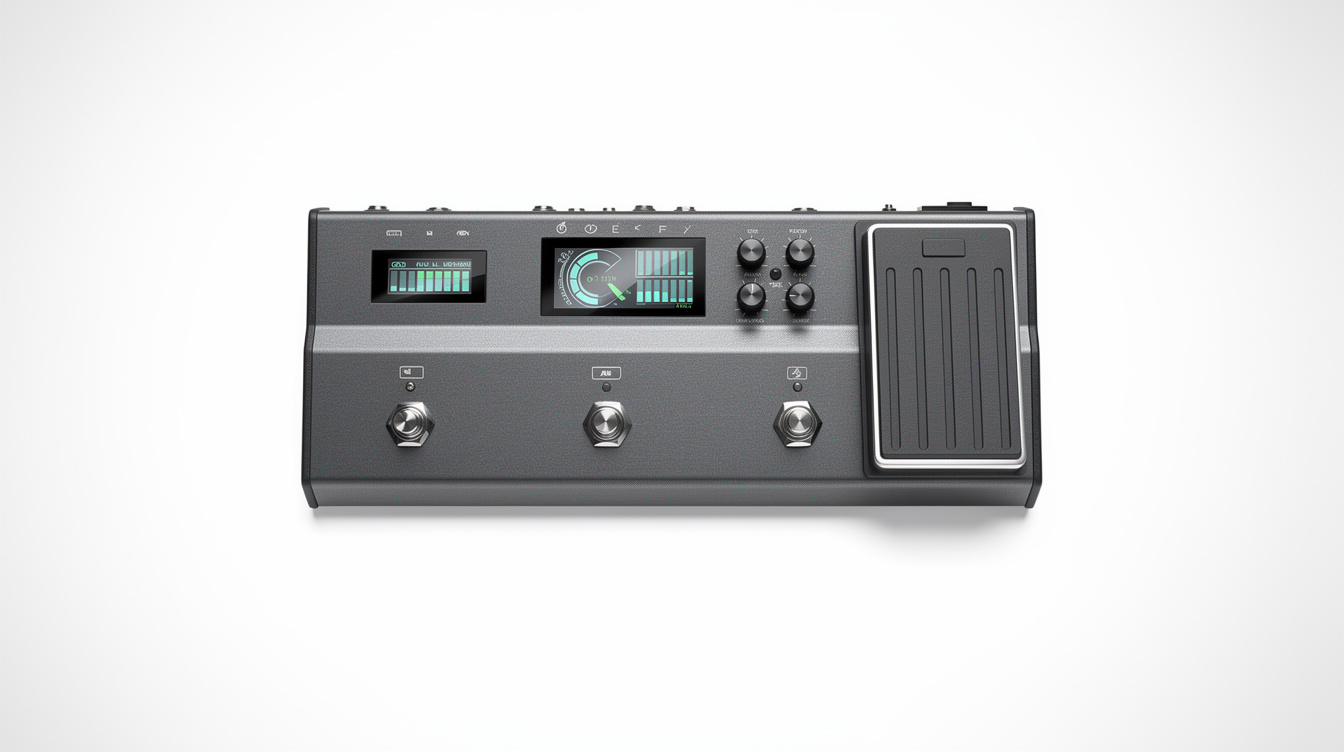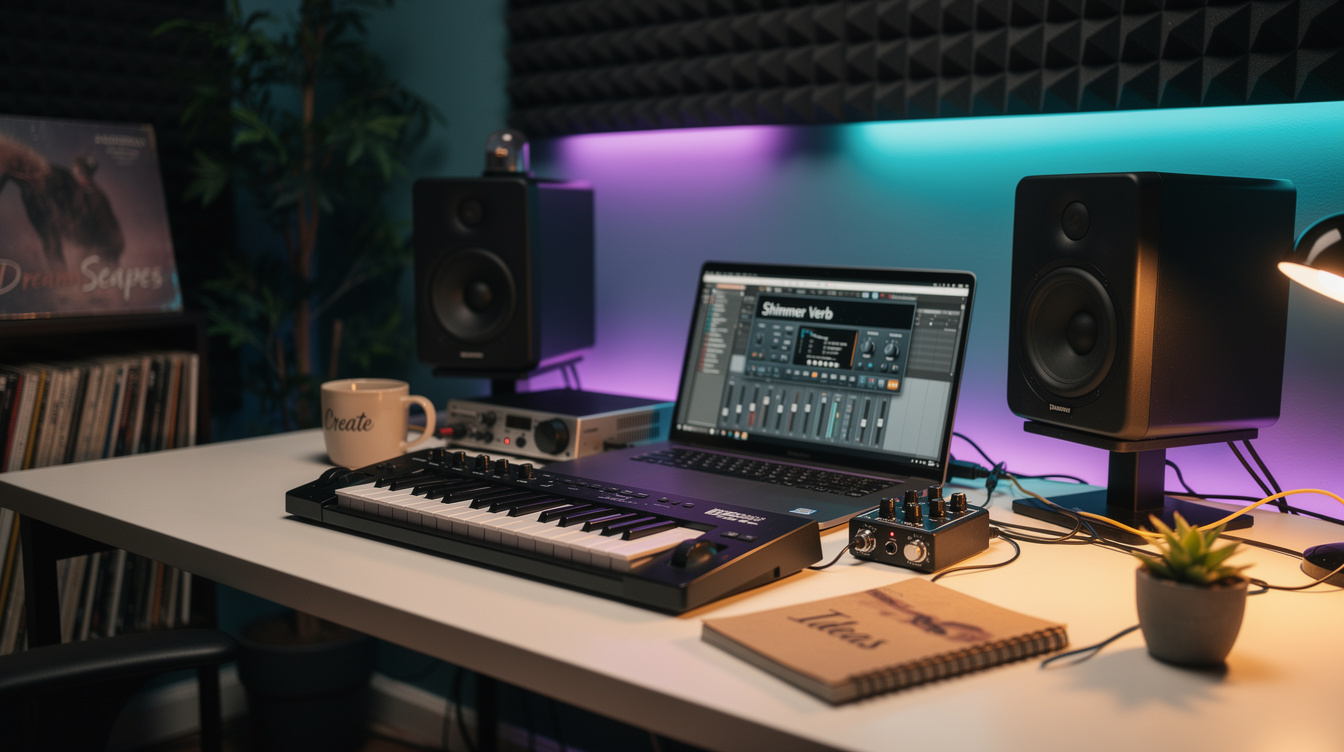
The Short Version Shimmer is a +12 pitch-shift feeding a long reverb. Build it free in your DAW (pitch-shifter → Valhalla Supermassive), build it in a modeler you already own (Dual Pitch +12 → big Hall), or buy a sub-$130 pedal if you need it under your foot. The flagship is optional.
Shimmer is the sound of a chord that keeps rising after your hand has stopped moving. Held notes bloom upward, an octave floats in above the fundamental, and the whole thing settles into something closer to a synth pad than a guitar. It's all over ambient records and Sunday-morning intros, and the moment you go looking for how to get it, someone points you at a $480 pedal.
You don't need the pedal. Shimmer isn't a proprietary algorithm — it's two ordinary things stacked: a pitch-shifter set an octave up, feeding a long reverb tail. Once you see it that way, the question stops being "which box do I buy" and becomes "where do I already have a pitch block and a reverb." For most people the answer is: right here, for free.
What Shimmer Actually Is
A reverb takes your note and smears it out into a decaying cloud. A shimmer reverb does the same thing, but before (or inside) that cloud, it raises the pitch — usually a full octave, +12 semitones. Each time the tail regenerates, it climbs. Stack enough of those rising octaves and the ambience turns into a slow, glassy pad that hovers above the chord.
Two ways to wire it, and they don't sound the same:
- Pitch in front of the reverb gives you a fixed octave layer sitting in the wash — steady, present, easy to control.
- Pitch inside the reverb's feedback loop gives you the true rising shimmer, where each repeat climbs higher than the last. This is what the big pedals do internally.
Most free and in-the-box setups do the first one, and here's the thing nobody tells you: for a held chord in a mix, the fixed-octave version is often the one you want anyway. The endlessly-rising version is gorgeous solo and can turn into a shrieking mess the second a second instrument shows up. I reach for the fixed octave more than I expected to.
The Free Path: DAW + Valhalla Supermassive
If you record, you already have everything. Valhalla Supermassive is a free reverb/delay plugin that is, no exaggeration, one of the best-sounding reverbs made at any price. It has no pitch-shifter of its own — so on its own it does a massive modulated wash, not true octave shimmer. To get the octave, you put a pitch-shifter in front of it (Ableton's Shifter, Logic's Pitch Shifter, or any free +12 plugin).
| Block | Setting | Why |
|---|---|---|
| Pitch shifter | +12 semitones, ~25-30% wet | The octave that turns reverb into a pad. Keep it under the dry note, not on top of it. |
| Reverb (Supermassive) | A long mode (Gemini/Andromeda), Delay/Decay long, Mix 20-30% | The bloom. Long decay is what sells it — 8 seconds and up. |
| Low cut on reverb | 250 Hz | The single most important knob here. Cuts the boom out of the tail so the octave floats instead of muddying the low end. |
| High cut on reverb | 8 kHz | Stops the shimmer from turning into glass and ice above the note. |
Run the reverb on a send, not inline, so the dry chord stays defined and only the wet path gets pitched and washed. That keeps the fundamental legible while the octave does its floating thing above it.
The surprised-discovery moment: I built my first shimmer chasing the octave — more pitch, more mix, louder rising layer. It sounded like a kazoo drowning. The thing that actually fixed it wasn't the octave at all; it was that 250 Hz low cut on the tail. Pull the low-mids out of the wash and suddenly the pad sits under the chord instead of swallowing it. The octave is the color. The low cut is what makes it a pad and not a mess. I now set the low cut before I touch anything else.
The In-the-Box Path: You Already Own This
If you play through a Helix, HX Stomp, or POD Go, there is almost no reason to buy a shimmer pedal, because the parts are already inside the unit. Drop a Dual Pitch block with one voice at +12 (mix around 30%) in front of a long reverb — a big Hall, or Searchlights if your firmware has it — with the decay cranked and the mix around 25%. That's shimmer, made from blocks you paid for once.
I won't re-walk every parameter here because the shimmer reverb settings guide already does it block by block, including how to add a fifth (+7) on top of the octave without it clashing in minor keys. The point for this post is just: the box does it. The same 250 Hz low cut applies — put it on the reverb block, or use the modeler's global and preset EQ to carve the tail.
Cross-platform quick notes:
- HX Stomp — plenty of DSP for Dual Pitch → reverb. This is the sweet spot.
- POD Go — DSP is tighter, so a single pitch voice into one reverb block is the realistic build; skip the second voice.
- Quad Cortex — a Poly Pitch or Pitch block at +12 into a Hall does the same job; the QC's headroom means you can run it in stereo without flinching.
The Budget-Pedal Path (and When It's Worth It)
You only need a pedal if you play out and want shimmer under your foot in real time, without a laptop. If that's you, you still don't need the flagship:
- Under $70 — Flamma FS06 or a Mooer shimmer mini. A dedicated shimmer mode, a real octave-up wash. The build is plasticky and the controls are shallow, but the sound is genuinely there. For a bedroom-to-small-room player this is the honest floor.
- Around $130 — NUX Atlantic. Delay and reverb in one box with a cleaner shimmer voice and true stereo out. This is the one worth having if you play out on a budget — it doubles as your delay, so it's earning two slots on the board.
- The flagships — Strymon BigSky, Meris Mercury, Empress Reverb. Covered in the flagship reverb comparison. What the extra $300-plus buys is not a better shimmer — it's instant preset recall, wide stereo imaging, and footswitchable depth. Convenience and polish, not a different sound.
Here's the decision, made simple:
- You record → build it free in the DAW. Nothing to buy, best-sounding option, full control.
- You already own a modeler → build it in the box. The pedal would be redundant.
- You gig without a modeler and need it live → a sub-$130 pedal. Buy the flagship only if that exact sound is your whole identity and instant recall matters more than the money.
The vibe you're chasing is real and it's not locked behind a price tag. It's a pitch block, a long reverb, and one low cut that keeps the whole thing from turning to soup. Everything past that is convenience — worth paying for if you play out every week, easy to skip if you're building loops in your room at midnight.