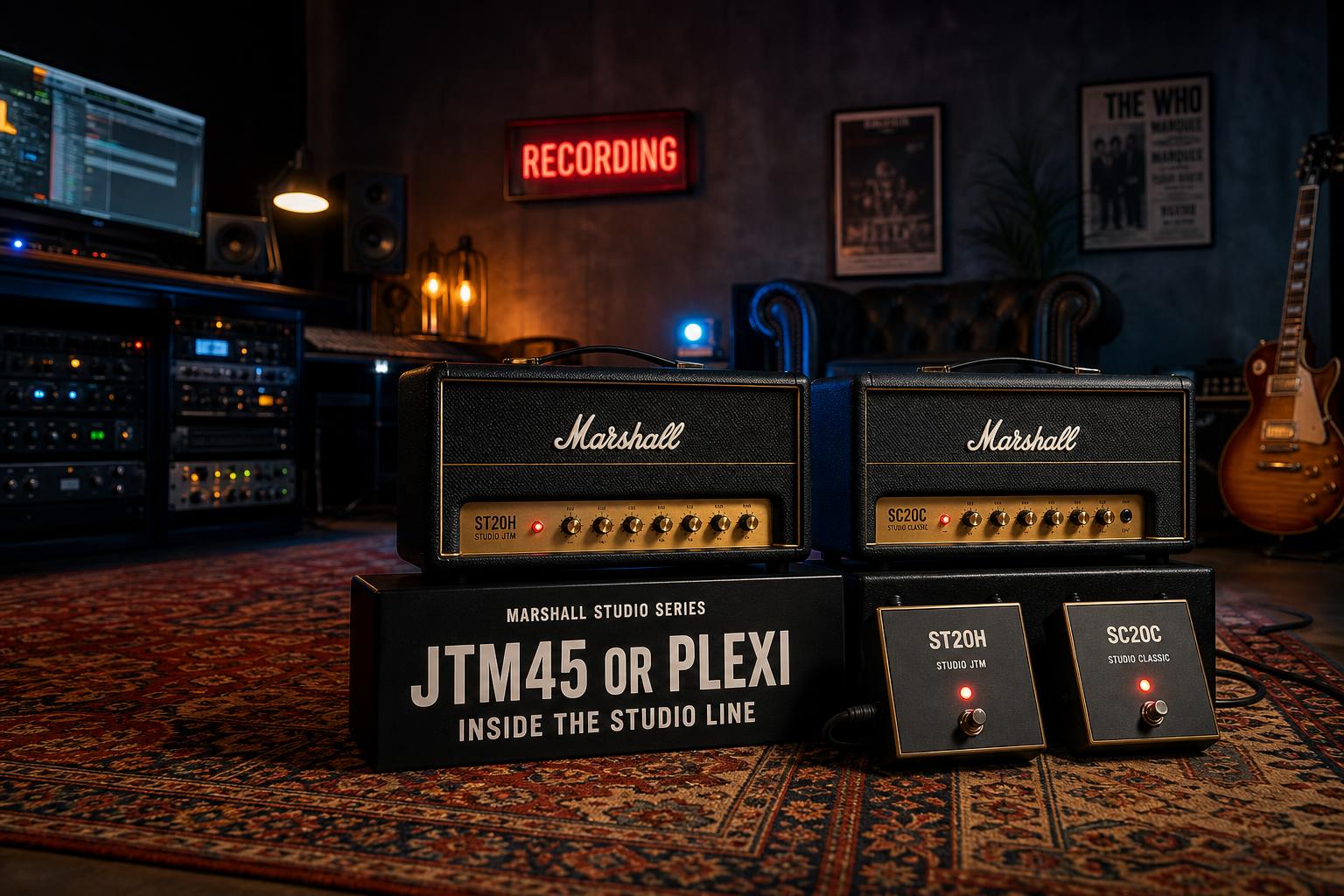
Quick read: The Marshall Studio JTM ST20H ($1,799 street head) is a 20-watt JTM45: KT66 power tubes, GZ34 tube rectifier, the warmer and earlier Marshall voicing that lived between the late-fifties Bassman it was cloned from and the brighter Plexi that came a few years later. The Studio Classic SC20C ($1,799 street combo) is a 20-watt 1959 Super Lead Plexi: EL34 power tubes, solid-state rectifier, the brighter and louder voicing that defined British rock from 1965 forward. Same Studio chassis, same 20 W / 5 W switch, very different amps. Buy the ST20H if your sound is bluesy, jazzier, more compressed, with the slow sag of a tube rectifier and a softer top end. Buy the SC20C if your sound is louder, brighter, more aggressive on the attack, with the tighter low end of a solid-state rectifier and the famous Plexi top-end bloom when you push it.
I covered the SC20C against the SV20H last week (Plexi vs. JCM800, the two iconic Marshall voicings most buyers cross-shop). The other comparison most buyers don't even know to ask is the SC20C against the ST20H, which is the comparison between the 1959 Super Lead and the JTM45. These are the two earliest Marshall circuits, and they're often lumped together as "old Marshall" by people who've never played both. They aren't the same amp.
The JTM45 was Marshall's first amp, released in 1962. It was a near-direct copy of the Fender Bassman 5F6-A circuit, with KT66 power tubes (because that's what was available in the UK at the time) instead of the Bassman's 6L6s. By 1965, Marshall had switched to EL34s for more output and brighter voicing, dropped the tube rectifier for a solid-state one, and started building what eventually became known as the 1959 Super Lead (the Plexi). Same general topology, different parts, very different amp.
| Spec | ST20H (Studio JTM) | SC20C (Studio Classic) |
|---|---|---|
| Circuit | JTM45 (1962) | 1959 Super Lead Plexi (1965) |
| Format | Head only | 1×10 combo |
| Power | 20 W / 5 W switchable | 20 W / 5 W switchable |
| Output tubes | 2× 5881 (6L6 family, KT66 substitute) | 2× EL34 |
| Preamp tubes | 3× ECC83 | 3× ECC83 |
| Rectifier | GZ34 tube rectifier | Solid-state |
| Inputs | 4 (Hi/Lo Treble, Hi/Lo Normal) | 4 (Hi/Lo Treble, Hi/Lo Normal) |
| Effects loop | Series, switchable | None |
| DI output | Emulated, balanced XLR | Emulated, balanced XLR |
| Speaker (combo) | n/a (head only) | 1× 10″ Celestion V-Type |
| Weight | 31 lb | 35 lb |
| Street price | $1,799 (head) | $1,799 (combo) |
A few things to point out before the tone-by-tone walkthrough.
The Studio JTM uses 5881 power tubes, not actual KT66s. The 5881 is in the 6L6 family (same socket, same general topology, similar voicing) and it's what Marshall ships from the factory. You can swap to actual KT66s if you want the period-correct voicing, but the 5881s are honest tubes and most players won't bother. The point is that both Studio amps use the same physical tube socket as their original-era counterparts and respond to the same kind of biasing.
The rectifier difference is the biggest single tonal variable between these two amps. A tube rectifier sags under load; when you hit a chord hard, the rectifier can't deliver current fast enough to keep the plate voltage up, so the voltage drops momentarily and the amp compresses the attack. A solid-state rectifier doesn't sag; it delivers all the current you need, which means the attack stays sharp and the amp feels tighter and louder. The ST20H sags. The SC20C does not. This is what most players hear as the "vintage" feel of the JTM45 vs. the "louder" feel of the Plexi, and it's a real circuit difference, not folklore.
The ST20H has a series effects loop. The SC20C does not. This matters more than people think; if you run delays or reverbs in front of the SC20C and crank the front end, the time-based effects get smeared by the amp's natural breakup. The ST20H lets you put delays after the preamp, where they belong. If you're running a stereo delay rig or any kind of post-preamp ambient setup, the ST20H is the better platform.
What Each Amp Sounds Like
The ST20H is the warmer amp. The KT66 family has a softer top end than EL34s, the tube rectifier rounds off the attack, and the result is a tone that sits closer to a Fender Bassman than to a typical Marshall: rich midrange, smooth high end, slow saturation that blooms rather than snaps. Push the volume up and you get a warm, sagging breakup that sounds like every classic blues record from 1962 onward. Eric Clapton on the Beano album was a JTM45, John Mayall's Bluesbreakers was a JTM45, the early Cream live recordings were JTM45s. It's the sound of British blues before British blues turned into hard rock.
The SC20C is brighter, louder, and more aggressive. EL34s have a sharper top end with a glassy upper-midrange peak that the JTM45's KT66s soften. The solid-state rectifier delivers all the current the power tubes can pull, so the attack stays crisp and the amp feels like it's punching forward instead of hugging the note. Push the volume up and you get the famous Plexi bloom: the upper mids open up, the top end sings, and the amp gets louder as you crank it (rather than just compressing further like the JTM does). It's the sound of Live at Leeds, AC/DC's first three albums, the early Van Halen records, anything Angus Young played before he got his Wizard.
These are the kind of tonal differences you can hear in two seconds if you A/B them. Players who say "all old Marshalls sound the same" haven't put both on the same cab side by side.
Settings That Work
Both amps have the same 4-input control panel: a high-input and low-input jack on the Treble channel, a high-input and low-input jack on the Normal channel, and individual volume knobs for each channel plus a shared bass/middle/treble/presence tone stack. There's no master volume on either amp; these are jump-the-channels-and-crank-the-volume amps. That's part of the point.
ST20H: bluesy lead at 5 watts
- Treble Vol: 6
- Normal Vol: 4 (jumped to Treble channel with a short cable between the high inputs)
- Bass: 5
- Middle: 7
- Treble: 5
- Presence: 4
- Power switch: 5 W
That's a Cream-era SRV-leaning lead tone at a volume your neighbors will accept. The KT66s start to compress when the Treble Vol gets above 5, the rectifier sags on chord stabs, and the amp settles into the warm, slow breakup the JTM45 is famous for. Roll the guitar volume back to 6 and you've got a clean rhythm tone with the same warmth.
SC20C: classic rock crunch at 5 watts
- Treble Vol: 7
- Normal Vol: 5 (jumped)
- Bass: 5
- Middle: 5
- Treble: 6
- Presence: 6
- Power switch: 5 W
That's an AC/DC Highway to Hell rhythm tone in a small room. The EL34s start to compress around Treble Vol 6, the solid-state rectifier keeps the attack crisp, and the upper mids open up the way they're supposed to. Roll the guitar volume back to 5 and you've got a glassy clean that no JTM45 will ever produce. The upper-midrange peak is what gives the Plexi its characteristic top-end shimmer when the guitar volume rolls down.
ST20H: clean jazz tone at 20 watts
- Treble Vol: 4
- Normal Vol: 6 (use the Normal channel directly, not jumped)
- Bass: 6
- Middle: 6
- Treble: 4
- Presence: 3
- Power switch: 20 W
The Normal channel on the ST20H has the warmest clean tone Marshall has ever made: round, full, with the tube rectifier giving the notes a slight bloom on the attack. Plug a Telecaster into the high input on the Normal channel, set the amp like above, and you've got a jazz tone that competes with a Twin Reverb but with more midrange complexity.
SC20C: chord work at 20 watts with a Tube Screamer
- Treble Vol: 5
- Normal Vol: 4 (jumped)
- Bass: 5
- Middle: 5
- Treble: 5
- Presence: 5
- Power switch: 20 W
- TS808 in front: Drive 9 o'clock, Tone noon, Level 2 o'clock
Classic Plexi-and-pedal recipe. The TS808 supplies the dirt, the SC20C supplies the breakup character. The amp is loud at 20 watts with the volume at 5 (louder than most people expect from a 20-watt amp) but it's the kind of loud that translates to a club gig without micing. This is the sound of a thousand records.
Cab Decisions for the Head
The ST20H is a head, so you need a cab. Marshall sells the SV112 1×12 with a Celestion G12M Greenback that pairs naturally with the JTM voicing. Greenbacks have a softer top end than V30s and they roll off the higher frequencies in a way that complements the KT66 warmth. A 2×12 with two Greenbacks works even better and gets you closer to the cab coupling of a 4×12 stack. If you want the period-correct ST20H rig, that's a Greenback-loaded cab.
A Celestion Blue alnico in a 1×12 is the other right answer. The Blue is the original Vox AC30 speaker, but it works beautifully with a JTM45. The alnico magnet structure gives the speaker a slow attack that complements the tube rectifier's sag, and the upper-midrange voicing is closer to what KT66s want than EL34s. It's a more expensive cab choice (Blue alnicos are about $300 a speaker) but it's the cab I'd buy if I were building an ST20H rig from scratch.
The SC20C is a combo with a 10-inch Celestion V-Type built in, so no cab decision is required. The V-Type is a competent speaker that doesn't move as much air as a 12-inch but does the job. If you want to add an external cab, the SC20C has a speaker output on the back that lets you run an additional 8-ohm cab in parallel with the internal speaker.
How Each Amp Takes Pedals
The JTM45 takes pedals well, but differently than a Plexi. Run a Tube Screamer in front of the ST20H and you don't get the same bloom you'd get into the SC20C. The JTM's slower attack and softer top end mean the TS808's midrange hump is more pronounced. The result is a more compressed, mid-forward dirt tone that suits blues better than rock. A treble booster (Rangemaster style) works better with the JTM45 than a TS does. The treble booster pushes the front end with extra high-mid energy, which the JTM's softer top end welcomes.
The Plexi takes pedals brilliantly. The SC20C's brighter top end and tighter low end mean an overdrive in front adds dirt without muddying anything. A TS808, a Klon, a Marshall Bluesbreaker, a Bluesbreaker-style mid-gain pedal: all work beautifully. The classic recipe is Strat (or Les Paul) into a Tube Screamer into a Plexi: the TS adds a midrange-focused boost, the Plexi adds the top-end bloom and the EL34 saturation, and the result is a hundred classic rock and metal records from the late '70s onward.
If you stack pedals, the ST20H is more sensitive to which pedals you stack. A TS into a klon-style pedal into a JTM45 can sound congested. The JTM's softer top end can't open up under the weight of two midrange-focused pedals. A klon into the JTM45 with no other pedal works beautifully, because the klon supplies the high-mid clarity the JTM lacks on its own.
Cross-Platform Notes for Modeler Players
Both circuits are modeled in Helix, Quad Cortex, and TONEX, but the JTM45 has historically been modeled less faithfully than the Plexi. The Plexi is the most-modeled amp circuit in history; every modeler has at least three good Plexi options. The JTM45 is rarer, and the modeler versions tend to lack the tube rectifier sag that defines the real amp's feel.
On a Helix, the "Brit J45 Nrm" model is the JTM45. It's a competent capture, but the sag parameter does most of the work in approximating the real amp's rectifier behavior. Set Sag to 6 or 7 and the Hum to 4 to get closer to the real ST20H feel. The "Brit Plexi Brt" model captures the SC20C voicing reliably with default settings.
On a Quad Cortex, the "Plexi 1959 Tweed" capture is the SC20C; the "JTM-45 Brit" capture is the ST20H. The QC's Sag parameter is the key to making the JTM model feel right; set it around 5 to 6 for the ST20H feel.
On TONEX, look for any capture labeled "JTM45" or "Bluesbreaker"; these are usually the closest. The Plexi captures are everywhere.
So Which One Should You Buy
Buy the ST20H if:
- Your sound is blues, blues-rock, or jazz with occasional crunch
- You want the slow attack and warm compression of a tube-rectified amp
- You play blues in the Eric Clapton / John Mayall / SRV-on-a-good-day tradition
- You want a series effects loop for time-based effects
- You like the head-and-cab format and want flexibility in cab choice
Buy the SC20C if:
- Your sound is classic rock, AC/DC-style crunch, or pedal-friendly British dirt
- You want the brighter top end and tighter attack of a solid-state-rectified amp
- You play in the early Van Halen / AC/DC / Rolling Stones tradition
- You're fine with a 10-inch combo and don't need an effects loop
- You want a self-contained amp you can carry in one trip
If you can't decide: buy the ST20H. The JTM45 is a more versatile amp than the Plexi for most playing situations; it covers blues, jazz, and clean tones with more grace than the Plexi does, and it can crunch when you push it. The Plexi is the more iconic amp, but it's also the more single-purpose amp. The ST20H is the right answer for the player who wants one Marshall to cover everything from a quiet jazz gig to a Saturday night classic-rock cover band. The SC20C is the right answer for the player who specifically wants the Plexi sound and nothing else.
For the broader Studio line, our SC20C vs. SV20H comparison covers Plexi vs. JCM800 within the Studio platform, and the SC20H combo vs. SV20H head + 1×12 cab covers the head-vs-combo question within the JCM800-circuit Studio line.