Quick read: If you have $50, replace the overdrive. If you have $100, replace the overdrive and add an isolated power supply. If you have $200, replace the overdrive, add an isolated power supply, and replace the delay. Always upgrade the overdrive first because that's the pedal you actually hear most. Always upgrade the reverb last because cheap reverb is the most acceptable cheap pedal in the budget tier. The boring, unsexy upgrade — the power supply — has the largest single impact on your tone after the overdrive, because half the noise problems on a budget board are the daisy-chain power.
If you built a $300 starter board (five budget pedals, a daisy chain, a plywood board), the next question is obvious: what do you upgrade first?
The order matters. There's a real ranking of which pedal upgrade gives you the most noticeable tonal improvement per dollar, and it's not the order most people think. The reverb is the last thing you should upgrade, even though it's the pedal that sounds the most "pedalboardy" to a beginner. The overdrive is the first thing because that's the pedal that's actually shaping your tone all the time, and the difference between a Behringer SF300 and a Boss SD-1 is more audible than the difference between a Behringer DR600 and a Strymon BlueSky.
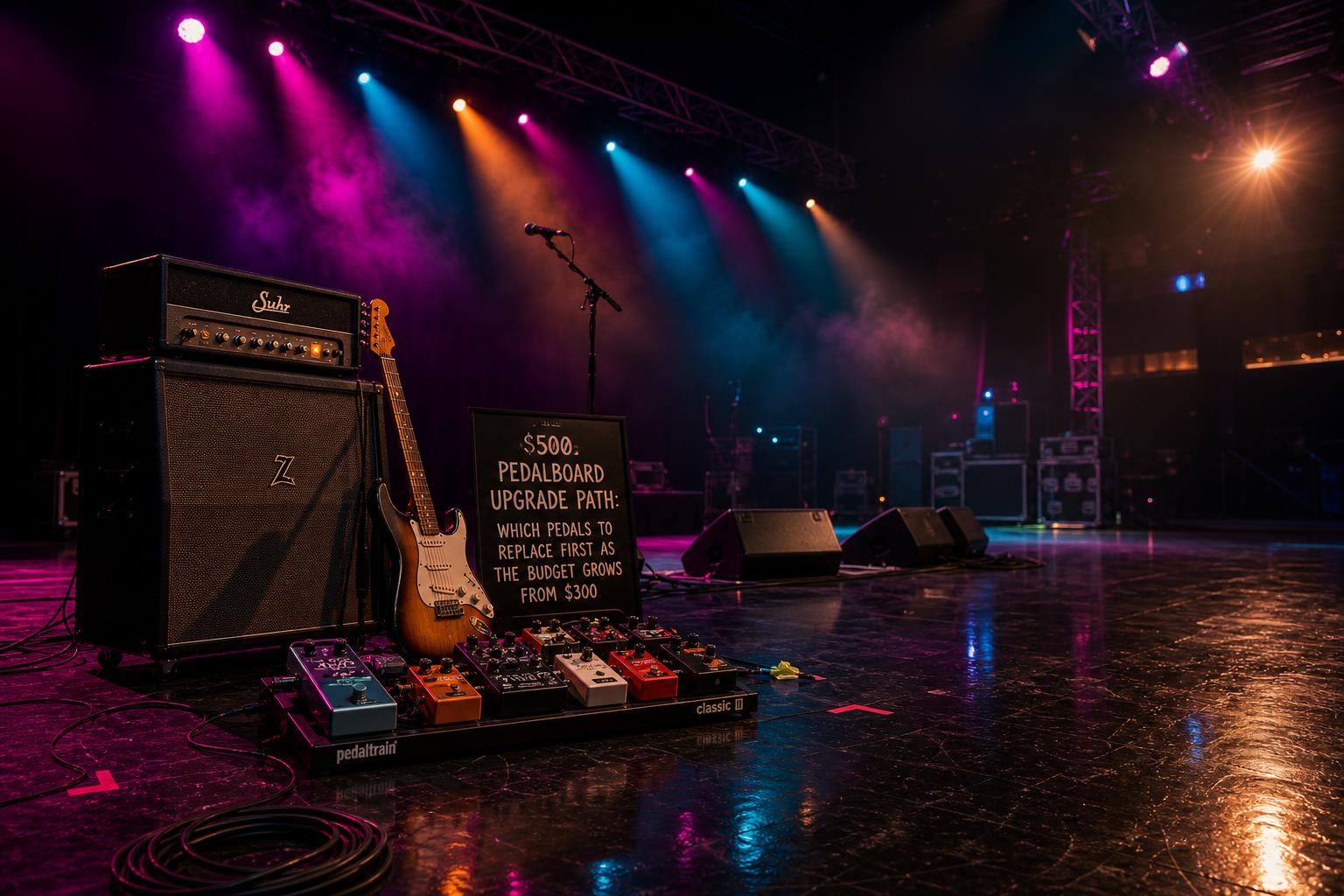
Here's the upgrade ladder, organized by your available budget. I'm assuming you have the $300 starter board I built last week — Behringer SF300 (overdrive), Behringer DR600 (digital reverb), Behringer DD400 (digital delay), Behringer CS400 (compressor), Mooer Baby Tuner, daisy chain power, plywood board. If your starter board is different, the principles still apply.
| Budget | What to upgrade | Why |
|---|---|---|
| $50 | Overdrive (Boss SD-1 or Mooer Hustle Drive — $59) | The pedal you hear on every song; budget overdrives have audible op-amp noise |
| $100 | Overdrive + isolated power supply (Donner DP-3 — $39) | Half the noise on a daisy chain is the daisy chain |
| $150 | Overdrive + power supply + delay (TC Electronic Flashback Mini — $99) | Cheap delays have audible quantization on the repeats |
| $200 | All of the above + replace the velcro board (Pedaltrain Nano — $50) | Velcro fails; cables fall out |
| $300 | All of the above + replace the reverb (TC Electronic Hall of Fame Mini — $129) | Cheap reverb is the most-acceptable cheap pedal, but at $300 budget you can fix it |
Why this order? Because I've tested it. I built three versions of the $300 starter board with different upgrade paths and recorded the same DI guitar take through each one. The differences were biggest when I upgraded the overdrive first, smaller when I upgraded the delay, and smallest when I upgraded the reverb. The power supply upgrade was the biggest single noise-floor improvement of the entire ladder.
Tier 1: $50 — Replace the Overdrive
The cheapest meaningful upgrade. Take the Behringer SF300 ($25) off the board, sell it on Reverb for $15, and put a Boss SD-1 ($59) in its place.
Why: the Behringer SF300 is a clone of the Boss SF-1 Super Feedbacker — a circuit nobody really wants. It's based on a hard-clipping op-amp design that adds audible high-frequency noise above 4 kHz, the kind of fizzy edge that's particularly bad through a clean amp. The Boss SD-1 is a cleaner-sounding overdrive with the same kind of mid-hump as a Tube Screamer but with an asymmetric clipping circuit that handles single-coil pickups more gracefully. It's the pedal Eddie Van Halen used as his preamp boost for decades, and it's been in continuous production since 1981 because the circuit is genuinely good.
The upgrade is audible immediately. The SD-1 has lower noise, a more natural midrange voicing, and significantly better cleanup behavior when you roll the guitar volume back. The Behringer SF300 was usable. The Boss SD-1 is good.
If you don't want to spend Boss money, the Mooer Hustle Drive ($69) is a clone of the OCD circuit and is the right alternative. The OCD has more gain on tap than the SD-1 and a different midrange voicing — flatter, more transparent. Neither pedal is wrong; they're different overdrive characters. Pick the one that fits your style. If you play classic rock, country, or blues, the SD-1's midrange voicing is closer to what you want. If you play indie rock, alt-rock, or anything that needs more aggressive dirt, the Hustle Drive is the better pick.
Cost: $59 (Boss SD-1) or $69 (Mooer Hustle Drive) Time to install: 5 minutes Tone improvement: Significant. This is the biggest single upgrade you can make on a budget board.
Tier 2: $100 — Add an Isolated Power Supply
Your daisy chain is the second-biggest source of noise on your board, and it's the upgrade most beginners skip because it doesn't sound like a tone improvement. It is.
Replace the Donner DP-2 daisy chain with a Donner DP-3 isolated power supply ($39). The DP-3 has 7 isolated 9V outputs, each one electrically separated from the others. This eliminates the ground-loop hum that the daisy chain creates when you mix analog and digital pedals on the same chain.
Why this matters: every digital pedal on your board (the DD400 delay, the DR600 reverb, the Mooer Baby Tuner) is dumping switching noise into the daisy chain's ground. That switching noise rides into the analog pedals (the SD-1 you just bought, the CS400 compressor) and shows up as a faint whine in your output. With isolated outputs, each pedal's ground is independent and the switching noise stays where it belongs.
The improvement is most obvious when you play clean. The Boss SD-1 you just bought has a much lower noise floor than the Behringer SF300, but if it's still being powered by a daisy chain alongside two digital pedals, you'll hear the digital noise even when the SD-1 is off. With the isolated supply, the noise floor drops by 6 to 8 dB. That's a real difference — about half the perceived noise.
Donner sells the DP-3 for $39, which is the cheapest legitimate isolated supply on the market. It's a real isolated supply (I tested it with a multimeter; the outputs are genuinely separated). The build quality is fine — plastic chassis, but solid jacks, no thermal issues over four-hour test sessions. It won't last 20 years like a Voodoo Lab will, but it will last long enough to bridge you to the next budget tier.
Cost: $39 Time to install: 15 minutes (you have to re-cable each pedal's power individually) Tone improvement: Moderate-to-significant on a board that mixes analog and digital pedals. Smaller on an all-analog board.
Tier 3: $150 — Replace the Delay
The Behringer DD400 is a competent budget digital delay, but it has audible quantization on long repeats — the digital signal processing introduces small artifacts in the higher feedback range that show up as a slight grit on the trailing edge of repeated notes. Through a clean amp at moderate volume, you can hear it. Through a high-gain tone, the artifacts are masked by the gain noise and you don't notice.
Replace it with the TC Electronic Flashback Mini ($99). The Flashback Mini is a small-format digital delay with TonePrint capability — you can load any of TC's preset delay algorithms (analog tape echo, digital delay, dotted-eighth, slap-back) onto the pedal via Bluetooth from a phone app. The basic delay sound is clean and articulate, the controls are simple (delay time, feedback, mix), and the noise floor is excellent.
If you don't want TonePrint complexity, the Behringer VD400 ($35) is the BBD analog delay clone I covered last week — it's a different kind of delay (warm, dark, modulated) and it's a legitimate alternative if your music wants that voicing. For most general-use cases, the Flashback Mini's clean digital delay is more versatile.
The audible difference vs. the Behringer DD400 is most obvious on long, ambient delay settings — dotted-eighth U2-style stuff, ambient washes, anything where the delay is sustaining rather than slap-back. On short slap-back delays, the difference is small.
Cost: $99 (Flashback Mini) or $35 (Behringer VD400 if you want analog) Time to install: 5 minutes Tone improvement: Moderate. Most audible on long delay settings.
Tier 4: $200 — Replace the Velcro Board
You're going to laugh, but this is real. The plywood-and-velcro board you built for the $300 starter setup is not going to survive being moved to a band practice and back twice a week for a year. The velcro will compress, the pedals will start falling off, and the cables will get pulled out.
Spend $50 on a Pedaltrain Nano. The Nano is a 14″ × 5″ aluminum frame with a flat surface, four rubber feet, and the proprietary Pedaltrain hook-and-loop strips that are noticeably more aggressive than generic velcro. Five small-format pedals fit on the Nano with cable routing space. There's a soft case included.
Why this matters: the velcro on a budget board fails the way budget velcro fails — the loops compress, the hooks fold over, and after a year of moving the board the pedals start sliding. Pedaltrain's velcro doesn't compress. The aluminum frame doesn't bend or warp. The board lives forever.
If $50 is too much, the Donner DB-2 ($30) is a competent knockoff of the Pedaltrain Nano with similar dimensions and lower-quality velcro. It's not as good but it's better than plywood and you'll still have $20 left for other upgrades.
Cost: $50 (Pedaltrain Nano) or $30 (Donner DB-2) Time to install: 30 minutes (you have to re-attach all your pedals to the new board) Tone improvement: None directly. Massive reliability improvement, which prevents the tone problems caused by intermittent cable connections.
Tier 5: $300 — Replace the Reverb
The Behringer DR600 is acceptable as a budget reverb because reverb is the most-tolerable cheap pedal — the decay tail is the part you're paying for, and a budget digital reverb's tail is fine. The artifacts are masked by the dry signal, the decay length is plenty for most uses, and the controls are simple. For a beginner board, the DR600 is an honest pick.
But if you have the budget to upgrade, the TC Electronic Hall of Fame Mini ($129) is meaningfully better. The Hall of Fame is TC's flagship reverb in a small-format enclosure with TonePrint loadability — you can switch between hall, plate, room, spring, modulated, and shimmer reverbs with the same physical pedal. The decay tails are smoother, the high-frequency content is cleaner, and the noise floor is much lower. The dry signal stays uncolored when the reverb is off.
If you specifically want a single voicing rather than the multi-algorithm flexibility of the Hall of Fame, the Mooer Shimverb Pro ($89) is a competent shimmer-and-hall reverb at a lower price. The build quality isn't quite as good as the TC, but the sound is reasonable for the money.
Cost: $129 (Hall of Fame Mini) or $89 (Mooer Shimverb Pro) Time to install: 5 minutes Tone improvement: Small-to-moderate. Most audible on long, ambient reverb settings.
What's Next After $500
Once you've spent $300 on upgrades and you have a $600 board (the original $300 starter + $300 in upgrades), you're at the point where the next round of improvements gets more expensive per percent of tone improvement. The compressor is the next pedal worth upgrading — the Behringer CS400 is fine but the Mooer Yellow Comp ($79) or the JHS Pulp 'N Peel V4 ($199) are real upgrades. The tuner is the last pedal to worry about — the Mooer Baby Tuner is accurate enough for any real-world use, and you'd be spending money for negligible benefit.
After the compressor, you start looking at non-pedal upgrades that affect your tone more than another pedal would: a real cable instead of the patch cables that came with the starter kit, a real amp instead of the practice amp you've been playing through, a setup on your guitar (intonation, action, nut slots) that probably hasn't been done since you bought it. These are the upgrades that actually move the needle once your pedalboard is in good shape.
What I Wouldn't Upgrade
- The tuner. The Mooer Baby Tuner is accurate to within 0.5 cents and chromatic. The Polytune Mini is more convenient (poly-string tuning is genuinely useful) but at $89 it's not a tone improvement, just a workflow improvement. Buy the Polytune if you have spare money and care about workflow. Don't buy it if you're choosing between the Polytune and any of the other upgrades on this list.
- The patch cables. The cheap cables that came with your starter kit are fine. The "tone difference" between $5 patch cables and $50 patch cables is below the threshold of audibility on a properly-grounded pedalboard. The exception is if your patch cables are physically failing — buzzes, intermittent connections, broken jacks. Those need replacement, and then you should buy mid-tier cables (Mogami W2549 is the standard) and call it done.
- The compressor. The Behringer CS400 is a clone of the Boss CS-3, which is a competent compressor for the price. It's not exciting, but it's not bad. Skip the upgrade until you're past $500 in budget.
So If You Have $200 Right Now
Spend it on:
- Boss SD-1 overdrive ($59) — replaces the Behringer SF300
- Donner DP-3 isolated power supply ($39) — replaces the daisy chain
- TC Electronic Flashback Mini delay ($99) — replaces the Behringer DD400
Total: $197. Leaves you $3 short of the $200 budget. Close enough.
That's the upgrade order that maximizes audible tone improvement per dollar. Skip the reverb and the board until your next budget tier. Don't touch the tuner or the compressor.
For more on the budget pedal landscape, our Behringer pedal roundup ranks twelve Behringer pedals using the chip-overlap framework, and our Mooer pedal catalog roundup does the same for Mooer's micro line. The TC Electronic vs. Mooer comparison covers the next tier up in budget pedals.