Start Here: The quick path to a Shredmaster equivalent in 2026:
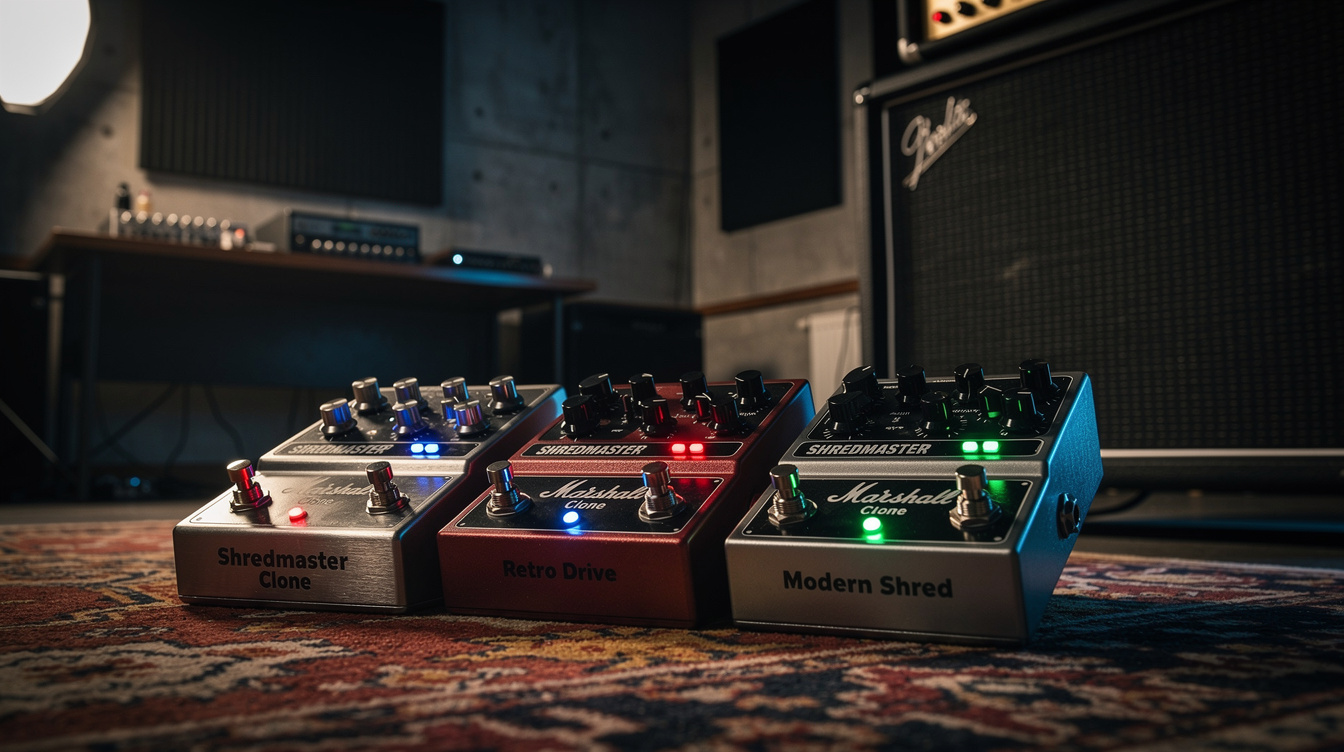
- Aion FX Solstice PCB ($35): build it yourself; faithful to the original; my recommendation for anyone who owns a soldering iron
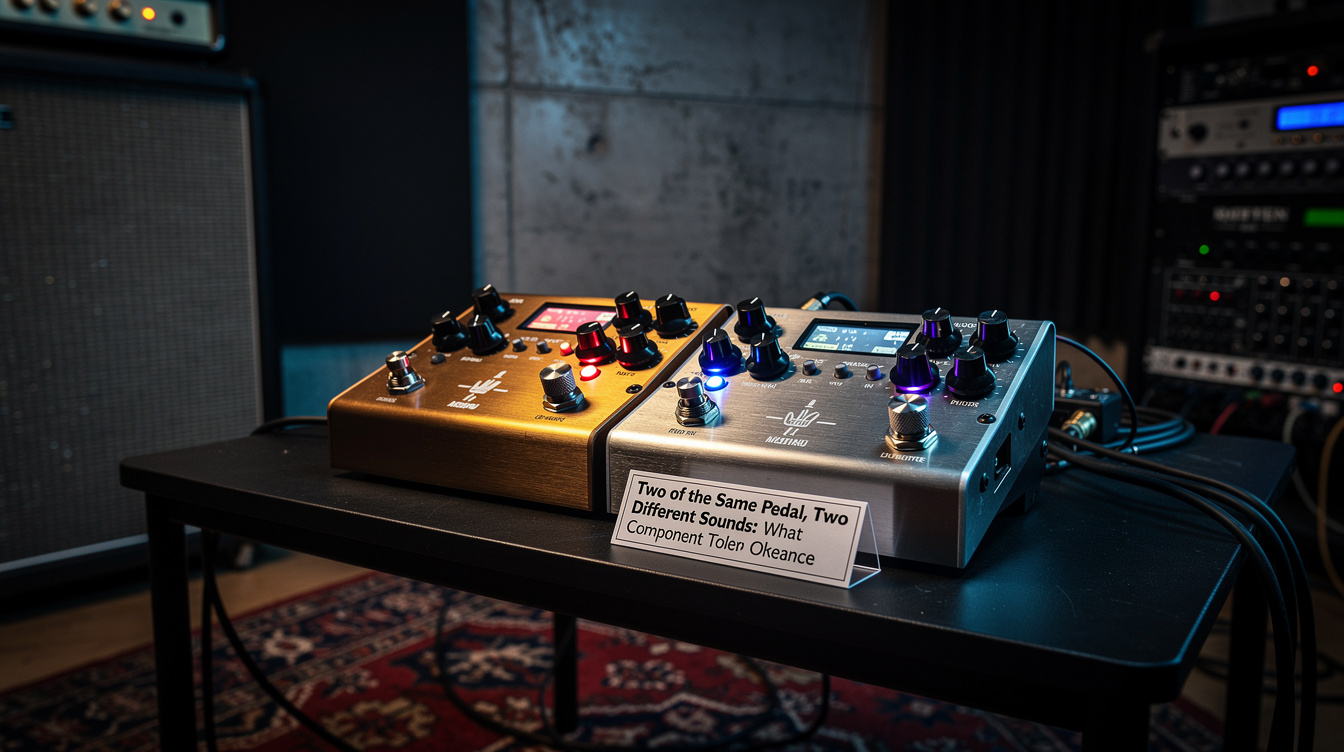
- Five Cats Pedals Shredder (approx. $150 USD): complete built pedal from a UK boutique builder; closest to original without building it
- Truetone Jekyll & Hyde: the Hyde side is a Shredmaster with a fixed Bass control; discontinued but common on used market
- Original Shredmaster: $200 to $400 on Reverb; worth it if condition is good, but clone circuit is identical to the original
Why the Shredmaster Matters
The Marshall Shredmaster was made from 1992 to 2000 and discontinued when Marshall shifted their effects line. It never got a reissue. What it produced (a distortion with a distinctive clarity at high gain, a scooped mid character that bypassed the typical "cocked wah" congestion of compressed distortion, and a Contour control that swept the midrange without completely removing note definition) was specific enough that it's never quite been replicated by anything built to replace it.
Jonny Greenwood used one on "Creep" and on early Radiohead recordings. Kevin Shields of My Bloody Valentine also used it in specific contexts. The pedal sits in an interesting position between a traditional distortion (RAT, DS-1) and a Marshall-in-a-box design; it uses a different gain topology that produces its own sound rather than approximating an amp.
Original Shredmasters in working condition now sell for $200 to $400 depending on the seller and the current Reverb market. That price range puts them in "serious purchase" territory, which is why the clone question matters.
The Circuit: What You're Actually Replicating
The Shredmaster uses a JFET gain stage feeding into a hard-clipping section with a specific midrange sculpting topology. The Contour control is the distinctive feature: it's a variable frequency cut/boost in the midrange band, allowing you to go from scooped to present without the usual binary "cut the mids" vs. "boost the mids" choice.
The gain topology produces a specific quality at high Gain settings that's cleaner than most hard-clipping pedals. The distortion has definition even at maximum Gain, which is why it worked for Greenwood's specific application on "Creep" where the verse tone needed to be identifiable as a guitar chord despite being heavily processed.
The Bass and Treble controls work independently and have a wider range than typical distortion pedal tone stacks. This is part of why the Contour's mid sweep works: you can EQ the bass and treble separately and then use the Contour to position the midrange character.
Every clone I've tested has matched this circuit faithfully. The gains, the Contour behavior, the Bass/Treble interaction. They're all in spec. If you build or buy a Solstice, Shredder, or any other faithful Shredmaster clone, you are getting the Shredmaster circuit.
Aion FX Solstice: The Build-It-Yourself Option
Aion FX makes PCBs and components kits for DIY pedal builders. Their Solstice project is a licensed Shredmaster clone. They document it accurately as a Shredmaster circuit and their documentation for the build is solid.
What you get: A PCB and optional component kit. Aion's Solstice PCB is $35; the full components kit (PCB + all components) runs around $45 to $55. You supply the enclosure, hardware, and time. With an enclosure from Hammond ($15 to $20) and all-in costs including hardware, expect $80 to $100 for a complete self-built Solstice.
One modification Aion adds: A clipping diode switch that allows you to choose between different clipping configurations. The stock Shredmaster uses 1N4148 silicon diodes; the switch lets you add an asymmetrical option or change the diode type to alter the clipping character. This is a genuine modification that the original doesn't have, and it expands the pedal's range. Whether you want it is personal, but knowing it's there is useful.
Honest assessment of the DIY route: If you own a soldering iron and have built a pedal before, the Solstice is the correct choice. The circuit is identical to the original, the build documentation from Aion is detailed and accurate, and $80 to $100 all-in is the right price for what you get. If you haven't built a pedal before, this is a reasonable first build (it's not complex), but you'll spend 3 to 4 hours and need to learn the process.
Five Cats Pedals Shredder: The Complete Pedal Option
Five Cats Pedals is a small UK-based boutique builder making a complete Shredmaster clone, the Shredder, that you can buy assembled and ready to use.
Their Shredder is priced in GBP; current pricing puts it at approximately $140 to $160 USD at current exchange rates. Five Cats doesn't have wide US distribution, so international shipping adds $15 to $25 for US buyers.
Build quality: From what I've handled, the build quality is boutique standard: genuine through-hole components, quality potentiometers, a Hammond enclosure with proper jacks. Not a PCB stuffed into a cheap plastic box. This matters for a pedal you'll use.
Circuit fidelity: Faithful to the original. No modification options; it's the stock Shredmaster circuit in a new enclosure. If the Aion's diode switch is a feature you want, the Shredder doesn't offer it. If you want a plug-and-play equivalent without modifications, the Shredder delivers that.
Practical note for US buyers: Total cost with shipping puts this at $155 to $185 USD, which approaches used original Shredmaster prices when condition is factored in. The advantage over buying original: the Shredder is a new pedal with new components and a warranty. The original is a 25-year-old pedal with aging components, possible capacitor leakage, and no repair support from Marshall.
Truetone Jekyll & Hyde: The Discontinued Option
The Truetone 1 Spot people made a two-channel drive pedal called the Jekyll & Hyde. The Jekyll side was an OD, and the Hyde side was a Shredmaster with a significant modification: the Bass control was fixed at approximately 90% rotation (very bass-heavy setting), leaving you with Gain, Treble, and Contour as the adjustable parameters.
This matters because it changes the usable range of the Hyde side. With Bass fixed high, the Contour control's mid sweep starts from a bass-heavy foundation. For some applications (heavy, dense tones where bass weight is wanted), this is fine. For the classic Shredmaster approach where you dial in the Bass independently, the fixed control removes flexibility.
The Jekyll & Hyde is discontinued and trades on Reverb for $80 to $150 for the unit, depending on condition. Given that a Shredder from Five Cats is a full, unfixed Shredmaster circuit for a similar price, I'd only recommend the Jekyll & Hyde if you find one particularly cheap or you specifically want the two-channel design.
Comparing the Options
| Option | Price (USD) | Build required | Circuit fidelity | Bass control | Availability |
|---|---|---|---|---|---|
| Original Shredmaster | $200 to $400 | No | Reference standard | Independent | Reverb, eBay |
| Aion FX Solstice (DIY) | $80 to $100 all-in | Yes (~3 to 4 hours) | Identical to original + diode switch option | Independent | aionfx.com |
| Five Cats Shredder | $155 to $185 (with shipping) | No | Identical to original | Independent | fivecatspedals.co.uk |
| Truetone Jekyll & Hyde | $80 to $150 used | No | Shredmaster circuit, Bass fixed high | Fixed at ~90% | Reverb, used market |
What the Shredmaster Doesn't Do Well
In the spirit of actually testing these things: the Shredmaster and all its clones have specific limitations worth knowing before you commit.
The mid-scoop can work against you in a band context. The Contour control's useful range in a full-band situation is narrower than it seems in isolation. At higher Contour settings (more mid scoop), the distortion sits in the mix in a way that sounds present but thin. The bass and treble content is there, but the guitar loses its ability to cut over a loud bass player. For solo or recording use, the full Contour range is available. Live, you'll likely end up with Contour between 9 and noon.
The gain character is specific, not universal. The Shredmaster doesn't produce a generic high-gain distortion; it has its own thing. If you're looking for a pedal that works for metal, then blues, then classic rock at different settings, this is not that pedal. It's good at what it does; what it does is specific.
Single-gain-stage design limits headroom recovery. Unlike a two-stage design (gain stage → recovery stage), the Shredmaster's gain character doesn't clean up as gradually when you roll the guitar volume back. It's more of a binary (on vs. off) than a TS or RAT that follows the guitar volume closely.
None of these are reasons to not get one if the Shredmaster character is what you want. They're reasons to know what you're getting.
The Right Context for This Pedal
The Shredmaster fits specific applications well:
Recording, for the Creep/Radiohead aesthetic. The specific distortion character, particularly the note clarity at high gain through the Contour cut, is distinctive enough that it produces a sound a RAT or DS-1 doesn't fully replicate. If you're tracking guitar for music that owes something to Pablo Honey-era Radiohead or early 90s British alternative, this is the historically accurate tool.
High-gain applications where you want note clarity. The Shredmaster at Gain 2 to 3 o'clock sounds defined and clear in a way that a Big Muff at maximum gain doesn't. Individual chord notes stay separated under the distortion. For playing styles that require this (melodic lines through high gain, chord passages that need to read at high volume), the Shredmaster circuit's design helps.
As an alternative to the RAT for players who want a different voice. The RAT and Shredmaster occupy similar territory (hard-clipping, high-gain capable, filter/Contour control) but produce different tonal characters. Players who've tried the RAT and found its Filter behavior too sharp may find the Shredmaster's Contour sweep more usable. The Marshall Shredmaster vs. RAT comparison covers this in detail.
My Recommendation
If you own a soldering iron and have any interest in building pedals, the Aion FX Solstice is the correct answer. You get the circuit at $80 to $100, you understand what you built, and the optional diode switch gives you a range the original doesn't have. It takes an afternoon and the result is identical to an original.
If you want plug-and-play, Five Cats' Shredder is the right call for the price. It's a new pedal with new components and the unmodified circuit. The shipping to the US is the friction, but it's manageable.
The original is worth buying at $150 to $200 in good working condition if you find one. Above $250, you're paying for provenance and the original hardware aesthetic, not for a better circuit. Clone and original circuits are the same.
FAQ
Why did Marshall discontinue the Shredmaster? Marshall's effects line shifted focus in the early 2000s toward multi-effects units and simpler single-purpose pedals for retail. The Shredmaster, Jackhammer, and other "Marshall in a box" designs from that era were discontinued during a product line restructuring. There's no public statement about why specifically; it wasn't a failed product, just a line edit.
Is the Solstice circuit different from the original Shredmaster? The core circuit is identical. The added diode switch is a modification not found in the original. If you build it without the switch (or wire it to the stock position), it's exactly the original circuit.
Do any current production (non-discontinued) alternatives replicate the Shredmaster character? The closest current-production option is the Barber Dirty Bomb, which is described as Shredmaster-inspired. The Truetone Son of Hyde (if you can find it) is the most direct current continuation of the Jekyll & Hyde's Hyde circuit. No major manufacturer makes a direct Shredmaster equivalent as a current production pedal. The clone and boutique routes are the correct path.
What strings and guitar work best with the Shredmaster? Humbucker guitars at standard or slightly-below-standard tuning are the natural match. The Contour control's bass/mid relationship is most musical here. Single coils work but require the Bass control to be set higher to compensate for less low-end fundamental. Lighter strings (9s) at standard tuning tend to sound thin; medium gauge (10s or 10.5s) gives the Contour sweep more to work with.
Can I get this tone on a modeler without the pedal? No modeler currently has a dedicated Shredmaster model. The RAT model available in Helix (Arbitrator Fuzz) gets in the same general territory (hard clipping, filter control), but the circuit character is different enough that it doesn't replicate the specific Shredmaster sound. For modeler users, running a clone into the modeler's front end and using the modeler for cab/room simulation is the closest option.