Start Here: What you need to know before buying anything for the Creep tone:
- The Shredmaster is discontinued. Used prices run $300 to $500+ on the right day. It's genuinely hard to find.
- Jonny Greenwood used a RAT live. The Shredmaster is the studio/album claim; the RAT2 is what appeared on stage consistently
- The DS-1 is the other contender. Shows up in Radiohead rig documentation and sounds closer than most players expect
- The tone is about contrast, not the pedal itself. The distortion only works because of what the clean verse sets up before it
- Recommendation upfront: RAT2 at $100 new. It's the right sound. Stop hunting for a $400 Shredmaster.
Why Does Everyone Want a Marshall Shredmaster?
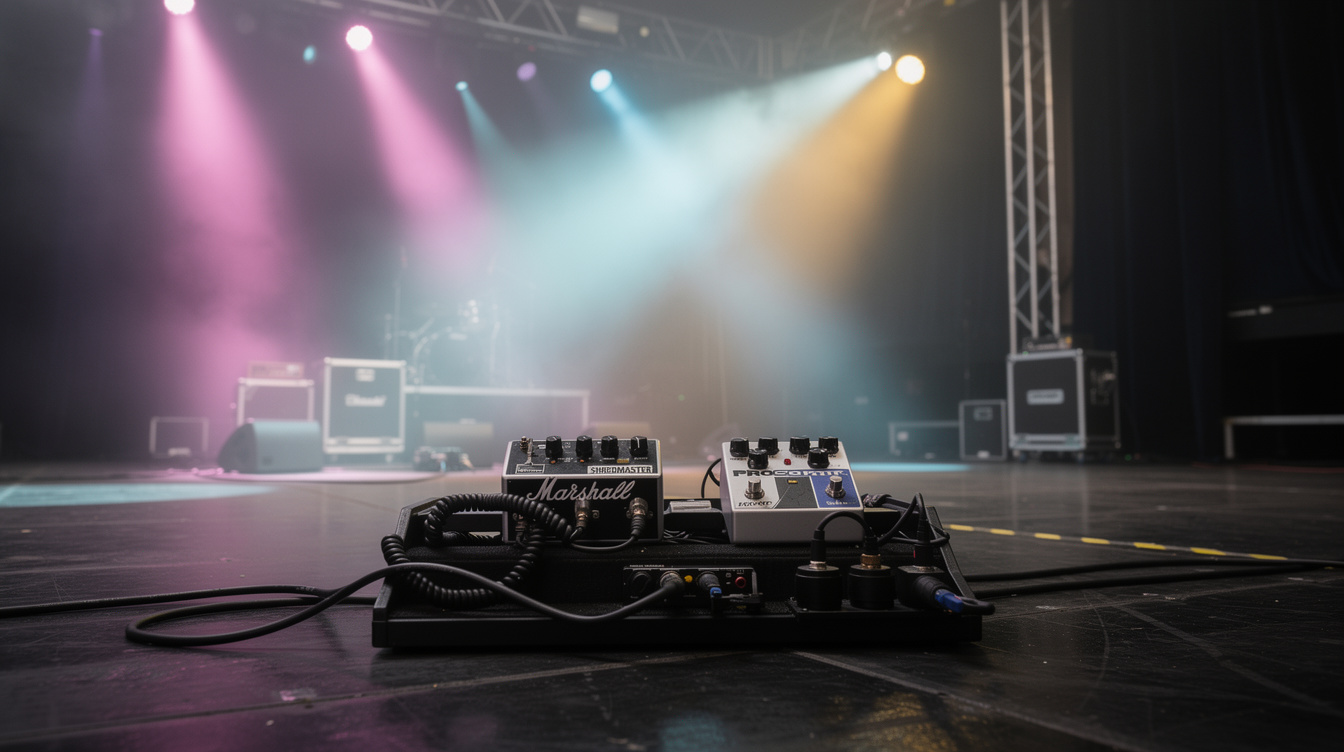
The short version: Jonny Greenwood's tone on the Creep recording has been traced back to the Shredmaster, a British amp-in-a-box pedal from Marshall's late '80s / early '90s line that was discontinued before most people who play guitar today were born. A few online sources locked onto this attribution, it circulated across forums, and now every few years someone overpays on Reverb for one while trying to nail the Creep chorus.
The problem is that the Shredmaster's connection to the Creep recording is documented but fuzzy. Multiple sources confirm it was part of Greenwood's studio setup during Pablo Honey. Whether it was the distortion on Creep specifically, or one of several pedals in rotation during that session, is less clear. What is clear is that Greenwood was running a RAT2 live during the period Creep became the band's biggest single.
The Shredmaster has a specific character: British amp-voiced midrange, slightly asymmetrical clipping, pronounced highs that cut through a mix without getting harsh. It is a genuinely good pedal and if you find one at a fair price and love vintage Marshall sounds, buy it. But for the specific purpose of nailing Creep, paying $400 for a discontinued pedal when a $100 RAT2 does the job is an expensive way to feel authentic.
For the full Creep tone breakdown (clean verse settings, transition technique, how to execute Greenwood's intentional string scrape), the Radiohead Creep tone recipe covers all of it in detail.
Quick Comparison: Three Pedals, One Amp
All three pedals tested through a clean amp (Fender Deluxe Reverb-style, gain low, tone flat), guitar volume full, bridge pickup. Settings tuned to approximate the Creep chorus character as closely as each pedal allows.
| Marshall Shredmaster | ProCo RAT2 | Boss DS-1 | |
|---|---|---|---|
| Street price (new) | Discontinued | ~$100 | ~$60 |
| Used price | $300 to $500 | $60 to $80 | $30 to $50 |
| Gain character | Asymmetrical, British midrange | Smooth op-amp clipping, mid-forward | Hard clipping, bright, aggressive |
| Tone stack | Bass/Contour/Treble (3 controls) | Filter (cuts highs, counterintuitive) | Tone (standard) |
| Note definition at high gain | Good (British amp voicing preserves articulation) | Good (op-amp clipping retains harmonics) | Moderate (gets compressed at high gain) |
| Creep approximation | Very close (probably the original) | Close (confirmed live use) | Closer than you'd think |
| Verdict for Creep | The real thing, if you can find/afford it | Best practical substitute | Underrated option, especially modified |
The Marshall Shredmaster: What You're Actually Buying
The Shredmaster uses a three-band tone stack (Bass, Contour, and Treble) rather than a single tone knob. This is the design choice that makes it sound different from a RAT or DS-1. The Contour control shapes the midrange specifically, which is how you get that British-amp-in-a-box quality. Push the Contour and it sounds aggressive. Pull it back and it cleans up into something almost Vox-like. The gain range is wide without getting unruly.
For Creep specifically: the Shredmaster at moderate Gain (around noon), Contour at noon to 1 o'clock, Treble at 10 o'clock, Bass at 11 o'clock, Level set for a significant volume jump over the clean tone. That's the chorus hitting the way it's supposed to: loud, blunt, slightly scooped in the high mids to avoid harshness.
The thing is: that character description also matches a RAT2 set correctly. The op-amp clipping in the RAT produces a smooth, mid-forward distortion that has more in common with the Shredmaster than it has differences. Both preserve note harmonics under gain in a way that hard-clipping transistor distortions like the DS-1 don't quite match.
If you already own a Shredmaster, great. If you're hunting for one specifically for Creep, I'd spend the $300 difference somewhere more useful.
The ProCo RAT2: The Practical Answer
The RAT2 is the live Creep distortion. Greenwood was photographed and filmed with it on stage during the period when Creep was the centerpiece of every Radiohead setlist. Whether or not it's the studio pedal, it's the confirmed live pedal, and those are the performances most people are trying to replicate.
The RAT's circuit uses an op-amp (LM308 in the original Rat, LM741 in later versions; the LM308 is widely considered to sound better, and the RAT2 has used both across its production run, with the earlier models generally preferred). The clipping is smooth rather than hard; it preserves harmonics across a wide gain range in a way that adds saturation without destroying note identity. This is why the RAT is consistently the right choice for "aggressive but musical" distortion settings.
For Creep:
| Control | Position | Notes |
|---|---|---|
| Distortion | About 1 to 2 o'clock | Moderate-high gain: crunch with weight, not wall of noise |
| Filter | About 11 o'clock | Balanced to slightly bright; keep the pick attack clear |
| Level | About 1 to 2 o'clock | Noticeably louder than your clean tone (this is intentional) |
The Level higher than unity is important. The Creep chorus isn't just a tonal change from the verse; it's a volume change. Greenwood was playing louder, not just differently. If you set the RAT at unity volume, you lose half of what makes the transition work.
For more on the RAT's full range of sounds across styles, the RAT pedal settings guide covers blues, grunge, shoegaze, and doom applications beyond the Creep context.
The Boss DS-1: The Overlooked Option
The DS-1 gets mentioned in Radiohead gear discussions frequently enough that it's worth taking seriously as a Creep substitute, even though it's not the primary documented pedal for this recording.
The DS-1 uses a different clipping architecture than the RAT: hard clipping via silicon diodes rather than op-amp soft clipping. This produces a brighter, more aggressive character at high gain settings. The DS-1 stock is not a subtle pedal; it has a certain harsh edge in the upper midrange that requires careful tone control management.
For Creep, the DS-1 works better than most players expect, but it requires a different approach than the RAT:
| Control | Position | Notes |
|---|---|---|
| Distortion | About 2 o'clock | High gain; the DS-1 needs more gain dialed in to reach the density of the RAT at lower settings |
| Tone | About 9 o'clock | Pulled back significantly; tame the upper midrange harshness |
| Level | About 1 to 2 o'clock | Same volume jump principle as the RAT |
The key insight: a Tone setting of 9 o'clock on the DS-1 for Creep, not the noon setting you'd find on most DS-1 guides. The DS-1's aggressive top end reads as harsh on its own but sounds correct when it's hitting a slightly dark amp tone in a reverbed live context. At 9 o'clock, it stops fighting the mix and starts sounding like it belongs there.
The DS-1 modified (specifically the Keeley Ultra mod) is a stronger Creep substitute than the stock pedal, with better note definition at high gain and less of the harsh high-mid content that requires aggressive tone management. The mod costs around $50 to $100 if you send the pedal out, or you can buy a pre-modded one used for $80 to $120. At that price point, it's competitive with the RAT2 for pure Creep application.
What Actually Makes the Creep Chorus Work
Here's the thing that's easy to miss when you're focused on finding the right distortion pedal: the pedal choice matters less than how it's set up relative to the clean tone.
The Creep chorus sounds enormous because of the contrast. If you set your distortion pedal to sound "good" on its own (balanced tone, controlled gain, pleasant level) and then switch from a clean tone to it, you lose most of the impact. The distortion should be louder than you'd normally run it, the gain should be high enough to feel genuinely aggressive, and the tonal character should be deliberately different from the verse clean tone.
The string scrape before each chorus (Greenwood's intentional noise between the verse and the distortion kicking in) exists because the song was "too pretty" and he wanted to mess it up. It's not a technique mistake to cover up. Trying to clean that up defeats the whole arrangement logic.
Any of these three pedals (Shredmaster, RAT2, or DS-1) works for Creep if you've set up the contrast correctly. None of them sounds right if you're treating the distortion as a "nicer" version of the clean tone rather than a deliberate emotional gear-change.
Which One Should You Buy?
| Your situation | Recommendation |
|---|---|
| You want the most accurate studio substitute and budget isn't the constraint | Find a Shredmaster in good condition; it's genuinely the closest |
| You want the confirmed live tone, new, affordable | RAT2. $100 new, problem solved |
| You already own a DS-1 and don't want to spend money | Use it at Distortion 2 o'clock, Tone 9 o'clock; it works |
| You want the best version of the DS-1 approach | Keeley-modded DS-1, used, ~$80 to $100 |
| You're running a modeler (Helix, QC) | Use the Rat Dist block; it's a direct model of the RAT circuit and sounds right for this |
The Shredmaster is a great pedal. It is not worth $400 for Creep. Buy the RAT.
FAQ
Is the Marshall Shredmaster the same as the Marshall Drivemaster? No. Both were part of Marshall's Vibratrem/Drivemaster/Shredmaster series from the late '80s and early '90s, but they're different circuits. The Drivemaster is a lower-gain, more Bluesbreaker-adjacent overdrive. The Shredmaster is the higher-gain distortion with the three-band tone stack.
Does the RAT2 sound exactly like the original RAT? Close but not identical. The original Rat used an LM308 op-amp, which has slightly different limiting characteristics than the LM741 used in some RAT2 production runs. Most players can't hear the difference in a band context. If you care about the LM308 specifically, look for earlier RAT2 units or a current-production Rat with verified LM308 spec.
Can I get the Creep tone on a Helix or Quad Cortex? Yes. The Rat Dist model on Helix is a direct RAT model. Run it at Dist around 60 to 65%, Filter around 45%, Level at 65 to 70%. It approximates the live Creep sound closely enough that most listeners won't hear the difference in context.
Does the Big Muff work for Creep? It's an option but not the right pedal for the specific Creep character. The Big Muff produces a fuller, more saturated distortion that leans into sustain rather than aggression. It would change the character of the chorus from "blunt gut punch" to "wall of fuzz," a different emotional register. Some players prefer it. It's not the Creep sound.
What amp works best for the Creep distortion? Clean amp platform: Fender Deluxe Reverb style, or a Vox AC30 at clean settings. The amp itself shouldn't be adding distortion; the character should come entirely from the pedal. A slightly driven amp muddies the RAT's op-amp character in ways that aren't useful for this sound.