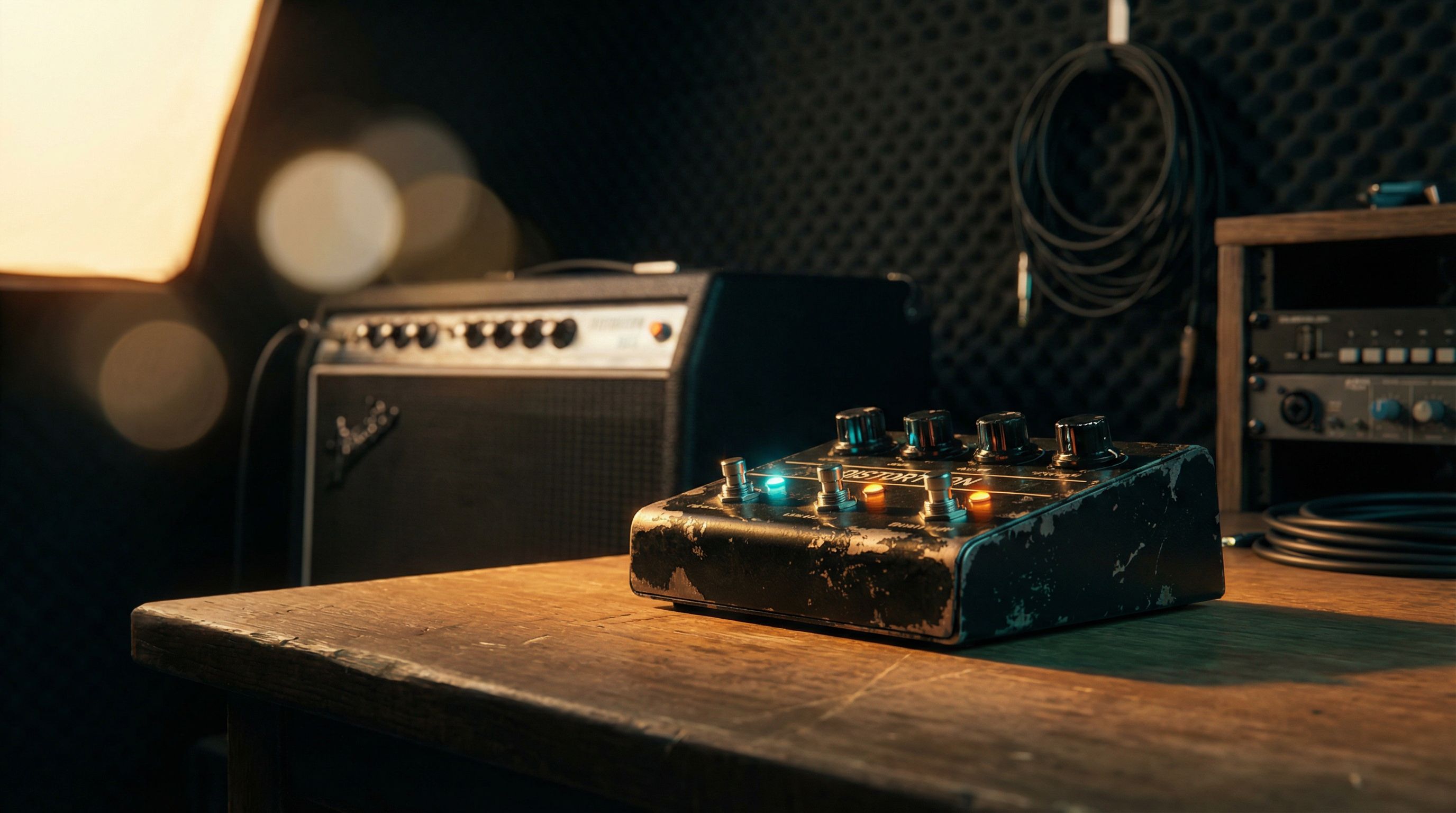
Start Here: The RAT has three controls: Distortion, Filter, and Volume. Most players use the Filter wrong. It's not a tone knob. Turning it up makes the sound darker. Turning it down makes it brighter. That backwards behavior is the single most useful thing to understand before touching anything else.
The One Thing You Need to Know About the Filter Knob
The RAT's Filter control is a passive low-pass filter; it rolls off high frequencies as you turn it clockwise (up). So:
- Filter turned down (counterclockwise): More treble, brighter, more cut
- Filter turned up (clockwise): Less treble, darker, warmer, more fuzz-adjacent
This is the opposite of how most guitar tone knobs work, and it trips up almost everyone who picks up a RAT for the first time. Turn the Filter all the way up and you get a dark, almost fuzz-like texture. Turn it all the way down and you get an aggressive, biting distortion that cuts through anything.
The Filter is where the RAT's versatility actually lives. The Distortion control is obvious (more gain is more gain). But the Filter is where you tune the character, and it does more work than most people realize.
RAT Controls: Quick Reference
| Control | Function | Range of effect |
|---|---|---|
| Distortion | Gain amount | Low = crunch, high = full distortion |
| Filter | High-frequency roll-off | Low (CCW) = bright, High (CW) = dark |
| Volume | Output level | Set to match or exceed bypassed signal |
RAT Versions: Which One Do You Have?
This is relevant because the versions sound different (not dramatically, but enough to affect where you set the controls).
| Version | Era | Character | Notes |
|---|---|---|---|
| Original / LM308 chip | Pre-1988 | Smoother, more vintage clipping | Sought after, sometimes expensive used |
| RAT2 / LM308 or OP07 | 1988–present | Very similar to original; slight variation by chip | The standard modern RAT |
| White Face RAT | Mid-'80s | Slightly different clipping response | Subtle difference from early RAT2 |
| Turbo RAT | 1989–present | LEDs instead of silicon diodes; harder clipping, more volume | Better for high-gain applications |
| You Dirty RAT | 2000s–present | Germanium clipping diodes; softer, more compressed, fuzz-leaning | The warmer, looser take on the circuit |
| Vintage RAT (reissue) | Current | LM308 chip reissue | Closest to original without hunting used market |
For most of the settings below, a standard RAT2 is the reference point. If you're running a Turbo RAT, dial the Distortion back slightly from the listed positions; the harder LED clipping hits differently.
Genre Settings
Blues
Blues on a RAT is a valid approach that doesn't get enough attention. The You Dirty RAT's softer germanium clipping leans this direction, but a standard RAT2 at moderate Distortion settings, with the Filter opened up (turned down toward bright), produces a compressed, singing lead tone that works for Chicago blues, Texas blues, and anything in between.
| Control | Position | Notes |
|---|---|---|
| Distortion | About 8 to 9 o'clock | Low gain; crunch at most |
| Filter | About 8 to 9 o'clock | Bright; let the pick attack come through |
| Volume | About 1 to 2 o'clock | Slightly above unity for presence |
Amp pairing: A clean Fender-style amp (Blues Junior, Deluxe Reverb, Hot Rod Deville) with the amp's own gain low. You want the RAT driving a clean platform, not stacking into a dirty amp. A slightly overdriven amp can work for a raunchier blues tone, but the RAT handles the grit; the amp handles the air.
What to listen for: At these settings, the RAT should add compression and sustain to lead lines without obscuring pick attack. Single notes should sing without trailing off into fizz. If it sounds harsh, open the Filter slightly (turn counterclockwise a small amount) until the top end rounds off.
Classic Rock
Classic rock territory on a RAT means medium-gain crunch with a balanced frequency response: not clean enough to be blues, not heavy enough to be metal. The RAT's clipping character at moderate gain has a roughness that works well for '70s rock textures.
| Control | Position | Notes |
|---|---|---|
| Distortion | About 11 o'clock to noon | Medium gain; crunch with sustain |
| Filter | Around noon | Balanced; not bright, not dark |
| Volume | About 1 to 2 o'clock | Match or slightly above unity |
Amp pairing: A Marshall-style amp or a Vox AC30 at edge-of-breakup. The RAT adds sustain and drive on top of the amp's natural character. Unlike the blues setting, classic rock benefits from a slightly dirty platform. The stacking of RAT distortion plus amp overdrive creates a denser, more saturated texture that sounds right for the genre.
Strat vs. humbucker note: On a Strat or Telecaster, open the Filter (turn counterclockwise) slightly from noon to compensate for the natural brightness of single coils. On humbuckers, noon is usually right or you may want to go slightly clockwise (darker) to avoid upper-mid harshness.
Grunge
This is the RAT's natural habitat. Kurt Cobain reportedly had a RAT on his board at various points; Billy Corgan's early tone had RAT characteristics; Radiohead's "Creep" actually leans on a Marshall ShredMaster, but it lives in the same grinding territory; the Pixies' rough-around-the-edges guitar tone does too. Medium-to-high Distortion, Filter rolled back to add some darkness, volume pushed.
| Control | Position | Notes |
|---|---|---|
| Distortion | About 1 to 2 o'clock | Higher gain; wall-of-sound starts here |
| Filter | About 2 o'clock | Darker; takes the edge off the high gain |
| Volume | About 1 to 2 o'clock | Unity or above |
Amp pairing: A Marshall-style amp at high volume, or a clean amp if you want the RAT to do all the work. Grunge tone benefits from a big cabinet. A 4x12 gives the low-end thickness that makes this setting sound right; a 1x12 or combo can work but will sound noticeably smaller.
Technique note: Grunge tone has an intentional looseness that comes from technique as much as settings. Don't fight the slight chaos at high Distortion settings. The RAT at this gain level responds to aggressive strumming and picks up pick noise, string squeaks, and attack artifacts that are part of the aesthetic.
Shoegaze
The RAT's high Distortion settings with the Filter swept dark approximate the wall-of-noise quality that shoegaze guitar tone requires. It's not quite a Big Muff (the mid-scoop is less pronounced and the clipping character is harder), but a RAT at maximum Distortion with a very dark Filter setting gets into shoegaze territory, especially through a loud clean amp.
| Control | Position | Notes |
|---|---|---|
| Distortion | About 3 o'clock to maximum | Maximum compression and saturation |
| Filter | About 3 o'clock | Very dark; almost closed |
| Volume | About 2 o'clock | Dark settings lose level; compensate here |
Amp pairing: A clean amp at high volume. Same principle as the Big Muff in shoegaze contexts: the distortion pedal provides all the saturation; the amp provides volume and speaker interaction. A Fender Twin or an AC30 pushed loud.
With tremolo or delay after: Layer tremolo or tape-delay-style delay after the RAT for the full shoegaze texture. The distortion generates the wall; the modulation animates it. Tremolo at about 4-5 Hz, depth at 60–70%; delay at medium-long feedback with a warm tone character.
Doom / Stoner
Doom territory on a RAT involves maximum Distortion, maximum Filter darkness, and amp pairing that emphasizes low-end weight. It's similar to the shoegaze settings but aimed at tightness and heaviness rather than texture and atmosphere.
| Control | Position | Notes |
|---|---|---|
| Distortion | Maximum (5 o'clock) | All of it |
| Filter | About 3 to 4 o'clock | Very dark; maximum low-end weight |
| Volume | About 2 to 3 o'clock | Compensate for the extreme filter rolloff |
Amp pairing: Same principle as every other heavy tone: a clean amp with headroom. The Turbo RAT is worth considering here because its LED clipping produces harder, more defined transients at maximum gain, which preserves the distinction between palm-muted notes even at extreme settings.
Tuning note: For drop D and lower tunings, the Filter dark setting at maximum Distortion can produce significant low-end mud. If the tone sounds congested or undefined, open the Filter slightly (turn counterclockwise) until individual notes have definition again.
Amp Pairing Summary
| Genre | Ideal Amp | Amp Gain Setting |
|---|---|---|
| Blues | Fender-style clean (Deluxe, Twin) | Clean; RAT provides the grit |
| Classic Rock | Marshall or Vox at edge-of-breakup | Slight drive; stack with RAT |
| Grunge | Marshall at high volume | Driven but not saturated |
| Shoegaze | Any clean amp at high volume | Clean; volume is the weapon |
| Doom | Clean amp with headroom | Clean; Distortion pedal does the work |
Is the RAT an Overdrive or a Distortion?
Technically, a distortion pedal, but it's a useful pedal across more of the overdrive-to-distortion spectrum than most players expect. At low Distortion settings with a bright Filter, the RAT behaves more like a crunchy overdrive. At high Distortion settings with a dark Filter, it's full distortion with fuzz characteristics. The clipping circuit uses hard clipping (silicon diodes to ground after the op-amp gain stage) rather than the soft clipping of most overdrive pedals, which is why it sounds different from a Tube Screamer at similar gain levels. For a full breakdown of how overdrive, distortion, and fuzz circuits differ in behavior, the overdrive vs. distortion vs. fuzz guide covers the circuit specifics.
Stacking RATs (Advanced)
Two RATs in series at moderate Distortion settings each (rather than one RAT at high Distortion) produces a different saturation character. The second RAT is compressing and shaping an already-driven signal, which creates harmonic density that a single RAT at maximum can't fully replicate. It's not a standard technique, but it shows up in the rigs of players who want the RAT's character with more saturation and less fizz than maximum Distortion delivers.
Settings for a stacked approach: First RAT at about 10–11 o'clock Distortion, Filter at noon; second RAT at about 11 o'clock to noon Distortion, Filter slightly darker. Keep the signal chain consistent with the signal chain order guide; both RATs go before any modulation or time-based effects.
Running Direct / Modeler Note
The RAT works well in front of a modeler's amp model, just as it would in front of a real amp. Set the amp model clean and use the RAT's Distortion for saturation. Alternatively, many modelers (Helix, HX Stomp, Quad Cortex) include a RAT model in their effects library. The digital versions are reasonably accurate; the Helix's Vermin Dist model is based on the original RAT, and the Quad Cortex ships a RAT-style model as well. Filter behavior translates correctly to the digital domain.
For running direct without an amp model, use a cab IR or cab block to provide the speaker filtering that would normally come from an amp and cabinet. A RAT direct into a DI with no cab sim sounds harsh and unusable.
FAQ
Is the RAT an overdrive or a distortion? Technically a distortion pedal, but it covers overdrive-adjacent territory at lower Distortion settings. The hard-clipping diode circuit behaves differently from the soft clipping of overdrives like the Tube Screamer. See overdrive vs. distortion vs. fuzz for the full circuit breakdown.
Why does my RAT sound harsh? Almost always the Filter position. If it's too low (counterclockwise/bright), the harsh upper frequencies of the clipping circuit become prominent. Move the Filter clockwise (up/darker) in small increments until the harshness rounds off. Don't go too far; you'll lose the presence and cut that makes the RAT useful.
What's the difference between the Turbo RAT and the standard RAT2? The Turbo RAT uses LED clipping diodes instead of silicon diodes. LEDs produce a harder, more defined clipping character with more output level. The result is a more aggressive, slightly less compressed tone at equivalent Distortion settings. The Turbo works better for higher-gain applications where the standard RAT starts to feel indistinct.
Can I use the RAT in my modeler's effects loop? You can, but the interaction changes. In the effects loop, the RAT isn't pushing the amp's front end; it's processing the preamp signal. The low-end tightening effect that the RAT creates by pre-distorting the signal before the amp doesn't happen in the loop. The loop position works for adding distortion to a clean amp patch, but the character is different from running the RAT in front of the amp.
Which RAT version should I buy? For most applications, a standard RAT2 is the right starting point. It's widely available, affordable, and covers the full range of these settings. If you primarily play high-gain styles (grunge, doom, metal), the Turbo RAT's harder clipping makes it a better choice at those extremes. The You Dirty RAT is worth considering if you want a warmer, more compressed, fuzz-leaning take on the circuit.